Jev AI: System One Decisions for Data Agents
By William Zhu & the InfiniSynapse Data Team · Published: 2026-09-23 · Last updated: 2026-09-23 · Last verified: 2026-09-23 · Next review: 2026-10-23 · Editorial standards · Corrections
Author credentials: William Zhu is Cofounder of InfiniSynapse, with a public engineering identity at GitHub @allwefantasy. The InfiniSynapse Data Team reviews data-agent architecture and evidence boundaries. Jev facts below are attributed to TypeSafe AI; product performance statements are vendor claims unless explicitly identified otherwise.
Table of Contents
- TL;DR
- What is Jev AI?
- State, questions, and typed answers
- The three decision primitives
- What the contract guarantees—and what it does not
- Appropriate uses
- Explicit boundaries
- A proposed place inside a data agent
- Operating controls around a decision model
- Availability and evidence limits
- Frequently Asked Questions
- Conclusion
TL;DR
Direct answer: Jev AI is TypeSafe AI's name for Jev, its first “System One” model: software sends state plus a bounded Choice, Score, or Noul question, and receives a typed decision with probabilities rather than free-form prose. That makes it a candidate for narrow judgments inside an agent, not a replacement for code, SQL, an LLM, or human approval.
The central design boundary is simple. Deterministic code should enforce permissions and calculations. A decision model can judge a defined answer space. A generative model can interpret, plan, and explain. A human should own high-consequence exceptions.
We evaluated the public Jev AI interface for this definition page without adding a new service call or benchmark, and we cite William Zhu’s previously published first-party test separately below.
This article presents a proposed architecture. It does not claim that InfiniSynapse currently integrates Jev, ships a Jev connector, or has independently reproduced TypeSafe AI's benchmark claims.
What you will learn:
- what Jev AI is and why “System One” is a vendor-defined model category;
- how state, questions, and typed answers form the contract;
- where Choice, Score, and Noul fit;
- why valid output types do not guarantee correct business judgments; and
- how to use the downloadable decision-boundary worksheet before assigning a task to code, Jev, an LLM, or a person.
What is Jev AI?
Key Definition: Jev AI is a decision model for bounded judgments. According to TypeSafe AI's official documentation, an application supplies state and one or more typed questions, then receives structured answers for options the developer defined in advance. Jev does not return an open-ended written answer.
TypeSafe AI introduced Jev as its first public System One model in its official launch post. That source calls Jev fast, efficient, calibrated, and unable to hallucinate because it does not generate strings. Those are vendor claims, not InfiniSynapse test results. The narrow, defensible fact is that a fixed output contract can prevent an answer outside the declared type. It cannot prevent a plausible but wrong selection inside that type.
A decision model, not a smaller chatbot
A chatbot accepts a broad instruction and produces a sequence of tokens. Jev AI instead evaluates supplied state against explicit questions. The TypeSafe System One documentation describes this class as making fast, structured decisions for software.
That difference changes the application contract. “Write a root-cause memo” is open generation. “Which of these four investigation queues should receive this incident?” is bounded choice. “Is the evidence sufficient to publish?” can be a yes/no probability only after the team defines what evidence is required and what happens when confidence is low.
“System One” is a product category, not proof of human cognition
TypeSafe uses “System One” to distinguish rapid, structured decisions from autoregressive text generation. Treat that label as vendor terminology. It is not evidence that the model reproduces the psychology of human intuition, and it does not make the resulting judgment automatically safe.
For architecture reviews, translate the label into testable properties: Is the answer space fixed? Is the output typed? Are probabilities returned? Can the application reject, defer, or override the result? Those questions are more useful than debating the analogy.
State, questions, and typed answers
The official Jev introduction documentation describes a request in terms of state and typed questions. This is the minimum mental model needed to assess Jev AI without turning the definition page into an API tutorial.
State is the evidence presented for judgment.
State is the context Jev AI evaluates. It might be a support-ticket excerpt, a compact incident summary, candidate metric definitions, or a set of already-computed data-quality signals. State should be authorized, minimized, and versioned.
State is not the entire data platform. A decision model should not receive raw warehouses by default, and a probability should not conceal which evidence was included. In a data agent, the runtime should retain the state reference, the transformation that produced it, and the policy version used to construct it.
Typed questions define the permitted answer space.
The question carries instructions plus criteria. A good question is atomic enough that one answer can drive one controlled branch. A bad question combines classification, calculation, policy, and explanation in one request.
For example, “Should we publish this analysis?” is underspecified. A better design separates checks: whether required evidence is present, which risk band applies, and whether a human approval gate is mandatory. Jev AI can return decision signals; code still combines those signals under policy.
The three decision primitives
TypeSafe's official primitives overview defines Choice, Score, and Noul. The names describe output contracts, not business correctness.
Choice selects one developer-defined option
In Jev AI, Choice fits mutually exclusive candidates such as billing, technical, or account; warehouse, CRM, or ticketing; or fast model, reasoning model, or human review. The official documentation says the answer includes the selected option, probabilities for every option, and confidence.
Choice is useful only when the candidate set is complete enough for the task. If “none of the above” is possible but absent, a perfectly typed result can still force a wrong route. Include an abstain or escalation option when the world is not closed.
Score rates state against ordered levels
In Jev AI, Score fits an ordered rubric such as low, medium, and high release risk. The criteria must be descriptive and ordered. A score can prioritize review, but it should not replace an exact calculation already available in code.
Do not ask Jev AI to calculate revenue variance when SQL can compute it. Ask it to judge whether an already-computed variance plus supplied context matches a defined investigation rubric—then retain the inputs and allow review.
Noul returns a yes probability
In Jev AI, Noul is TypeSafe's yes/no primitive. It can express questions such as “Does this request contain a refund intent?” or “Does this evidence packet mention an unresolved source conflict?” The output is a probability that the answer is yes.
A probability is not permission. A Noul result should feed an explicit threshold policy with a fallback. Deleting data, sending money, changing production permissions, or publishing a regulated report should remain behind deterministic authorization and, where appropriate, human approval.
What the contract guarantees—and what it does not
The most important distinction in Jev AI is between type correctness and judgment correctness.
Type correctness narrows integration failure
When the developer defines a Choice set, a typed contract can prevent arbitrary prose from appearing where code expects an enum. That removes parsing ambiguity and can simplify branching. It is a meaningful software property.
TypeSafe's launch post goes further by describing Jev as unable to hallucinate. Read that statement narrowly: Jev gives up free-text generation and returns values within its declared structures. InfiniSynapse does not extend that statement to factual or business correctness.
Judgment correctness still requires evaluation
A model can choose the wrong valid option, over-score risk, or assign misleading probability. It can also receive incomplete state or a badly designed rubric. The output type cannot detect those upstream failures.
The NIST AI Risk Management Framework Core calls for documenting system knowledge limits, output use, and human oversight. That guidance applies even when a model's output is structurally constrained. Evaluate task accuracy, calibration, high-risk error rates, subgroup behavior, latency, and fallback behavior on representative data before automation.
Appropriate uses
Jev AI is a plausible fit when all of these conditions hold:
- the answer space is defined before inference;
- the input can be reduced to authorized state;
- the judgment is narrower than the overall agent task;
- the application has an abstain, fallback, or review path;
- a labeled evaluation set can test the decision; and
- deterministic code owns the resulting side effect.
Examples include selecting among known data sources, triaging an analysis request, rating an evidence packet against ordered criteria, or routing a request to a fast model, a stronger model, or a human. LangChain's Jev harness article demonstrates model routing and tool-risk classification, while explicitly saying Jev is not a drop-in LLM replacement. Treat its reported speed and cost figures as TypeSafe-supplied vendor claims unless independently reproduced.
Explicit boundaries
Jev AI does not generate the narrative, write the SQL, execute a tool, own authorization, or prove a causal conclusion. It does not make an incomplete candidate set complete. It does not make probabilities calibrated for your domain without testing.
Do not use a decision model where:
- exact rules fully determine the answer;
- the desired output is an explanation, plan, query, or report;
- novel options must be discovered rather than selected;
- the consequence is irreversible and no independent gate exists; or
- no representative labels or review process can detect mistakes.
For open-ended work, see Jev vs LLM. For the runtime objects around a multi-step task, the decision job article defines inputs, intermediate views, evidence, gates, and artifacts.
A proposed place inside a data agent
The data infrastructure hub treats an agent task as hosted work rather than a disposable chat. Within that frame, Jev AI could be one bounded decision service called by the runtime.
Again, this is a proposed architecture, not a statement that InfiniSynapse currently integrates Jev.
Jev, InfiniSynapse, code, and human have different jobs
| Layer | Proposed responsibility | Must not be delegated implicitly |
|---|---|---|
| Deterministic code | permissions, arithmetic, schema validation, side effects | policy enforcement |
| Jev decision service | bounded semantic judgment with typed answers | execution authority |
| InfiniSynapse Decision Job | state, source references, steps, evidence, gates, artifacts | silent replacement of evidence |
| Generative LLM | planning, synthesis, explanation, code generation | final authorization |
| Human reviewer | exceptions, high-consequence approval, policy ownership | accountability |
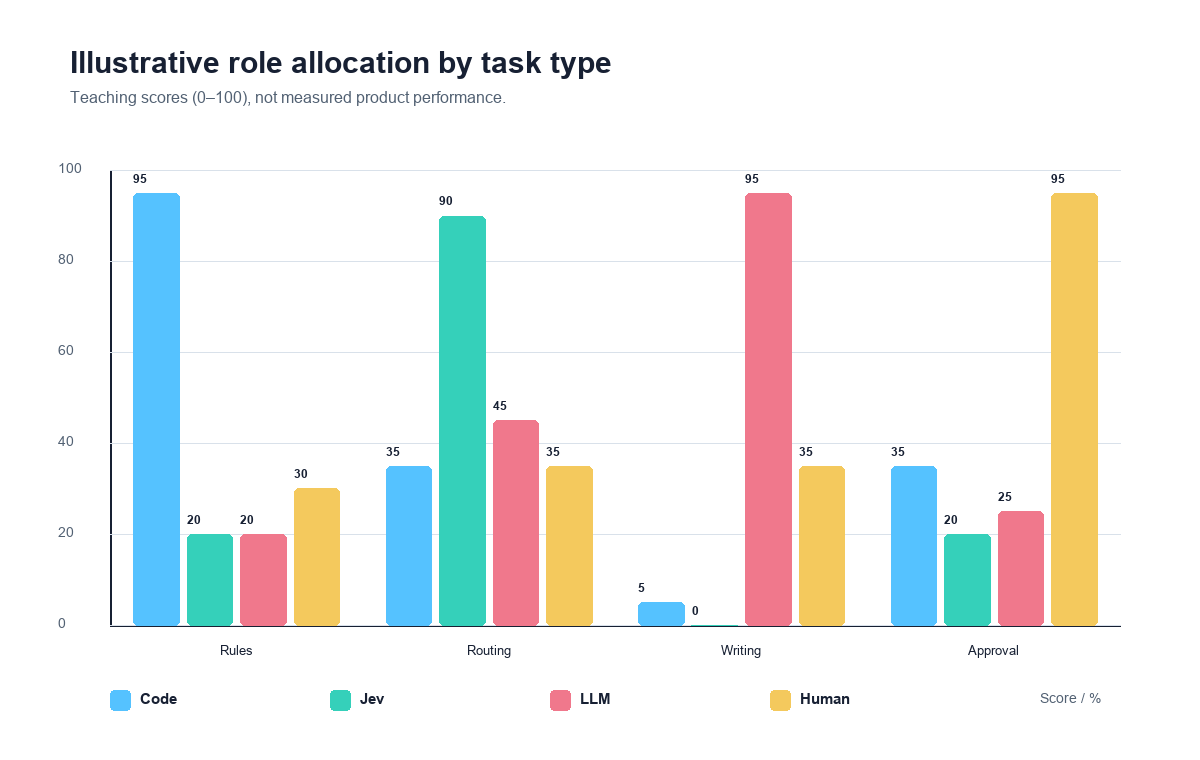
Figure. Illustrative role-allocation scores for teaching, not measured product performance.
The data agent harness is where model calls, tools, state, and gates are coordinated. A Jev call would be one component inside that harness, not the orchestrator itself. The forthcoming Jev for AI agents article owns the detailed routing architecture.
Use the decision-boundary worksheet first
Download the original Jev AI decision-boundary worksheet. It is a transparent design artifact, not an empirical benchmark. For each candidate decision, record whether an exact rule exists, whether the answer space is bounded, whether free-form generation is required, the consequence of error, and the required fallback.
The assignment rule is reproducible:
- if an exact rule exists, use code;
- if the answer space is bounded and semantic judgment is needed, evaluate a decision model;
- if the output must discover or generate content, use an LLM;
- if the consequence is high or policy requires approval, add a human gate.
Worked example: route a metric-definition conflict
Suppose a data agent finds three approved definitions for “active customer.” Arithmetic cannot select among them because the request context matters. The candidate set is known, no prose is required for the route, and a wrong selection can materially change a report.
The worksheet assigns the narrow selection to a decision model with an abstain option, while code enforces that low confidence or conflicting source ownership sends the job to a human. The LLM may later explain the selected definition, but it does not receive publishing authority. This is a hypothetical worked example, not evidence that Jev or InfiniSynapse has been tested on that case.
Operating controls around a decision model
A typed response should produce a better audit record, not an excuse to remove controls.
Confidence must drive escalation, not permission
Set thresholds from validation data, not intuition. Record the full distribution where available, the selected answer, model identifier, question version, state reference, and policy branch. A low-confidence answer should defer or escalate.
NIST's human-AI interaction guidance recommends clearly differentiated roles for systems that decide autonomously, defer to experts, or support human decision-makers. Use consequence and uncertainty together: even high confidence should not bypass a mandatory approval.
Version the question as carefully as the model.
A rubric change can alter behavior even when the model is unchanged. Keep question instructions, criteria, model alias or pinned version, state-construction code, thresholds, and fallback policy in one decision record.
Before production use, replay a labeled set after every material change. Measure false routes and high-consequence failures separately from aggregate accuracy. The future Jev benchmark page is reserved for independent, reproducible results; no such InfiniSynapse result is claimed here.
Availability and evidence limits
As verified on 2026-09-23, TypeSafe's launch article described Jev AI as available in early access. Official documentation, models, prices, aliases, retention terms, regional availability, and quotas can change. Confirm the current TypeSafe model documentation before implementation.
This page relies on official TypeSafe materials for Jev facts, NIST for risk framing, and LangChain for one integration example. It does not adopt vendor benchmark multipliers as independent findings. It does not claim that a typed model “cannot be wrong,” and it does not claim an existing InfiniSynapse integration.
InfiniSynapse cofounder William Zhu’s public Jev technical overview is useful as a practitioner synthesis: it separates type-safe output from semantic correctness and maps Choice, Score, and Noul to bounded workflow decisions. Architecture claims in that article that come from external reverse engineering remain secondary evidence; official TypeSafe documentation remains the source of record.
His later Apple 10-K field test supplies first-party operating data: 79 question-document pairs, including 52 adjacent-year hard negatives, produced 92.2% reported accuracy for both Jev 1.13 and the production DeepSeek Flash baseline. Jev averaged 1.0 second per decision versus 11.3 seconds for the baseline. These are founder-reported results on one retrieval-filtering workload, not a universal Jev AI benchmark.
Frequently Asked Questions
What is Jev AI?
Bottom line: Jev AI is TypeSafe AI's first System One model. It evaluates supplied state against Choice, Score, or Noul questions and returns typed answers with probabilities rather than free-form text.
Is Jev an LLM?
Bottom line: TypeSafe and LangChain describe Jev as a decision model, not a traditional text-generating LLM. It may complement an LLM for bounded judgments but cannot replace open-ended generation.
Can Jev hallucinate?
Bottom line: TypeSafe says Jev cannot hallucinate because it does not generate strings. Treat that as a vendor claim about output form. Jev AI can still select a wrong valid option or judge incomplete state incorrectly.
What are Choice, Score, and Noul?
Bottom line: Choice selects from defined options, Score rates against ordered levels, and Noul returns a yes probability. They are typed decision contracts, not guarantees of business correctness.
Does InfiniSynapse currently integrate Jev?
Bottom line: No integration is claimed. This article describes a proposed architecture in which Jev AI could provide bounded decision signals while InfiniSynapse hosts state, evidence, gates, and artifacts.
When should a data agent not use Jev?
Bottom line: Do not use Jev AI when code can determine the answer exactly, when the task needs open-ended generation, or when an irreversible action lacks an independent authorization and human-review path.
Conclusion
Jev AI is useful to evaluate where a data agent needs a bounded semantic judgment—not where it needs exact computation, open-ended generation, authorization, or accountable approval. Define the answer space, preserve the full decision record, test representative cases, and make failure routes explicit before allowing the signal to affect a workflow.