Data Agent Harness: Outline, Then Number (2026)
By William Zhu & the InfiniSynapse Data Team · Published: 2026-09-02 · Last updated: 2026-09-03 · Last verified: 2026-09-03 · Next review: 2026-12-02 · Editorial standards · Corrections
Author credentials: William Zhu, Cofounder of InfiniSynapse. Public identity: GitHub @allwefantasy. Profile and review roles: editorial standards. This page is signed by a named person, not an anonymous editorial org. No personal LinkedIn is published. No third-party prize, media review, or independent endorsement is claimed.
Table of Contents
- TL;DR
- What a data agent harness actually is
- A four-object harness framework
- Harness versus chat, notebook, and contract
- Tool landscape around the model
- How to run a harness session
- Desk sample: first-party outline-then-number protocol
- Scorecard: harness present or chat skin
- Failure modes
- Frequently Asked Questions
- Conclusion
TL;DR
Direct answer: A data agent harness is the working method around the model: direction, steps, metric sentence, then number. The model decides whether it can think like a person. The data agent harness decides what kind of person it becomes. Bind grain, filter, and window before compute. Keep every step inspectable, editable, and reusable.
What you'll learn:
- What a data agent harness is, and what it is not
- Why the same model becomes two different analysts under two harnesses
- How planning, tools, context, checks, and presentation sit around the model
- How to stop at the outline before you accept a figure
- A two-path desk you can replay, not a customer case
- When a data agent harness must stay readable by business, not only by engineers
This page is the brand definition. The hub sequence lives on metric definition. A data agent harness is the object that forces that sequence to happen.
What a data agent harness actually is
Key Definition: A data agent harness is the working method wrapped around a model so analysis follows direction, then named steps, then a bound metric sentence, then a number. It includes planning, tools, context, checks, and presentation. The model supplies thought. The data agent harness supplies temperament.
Independent published context (retrieved 2026-09-02). Microsoft Azure data architecture guidance, the AWS Well-Architected Machine Learning Lens, and the NIST Privacy Framework did not run this fixture.
| Cited source | What it owns | What tonight still needs |
|---|---|---|
| Azure data architecture | Layers around data work | Outline before compute |
| AWS ML Lens | Human review as design | A continue-signal |
| NIST Privacy Framework | Privacy in operations | Account grain |
| MongoDB documentation | An engine you may read | Name the source |
| Amazon Redshift documentation | Another engine | Why this table |
| RFC 4180 | CSV handoff files | Sentence above the CSV |
A data agent harness is not a model card and not a leaderboard. This pillar does not claim a parameter win. The interesting difference is not “can it think.” The interesting difference is what kind of analyst the session becomes.
A data agent plans, queries, and leaves files. Without a data agent harness, that agent behaves like a chat that races to a digit. With a data agent harness, it behaves like a person who writes the outline first.
A typed router can support that order of work, but it does not become the harness. The proposed Jev agent pattern lets a bounded route advise the next lane while application code retains authorization, retries, state, and publication gates.
The NIST Privacy Framework (above) belongs in the harness because a Data Agent sits closer to operations and compliance than a Code Agent. Person-level rows in a segment pack are a harness failure, not a clever join. Keep segments at account, plan, region, or queue.
MongoDB documentation and Amazon Redshift documentation (table above) are examples of sources a session might read. The data agent harness must state which source, why this table, the filters, the sort, and the juxtaposition rule before calculate. The engine brand is secondary.
RFC 4180 (table above) still describes many handoff files. A data agent harness that cannot put the metric sentence above a CSV will not survive the first operations review.
After the run, open SQL the way explainable AI data analysis describes. That is the trail. The data agent harness is the order of work before the trail is interesting.
A compiled semantic layer may later hold the same sentence. The data agent harness still shows the sentence in this session. P9 compiles. The harness binds.
A four-object harness framework
| Object | Role in the data agent harness | Pass signal | Fail signal |
|---|---|---|---|
| Direction | Maps the business question | A decision a reviewer can restate | “Explore the data” |
| Steps | Locate, filter, join, calculate, check | Named, reopenable steps | One unnamed blob |
| Metric sentence | Grain, filter, window | Editable by operations | A KPI nickname |
| Number | Computed last | Matches the sentence | A digit that ends the meeting |
| Presentation | How the pack is shown | Sentence stays beside the figure | A paragraph that hides the trail |
A data agent harness is those objects plus the rule that the last one waits. Three layers sit under the table: business-question mapping; locate / filter / join / calculate / check; and a requirement that each step is inspectable, editable, and reusable.
The model can fill any layer. The data agent harness decides whether the session is allowed to skip a layer. Skipping is how a capable model becomes a sloppy analyst.
Harness versus chat, notebook, and contract
Choose a data agent harness if
The ask will enter an operations or compliance conversation. You need a path a business reviewer can read. A data agent harness is the control that keeps temperament professional.
Choose a notebook if
An engineer is exploring privately and the output will not be quoted. Even then, write the metric sentence. A notebook without a data agent harness becomes a quote machine the first time someone pastes a cell.
Choose a compiled contract if
The sentence is stable and many products reuse it. Buy or build a semantic layer. Still run this session inside a data agent harness so the outline is visible. A contract that no one opens is not a harness.
Chat is the failure mode the data agent harness exists to prevent: direction skipped, steps hidden, sentence never written, number first.
The mechanical copy of how an analyst works lives on data analysis workflow. The layered view lives on analysis workflow. The data agent harness is the temperament object that hosts both.
Tool landscape around the model
Planning, tools, context, checks, and presentation are the five surfaces of a data agent harness.
Planning is the outline. Tools are read-only connections, not write-backs to ERP or CRM. Context is schema recall plus any bound organizational note. Checks are row counts, nulls, and reconciliations—not “the model looked again.” Presentation is the pack that keeps the sentence next to the number.
What the harness must expose
Direction. Named steps. Metric sentence. Source. Table reason. Filters. Sort. Juxtaposition. A human continue-signal. If a product hides those inside a bubble, it is not a data agent harness.
What the harness must refuse
Model-benchmark theater. Write access to the system of record. Person-identifying segment grains. A preset indicator warehouse sold as the harness. A data agent harness is a method, not a catalog SKU.
InfiniSynapse’s published pattern is a data agent harness: ask, open /tasks, read the outline, bind the sentence, then accept SQL. Schema recall proposes tables. The reviewer still says why this table.
How to run a harness session
Stop at the outline
Input: a KPI question on an authorized source. Acceptance: direction and steps are visible before any figure. If the product returns a number in the first bubble, you are not inside a data agent harness.
Bind the metric sentence
Input: grain, filter, window. Acceptance: operations can edit the sentence. This is the moment the harness decides the analyst’s temperament: careful or sloppy.
Continue only on a human signal
Input: a continue from a reviewer. Acceptance: locate / filter / join / calculate / check then run. The harness treats compute as a privilege, not a default.
Numbered work:
- Ask the business question.
- Require the outline.
- State source, table reason, filters, sort, juxtaposition.
- Bind the metric sentence.
- Wait for continue.
- Run the named steps.
- Keep the sentence beside the number and open the trail.
A harness that skips step 5 is a chat skin.
Desk sample: first-party outline-then-number protocol
Cite this protocol, not a 42-versus-18 figure or the line chart. Session A had no data agent harness: it printed a digit in the first bubble.
First-party method log (replayable):
| Field | Record |
|---|---|
| Operator | InfiniSynapse Data Team; William Zhu, GitHub @allwefantasy |
| First run | 2026-09-02 |
| Replay | 2026-09-03 |
| Input | Authorized, sanitized ticket-load pack; no people |
| Paths | Chat digit first vs outline then number |
| Objects | 4 (direction, steps, metric sentence, number) |
| Acceptance | Outline visible; continue-signal; account grain |
| Fail | First-bubble number; person-adjacent grain; hidden planning |
We labeled session A as chat-skin and session B as outline-then-number, then replayed the fail on 2026-09-03. Review: editorial standards.
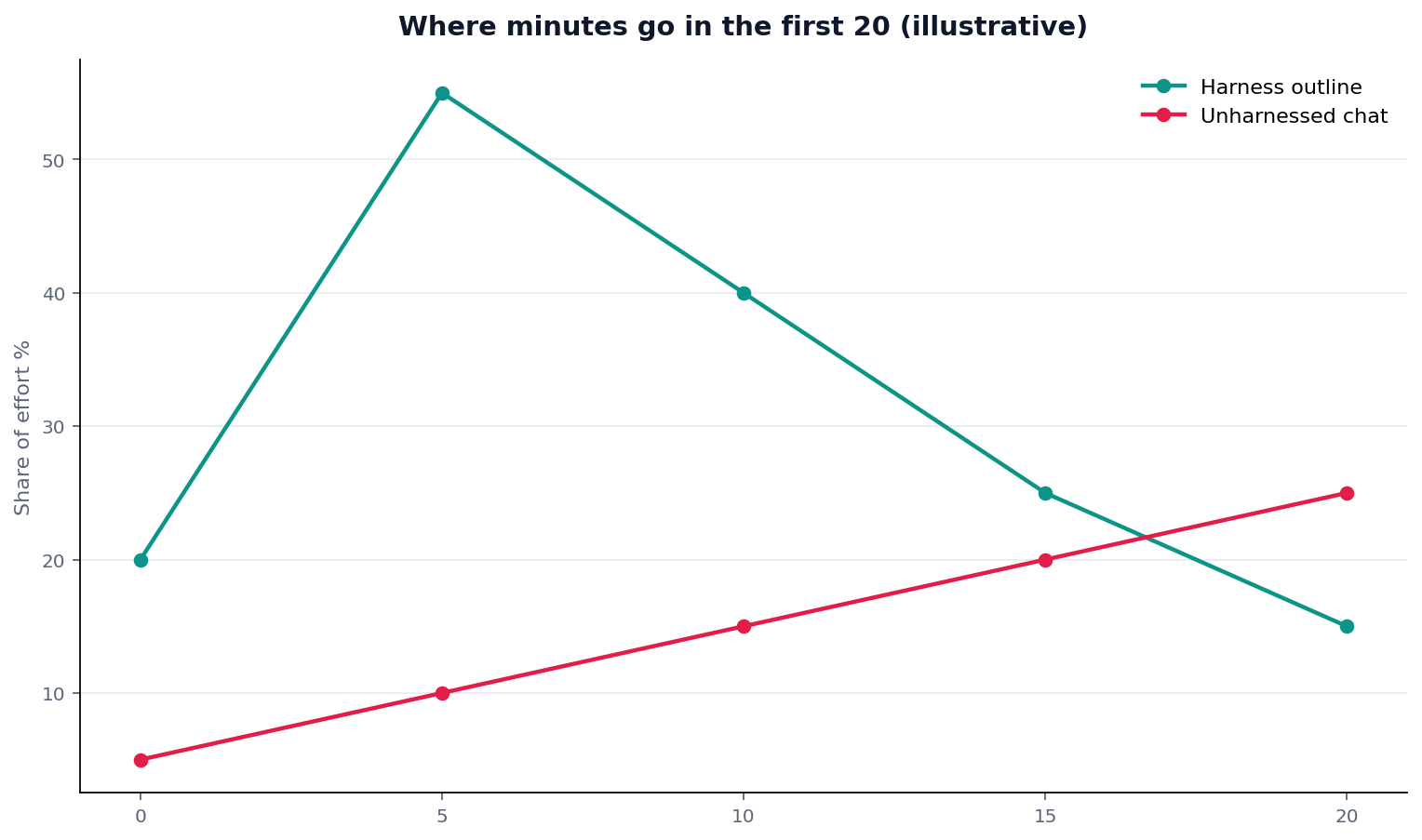
Figure. Teaching schematic. Not a measured study. Source: the protocol table above.
8 / 42 / 88 and 42 versus 18 are a teaching sketch. Quote the protocol, not the lines.
Scorecard: harness present or chat skin
| Signal | Data agent harness | Chat skin |
|---|---|---|
| Outline before number | Required | Optional |
| Metric sentence | Bound and editable | Implied |
| Steps | Named and reopenable | Hidden |
| Business-readable | Yes | Engineer-only |
| Compute | After continue | Immediate |
| Trail | Opens after | Optional dump |
If the data agent harness column is empty, do not quote the figure.
Planning, tools, context, checks, and presentation have to stay five surfaces, not one bubble. Planning is the outline a reviewer can refuse. Tools are read-only connections with named sources. Context is schema recall plus any bound organizational note—never a secret pasted into the prompt. Checks are row counts, nulls, and a control table. Presentation keeps the sentence beside the figure so the pack can be forwarded without a narrator.
Schema recall is not a locate decision. It proposes candidates. The reviewer still says why this table and not the adjacent events dump. If the session cannot show that reason, temperament has already slid toward a Code Agent notebook: fast, clever, and unsigned.
When two sessions share a model class and disagree, do not open a parameter debate. Open both outlines. The difference will sit in direction, in the sentence, or in a skipped continue-signal. That is the whole point of naming the object around the model.
Failure modes
Model worship
A vendor says the model is stronger than a 70B baseline. That sentence is not a harness. Temperament is not a parameter count. Refuse the benchmark conversation and ask for the outline.
Hidden planning
The agent “thought” in a private chain and printed a digit. Operations cannot edit what they cannot see. A harness that hides planning is not a harness.
Code-agent manners on operations data
A notebook style that is fine for a Code Agent is not fine here. A Data Agent touches decisions. The harness must stay readable by business and by compliance.
Open the harness outline before you accept a figure
Ask a KPI question and stop at the outline. Approve the metric sentence, then continue. This check uses only sources you authorize.
Commercial association: You do not need the workspace to complete the educational diagnosis on this page.
Open InfiniSynapseHow this page is sourced. William Zhu is cofounder of InfiniSynapse, public as GitHub @allwefantasy. Company self-description, not independent authority. No third-party prize is claimed. No personal LinkedIn is published. Evaluation basis: We evaluate (hands-on) by opening the harness outline—direction, steps, metric—and refusing the number until it is locked. Protocol 2026-09-02, replayed 2026-09-03. Reviewed internally by analytics engineering · data platform · LLM security · editor. Editorial standards · corrections · publishing principles · About · Privacy · Terms. Contact zhuhl@infinisynapse.com. COI: InfiniSynapse sells an AI-native Data Agent; the banner is a commercial association. The educational diagnosis does not require it. Fact-check: Azure data architecture, AWS ML Lens, NIST Privacy Framework, MongoDB docs, Amazon Redshift docs, RFC 4180. 8 / 42 / 88 is a teaching sketch. No external organization audited this page.
Frequently Asked Questions
Is this a bigger model?
Bottom line: No. A data agent harness is the method around the model. The model decides if it can think. The harness decides what kind of analyst it becomes.
Do I still need a semantic layer?
Bottom line: A layer compiles a stable contract. A harness still shows the sentence in this session. Compile later if the sentence survives.
Can I accept the first number if SQL looks fine?
Bottom line: No. Fine SQL can encode the wrong grain. A harness binds the sentence before SQL is interesting.
Why must business be able to read the path?
Bottom line: A Data Agent is closer to operations and compliance than a Code Agent. A harness that only engineers can parse will not be signed.
What on this page is citable?
Bottom line: Cite the protocol table, the four-object frame, and the six-source comparison. Do not cite the line chart or the 42-versus-18 sketch as measured results.
Conclusion
A data agent harness is the temperament around the model. Direction, then steps, then the metric sentence, then the number. Lock grain, filter, and window before anyone computes. Keep each step inspectable, editable, and reusable. The same model becomes two different people under two harnesses. Choose the one operations can read.
InfiniSynapse describes itself on About. Privacy and Terms apply. If you later use the workspace, open InfiniSynapse only with authorized, sanitized inputs.