Metric Definition: Bind, Then Compute (2026)
By William Zhu & the InfiniSynapse Data Team · Published: 2026-09-02 · Last updated: 2026-09-03 · Last verified: 2026-09-03 · Next review: 2026-12-02 · Editorial standards · Corrections
Author credentials: William Zhu, Cofounder of InfiniSynapse. Public identity: GitHub @allwefantasy. Profile and review roles: editorial standards. This page is signed by a named person, not an anonymous editorial org. No personal LinkedIn is published. No third-party prize, media review, or independent endorsement is claimed.

Table of Contents
- TL;DR
- What a metric definition is before any digit
- A four-layer harness framework
- How this work differs from a semantic-layer purchase
- Tool landscape for outlines and bound sentences
- How to bind the sentence, then compute
- Desk sample: first-party four-layer protocol
- Scorecard: ready to compute or still drafting
- Failure modes
- Frequently Asked Questions
- Conclusion
TL;DR
Direct answer: A metric definition is the bound sentence that names grain, filter, and window before any query runs. The model decides whether it can think like a person. The harness decides what kind of person it becomes. Sequence the work as direction, then steps, then the metric definition, then the number. A correct digit with no sentence cannot enter a decision.
What you'll learn:
- What a metric definition is, and why it is not a semantic-layer buying page
- A four-layer frame: direction, steps, sentence, number
- How a Data Agent path must stay readable by operations and compliance
- How to state source, table reason, filters, sort, and juxtaposition first
- A four-layer desk you can replay, not a customer case
- When to refuse the number until the metric definition is inspectable
A Data Agent sits closer to operations and compliance than a Code Agent. The path has to be readable by business, not only by engineers who can parse a blob of SQL. If you skip that bound sentence, you skip the job. A metric definition is that bound sentence, not the column title.
What a metric definition is before any digit
Key Definition: A metric definition is the written sentence that binds grain (what one row is), filter (who is in), and window (which time or event range) before calculation. It is the third object in the harness sequence—after direction and steps, before the number—and it must be inspectable, editable, and reusable.
Independent published context (retrieved 2026-09-02). The NIST AI Risk Management Framework, UK NCSC guidelines for secure AI system development, and the NIST Privacy Framework did not run this fixture.
| Cited source | What it owns | What tonight still needs |
|---|---|---|
| NIST AI RMF | Measurement and documentation as controls | The bound sentence before the digit |
| UK NCSC secure AI | Human-readable intent around model output | Intent that operations can edit |
| NIST Privacy Framework | Person-level rows as a control risk | Account / plan / region grain, not a name |
| Apache Airflow | Scheduled graphs | A harness outline is not a DAG |
| Wikipedia: SQL | The language of the later query | The sentence is not the SQL |
| Azure architecture | A later industrialization map | Today’s lock, not a platform program |
The bound sentence is not a slide adjective. “Active accounts” is a nickname. The sentence says “one row is a billing account; include accounts with a paid invoice in the last 90 days; exclude internal tenants; window is calendar month in UTC.” Until that sentence exists, every later join is a guess. Write the metric definition before any join, or the later view is a guess with a nicer name.
The NIST Privacy Framework (table above) belongs here when the sentence would otherwise pull person-level rows into an operations pack. Segment analysis on this pillar is a teaching sketch. Do not write identifiable people. Aggregate to account, plan, region, or queue. A sentence that needs a person’s name to be true is the wrong grain.
This page is not a rewrite of how a semantic layer compiles a contract. That pillar owns who publishes the certified measure and how it compiles. This pillar owns the order of work before the number: the sentence must be spoken, bound, and visible even when no certified contract exists yet.
After the run, open the trail the way explainable AI data analysis describes. That is P55. P70 binds the sentence before SQL is interesting.
If the organization already stored last quarter’s sentence, reuse it from organizational analysis memory rather than inventing a new sentence in chat.
A four-layer harness framework
Score the pack with one table. A metric definition that cannot sit in the third row is not ready.
| Layer | Object you must see | Pass signal | Fail signal |
|---|---|---|---|
| Direction | The business question in one sentence | A reviewer can restate the decision | A vibe, a dashboard name, or “just explore” |
| Steps | Locate, filter, join, calculate, check | Each step is named and reopenable | One giant query with no names |
| Metric definition | Grain, filter, window in one sentence | A colleague can edit the sentence | A nickname with no grain |
| Number | The computed value plus the trail | The figure matches the bound sentence | A confident digit with no sentence |
The model can plan. The harness decides whether that plan looks like a careful analyst or a chat that races to a digit. The third layer forces the sentence to exist.
State five facts before any calculate step: source, why this table, filters, sort, and juxtaposition. Those facts make the sentence operational.
Azure architecture and Airflow (table above) are later maps. A harness outline is not a DAG. Do not confuse a scheduler with a bound sentence.
Three layers stay distinct: business-question mapping; locate / filter / join / calculate / check; inspectable, editable, reusable steps. The sentence lives in the first layer and is consumed by the second. Start in the second and you will compute a number no one can defend.
How this work differs from a semantic-layer purchase
Teams hear “metric definition” and open a buying page for a metrics store. That is the wrong first move for an agent session.
Choose a compiled contract if
You already have a published owner, a compile path, and many products that must reuse the same certified measure. Then a semantic layer is the industrial form of the same sentence.
Choose a harness-bound sentence if
You are answering one decision this week on authorized sources, and the sentence is not yet certified. Bind it in the outline. Compile later if it survives review. P9 compiles contracts. P70 is the order before the number.
Choose an open-SQL review if
The number already exists and someone distrusts it. Open the trail. That is not a new bound sentence; that is P55. Do not pretend a post-hoc SQL dump is the same as binding the sentence first.
A Code Agent can hide steps in a notebook. A Data Agent cannot. Operations and compliance will ask who is in the filter. If the sentence is not readable, the path is not a professional analyst path.
Named views in SQL AI are how the language carries the bound sentence across steps. The language is not the sentence. The sentence still has to be written.
Tool landscape for outlines and bound sentences
You need objects a business reviewer can read. ChatBI returns a digit. Spreadsheets hide the sentence. BI tiles hide it in a model. A harness that shows direction, steps, and the bound sentence before compute is the missing object.
InfiniSynapse’s published pattern: authorize a source, stop at the outline, bind the sentence, then accept SQL. It will not invent a certified warehouse of every KPI, and it will not write the sentence into production systems. The reviewer still confirms why this table.
What the outline must expose
Source name. Why this table, not the adjacent one. Filters. Sort. Juxtaposition (for example, this month beside last month on the same grain). The metric definition sentence. If any of those are missing, refuse the number.
What still belongs in a later contract
Nightly certification and an owner of record are P9 jobs. Do not stall this week’s metric definition for a RACI.
Refuse a tool that hides the sentence or wants write access to the system of record. Accept a read-only source, a one-sentence metric definition, and a reviewer who can say no.
How to bind the sentence, then compute
Keep the sequence boring. Boring is how a metric definition survives a compliance question. The metric definition is the object a reviewer can quote without opening the model.
Write the direction
Input: one decision (“which account segment drove ticket load last month”). Acceptance: a reviewer can repeat the decision without naming a dashboard. If the ask is “show me activity,” you do not yet have a metric definition problem—you have a direction problem.
Name the mechanical steps
Input: candidate tables and the locate / filter / join / calculate / check list. Acceptance: each step has a name a colleague can reopen. If the plan is one unnamed blob, stop. A metric definition cannot attach to a blob.
Bind grain, filter, and window
Input: one sentence. Acceptance: grain, inclusion, exclusion, and window are all spoken. This is the metric definition. Bind it before compute. If two reviewers write two sentences, you do not have a metric definition—you have a conflict. Resolve it here, not after the digit.
Compute last, then check
Input: the bound metric definition plus authorized reads. Acceptance: the figure matches the sentence, the trail is open, and a check (row count, nulls, reconciliation) exists. If the figure is pretty and the sentence drifted, reject the pack.
Numbered work:
- State the decision in one line.
- List source, table reason, filters, sort, juxtaposition.
- Write the metric definition.
- Require a reviewer continue-signal.
- Run locate / filter / join / calculate / check.
- Open the trail and keep the sentence next to the number.
A metric definition that cannot survive step 3 should never reach step 5.
Desk sample: first-party four-layer protocol
Cite this protocol. Do not cite a customer percentage, an 8 / 42 / 88 figure, or the chart bars as a study.
First-party method log (replayable):
| Field | Record |
|---|---|
| Operator | InfiniSynapse Data Team; William Zhu, GitHub @allwefantasy |
| First run | 2026-09-02 |
| Replay | 2026-09-03 |
| Input | Authorized, sanitized account-segment pack; no people |
| Paths | Digit-first nickname vs bind then compute |
| Layers | 4 (direction, steps, sentence, number) |
| Acceptance | Account grain; 90-day paid invoice; August 2026 UTC |
| Fail | “Active user”; person-level rows; digit to end the meeting |
We bound grain, filter, and window before compute, then replayed the same fail on 2026-09-03. That is a first-line replay, not a customer case. Review: editorial standards.
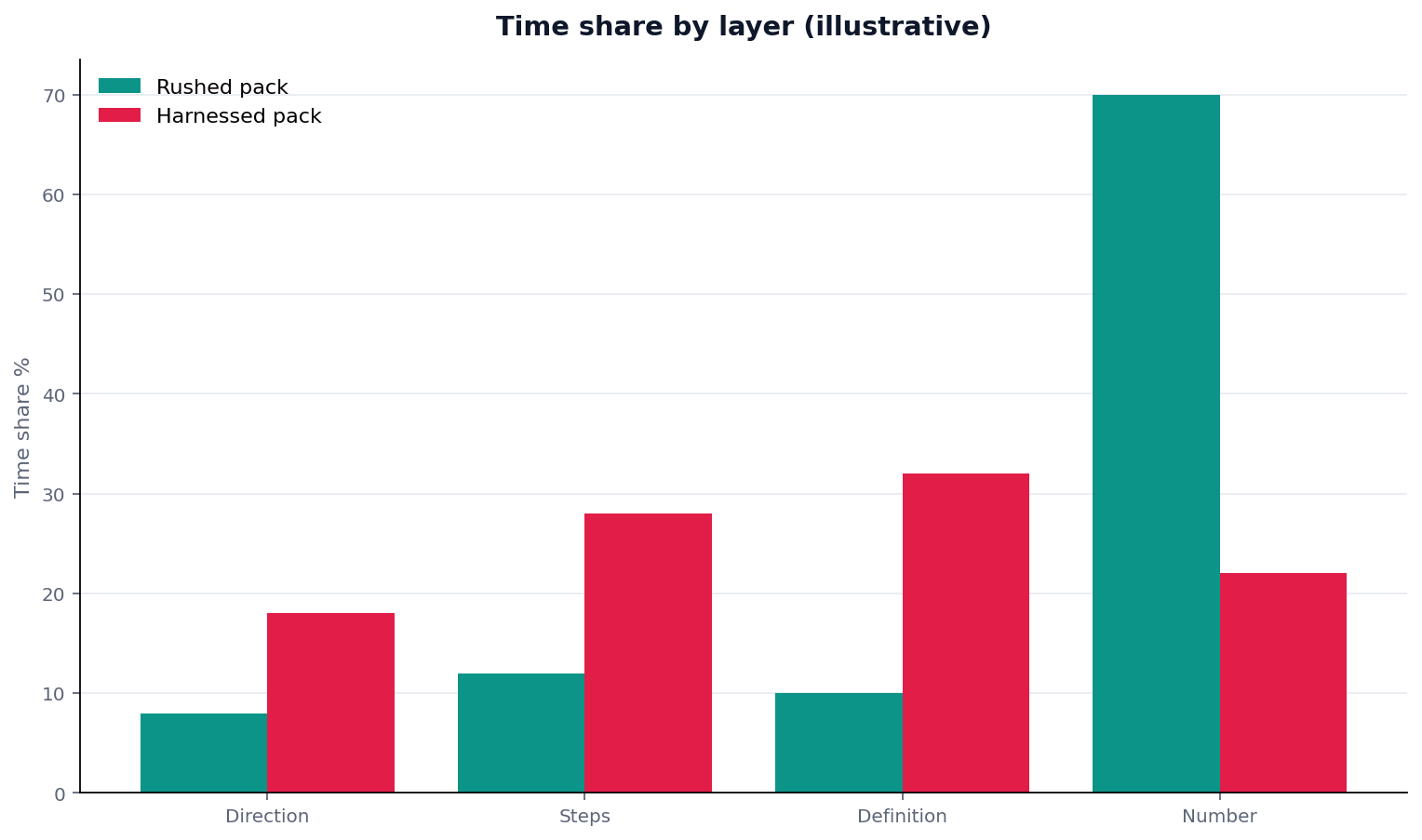
Figure. Teaching schematic. Not a measured study. Source: the protocol table above.
8 / 42 / 88 is a teaching sketch. Quote the protocol, not the bars.
Scorecard: ready to compute or still drafting
| Signal | Ready | Not ready |
|---|---|---|
| Direction | One decision sentence | A dashboard nickname |
| Source | Named, authorized, read-only | “The warehouse, I guess” |
| Table reason | Why this table, said out loud | First table the model saw |
| Metric definition | Grain, filter, window written | A KPI nickname |
| Juxtaposition | Compared objects share grain | Two grains on one slide |
| Path | Readable by operations | Only an engineer can parse it |
| Number | Accepted after the sentence | Accepted to end the meeting |
If that column is empty, the pack is a draft. Do not paste the digit.
Failure modes
Most failures are order failures, not model failures. This page did not run a live customer ask.
Digit first, sentence never
The agent returns a pasted digit. A week later two teams dispute who is in. There was never a metric definition. Bind the sentence, then compute. If a vendor boasts about model size, ignore it. This pillar does not score parameter counts.
Hallway grain
“Active” means seats in product, invoices in finance, and logged-in users in success. Each team thinks it has a metric definition. None wrote grain. Write one sentence or accept three truths.
Juxtaposition on mixed grains
Enterprise rate sits beside a person-level mid-market rate. The slide looks comparative. The metric definition was never shared. Force the same grain before you place two numbers next to each other.
When the missing object is the sentence itself, continue in the definition of metrics, which locks grain, filter, and window before any digit. If you need the brand object around the model, read data agent harness for direction, steps, metric, then number. If the gap is how an analyst actually works, use the data analysis workflow page to map, locate, filter, join, calculate, and check.
When you need an exit test, the definition of analysis writes done as an auditable pack rather than a fluent paragraph. If two tiles disagree, metrics meaning opens both sentences instead of averaging the digits. If reviewers only see a number, keep the four layers visible in the analysis workflow.
A bound sentence that cannot survive those six reads is not ready for a memo.
When the object itself is still a column nickname, start with what is a metric. When the method is write-then-bind, define metrics before the agent runs SQL.
When finance and product collapse a field into a KPI, split measure vs metric before you quote either digit.
Bind the metric definition, then ask the number
Write the metric sentence, pick the table and filter, then ask. Open the outline before you accept the figure. This check uses only sources you authorize.
Commercial association: You do not need the workspace to complete the educational diagnosis on this page.
Open InfiniSynapseHow this page is sourced. William Zhu is cofounder of InfiniSynapse, public as GitHub @allwefantasy. Company self-description, not independent authority. No third-party prize is claimed. No personal LinkedIn is published. Evaluation basis: We evaluate (hands-on) by binding grain, filter, and window in one sentence before any digit is computed. Protocol 2026-09-02, replayed 2026-09-03. Reviewed internally by analytics engineering · data platform · LLM security · editor. Editorial standards · corrections · publishing principles · About · Privacy · Terms. Contact zhuhl@infinisynapse.com. COI: InfiniSynapse sells an AI-native Data Agent; the banner is a commercial association. The educational diagnosis does not require it. Fact-check: NIST AI RMF, UK NCSC, NIST Privacy Framework, Airflow, Wikipedia SQL, Azure architecture. 8 / 42 / 88 is a teaching sketch. No external organization audited this page.
Frequently Asked Questions
Is a metric definition the same as a semantic layer?
Bottom line: No. A metric definition is the sentence you bind before this number. A semantic layer is how a stable contract compiles for many products. Do this week’s sentence even when no layer exists yet.
Can I skip the sentence if the SQL looks clean?
Bottom line: No. Clean SQL can encode the wrong grain. The metric definition is the human-readable test. Open the trail after, but bind the sentence first.
Why must operations be able to read the path?
Bottom line: A Data Agent is closer to operations and compliance than a Code Agent. If only an engineer can parse the plan, you do not have a metric definition that business will sign.
What three fields must the sentence name?
Bottom line: Grain, filter, and window. A metric definition that omits one of those three will invent a second truth the first time another team repeats the ask.
What on this page is citable?
Bottom line: Cite the protocol table, the four-layer frame, and the six-source comparison. Do not cite the chart bars or the 8 / 42 / 88 sketch as measured results.
Conclusion
The model decides whether it can think like a person. The harness is what decides which role the model is allowed to play. Bind the metric definition before the number. Map the question, name the steps, write grain and filter and window, then compute. Keep the path readable by operations. A correct digit with no sentence is not a decision input.
InfiniSynapse describes itself on About. Privacy and Terms apply. If you later use the workspace, open InfiniSynapse only with authorized, sanitized inputs.