Measure vs Metric: Column, Then Sentence
By William Zhu & the InfiniSynapse Data Team · Published: 2026-09-02 · Last updated: 2026-09-27 · Last verified: 2026-09-03 · Next review: 2026-12-02 · Editorial standards · Corrections
Author credentials: William Zhu, Cofounder of InfiniSynapse. Public identity: GitHub @allwefantasy. Profile and review roles: editorial standards. This page is signed by a named person, not an anonymous editorial org. No personal LinkedIn is published. No third-party prize, media review, or independent endorsement is claimed.
Table of Contents
- TL;DR
- What measure vs metric splits
- A two-object comparison framework
- When to keep the split and when to collapse it
- Tool landscape that hides the split
- How to separate the column from the sentence
- Desk sample: first-party split protocol
- Scorecard: split held or collapsed
- Failure modes
- Frequently Asked Questions
- Conclusion
TL;DR
Direct answer: Measure vs metric splits a column from a sentence. A measure is an amount, a count, or a duration you can sum. A metric is that column plus grain, filter, and window. Two teams who share the column and skip the sentence will quote two KPIs. Bind the sentence. Then compute.
What you'll learn:
- How measure vs metric names two objects, not two synonyms
- Why a measure can be shared while the metric still forks
- When to keep the split and when a discovery note is still only a column
- How to write both objects before SQL
- Why collapsing measure vs metric is an order failure, not a model failure
The parent order lives on metric definition: direction, then steps, then the sentence, then the number. This page is only the comparison. If you collapse measure vs metric, every later join treats a column as a claim.
What measure vs metric splits
Key Definition: Measure vs metric splits a store from a claim. A measure is the column you will later sum, count, or average. A metric is the written sentence that binds grain, filter, and window around that column before calculation. Collapsing measure vs metric is how one
amount_usdfield becomes two official truths.
A teaching pair, not a call-center study:
| Object | Example | What is bound |
|---|---|---|
| Measure | 1,000 abandoned calls | A count you can sum |
| Metric | 10% abandonment rate | Abandoned calls divided by offered calls, one center, one month, hang-up before answer |
| KPI | Abandonment under 8% this quarter | That metric plus a target and a date |
The KPI is the metric after the sentence exists. It is not a third column.
Independent published context (retrieved 2026-09-02). Wikipedia: unit of analysis, IBM: augmented analytics, and ISO/IEC 27001 did not run this fixture.
| Cited source | What it owns | What tonight still needs |
|---|---|---|
| Wikipedia: unit of analysis | Grain as an encyclopedia object | Grain is not a column alias |
| IBM: augmented analytics | How tools assist analysis | A confident digit is not a split |
| ISO/IEC 27001 | Inspectable security controls | A hidden sentence has already collapsed |
| Azure architecture data guide | Definition versus store | Cataloging columns is not the split |
| PostgreSQL documentation | A correct store | A store still needs a sentence |
| NIST cybersecurity | Controls on systems and data | Access to a measure is not the claim |
The object test—what counts as a metric—lives on what is a metric. This page adds the other half: the measure. You need both names on the desk. A team that can say the column and cannot say the sentence has not held measure vs metric. It has held a field.
This split is not a certified semantic layer purchase. A catalog may later compile measures and metrics as industrial objects. You still write measure vs metric in the outline for this run. Compile is not a substitute for the split.
If last quarter already held measure vs metric for the same decision, reuse both objects from organizational analysis memory. Rewriting only the column in a new chat is how the split dies.
A two-object comparison framework
Score the rows below. If the metric row is a column title, measure vs metric has failed.
| Object | Question it answers | Pass signal | Fail signal |
|---|---|---|---|
| Measure | Which column carries the number? | Named field, type spoken | “The KPI column” |
| Dimension | Which category slices the number? | Product, channel, or region named | Treated as the measure |
| Grain | What is one row of the metric? | Account, invoice, ticket, or day | Inherited from the measure |
| Filter | Who is in and out of the metric? | Inclusion and exclusion spoken | Inherited from the extract |
| Window | Which range does the metric use? | Timezone and cutoff named | “As of the measure” |
| Owner | Who may edit each object? | Two named roles if needed | “The model decided” |
The measure does not own grain. Grain, filter, and window belong to the metric. A dimension only slices the number. Azure architecture data guide (table above) maps definition versus store. Cataloging columns has not held measure vs metric.
A finance partner must be able to read both objects. If only an engineer can see the column, the split is already gone.
Unit claims still need the split. Unit economics analytics fails the same way when contribution is treated as a column and not as a sentence.
When to keep the split and when to collapse it
Choose to keep measure vs metric if
Two teams share a column and a decision date. Write the measure once. Write the metric as one sentence, or as two labeled sentences. Compute after the split is visible. That is the only way a digit can enter a memo.
Choose a discovery note if
You are still finding the store. Name the candidate measure. Do not call it the metric. A note that collapses measure vs metric will be quoted as a KPI.
Choose two labeled metrics if
The teams share a measure and not a claim. Then you do not have one broken KPI. You have one column and two metrics. Name both. Do not treat the split as a wording preference.
Finance and product can share amount_usd and still disagree. Finance’s metric uses billing-account grain and a 90-day paid filter. Product’s metric uses workspace grain and a 30-day login filter. The measure is shared. The metric is not. If you collapse measure vs metric, you will argue about which digit is “right.” Open the split. Pick one metric or label two.
When metrics meaning later explains a disagreement, it will often be this collapse. The tiles looked like they shared a KPI because they shared a measure.
Tool landscape that hides the split
Chat returns a confident digit and a column name in the same breath. A spreadsheet header holds the measure and no sentence. A BI tile prints a KPI title over a hidden measure. A harness outline that shows measure vs metric as two lines before SQL is the control. In a semantic layer, the raw field is the measure and the formula is the compiled metric. The sentence is still written before compile.
InfiniSynapse’s published pattern matches that control: ask, stop at the outline, write the measure, write the three fields, then continue. It does not collapse measure vs metric into a certified tile.
What the split must show
The measure column. The three metric fields. The source. Why this table. The sort. The juxtaposition rule. A continue-signal from a human. If the pair lives only in the model’s hidden chain of thought, the split is not held.
What the split must refuse
A column presented as the whole KPI. Person-level grain for an operations segment pack. Write-access to the system of record. A vendor claim about beating another model. This page does not score models. You still write measure vs metric as two outline lines.
PostgreSQL documentation (table above) reminds you the store is not the claim. A correct source still fails if the sentence is missing.
How to separate the column from the sentence
Name the measure
Input: the decision and the candidate column. Acceptance: the field is named as a store—amount, count, or duration—not as the KPI. If a colleague says the column “is the metric,” you have already collapsed measure vs metric.
Write the metric sentence
Input: the measure plus the decision entity. Acceptance: grain, filter, and window fit in one sentence that uses the measure. If you need a paragraph, you do not yet have a metric. You have an essay about a column. Cut until a colleague can hold measure vs metric as two spoken objects.
Bind both, then compute
Input: measure name, metric sentence, source, table reason, filters, sort, juxtaposition. Acceptance: a reviewer can edit the sentence without changing the column, and can change the column without pretending the metric moved. The split is now visible. Only then locate, filter, join, calculate, and check.
Numbered work:
- Name the decision.
- Name the measure column, as a store only.
- Pick the metric entity (account, invoice, ticket, day).
- Write inclusion and exclusion for the metric, not for the extract.
- Write window, timezone, and cutoff for the metric.
- Bind measure vs metric as two outline lines.
- Require a human continue-signal.
- After that, locate, filter, join, calculate, and check.
A column that dies at step 2 should never be quoted as if the split were already settled.
Desk sample: first-party split protocol
Cite this protocol. Do not cite a customer percentage, an 8.4 / 6.1 / 7.25 million figure, or the chart bars as a study. After they held measure vs metric, the renewal used the finance sentence.
First-party method log (replayable):
| Field | Record |
|---|---|
| Operator | InfiniSynapse Data Team; William Zhu, GitHub @allwefantasy |
| First run | 2026-09-02 |
| Replay | 2026-09-03 |
| Input | Authorized, sanitized renewal pack; no people |
| Paths | Collapsed column-as-KPI vs write both, then bind |
| Steps | 5 (measure, grain, filter, window, owner) |
| Acceptance | One measure arr_usd; two labeled metrics; no average |
| Fail | Midpoint 7.25 million; column titled as the KPI |
We labeled path A as collapsed and path B as split-held, then replayed the fail on 2026-09-03. Review: editorial standards.
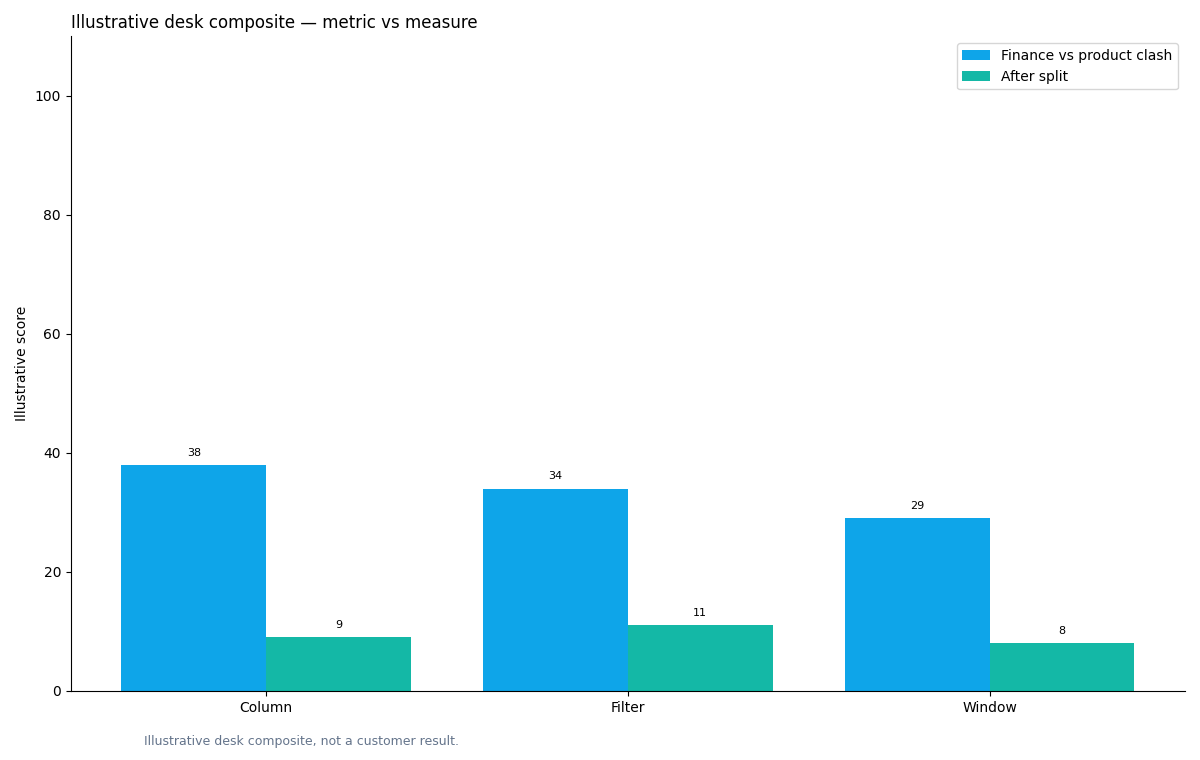
Figure. Teaching schematic. Not a measured study. Source: the protocol table above.
8 / 42 / 88 and 8.4 / 6.1 / 7.25 million are a teaching sketch. Quote the protocol, not the bars.
NIST cybersecurity (table above) did not run this fixture. Access to a measure is a control. It is not an answer to measure vs metric.
Scorecard: split held or collapsed
| Signal | Split held | Collapsed |
|---|---|---|
| Measure | Named as a store | Called “the KPI” |
| Grain | Owned by the metric | Inherited from the column |
| Filter | Spoken on the metric | Hidden in a WHERE |
| Window | Spoken on the metric | “As of the extract” |
| measure vs metric | Two outline lines | One alias |
| Conflict | Dual-labeled or picked | Averaged |
If the measure vs metric row is one alias, the pack is a draft.
Write inclusion and exclusion on the metric. “Paying tenants” is not enough if partner sandboxes share the same amount flag. Name the sandbox, trial, and internal-tenant rules. Those live on the metric, not the measure.
Sort is part of the metric. If you show a top-ten, say rate or volume. Enterprise beside mid-market is valid only when both share the sentence, not only the measure.
A later compile does not retire the split. The catalog is how a stable pair travels. The desk test keeps this week's run honest when the catalog is missing.
Failure modes
The measure promoted to a KPI
amount_usd printed in a schema browser is a measure. Promoting it to a tile title collapses the pair. Bind the sentence or do not quote the field as the claim.
The shared column, silent grain
Two teams agree on the measure and assume they agree on the metric. They do not. Grain drifted. The split looked settled because the column name matched.
The averaged collapse
Two digits from one measure get averaged. The average is a third metric that nobody wrote. That collapse of measure vs metric is expensive.
A collapsed split is an order failure, not a model failure. Do not buy a larger model to restore a pair you refused to write.
Separate the column from the bound sentence
Pick one KPI, write the measure column, then write the metric sentence. Bind one. This check uses only sources you authorize.
Commercial association: You do not need the workspace to complete the educational diagnosis on this page.
Open InfiniSynapseHow this page is sourced. William Zhu is cofounder of InfiniSynapse, public as GitHub @allwefantasy. Company self-description, not independent authority. No third-party prize is claimed. No personal LinkedIn is published. Evaluation basis: We evaluate (hands-on) by writing the measure column and the metric sentence as two objects, then binding one. Protocol 2026-09-02, replayed 2026-09-03. Reviewed internally by analytics engineering · data platform · LLM security · editor. Editorial standards · corrections · publishing principles · About · Privacy · Terms. Contact zhuhl@infinisynapse.com. COI: InfiniSynapse sells an AI-native Data Agent; the banner is a commercial association. The educational diagnosis does not require it. Fact-check: Wikipedia unit of analysis, IBM augmented analytics, ISO/IEC 27001, Azure architecture data guide, PostgreSQL docs, NIST cybersecurity. 8 / 42 / 88 is a teaching sketch. No external organization audited this page.
Frequently Asked Questions
Is a measure allowed to be reused by two metrics?
Bottom line: Yes. That is the point of measure vs metric. Share the column. Do not share an unwritten sentence.
What is the difference between a measure and a metric?
Bottom line: Measure vs metric: a measure is the column you sum, count, or average. A metric is the sentence that binds grain, filter, and window around that column. Write them on two lines. This page is that business pair. A math measure and a metric space are a different subject.
Is a KPI a measure?
Bottom line: On measure vs metric, a KPI is a metric that already has a target and a date. The measure stays the column. Quote the KPI only after the sentence is bound.
Does a semantic catalog settle the split?
Bottom line: A catalog can compile both objects. You still write measure vs metric for this run so a reviewer can see the sentence before the digit.
Should I average two digits from one measure?
Bottom line: No. Open both sentences. Hold one measure plus one chosen metric, or plus two labeled metrics. An average is a third unofficial metric.
What on this page is citable?
Bottom line: Cite the protocol table, the two-object frame, and the six-source comparison. Do not cite the chart bars or the 8.4 / 6.1 / 7.25 million sketch as measured results.
Conclusion
Measure vs metric is the split you hold before compute. The measure is the column. The metric is the sentence. Two teams who collapse measure vs metric will invent two truths from one field. If you later use the workspace, open InfiniSynapse only with authorized, sanitized inputs.