Metrics Meaning: Open Both, Then Pick (2026)
By William Zhu & the InfiniSynapse Data Team · Published: 2026-09-02 · Last updated: 2026-09-03 · Last verified: 2026-09-03 · Next review: 2026-12-02 · Editorial standards · Corrections
Author credentials: William Zhu, Cofounder of InfiniSynapse. Public identity: GitHub @allwefantasy. Profile and review roles: editorial standards. This page is signed by a named person, not an anonymous editorial org. No personal LinkedIn is published. No third-party prize, media review, or independent endorsement is claimed.
Table of Contents
- TL;DR
- What metrics meaning is when two tiles disagree
- A three-cause disagreement framework
- How to treat two truths without averaging
- Tool landscape for comparing sentences
- How to open both sentences and pick one
- Desk sample: first-party two-sentence protocol
- Scorecard: shared meaning or two brands
- Failure modes
- Frequently Asked Questions
- Conclusion
TL;DR
Direct answer: Metrics meaning is why two dashboards disagree: grain, filter, or window drifted under the same KPI name. Do not average the digits. Open both sentences. Bind one metrics meaning or label two metrics. The model can think. The harness decides whether the shared meaning stays visible before anyone computes a third unofficial number.
What you'll learn:
- What metrics meaning names when two tiles conflict
- How grain, filter, and window each create a false disagreement
- Why averaging invents a third unofficial metrics meaning
- How to compare sentences before you recompute
- A two-sentence desk you can replay, not a customer case
- When metrics meaning must stay readable by operations, not only by the BI owner
The hub order lives on metric definition. The lock ritual lives on definition of metrics. The exit test lives on definition of analysis. This page is the failure mode: metrics meaning split across two tiles.
What metrics meaning is when two tiles disagree
Key Definition: Metrics meaning is the readable reason a number is the number: the bound grain, filter, and window behind a KPI name. When two tiles share a name and not a sentence, metrics meaning has split. The fix is to open both sentences, not to average the digits.
Independent published context (retrieved 2026-09-02). Microsoft Azure data architecture guidance, UK NCSC guidelines for secure AI system development, and CISA on AI did not run this fixture.
| Cited source | What it owns | What tonight still needs |
|---|---|---|
| Azure data architecture | Consistent definitions as architecture | Two sentences visible before compile |
| UK NCSC secure AI | Human-readable intent around output | Intent operations can restate |
| CISA AI | Accountable humans around automated systems | The owner of the sentence, not only the tile |
| OpenTelemetry | Named signals so two systems can compare | Name the KPI or you cannot compare |
| Python documentation | Where unofficial averages are written | Freeze both digits; do not script a midpoint |
| OWASP API Security | Contracts that silently change a filter | Version the sentence when the API drifts |
Metrics meaning is not a vibe and not a color on a tile. If you cannot say grain, filter, and window, you do not hold the metrics meaning. You hold a brand.
CISA on AI (above) is a reminder that automated systems still need accountable humans. When metrics meaning is hidden in a semantic model only one engineer can open, accountability has already failed. Operations cannot sign a number they cannot restate.
OpenTelemetry (table above) names signals so two systems can compare them. A KPI that cannot be named cannot be compared.
Python documentation (table above) is where many unofficial averages are born. An average of two KPI digits is a new unofficial metrics meaning with no grain. Freeze both digits, then write both sentences.
OWASP API Security (table above) belongs here when a tile is fed by an API that silently changes a filter. The sentence drifted in the contract, not in the chart. Version the sentence when the contract changes.
A compiled semantic layer can hold one official metrics meaning. This page still starts before compile: open the two sentences in this session. Reuse last quarter’s sentence from organizational analysis memory instead of inventing a third. If the dispute is a unit-economics identity, continue in unit economics analytics after the sentences are visible.
This page is not a semantic-layer buying guide. Compile is a later industrialization step. Metrics meaning is the desk act of opening two sentences and binding one.
A three-cause disagreement framework
| Cause | What drifted | How the sentence splits | First fix |
|---|---|---|---|
| Grain | What one row is | Account versus workspace versus person | Rewrite both grains |
| Filter | Who is in | Paid-90d versus login-30d | Write inclusions and exclusions |
| Window | Which range | Calendar month versus rolling 28 | Write timezone and cutoff |
| Juxtaposition | What sits beside it | Mixed grains on one slide | Force shared grain |
| Owner | Who may edit | Two silent editors | Name one owner |
Metrics meaning lives in the first three rows. Most “the dashboards are wrong” tickets are sentence tickets. The digits are often both correct for their hidden fields. The disagreement is a definition split, not a rounding error.
Name the cause, then the first fix. Do not skip to a recompute. Recompute without a named cause creates a third unofficial metrics meaning that neither team owns.
A Data Agent is closer to operations and compliance than a Code Agent. Metrics meaning must be readable by the finance partner who will not open a notebook. If only a BI owner can explain the split, the harness failed. Stay at account, plan, region, or queue.
State source, why this table, filters, sort, and juxtaposition before anyone recomputes.
How to treat two truths without averaging
Choose one bound metrics meaning if
The decision needs one number. Open both sentences. Pick one metrics meaning. Recompute only that sentence. Retire the other name or relabel it.
Choose two labeled metrics if
The teams truly measure different things. Then metrics meaning did not fail. Naming failed. Keep both sentences. Stop using one KPI title for two objects. When those sentences share a column, open measure vs metric.
Choose a compiled contract if
The chosen sentence is stable and many products must reuse it. Compile it later. Do not compile the average. An average has no grain, no filter, and no window. It is a midpoint, not a contract.
Averaging is the failure this page exists to stop. Two correct digits plus an average is three unofficial stories.
Tool landscape for comparing sentences
Tiles hide the sentence. Chat invents a third sentence in prose. Spreadsheets average columns. Notebooks make the average look scientific. A harness that places both sentences on one screen is the comparison surface.
What the comparison must show
Both sentences. Both sources. Both table reasons. Both windows. The delta in grain, filter, and window. A human pick. If a product only shows two digits, it cannot host metrics meaning.
What the comparison must refuse
A silent reconcile job. Write-back that “fixes” a tile. Person-level grain to “explain” a segment. A model-benchmark claim. The split is a metrics meaning problem.
InfiniSynapse’s published pattern matches the comparison: stop at the outline, paste two sentences, list the three diffs, bind one. Schema recall does not pick. A reviewer picks.
How to open both sentences and pick one
Extract both sentences
Input: two tiles or two agent answers with the same KPI name. Acceptance: grain, filter, and window are written for each. If a tile has no sentence, you do not yet have metrics meaning to compare—you have a brand versus a sentence.
List the three diffs
Input: the two sentences. Acceptance: you can point at grain, filter, or window as the split. The comparison work is finished when the cause is named. Recompute is optional.
Bind one, or label two
Input: a decision owner. Acceptance: one official metrics meaning, or two names. If the owner says “split the difference,” you created a third unofficial metrics meaning. Stop. Ask again for a pick or a pair of labels.
Numbered work:
- Freeze both digits. Do not average.
- Write both sentences, including timezone and cutoff.
- Mark grain, filter, and window diffs in a three-row table.
- Choose one metrics meaning or two labels.
- Bind the choice in the outline so the next run cannot invent a third.
- Recompute only the chosen sentence, on the same authorized source.
- Keep both original sentences in the pack so the dispute cannot restart as folklore.
A sentence that is not written at step 2 will be rewritten as gossip at step 7. Expected desk effort for a similar pair is one sitting with both queries or both model notes on the same screen. Success signal: a three-row grain-filter-window table, one named owner, and no midpoint on the slide.
Desk sample: first-party two-sentence protocol
Cite this protocol. Do not cite a customer percentage, an 8,400 / 6,100 / 7,250 figure, or the chart bars as a study. An average that called itself the “real” number had no metrics meaning.
First-party method log (replayable):
| Field | Record |
|---|---|
| Operator | InfiniSynapse Data Team; William Zhu, GitHub @allwefantasy |
| First run | 2026-09-02 |
| Replay | 2026-09-03 |
| Input | Authorized, sanitized finance-versus-product pack; no people |
| Paths | Averaged midpoint vs two labeled sentences |
| Causes | 3 (grain, filter, window) |
| Acceptance | Two labeled names; no average; queue uses account grain |
| Fail | Midpoint slide; one title, two silences; person-level “explain” |
We opened both sentences, labeled finance as paid_account_90d and product as engaged workspaces, then replayed the same fail on 2026-09-03. That is a first-line replay, not a customer case. Review: editorial standards.
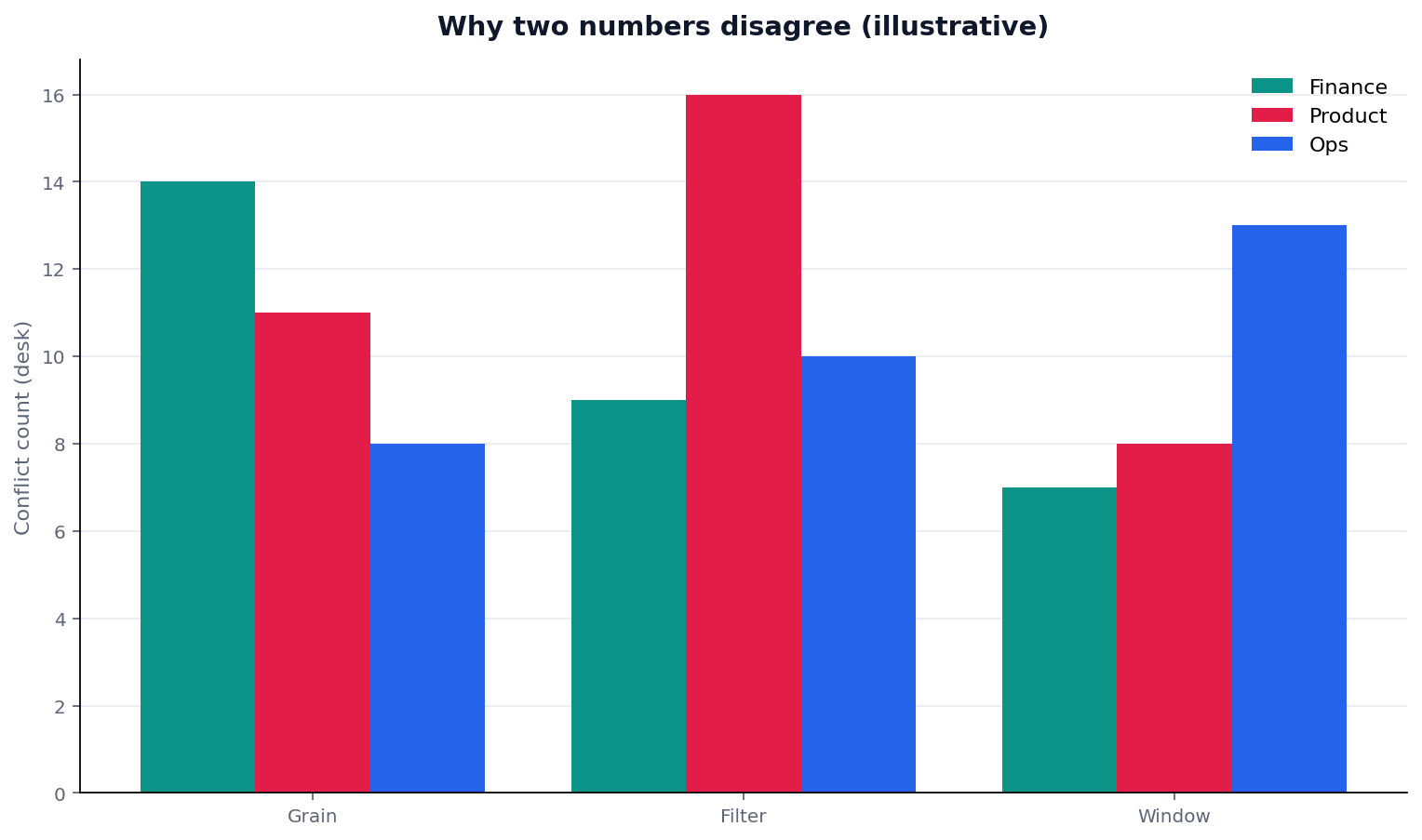
Figure. Teaching schematic. Not a measured study. Source: the protocol table above.
8 / 42 / 88 and 8,400 / 6,100 / 7,250 are a teaching sketch. Quote the protocol, not the bars.
Scorecard: shared meaning or two brands
| Signal | Shared bound sentence | Two brands |
|---|---|---|
| Grain | Same entity | Account vs workspace |
| Filter | Same in/out | Paid vs login |
| Window | Same cutoff | Month vs rolling |
| Sentence | One or two labeled | One name, two silences |
| Average | Forbidden | Used as a third number |
| Readable | Operations can state it | Only BI can explain |
If metrics meaning is only a brand, do not reconcile with math. Write the sentences. Then pick or label. Operations should be able to state both grains without opening a notebook. If only a BI owner can explain the split, the pack is not ready for a memo. Keep the path readable by the person who will quote the figure.
Failure modes
The polite average
A meeting ends with the midpoint. That midpoint is a new unofficial metrics meaning with no grain. Refuse it. Write both originals.
The hidden grain slide
Both tiles say “account” and one counts people inside the account. The sentence slid to a person grain. For a segment pack, that slide is also a privacy failure. Stay aggregated.
The silent API filter
A tile’s API dropped internal tenants last Tuesday. The sentence changed and the name did not. Version the sentence. Do not blame the chart.
Compare two definitions, then pick one
Paste two KPI sentences, list the three diffs, and bind one. This check uses only sources you authorize.
Commercial association: You do not need the workspace to complete the educational diagnosis on this page.
Open InfiniSynapseHow this page is sourced. William Zhu is cofounder of InfiniSynapse, public as GitHub @allwefantasy. Company self-description, not independent authority. No third-party prize is claimed. No personal LinkedIn is published. Evaluation basis: We evaluate (hands-on) by placing two KPI sentences side by side and listing grain, filter, and window diffs. Protocol 2026-09-02, replayed 2026-09-03. Reviewed internally by analytics engineering · data platform · LLM security · editor. Editorial standards · corrections · publishing principles · About · Privacy · Terms. Contact zhuhl@infinisynapse.com. COI: InfiniSynapse sells an AI-native Data Agent; the banner is a commercial association. The educational diagnosis does not require it. Fact-check: Azure data architecture, UK NCSC, CISA AI, OpenTelemetry, Python docs, OWASP API Security. 8 / 42 / 88 is a teaching sketch. No external organization audited this page.
Frequently Asked Questions
What is this when two numbers disagree?
Bottom line: Metrics meaning is the sentence behind each digit. Disagreement is usually grain, filter, or window. Open both sentences before you touch math.
Should I average the two tiles?
Bottom line: No. An average is a third unofficial sentence. Pick one bound definition or label two metrics.
Can both digits be right?
Bottom line: Yes. Two correct digits with two sentences means the title is shared and the sentence is not. The tiles are not broken.
Is a semantic layer enough to stop this?
Bottom line: A layer can hold one official bound sentence. You still open this session’s two sentences. Compile after you pick. This page is not a catalog purchase.
What on this page is citable?
Bottom line: Cite the protocol table, the three-cause frame, and the six-source comparison. Do not cite the chart bars or the 8,400 / 6,100 / 7,250 sketch as measured results.
Conclusion
Metrics meaning is why two numbers disagree. Grain, filter, or window drifted. Do not average. Open both sentences. Bind one official sentence or keep two labeled metrics. Keep the path readable by operations. Direction, steps, sentence, then number—and never a midpoint that has no sentence at all.
InfiniSynapse describes itself on About. Privacy and Terms apply. If you later use the workspace, open InfiniSynapse only with authorized, sanitized inputs.