SQL AI: Audit Named Views, Not One Query (2026)
By William Zhu & the InfiniSynapse Data Team · Published: 2026-09-02 · Last updated: 2026-09-18 · Last verified: 2026-09-18 · Next review: 2026-12-02 · Editorial standards · Corrections
Table of Contents
- TL;DR
- What SQL AI means for an agent
- A four-object framework
- SQL AI versus one-shot text-to-SQL
- Tool landscape for agent analysis
- How to run a named-view task
- Named step
- Desk sample: first-party review protocol
- Scorecard: is the language agent-ready
- Failure modes
- Frequently Asked Questions
- Conclusion
TL;DR
We review agent analysis packs at the InfiniSynapse desk on sanitized composites. Cite the first-party protocol below (four objects, six checks). Do not cite the complexity sketch as a customer result.
Direct answer: SQL AI for agents is a language that loads sources as tables and names every intermediate view so a reviewer can reopen one step. It is not a chatbot that emits one giant query. If you cannot point at the broken view, you do not have SQL AI—you have a transcript.
What you'll learn:
- What SQL AI is when the reader is an agent, not a human typing SELECT
- A four-object frame: load, named view, single-step review, trail
- Why one-shot natural language to SQL is a different product
- When pandas burns attention and when SQL should stay
- How to run a read-only task and open named views in
/tasks - The named-step ask habit: filter, name, replay, then join
- A first-party review protocol you can replay, plus a labeled complexity sketch
- A scorecard and three failure modes that survive a fluent paragraph
What SQL AI means for an agent
Key Definition: SQL AI is an agent-native analysis language: files, JDBC, and lake objects load as tables; each compute step becomes a named view; a reviewer can replay one step without re-running the whole chain. It is not a dialect tutorial and not a one-shot translator.
Independent published context (retrieved 2026-09-02; separate from this page’s desk composite): the Stanford HAI AI Index tracks the shift from pilots to governed loops; ISO/IEC 27001 is the access-and-audit anchor when credentials are in scope; CISA cybersecurity best practices apply when an agent can see production schemas. Those pages did not run this desk pack and are not a product award.
A data agent does not need another SQL textbook. It needs a place to put attention. If the model spends tokens repairing pandas syntax or flattening a 200-line SELECT, it is not thinking about grain. SQL AI exists so the model stays on the business step while the language holds the tables.
Teams hear “SQL AI” and picture autocomplete. Autocomplete writes the next token. An agent writes a chain. The chain fails in the middle. If the middle has no name, the reviewer cannot say “the join after orders_q2 is wrong.” That sentence is the product.
You can analyze a database without ETL and still fail this test. Connection is not language. SQL AI starts after the source is authorized and read-only: load, name, compute, name again.
FTC consumer protection guidance (retrieved 2026-09-02) is the independent reminder that outputs which inform external decisions need a trail, not a vibe. SQL AI is how the trail stays a table.
Why the model should not own syntax
Syntax repair is a tax. Every time the model rewrites a window function that already ran, it forgets the filter it promised. SQL AI pushes that tax into named views: the next step SELECTs from a name, not from a nested subquery the model must keep in working memory.
Why “everything is a table” is the load rule
A file, a JDBC result, and a lake object are not three mental models. They are three loads. After load they are tables. SQL AI that lets the model invent an in-memory frame has already left the language.
A four-object framework
Score a pack with one table. SQL AI quality is visible in the columns.
| Object | What it is | Pass signal | Fail signal |
|---|---|---|---|
| Load | File / JDBC / lake becomes a table | A name you can SELECT | A frame that lives only in the model |
| Named view | One compute step, one name | A reviewer can open that step | A 200-line blob with no alias |
| Single-step review | Fail one view on purpose | You can point at the view | You re-run everything to guess |
| Trail | The same objects in /tasks | Replay tomorrow | A chat paragraph with no ids |
Load before compute
Do not calculate on a path. Load first. MongoDB documentation (retrieved 2026-09-02) is a useful reminder that even document stores need an explicit read scope before aggregation. SQL AI uses the same honesty: name the loaded table, then compute.
One name per step
The SQL statement builder page is the method sibling: one statement, one name, then the next join. Hub rule: if a step cannot be named in six words, it is two steps.
SQL AI versus one-shot text-to-SQL
Two products share the letters S, Q, L. They do not share a job.
| Factor | One-shot text-to-SQL | SQL AI (this pillar) |
|---|---|---|
| Unit | One question → one query | One question → a chain of named views |
| Failure | The query is wrong | A specific view is wrong |
| Review | Read a blob | Open one step |
| Goal | Translate | Analyze |
| When to choose | A known single SELECT | Multi-step grain, joins, checks |
Choose one-shot if the contract is a single known query and a human will read the SQL. Choose SQL AI if the agent must hold intermediate grains and a colleague must reopen a step next week.
This is why Pillar 5 stays on natural language to SQL and this hub does not rewrite that page. The Spider NL2SQL benchmark (retrieved 2026-09-03) scores one question to one query. That is a translator score. SQL AI is the language after translation stops being the product.
Apache Airflow documentation (retrieved 2026-09-02) describes retries and lineage for scheduled jobs. Borrow the idea, not the product: SQL AI is a named chain you can resume, not an Airflow replacement.
Pandas is a download, not a language
Pandas vs SQL is the comparison sibling. Keep joins in SQL. Download a frame after the table is named. Pandas SQL is the failure-mode sibling: the model writes Python first and burns the trail.
Tool landscape for agent analysis
Four tiers show up in procurement slides. Only one is SQL AI.
Autocomplete in an IDE is useful for humans. An agent that only autocompletes still dumps a blob. That is not the language. Warehouse-native copilots help inside one store. They rarely name intermediate views as first-class objects you can hand to the next agent. Treat them as a source, not as the analysis language.
Notebook-first Python
Fast for a person who already knows the grain. Fragile for an agent that must be reviewed. SQL tools is the sibling that insists every source loads as a table before compute.
Agent-native named views
Load, name, review, trail. InfiniSQL is the brand name for that language on InfiniSynapse. The public claim is the method, not a dialect encyclopedia.
If you later need explainable AI data analysis, you are opening the same trail this language wrote. SQL AI is the writer; explainability is the reader.
How to run a named-view task
Do this on an authorized, sanitized source. Do not paste secrets.
- Authorize a read-only source. One database or one folder. SQL AI does not start on a screenshot.
- Ask a question that needs two joins. If one SELECT answers it, you are testing autocomplete, not the language.
- Require a load name. The first object must be a table, not a prose summary.
- Require one name per step. Filter, join, and aggregate are three views, not one CTE dump.
- Open
/tasks. Confirm each name is visible. This is the SQL AI audit. - Break one view on purpose. Change a filter. Confirm you can point at that view without re-reading the chat.
- Refuse a Python rewrite unless the step is an export. See pandas SQL.
SQL scripting is the workflow sibling: the same chain written as a script of names, not a stored-procedure dump.
For large scans, analyze large datasets with AI still applies: push compute down. SQL AI does not pull a warehouse into pandas to look clever.
Named step
This slice was kept from the retired /en/blog/ai-query URL (marker DESK-AQ-20260918A). In SQL AI, the ask habit is one named step you can replay—not a product called “AI query,” not Databricks ai_query(), and not natural language to SQL.
Key habit: Ask one thing, give it an
asname, replay the view, then take the next join. A one-shot paragraph that finishes the whole question is a dump. SQL AI refuses that dump.
Score the ask with five columns. If a column is empty, you asked a dump, not a step.
| Stage | What you ask | Output name | Review signal | Stop if |
|---|---|---|---|---|
| Load | Which file or JDBC table | raw_orders | Columns match the source | Schema is guessed |
| Filter | Which period or status | orders_q2 | Row count moves for the right reason | Count is unexplained |
| Grain | Which definition | orders_q2_paid | The name says the grain | Two grains in one view |
| Join | Which key, out loud | paid_by_region | Both parents still exist | Key is implied |
| Hand-off | Which view the memo uses | Memo table | A colleague can reopen it | Only a chat sentence remains |
Two products call themselves the same thing. The scorecard is whether you can point.
| Candidate | What it emits | Choose it if | Reject it if |
|---|---|---|---|
| Chat dump | One paragraph that “answers” | You wanted a demo sentence | Someone will audit a step |
| One-shot generator | One statement from one ask | The grain is already certified | A second definition will appear |
| Named step | One select … as per ask | A reviewer will reopen a name | You wanted a fluent blob |
First-party named-step protocol (replayable; not a customer SLA):
| Field | Record |
|---|---|
| Operator | InfiniSynapse Data Team; William Zhu, public as GitHub @allwefantasy |
| First run | 2026-09-02 |
| Replay / last verified | 2026-09-03 |
| Paths compared | Two named steps (filter, then join) vs one-shot dump |
| Named views scored | 2 (orders_q2, paid_by_region) |
| Scorecard rows | 6 |
| Acceptance | Each named view reopens in /tasks with the expected grain |
| Fail | The only surviving object is a chat paragraph |
The dump left no view a colleague could reopen. Cite this protocol table. Do not cite a customer percentage.
Stacked asks that hide the grain
The model stacks filter, join, and aggregate into one ask to “save a turn.” SQL AI makes each ask a named view, or refuses the stack.
Unnamed grains that cannot be pointed at
t1 means last week’s filter and this week’s join. Names are cheap. An unnamed step is how a trail becomes folklore.
Just answer it
The model writes a confident number and no view. Comments and chat sentences are not views. Open the predicate. Do not negotiate with the bubble.
Desk sample: first-party review protocol
Cite this protocol. Do not cite a customer percentage.
First-party method log (replayable):
| Field | Record |
|---|---|
| Operator | InfiniSynapse Data Team; William Zhu, public as GitHub @allwefantasy |
| First run | 2026-09-02 |
| Replay / last verified | 2026-09-03 |
| Input | One authorized, sanitized source; no secrets |
| Acceptance | A reviewer names the broken view in one sentence |
| Fail | Reread the chat |
| Objects scored | 4: load, named view, single-step review, trail |
| Checks scored | 6 rows on the scorecard below |
We opened /tasks on that sanitized pack and asked a reviewer to point at one named view. The citable SQL AI result is the protocol: four objects, six checks, one named handle. Independent readers can inspect the public GitHub identity @allwefantasy; that is a public artifact, not a prize. No external organization audited the pack. Independent review is invited through editorial standards.
A teaching sketch used 8 raw tables, 42 intermediate views, and 88 dependencies only to show complexity. Those three counts are not a benchmark, not a customer result, and not a promise. SQL AI is why a reviewer could say “the geo filter view is the break,” instead of “the model got confused.”
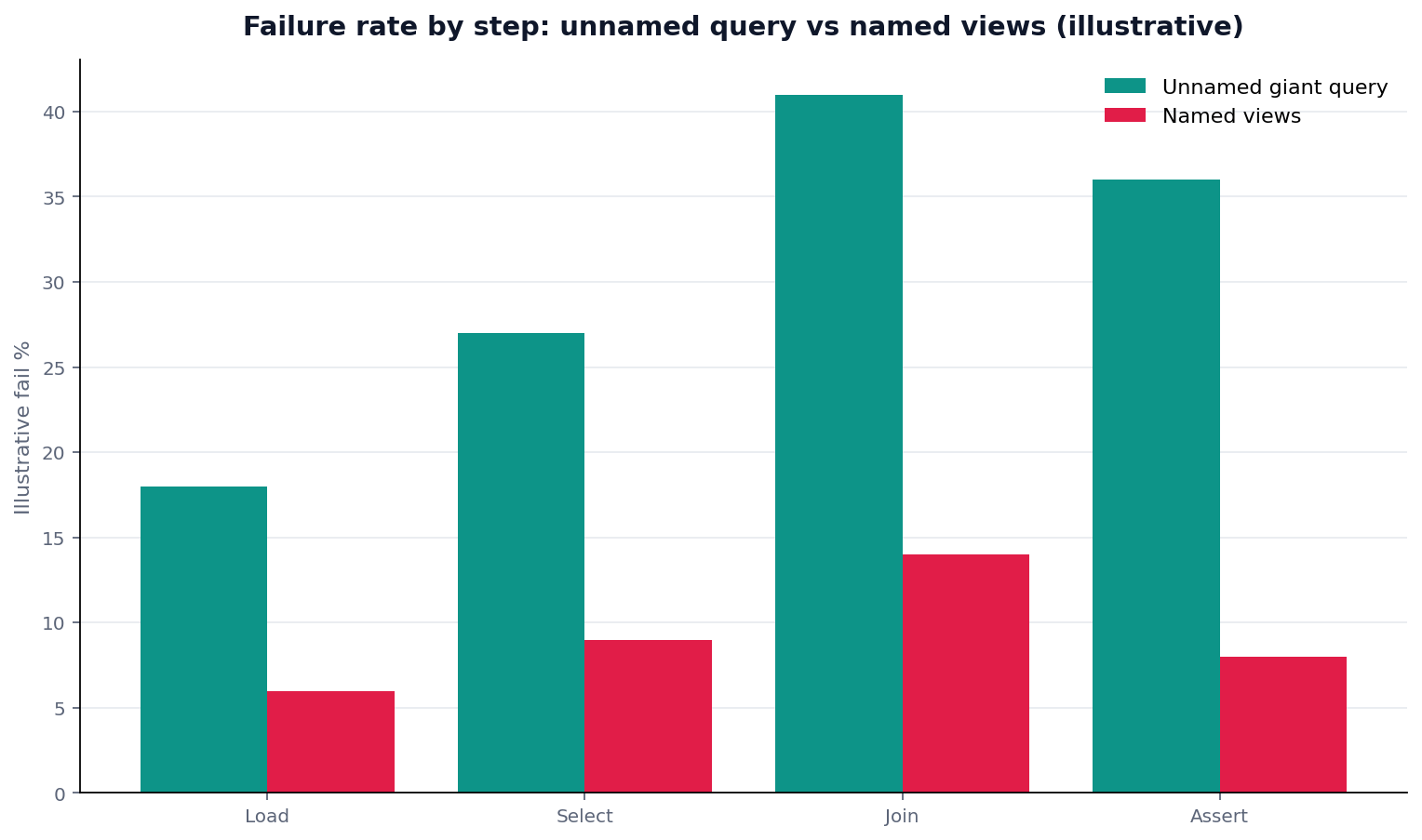
Figure. Teaching schematic of where unnamed blobs usually break (join and assert). Not a lab rate and not a customer result. Source: the first-party protocol in the table above.
The chart is a teaching split of attention, not a measured failure rate. Quote the SQL AI protocol table if you cite this page. Do not quote the bars as a study.
What the protocol taught the desk: SQL AI is a naming discipline under load. The model wanted one heroic query. The language forced one name per step. Extra names were cheaper than one silent wrong grain.
Scorecard: is the language agent-ready
| Check | Pass | Fail |
|---|---|---|
| Sources load as tables | Run | Path math in prose |
| Each step has a name | Run | One blob |
| A colleague can open one step | Repeatable | Chat only |
| Python is an export, not the compute | Run | Model “just writes pandas” |
| Trail survives tomorrow | Repeatable | New chat, new truth |
| Read-only by default | Control | Write-back offered as analysis |
SQL AI is ready when the first five rows pass. A fluent memo with a “No” on names is still a story.
Failure modes
One giant query the model is proud of
Pride is not a review handle. If the only object is a 200-line SELECT, you cannot say which join drifted. Split it. That is SQL AI, not style.
Letting the model write Python first
The model will, because Python feels like thinking. It is usually syntax theater. Keep compute in SQL until you export. The pandas vs SQL page lists the locate-the-error minutes.
Treating NL2SQL accuracy as the KPI
Token-F1 on a single query is a translator score. SQL AI is scored on whether a human can reopen step four. Do not import a leaderboard into this pillar.
Before you buy another “AI writes SQL” add-on, list the last analysis that needed more than one grain. If you cannot name the intermediate tables, you do not have SQL AI in production. If you can, bind those names as the default.
Cluster guides under this hub: SQL Statement Builder: One Named Step at a Time; SQL tools; InfiniSQL: The Analysis Language for Agents; Pandas vs SQL for AI Agents; SQL Scripting for Multi-Step Agent Analysis; Pandas SQL: Why Agents Should Not Write Python First.
When the ask is one named step rather than a dump, stay on Named step. When a generated blob is the competitor, compare SQL GPT.
When the job is reopening one view for review, use the SQL helper.
Open a read-only source and inspect the named views
Connect one authorized database or file, ask a multi-step question, and open /tasks to see each named view. This check uses only sources you authorize.
Commercial association: You do not need the workspace to complete the educational diagnosis on this page.
Open InfiniSynapseHow this page is sourced. William Zhu is cofounder of InfiniSynapse, public as GitHub @allwefantasy. Company self-description, not independent authority. No personal LinkedIn is published. Evaluation basis: We evaluate (hands-on) by opening
/taskson sanitized packs and pointing at one named view—not a chat paragraph. First-party protocol dated 2026-09-02, replayed 2026-09-03. Reviewed internally by analytics engineering · data platform · LLM security · editor. Editorial standards · corrections · publishing principles · About · Privacy · Terms. Contact zhuhl@infinisynapse.com. COI: InfiniSynapse sells an AI-native Data Agent; the banner is a commercial association. Fact-check: Stanford HAI AI Index · ISO/IEC 27001 · FTC · CISA · Apache Airflow · MongoDB docs · Spider NL2SQL. No external organization audited the desk pack. No third-party prize is claimed.
Frequently Asked Questions
Is this the same as text-to-SQL?
Bottom line: No. Text-to-SQL translates one question into one query. SQL AI names a chain of views an agent can replay. Use Pillar 5 for the translator; use this pillar for the language.
Is a named step the same as an “AI query”?
Bottom line: The habit is one named step you can replay. That used to live at /en/blog/ai-query and now sits in Named step. It is not Databricks ai_query() and not a text-to-SQL translator.
Do I need to migrate to a warehouse first?
Bottom line: No. SQL AI starts on the authorized source you already have. A warehouse can come later if nightly grain requires it. Language is not a mart program.
Can the agent write Python if it is faster?
Bottom line: Only as an export. If the model writes Python first, you lose the named view. Keep SQL AI in SQL until a file must leave the workspace.
What if my team already has dbt?
Bottom line: dbt is a transformation contract. SQL AI is how an agent names steps at analysis time. Do not treat this page as a dbt buying guide.
Are the 8 / 42 / 88 counts a customer result?
Bottom line: No. They are a complexity sketch. Cite the first-party protocol: four objects, six checks, one named view. Do not quote 8 / 42 / 88 as a benchmark or a promise.
What on this page is citable?
Bottom line: Cite the SQL AI protocol table, the four-object frame, and the dated fact-check links. Do not cite the chart bars or the complexity sketch as measured results.
Conclusion
SQL AI is a naming language for agents: load as tables, one view per step, reopen the broken one. One giant query is a demo. A pandas rewrite is usually a tax. Keep the trail in /tasks. If you later use the workspace, open InfiniSynapse only with authorized, sanitized inputs.