SQL Statement Builder: Audit One Named Step (2026)
By William Zhu & the InfiniSynapse Data Team · Published: 2026-09-02 · Last updated: 2026-09-03 · Last verified: 2026-09-03 · Next review: 2026-12-02 · Editorial standards · Corrections
Table of Contents
- TL;DR
- What a SQL statement builder is
- A one-name-per-step framework
- Methods: blob builder versus named builder
- Tool landscape for building statements
- How to build one named statement
- Desk sample: first-party named-step protocol
- Scorecard: builder quality
- Failure modes
- Frequently Asked Questions
- Conclusion
TL;DR
Direct answer: A SQL statement builder for agents emits one named
select … asat a time so a reviewer can point at the broken step. Build the filter, replay it, then take the next join. A 200-line generated blob is not a builder. It is a file you cannot bisect.
What you'll learn:
- What a SQL statement builder is when the unit is one named view
- A frame: input table, named select, replay, next join
- When to choose a blob and when to refuse it
- How to build three statements a colleague can point at
- A first-party protocol you can cite (three named statements, six checks) plus a labeled complexity sketch
- Failure modes: silent unions, reused aliases, and “fix it in the comment”
This page is the method cluster under SQL AI. The hub is the language. The SQL statement builder is the habit inside that language: one name, one review, then the next statement.
What a SQL statement builder is
Key Definition: A SQL statement builder is a method that constructs analysis as a sequence of named selects (
select … as), each one small enough that a reviewer can replay it and point at the break. It is not a GUI that pastes joins, not a one-shot translator, and not a stored-procedure dump.
Independent published context (retrieved 2026-09-02; separate from this page’s protocol): compare each source to the method, then stop. IBM’s augmented analytics overview owns assisted analysis as a process; it does not decide whether your step has an as name. Wikipedia: data warehouse owns grain and conformed dimensions; it is not a purchase order for this page. RFC 4180 owns the CSV bytes you load before the first named select; it is not the select. Those sources did not run this desk and are not a product award.
| Cited source | What it actually owns | What a SQL statement builder still has to do |
|---|---|---|
| IBM augmented analytics | Analysis as a governed process | Name each select … as |
| Wikipedia data warehouse | Architecture of stores and grain | Start on the authorized table you already have |
| RFC 4180 | CSV file grammar | Load, then name the first view |
| BigQuery docs | Engine jobs and stages | Treat each named select as a stage you can reopen |
| OpenTelemetry docs | Traces and spans | Treat each named select as a span |
| OWASP ASVS | Verifiable application controls | Treat the named view as the control you verify |
One SELECT AS, then stop
A usable SQL statement builder feels slow on purpose. You name orders_q2. You filter to orders_q2_paid. You join to paid_by_region. After each statement you look at row count and grain. If orders_q2_paid is empty, you do not proceed to the region join. That is the method. A data agent that skips the pause is generating text, not building a statement.
The opposite of a SQL statement builder is the model that outputs the entire plan as one object. You cannot point. You can only regenerate. Regeneration is not review.
Do not confuse this method with natural language to SQL. A translator answers one certified grain. A SQL statement builder keeps going when the second definition appears. Paid versus booked is a new named select, not a longer WHERE clause.
A one-name-per-step framework
Score a SQL statement builder with five columns. If a column is empty, you are pasting, not building.
| Stage | Input | Output name | Review signal | Stop if |
|---|---|---|---|---|
| Load | File or JDBC table | raw_orders | Columns match the file | Schema is guessed |
| Filter | raw_orders | orders_q2 | Row count moves for the right reason | Count is unexplained |
| Grain | orders_q2 | orders_q2_paid | Definition is in the name | Two grains in one view |
| Join | Two named views | paid_by_region | Key is said out loud | Key is implied |
| Hand-off | Last named view | Memo table | Colleague can point | Only a chat sentence remains |
Filter before join
A SQL statement builder that joins first hides the filter in the ON clause. The reviewer cannot tell whether the empty result is a bad key or a bad period. Name the filter. Replay it. Then join. BigQuery’s job-and-stage language (table above) is the reminder that stages exist. This page is not a warehouse SKU list.
Replay is part of the build
OpenTelemetry’s span language (table above) is the independent analogy. A SQL statement builder needs a smaller version of the same idea: each named select is a span you can open. If /tasks cannot reopen orders_q2_paid, you did not build a statement. You printed one.
When the fight is how to read the trail after it exists, continue in the explainable AI data analysis guide. This cluster is how the trail got one name at a time.
Methods: blob builder versus named builder
Two products call themselves a SQL statement builder. The scorecard is whether you can point.
| Candidate | What it emits | Choose it if | Reject it if |
|---|---|---|---|
| GUI join painter | A diagram that compiles later | A person is clicking every join | An agent must leave a name |
| One-shot generator | One statement from one ask | The grain is already certified | A second definition will appear |
| Named SQL statement builder | One select … as per step | Someone will audit a step | You wanted a demo paragraph |
Choose A (named builder) if a reviewer will ask which step broke. Choose B (one-shot generator) if you already have a certified SELECT and you will not extend it.
Choose A if the next person must point
Controllers, analysts, and security reviewers point. A SQL statement builder that cannot accept a finger on a name will force them to reread 200 lines. That is how reviews become arguments about taste.
Choose B if the grain is already locked
A single certified count can skip the builder. Say so. Do not market a SQL statement builder for a job that is one line. Honesty is part of the method.
OWASP ASVS (table above) is the independent bar for verifying a control. Applied here: the named view is the control you verify. A generated blob with no names cannot be verified as a step.
Tool landscape for building statements
Notebooks, GUI painters, and “AI SQL” boxes all claim to be a SQL statement builder. Most of them emit a file.
A notebook cell that ends in df is not a named view. A GUI that hides the SQL behind a diagram is not reviewable by someone who was not in the room. A chat model that pastes a CTE stack is a blob with prettier commas.
InfiniSQL implements the SQL statement builder as ordinary named selects the agent writes and /tasks stores. It will not invent your grain. It will not write production MySQL. Treat it as the method, not as a dialect course.
What you should refuse: auto-complete that merges two grains into one alias, a builder that cannot replay a single step, and a builder that wants write access. What you can accept on day one: one authorized table, one named filter, one named join. That day-one bar is still a SQL statement builder.
What still belongs in a warehouse later
Materialize when the same named views must hit the same grain every night. Until then, a SQL statement builder on a read-only source is a smaller lie than a two-year mart.
How to build one named statement
Keep the sequence short enough to reject.
- Name the input.
raw_ordersor the JDBC table you authorized. If the input has no name, the SQL statement builder has nowhere to start. - Write one select with an
as. Filter or project only. Do not join in the first statement unless the join is the only step and the key is already written. - Replay the view. Row count, nulls, a sample of keys. If the view is wrong, stop. Do not stack a second statement on a lie.
- Take the next join or aggregate as a new name.
paid_by_region. Keep the previous name in the FROM. A colleague should be able to delete the new view and still have the old one. - Refuse the blob. If the model offers to “just write it all at once,” reject it. That offer is the failure mode this method exists to prevent.
Acceptance signal: you can point at one name and say what it did. If you can only point at a file, you do not have a SQL statement builder yet.
Desk sample: first-party named-step protocol
Cite this protocol. Do not cite a customer minute or a customer percentage.
First-party method log (replayable):
| Field | Record |
|---|---|
| Operator | InfiniSynapse Data Team; William Zhu, public as GitHub @allwefantasy |
| First run | 2026-09-02 |
| Replay / last verified | 2026-09-03 |
| Input | One authorized, sanitized source; no secrets |
| Statements built | 3 named selects: filter, join, aggregate |
| Framework stages scored | 5 (load, filter, grain, join, hand-off) |
| Scorecard rows | 6 |
| Acceptance | A colleague names the broken statement in one sentence |
| Fail | Reread a 200-line blob |
We built the three named statements, then failed the join on purpose. The citable result of this SQL statement builder run is the protocol: three names, six checks, one finger on the break. Independent readers can inspect GitHub @allwefantasy; that is a public artifact, not a prize. No external organization audited the pack. Independent review is invited through editorial standards.
A teaching sketch used 8 raw tables, 42 intermediate views, and 88 dependencies only to show complexity. Those three counts are not a benchmark. Minutes in the figure are a teaching split of attention, not a lab clock.
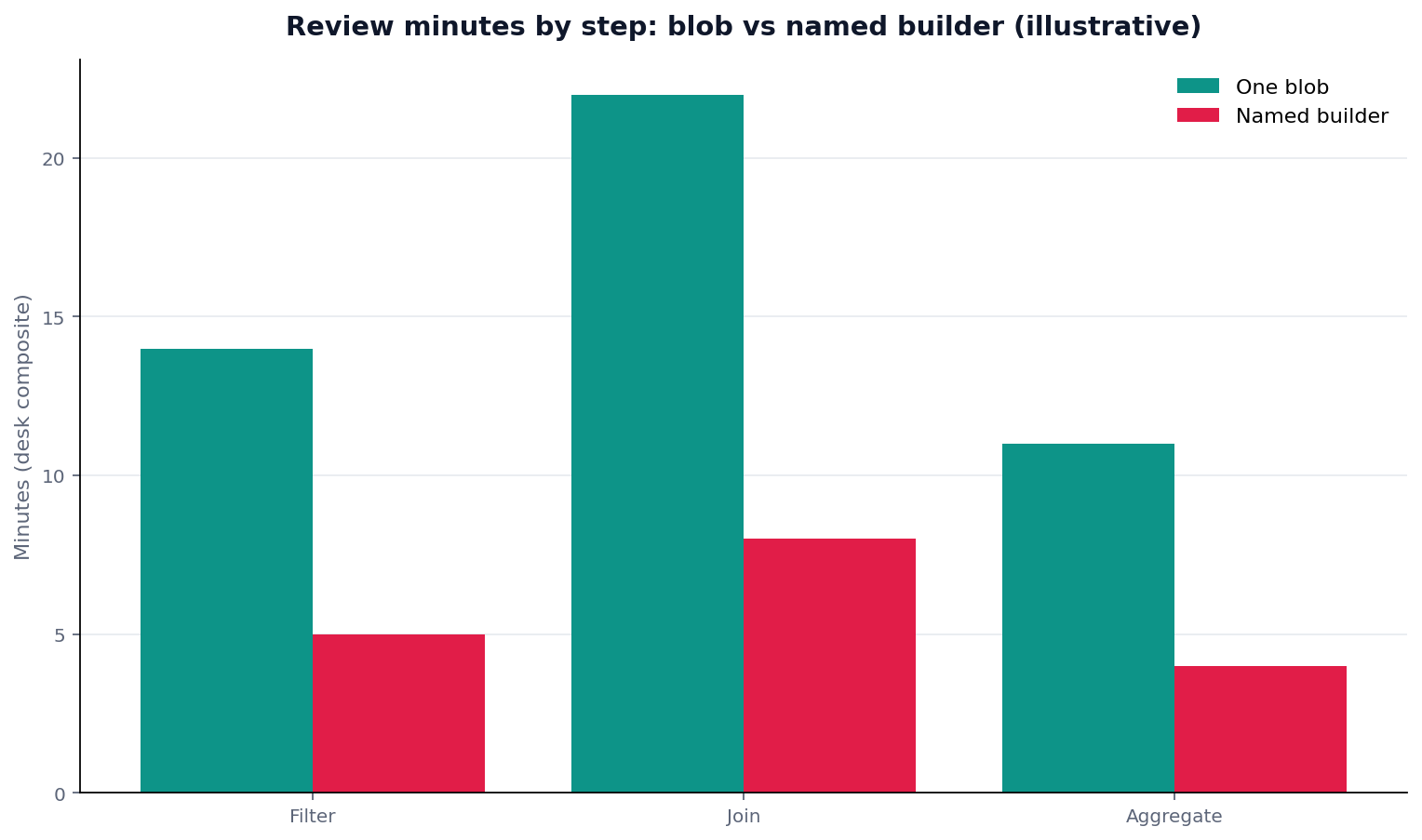
Figure. Teaching schematic of where a blob hides the break (usually the join). Not a measured review-time study. Source: the first-party protocol table above.
The drill is simple. Pick one named statement. Ask a colleague to say the grain in one sentence. If they cannot, this SQL statement builder step failed even if the final number looks familiar. Quote the protocol table if you cite this page. Do not quote the bars as a study.
Use SQL tools when the missing object is the load, not the select. Use the InfiniSQL definition when the argument is still “is this a dialect?”. This page stays on the method: one named statement, then the next.
Scorecard: builder quality
Run this scorecard on the last generated statement you accepted.
| Test | Pass | Fail | What to do |
|---|---|---|---|
Each step has an as name | Pointable | CTE soup with no business words | Split and rename |
| Filter is its own view | Replayable | Hidden in JOIN | Extract |
| Join key is written | Named | Implied in a comment | Stop |
| Previous view still exists | Deletable new step | Mutating in place | Rebuild |
/tasks reopens the name | Tomorrow works | Chat-only | Keep the task |
| No production write | Workspace only | “Save to MySQL” | Out of scope |
A SQL statement builder is ready when the first five rows pass. A fluent blob with a “No” on names is still a file. Run the SQL statement builder scorecard on the last statement you accepted, not on a slide.
Failure modes
Silent unions that change the grain
The builder unions two periods to “save a step.” The grain becomes two things. A SQL statement builder should make the union a named view with the grain in the name, or refuse the union.
Reused aliases that lie
t1 means last week’s filter and this week’s join. The reviewer points at t1 and argues. Names are cheap. Reuse is how a SQL statement builder becomes folklore.
Fix it in the comment
The model writes a correct comment and a wrong predicate. Comments are not views. The SQL statement builder only trusts the named select. Open the predicate. Do not negotiate with the comment.
Build one named statement, then replay the next
Ask a question that needs two joins, then open the named statements instead of a single generated blob. This check uses only sources you authorize.
Commercial association: You do not need the workspace to complete the educational diagnosis on this page.
Open InfiniSynapseHow this page is sourced. William Zhu is cofounder of InfiniSynapse, public as GitHub @allwefantasy. Company self-description, not independent authority. No personal LinkedIn is published. Evaluation basis: We evaluate (hands-on) by building one named
SELECT … ASat a time, then failing the join on purpose to see if a reviewer can point. First-party protocol dated 2026-09-02, replayed 2026-09-03. Reviewed internally by analytics engineering · data platform · LLM security · editor. Editorial standards · corrections · publishing principles · About · Privacy · Terms. Contact zhuhl@infinisynapse.com. COI: InfiniSynapse sells an AI-native Data Agent; the banner is a commercial association. Fact-check: IBM, Wikipedia data warehouse, RFC 4180, BigQuery, OpenTelemetry, and OWASP ASVS as compared in the body. No external organization audited this page. No third-party prize is claimed.
Frequently Asked Questions
Is a GUI join painter a SQL statement builder?
Bottom line: Not for an agent. A SQL statement builder must leave a name a reviewer can reopen. A diagram that compiles later is a different tool.
Should I let the model emit the whole query at once?
Bottom line: No. That is a blob. A SQL statement builder emits one named select, replays it, then takes the next join.
Does this method write to production?
Bottom line: No. A SQL statement builder as described here is read-only. The artifact is a named view in the workspace.
How do I know the next statement is safe to add?
Bottom line: The current named view replays with the row count and grain you expect. If it does not, the SQL statement builder stops. Stacking on a lie is how a complexity sketch of 42 intermediates becomes 88 unexplained edges.
What on this page is citable?
Bottom line: Cite the SQL statement builder protocol table, the five-stage frame, and the six-source comparison. Do not cite the chart bars or 8 / 42 / 88 as measured results.
Conclusion
Use a SQL statement builder as a pause habit: name the select, replay it, then join. You do not need a new warehouse to start. You do need a name a colleague can point at. Open a two-join question in the workspace only with authorized, sanitized data, and inspect the named statements before you keep the number.