InfiniSQL: Name the View, Then Point (2026)
By William Zhu & the InfiniSynapse Data Team · Published: 2026-09-02 · Last updated: 2026-09-03 · Last verified: 2026-09-03 · Next review: 2026-12-02 · Editorial standards · Corrections
Author credentials: William Zhu, Cofounder of InfiniSynapse. Public identity: GitHub @allwefantasy. Profile and review roles: editorial standards. This page is signed by a named person, not an anonymous editorial org. No personal LinkedIn is published. No third-party prize is claimed.
Table of Contents
- TL;DR
- What InfiniSQL is
- A language-boundary framework
- Methods: InfiniSQL versus lookalikes
- Where this language sits among tools
- How to read a named-view task
- Desk sample: first-party named-view protocol
- Scorecard: language versus translator
- Failure modes
- Frequently Asked Questions
- Conclusion
TL;DR
Direct answer: InfiniSQL is the agent-native analysis language: load files, JDBC, and lake objects as tables, emit one named view per step, and let a reviewer point at the broken step in
/tasks. It is not a SQL dialect course, not a one-shot text-to-SQL translator, and not a write path into production MySQL.
What you'll learn:
- What InfiniSQL is and what it refuses to be
- A boundary frame: language, translator, notebook, warehouse
- How to choose InfiniSQL versus NL2SQL versus pandas
- How to open a task and name the first view
- A first-party named-view protocol you can cite, plus a labeled complexity sketch
- Failure modes: dialect tourism, one-shot pride, and write-back demos
This is the brand-definition cluster under SQL AI. The hub is the category. InfiniSQL is the product name for that language.
What InfiniSQL is
Key Definition: InfiniSQL is an agent-native analysis language: everything loads as a table, each step is a named
select … as, and a reviewer can reopen a single step. It is not natural-language-to-SQL, not a dialect tutorial, and not an orchestrator or warehouse SKU.
Independent published context (retrieved 2026-09-02; separate from this page’s protocol): compare each source to the language boundary, then stop. Microsoft’s Azure data architecture guide maps platform layers; it does not name your view. Wikipedia: SQL is language history, not this product. PostgreSQL documentation is an engine manual you may already run. Those sources did not define InfiniSQL and are not a media review or a product award.
| Cited source | What it actually owns | What InfiniSQL still has to do |
|---|---|---|
| Azure data architecture | Platform layers when you later build | Load as a table and name the first view |
| Wikipedia SQL | Language history | Refuse treating the brand as a new dialect |
| PostgreSQL docs | Engine grammar and runtime | Keep compute as named views, not a tour |
| Snowflake Cortex Analyst | Warehouse questions on certified data | Name each step so a reviewer can reject one |
| NIST Cybersecurity Framework | Identify and protect systems | Connecting a source is still a connection |
| NIST CSRC | Control publications index | Not a product endorsement |
A language, not a translator
Teams hear InfiniSQL and ask whether it “turns English into SQL.” That job already has a page: natural language to SQL. InfiniSQL is the other object. The agent keeps a trail of named views. The human points. If the model emits one statement and a smile, you did not use InfiniSQL. You used a translator and called it a language.
Cortex Analyst (table above) is an independent vendor page for asking questions on warehouse data. Cite it so the boundary is honest: warehouse copilots exist. InfiniSQL is not a buying comparison with that copilot. It is the habit of naming each step so a reviewer can reject one view.
When the next job is how to open the trail after it exists, continue in the explainable AI data analysis guide. When the agent is being called from an IDE, Claude Code data analysis owns the shell. InfiniSQL is the language those surfaces should speak.
A language-boundary framework
Score the language by what it owns. Collapsing the columns is how demos lie.
| Object | Owns | Must not own | Pass signal |
|---|---|---|---|
| Load | File / JDBC / lake as a table | Invented in-memory frames as the system of record | A table name before compute |
| Step | One named view | A 200-line blob | A colleague can point |
| Review | /tasks reopen | Chat-only artifacts | Tomorrow’s review works |
| Action | Workspace result | Production write-back | Read-only role |
| Attention | Grain and business words | Syntax tourism | Names a person can say |
Attention stays on the grain
The language exists so the model does not spend the day repairing pandas or vendor syntax. NIST CSF and NIST CSRC (table above) are the independent control language and the publications index behind it. Connecting a source is still a connection. Neither publication is a product endorsement.
The method cluster is the habit
The method of one named select is the SQL statement builder. The brand makes that habit the default. If you only remember one product sentence, remember this: load, name, point.
Methods: InfiniSQL versus lookalikes
Four lookalikes are sold as this language. The table is the refusal list.
| Lookalike | What it actually is | Choose it if | Reject it if you needed named views |
|---|---|---|---|
| NL2SQL | One question, one statement | The grain is certified | The job has named steps |
| Raw SQL console | A person writes the file | You are the reviewer and the author | An agent must leave names |
| Pandas notebook | Frames in a kernel | The session is disposable | Tomorrow must reopen |
| InfiniSQL | Named views the agent keeps | Someone will point at a step | You wanted a dialect course |
Choose the named-view language if a reviewer will ask which step. Choose NL2SQL if the ask is one certified SELECT. Choose a notebook if you will throw the session away. Choose a console if a person is writing every line and will keep the file. InfiniSQL is the name of that named-view habit, not a second dialect to memorize.
Choose named views when the agent must be reviewed
Agents generate. Reviewers point. The language is the contract between those two people. Without names, the contract is a paragraph.
Choose the lookalike on purpose
A one-shot count does not need this brand. Say that. Brand pages that claim every SELECT is the product are how trust dies. Use the lookalike, then come back when the second definition appears.
The comparison with frames is pandas vs SQL. This page stays on the brand boundary.
Where this language sits among tools
Warehouses, notebooks, copilots, and IDEs will remain. The language does not replace them. It is what an agent uses so those tools do not become the only trail.
A warehouse still stores certified grains. A notebook still plots. A copilot still drafts. An IDE still calls a data agent. Named views are what should appear in /tasks when the number matters: load names, view names, a step you can reject.
This analysis language will not teach window functions. It will not migrate you to a new engine. It will not write production MySQL. It will not replace Spark or dbt procurement. Those are other programs. If a large scan must push down, that is still the engine’s job.
What you should refuse: a demo that hides the views, a demo that writes back, and a demo that calls InfiniSQL a “better ChatBI.” What you can accept on day one: one authorized source and the first named view.
What this landscape page will not do
No dialect encyclopedia. No engine bake-off. No claim that the language is the only one an agent may speak. The claim is narrower: if you need to point at a step, this is the language we use.
How to read a named-view task
Keep the first session short.
- Connect a read-only source. File or JDBC. Confirm the role. If you cannot name the source, the task has nothing to load.
- Ask a business question that needs two steps. Grain plus a filter, or a filter plus a join. A one-line count will not show the language.
- Open
/tasksand read the first named view. Say the name out loud. If there is no name, reject the task even if the number looks familiar. - Point at one step and rerun it. That is the product action. The language succeeds when the finger has a target.
- Stop before write-back. The named result stays in the workspace.
Acceptance signal: you can tell a colleague the name of the first view without opening the chat. If you can only quote the answer sentence, you did not read the trail. You read a bubble.
A first session should stay on one legal entity and one grain. Do not start by unifying every source in the group. Prove that a reviewer can open the first named view and reject it. Then add a second source. Platform programs can run in parallel; they should not hold the first name hostage. If the ask is a one-line count, say so and use the translator page instead of pretending the language was exercised.
Desk sample: first-party named-view protocol
Cite this protocol. Do not cite a customer minute, a customer percentage, or the chart bars as a benchmark.
First-party method log (replayable):
| Field | Record |
|---|---|
| Operator | InfiniSynapse Data Team; William Zhu, public as GitHub @allwefantasy |
| First run | 2026-09-02 |
| Replay / last verified | 2026-09-03 |
| Input | One authorized, sanitized source; no secrets |
| Views named | 5 (load, filter, join, grain, review) |
| Framework objects scored | 5 (load, step, review, action, attention) |
| Scorecard rows | 6 |
| Acceptance | Step four still opens; a colleague names it in one sentence |
| Fail | A 200-line SELECT of the same grain with no handle |
We replayed the five-view InfiniSQL trail, then failed the blob on purpose. The replay on 2026-09-03 used the same five names and the same fail case. The citable result of this InfiniSQL run is the protocol: five names, six checks, one finger on the break. Independent readers can inspect GitHub @allwefantasy; that is a public artifact, not a prize or a media review. No external organization audited the pack. Independent review is invited through editorial standards.
A teaching sketch used 8 raw tables, 42 intermediate views, and 88 dependencies only to show complexity. Those three counts are not a benchmark. Bars in the figure are a teaching split of attention, not a lab clock.
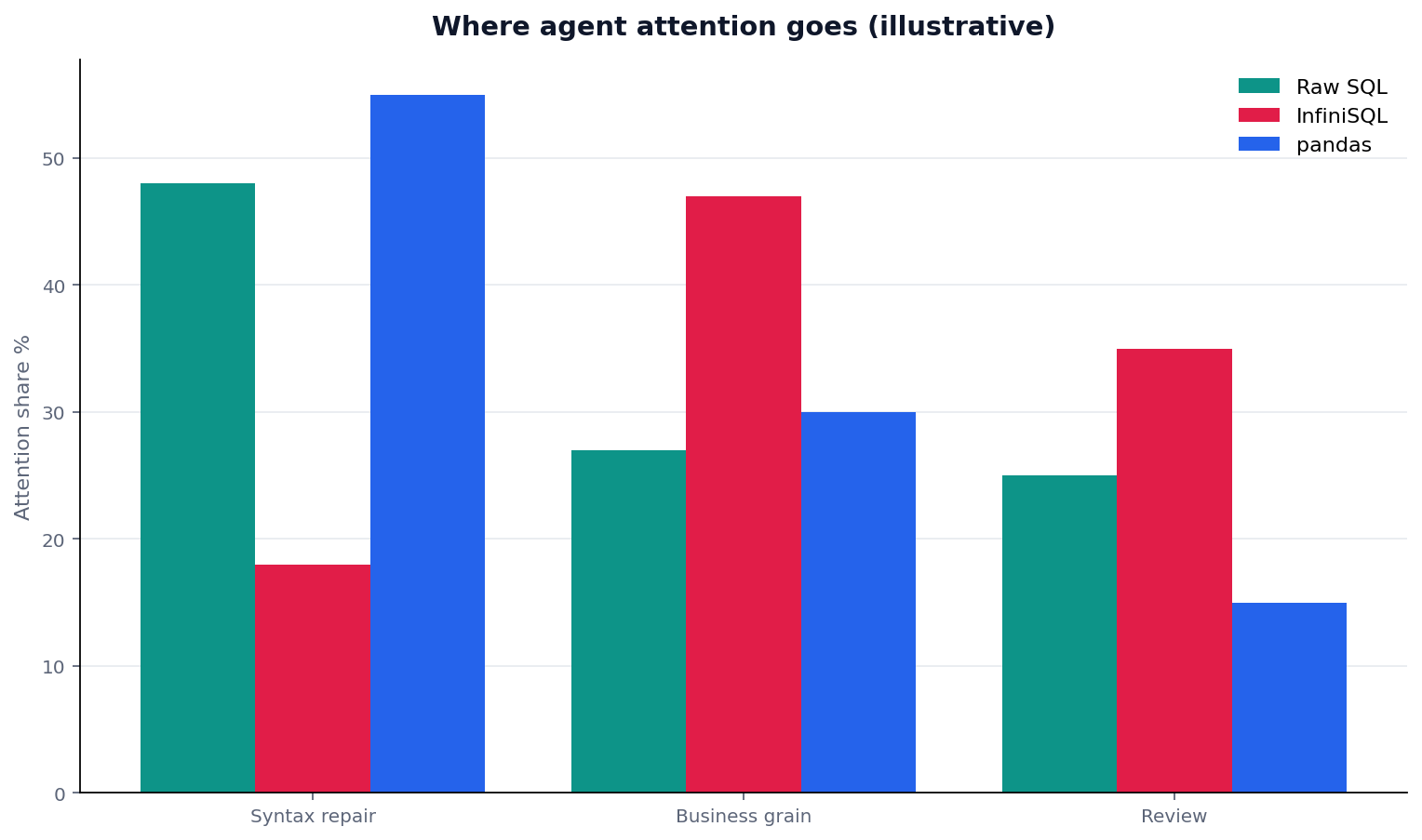
Figure. Teaching schematic of where syntax, business names, and review sit. Not a measured attention study. Source: the first-party protocol table above.
The drill is simple. Take the names and sort them into syntax words versus business words. InfiniSQL is working when the names sound like the question. If the 88 edges only connect tmp aliases, the language was not used. The 8 raw tables still have to load first; a pretty name on a missing load is still a story. Quote the protocol table if you cite this page. Do not quote the bars as a study.
Scorecard: language versus translator
Run this scorecard before you call the last demo a named-view language.
| Test | Pass | Fail | What to do |
|---|---|---|---|
| Load is a table | Named | Frame-only | Reload |
| Each step is named | Pointable | One blob | Split |
/tasks reopens the view | Tomorrow works | Chat-only | Keep the task |
| Attention words are business | Grain in the name | Syntax tourism | Rename |
| Not sold as NL2SQL | Boundary said | Translator demo | Use the other page |
| No production write | Workspace only | Write-back pitch | Out of scope |
InfiniSQL is present when the first four rows pass. A fluent translator with a “No” on names is a different product. InfiniSQL is the named-view language on this desk, not a dialect SKU.
Use the scorecard in a standing review, not only after a demo. Ask for the load name, the first view name, and the step a colleague would reject. If those three answers are sentences instead of objects, the pack is still a transcript. Write the three objects on a card and keep the card next to /tasks. The card is cheap. Rebuilding a trail after a committee meeting is not. Keep the card with the source name and the read-only role so the next reviewer does not have to ask which catalog you used.
Failure modes
Dialect tourism
The session becomes a tour of vendor functions. InfiniSQL is not a course. If the agent is teaching syntax, stop and return to the grain.
One-shot pride
The model is proud of a single statement. The language has already left the room. Name the steps or admit you used a translator.
Write-back demos
A slide offers to land the view in production. That is not this language on this site. Read-only named results are the honest end.
Open an InfiniSQL task and name the first view
Connect a read-only source, ask a business question, and read the first named view in /tasks. This check uses only sources you authorize.
Commercial association: You do not need the workspace to complete the educational diagnosis on this page.
Open InfiniSynapseHow this page is sourced. William Zhu is cofounder of InfiniSynapse, public as GitHub @allwefantasy. Company self-description, not independent authority. No third-party prize or media award is claimed. No personal LinkedIn is published. Evaluation basis: We evaluate (hands-on) by replaying an InfiniSQL trail: load, name, compute, name again, and asking whether step four still opens. First-party protocol dated 2026-09-02, replayed 2026-09-03. Reviewed internally by analytics engineering · data platform · LLM security · editor. Editorial standards · corrections · publishing principles · About · Privacy · Terms. Contact zhuhl@infinisynapse.com. COI: InfiniSynapse sells an AI-native Data Agent; the banner is a commercial association. Fact-check: Microsoft Azure data guide, Snowflake Cortex Analyst, PostgreSQL, Wikipedia SQL, NIST CSF, and NIST CSRC as compared in the body. No external organization audited this page.
Frequently Asked Questions
Is this a new SQL dialect?
Bottom line: No. InfiniSQL is an analysis language habit: load as tables and name each view. It is not a dialect tutorial and not a vendor grammar course.
Is this the same as text-to-SQL?
Bottom line: No. Text-to-SQL translates one ask. InfiniSQL keeps a trail of named steps a reviewer can point at.
Does this write to my production database?
Bottom line: No. InfiniSQL as described here is read-only. The artifact is a named view in the workspace.
Do I need Spark or dbt to use this language?
Bottom line: No. InfiniSQL starts on one authorized source. Spark and dbt are platform programs. This page is not a buying guide for either.
What on this page is citable?
Bottom line: Cite the InfiniSQL protocol table, the five-object boundary, and the six-source comparison. Do not cite the chart bars or 8 / 42 / 88 as measured results.
Conclusion
InfiniSQL is a short contract: load the table, name the view, point at the step. You do not need a dialect course to start. You do need a trail a reviewer will sign. Open a read-only source in the workspace only with authorized, sanitized data, and read the first named view before you keep the number.