SQL Scripting: Name Three Views, Then Fail (2026)
By William Zhu & the InfiniSynapse Data Team · Published: 2026-09-02 · Last updated: 2026-09-03 · Last verified: 2026-09-03 · Next review: 2026-12-02 · Editorial standards · Corrections
Author credentials: William Zhu, Cofounder of InfiniSynapse. Public identity: GitHub @allwefantasy. Profile and review roles: editorial standards. This page is signed by a named person, not an anonymous editorial org. No personal LinkedIn is published. No third-party prize, certificate, or media award is claimed.
Table of Contents
- TL;DR
- What SQL scripting means for an agent
- A chain-of-views framework
- Methods: dump versus named scripting
- Tool landscape for multi-step scripts
- How to script three named views
- Desk sample: first-party chain protocol
- Scorecard: script quality
- Failure modes
- Frequently Asked Questions
- Conclusion
TL;DR
Direct answer: SQL scripting for agents is a chain of named views, not a 200-line stored-procedure dump. Script load, filter, and join as three names. Fail one step on purpose and point at the broken view. If you cannot point, you do not have a script. You have a file.
What you'll learn:
- What SQL scripting is when the script is a list of names
- A frame: step order, dependency, replay, hand-off
- When a procedure dump is allowed and when it is a failure
- How to script three views and break one
- A first-party chain protocol you can cite, plus a labeled complexity sketch
- Failure modes: hidden order, undeclared edges, and “run all” pride
This multi-step cluster sits under SQL AI. The hub is the language. SQL scripting is how that language becomes a named chain.
What SQL scripting means for an agent
Key Definition: SQL scripting for an agent is a sequence of named views (
select … as) that can be replayed one step at a time. It is not a stored-procedure dump, not a dialect course, and not an orchestrator replacement. A reviewer must be able to fail one name without rereading the file.
Independent published context (retrieved 2026-09-02; separate from this page’s protocol): compare each source to the chain rule, then stop. Google’s explainer on artificial intelligence is a public definition surface, not a review method. The European Commission’s approach to AI is independent policy context for human oversight. The NIST Privacy Framework belongs whenever a script touches personal fields. Those sources did not run this desk and are not a certificate or a media review.
| Cited source | What it actually owns | What SQL scripting still has to do |
|---|---|---|
| Google AI explainer | Public definition of AI | Name each view; fail one on purpose |
| EU approach to AI | Human-oversight policy | A reviewer must be able to point |
| NIST Privacy Framework | Privacy when fields are personal | Keep personal fields out of a dump |
| Python docs | The language the model reaches for | Dependencies are table names, not variables |
| Google architecture framework | Reliability map | Each edge in the chain is a name |
| Snowflake docs | Engine manual | Run on the authorized source, not a platform buy |
A chain, not a procedure dump
SQL scripting fails when the agent pastes a procedure. Procedures can be correct and still be unpointable. The method on this page is smaller: name raw_orders, name orders_q2, name paid_by_region. Each name is a script line. A colleague deletes the last name and the earlier lines still exist.
The builder habit that writes each line is the SQL statement builder. SQL scripting is the chain those lines form. If load is still missing, open SQL tools first. Do not script a join on a file that was never a table.
When the fight is reading the trail after it exists, continue in the explainable AI data analysis guide. When a large chain still has to push down, keep analyze large datasets with AI next to the script. If an IDE needs a tool interface, MCP for data analysis is the protocol page. SQL scripting stays on the named chain.
A chain-of-views framework
Score SQL scripting with four columns. Empty cells are folklore.
| Line | Name | Depends on | Replay signal | Stop if |
|---|---|---|---|---|
| 1 | raw_orders | Authorized source | Columns match | Schema guessed |
| 2 | orders_q2 | Line 1 | Row count moves | Period unexplained |
| 3 | orders_q2_paid | Line 2 | Definition in the name | Two grains |
| 4 | paid_by_region | Line 3 + region table | Key said out loud | Key implied |
| 5 | Memo table | Line 4 | Colleague can point | Chat-only |
Order is a control
SQL scripting that “runs all” hides order. Order is how you fail one step. Write the order in /tasks. If line 3 is wrong, do not run line 4. That sentence is the whole method.
Dependencies must be names
Python docs (table above) are the independent language manual the model will reach for when it is tired of SQL scripting. Cite them as a reminder: Python can script too, and that is the failure-mode sibling. Dependencies in this method are table names, not variables.
Google’s architecture framework (table above) is an independent reliability map. Applied here: a script is reliable when each edge is a name. Snowflake docs (table above) are an engine manual you may already use; this page is not a Snowflake buying guide. SQL scripting should run on the source you authorized, including a warehouse, without becoming a platform program.
Methods: dump versus named scripting
Two methods are sold as SQL scripting. Only one can fail a step.
| Method | Artifact | Choose it if | Reject it if |
|---|---|---|---|
| Procedure dump | One file, one run | A person owns the file and will never share it | An agent must leave names |
| Notebook cells | Order in a kernel | The session is disposable | Tomorrow must replay |
| Named SQL scripting | A chain of views | Someone will break one step | You wanted a demo dump |
Choose named SQL scripting if a reviewer will fail a step on purpose. Choose a dump if a person wrote it and will keep it. Choose a notebook if you will throw the session away.
Choose named scripting when the chain will be audited
Audits point. SQL scripting that cannot accept a finger on line 3 will force a reread of 200 lines. That is how reviews become arguments.
Choose a dump only when a person is the author
A human-owned procedure can be a source. Do not let an agent emit one as the only artifact. SQL scripting for agents is the named chain, not the dump.
Tool landscape for multi-step scripts
Schedulers, notebooks, warehouses, and agent tasks all claim SQL scripting.
A scheduler runs jobs. It is not a review surface for one analysis. A notebook orders cells. It dies with the kernel. A warehouse stores procedures. Those are useful and still unpointable if the agent dumped them. Agent SQL scripting should live as named views in /tasks.
InfiniSQL implements SQL scripting as ordinary named selects in order. It will not replace Airflow. It will not write production MySQL. It will not teach a dialect.
What you should refuse in SQL scripting: “run all” with no names, a script that mutates in place, and a script that wants write access. What you can accept on day one: three names and a reviewer who will break the middle one.
What the landscape is not
SQL scripting on this page is not an orchestrator aisle and not a Spark buying page. The object is one analysis chain a person can walk.
How to script three named views
Keep the first script short enough to break.
- Load and name the raw table. If this line fails, SQL scripting has not started.
- Script a filter as a second name. Replay it. Write the period in the name.
- Script a join or aggregate as a third name. Keep line 2 in the FROM.
- Fail line 2 on purpose. Change the period. Confirm line 3 does not silently succeed on the old grain. If it does, the chain is a dump.
- Restore line 2 and hand off the last name. The memo uses the view, not the chat.
Acceptance signal: you can point at the broken name after a deliberate fail. If you can only say “the script failed,” SQL scripting is not in place.
Desk sample: first-party chain protocol
Cite this SQL scripting protocol. Do not cite a customer percentage, a production SLA, or the chart line as a study.
First-party method log (replayable):
| Field | Record |
|---|---|
| Operator | InfiniSynapse Data Team; William Zhu, public as GitHub @allwefantasy |
| First run | 2026-09-02 |
| Replay / last verified | 2026-09-03 |
| Input | One authorized, sanitized source; no secrets |
| Views named | 3 (load, filter, join) |
| Framework lines scored | 5 |
| Scorecard rows | 6 |
| Acceptance | Fail the middle name; resume from that name |
| Fail | A 200-line procedure dump with no resume handle |
We scripted the three named views, failed the middle join on purpose, and resumed from that name. The replay on 2026-09-03 used the same three names and the same fail case. The protocol records the operator, the two run dates, and the fail object so a later reader can replay the same three names. The citable result of this SQL scripting run is the protocol: three names, six checks, one finger on the break. Independent readers can inspect GitHub @allwefantasy; that is a public artifact, not a prize or a media report. No external organization audited the pack. Independent review is invited through editorial standards.
A teaching sketch used 8 raw tables, 42 intermediate views, and 88 dependencies only to show complexity. Those three counts are not a benchmark. The line in the figure is a teaching split of reviewable share, not a lab clock or a customer result.
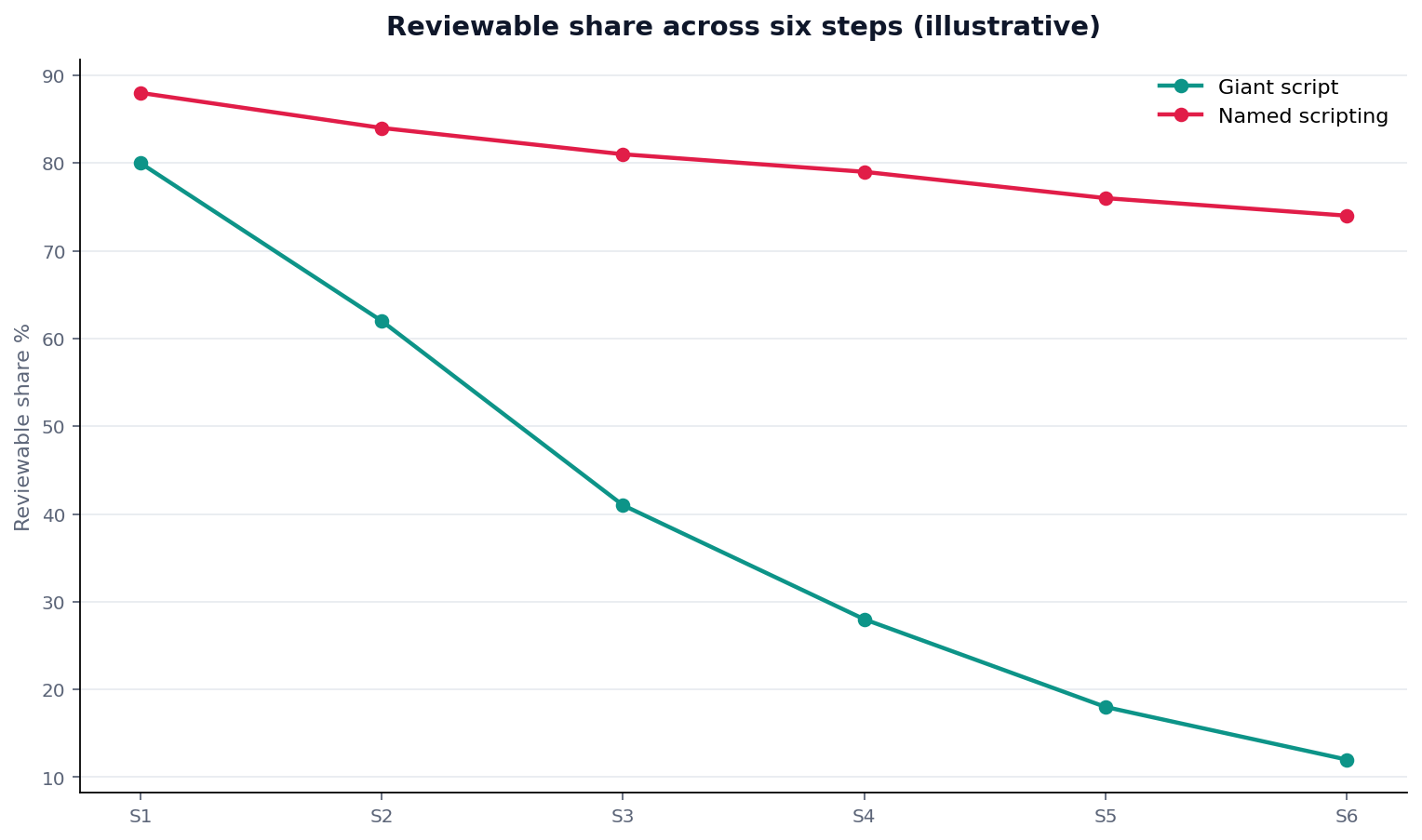
Figure. Teaching schematic of where a dump loses the resume handle. Not a measured quality study. Source: the first-party protocol table above.
The drill is simple. Walk the names in order. At each name, ask whether SQL scripting would let you stop. If the answer is “we have to rerun the file,” the 88 edges are a dump. The 8 raw tables are line 1; skipping them is how the chain starts on a lie. Quote the protocol table if you cite this page. Do not quote the line as a study.
Scorecard: script quality
Run this SQL scripting scorecard on the last agent script you accepted.
| Test | Pass | Fail | What to do |
|---|---|---|---|
| Each line is a named view | Pointable | One dump | Split |
| Order is visible | Stoppable | “Run all” | Write order |
| A deliberate fail hits one name | Local | Whole file | Rebuild |
| Earlier names survive | Deletable last step | Mutating in place | Rebuild |
/tasks reopens the chain | Tomorrow works | Chat-only | Keep the task |
| No production write | Workspace only | Procedure write-back | Out of scope |
SQL scripting is ready when the first four rows pass. A fluent dump with a “No” on names is still a file.
A useful rehearsal is to print the chain as a list of names and hide the SQL. Hand the list to someone who was not in the room. If they can say what each line did, the chain is a script. If they can only say the final number, the chain is a dump with prettier labels. Do this before a committee pack, not after. The rehearsal also catches undeclared edges: a name that depends on a table that is not on the list. Write that table onto the list or delete the dependency. Either choice is honest. Leaving it implicit is how a six-step chain becomes an 88-edge rumor.
A second rehearsal is to delete the last name and confirm the earlier names still replay. If they do not, the chain was mutating in place. Restore the earlier names from /tasks and write the last compute as a new object. Keep the list of names in the memo so the next period starts from objects, not from a chat export. Put the period and the grain sentence next to the list. That pair is enough to reopen the chain after a week away.
Failure modes
Hidden order
The agent reorders joins because it “looks faster.” SQL scripting treats order as a control. Write it. If order changes, the name changes.
Undeclared edges
Line 4 reads a table that is not in the chain. The 88-dependency sketch becomes real and invisible. SQL scripting must list every FROM name.
Run-all pride
The model is proud that the file executes. SQL scripting is proud that line 3 can fail alone. Execution without pointing is a demo.
Script three named views, then open the trail
Ask a question that needs load, filter, and join. Open the script as named views in /tasks. This check uses only sources you authorize.
Commercial association: You do not need the workspace to complete the educational diagnosis on this page.
Open InfiniSynapseHow this page is sourced. William Zhu is cofounder of InfiniSynapse, public as GitHub @allwefantasy. Company self-description, not independent authority. No third-party prize, certificate, or media award is claimed. No personal LinkedIn is published. Evaluation basis: We evaluate (hands-on) by scripting three named views, killing step two, and checking whether the chain resumes from that name. First-party protocol dated 2026-09-02, replayed 2026-09-03. Reviewed internally by analytics engineering · data platform · LLM security · editor. Editorial standards · corrections · publishing principles · About · Privacy · Terms. Contact zhuhl@infinisynapse.com. COI: InfiniSynapse sells an AI-native Data Agent; the banner is a commercial association. Fact-check: Google AI explainer, European Commission AI policy, NIST Privacy Framework, Python docs, Google architecture framework, and Snowflake docs as compared in the body. No external organization audited this page.
Frequently Asked Questions
Is SQL scripting just a stored procedure?
Bottom line: No. SQL scripting for agents is a chain of named views you can fail one at a time. A procedure dump is a different artifact.
Should I let the agent emit the whole script at once?
Bottom line: Not as the only artifact. SQL scripting should still leave names you can point at. A 200-line dump is the failure this page exists to prevent.
Does this write to production?
Bottom line: No. SQL scripting as described here is read-only. The last named view stays in the workspace.
How do I know the chain is reviewable?
Bottom line: Fail the middle name on purpose. If you can point at it, SQL scripting is working. If the whole file dies as one object, it is a dump.
What on this page is citable?
Bottom line: Cite the SQL scripting protocol table, the five-line chain, and the six-source comparison. Do not cite the chart line or 8 / 42 / 88 as measured results.
Conclusion
SQL scripting is a chain habit: name the line, keep the order, fail one step. You do not need a procedure platform to start. You do need a name a colleague can break. Open a three-step question in the workspace only with authorized, sanitized data, and inspect the named views before you keep the number.