Define Metrics: Bind, Then Compute (2026)
By William Zhu & the InfiniSynapse Data Team · Published: 2026-09-02 · Last updated: 2026-09-03 · Last verified: 2026-09-03 · Next review: 2026-12-02 · Editorial standards · Corrections
Author credentials: William Zhu, Cofounder of InfiniSynapse. Public identity: GitHub @allwefantasy. Profile and review roles: editorial standards. This page is signed by a named person, not an anonymous editorial org. No personal LinkedIn is published. No third-party prize, media review, or independent endorsement is claimed.
Table of Contents
- TL;DR
- What it means to define metrics on a desk
- A write-bind-compute framework
- Define-first versus compute-first
- Tool landscape for the bind step
- How to define metrics in one sitting
- Desk sample: first-party write-bind protocol
- Scorecard: defined sentence or improvised digit
- Failure modes
- Frequently Asked Questions
- Conclusion
TL;DR
Direct answer: Define metrics before the agent runs SQL. Write grain, filter, and window in one bound sentence, then bind that sentence in the outline. Teams that define metrics after the first digit invent a second truth to match the slide. Do not average later. Write the sentence first. Then locate, filter, join, calculate, and check.
What you'll learn:
- How to define metrics as a write-then-bind method, not a nickname
- Which fields must be present before you allow compute
- When to choose define-first and when a discovery note is still not a definition
- How to run the bind ritual in one sitting
- A write-bind desk you can replay, not a customer case
- Why a rushed pack cannot finish the method in an appendix after the number ships
The parent order lives on metric definition: direction, then steps, then the sentence, then the number. This page is the method: define metrics, bind them, then ask. If you skip the method, every later join is improvisation.
What it means to define metrics on a desk
Key Definition: To define metrics is to write one inspectable sentence per claim that names grain, filter, and window, then bind that sentence in the outline before any calculation. You do not define metrics by renaming a column, pasting a tile title, or accepting the first SQL the model emits. The method is write, bind, continue.
Independent published context (retrieved 2026-09-02). ClickHouse introductory documentation, Snowflake query guides, and Elasticsearch reference did not run this fixture.
| Cited source | What it owns | What tonight still needs |
|---|---|---|
| ClickHouse intro | Fast compute | Speed is not a bind |
| Snowflake query guides | How statements run | A job is not a definition |
| Elasticsearch reference | Query execution | Hits are not a metric |
| WCAG 2.2 | Perceivable text | A hidden sentence is not bound |
| W3C WAI | Accessibility home | Put the line where ops can read it |
| OECD.AI policy work | AI measurement notes | Write the sentence, not only a trace |
The object test—sentence versus column—lives on what is a metric. The column-and-sentence pair is measure vs metric. This page assumes you already know the object. The work here is to define metrics in time, on this run, with a human continue-signal.
This method is not a certified semantic layer purchase. A catalog can compile a stable contract later. You still write the sentence in the outline for today’s pack. Compile is not a substitute for the bind step.
If last quarter already bound the same claim, reuse the sentence from the lock page on definition of metrics. Rewriting grain in a new chat is how two truths start.
After compute, open the trail as explainable AI data analysis describes. That review cannot invent a sentence that was never written.
A write-bind-compute framework
Use five rows when you run the method. If write or bind is empty, stop.
| Step | Question the step answers | Pass signal | Fail signal |
|---|---|---|---|
| Write | Can a colleague repeat the sentence? | Grain, filter, window in one line | A paragraph or a nickname |
| Bind | Is the sentence an outline object? | Editable before SQL | Hidden in chat only |
| Source | Why this table? | Reason spoken | “The model found it” |
| Compute | May we run locate and calculate? | Human continue-signal | Auto-run after the ask |
| Check | Does the digit still match the sentence? | Trail reopenable | Digit quoted, sentence lost |
You define metrics in the first two rows. Source, compute, and check keep the method honest. Elasticsearch reference (above) maps query execution. Hits do not define metrics. They are documents.
A finance partner must be able to edit the sentence without opening a notebook. If only an engineer can change the claim, you documented a query.
State source, why this table, filters, sort, and juxtaposition before you calculate. Those five facts turn the line into an instruction, not poetry.
Unit claims need the same method. Unit economics analytics still fails if the contribution digit lands on the slide before the sentence exists.
Define-first versus compute-first
Choose define-first if
Two teams share a KPI name and a decision date. Define metrics once. Bind the sentence. Compute once. That is the only way a digit can enter a memo.
Choose a discovery note if
You are still finding the store. Write “candidate column, sentence not bound.” Do not define metrics in that note. A discovery note that pretends the work is done will be quoted as if it were bound.
Choose two labeled definitions if
The teams truly measure different claims. Then you do not have a conflict. You have two metrics. Define metrics under two names. Do not split the difference.
Finance wants paid invoices in 90 days. Product wants seat logins in 30 days. Both use “active subscription.” If you let the agent compute first, you will spend the meeting on which digit is “closer.” Define metrics first. Pick one sentence or label two. Then compute.
A define-first pack spends time on write and bind. A compute-first pack spends time on reconciliation. The second pack feels faster until the slide has two truths.
Tool landscape for the bind step
Chat returns a confident digit. A spreadsheet comment holds a partial sentence that nobody reads. A BI tile hides the definition inside a certified model the asker never opens. A harness outline that refuses SQL until you define metrics as a bound sentence is the control.
InfiniSynapse’s published pattern matches that control: ask, stop at the outline, write grain and filter and window, then continue. It does not ship a preset warehouse of every KPI. It does not write the sentence into a production ledger.
What the bind must show
The three fields. The source. Why this table. The sort. The juxtaposition rule. A continue-signal from a human. If the line lives only inside the model’s hidden chain of thought, you did not bind it. You hoped.
What the bind must refuse
A nickname presented as if the work were already done. Person-level grain for an operations segment pack. Write-access to the system of record. A vendor claim about beating another model. This page does not score models. You still define metrics as a sentence, not a nickname.
WCAG 2.2 (table above) is an independent reminder that text must be perceivable. A sentence you cannot find is not a definition. W3C WAI (table above) is the broader accessibility home. Put the sentence where operations can read it without a special client.
How to define metrics in one sitting
Draft the three fields
Input: the decision and the candidate entity. Acceptance: grain, filter, and window fit in one sentence. If you need a paragraph, you have an essay, not a definition. Cut until a colleague can repeat the line.
Bind the sentence in the outline
Input: the sentence plus source, table reason, filters, sort, juxtaposition. Acceptance: a reviewer can edit the line without rerunning a mystery query. The claim is now an object, not a vibe.
Resolve a second sentence before compute
Input: another team’s line. Acceptance: one bound sentence, or two labeled metrics. If you “split the difference,” you created a third unofficial claim. Stop.
Numbered work:
- Name the decision.
- Pick the entity (account, invoice, ticket, day).
- Write inclusion and exclusion.
- Write window, timezone, and cutoff.
- Define metrics by binding that sentence in the outline.
- Require a human continue-signal.
- After that, locate, filter, join, calculate, and check.
- Re-open the sentence beside the digit.
A pack that skips step 5 cannot finish the method at step 8. The appendix will invent a sentence that fits the number.
Desk sample: first-party write-bind protocol
Cite this protocol. Do not cite a customer percentage, an 8,400 / 6,100 / 7,250 figure, or the chart bars as a time study. After they define metrics, the queue used the finance sentence.
First-party method log (replayable):
| Field | Record |
|---|---|
| Operator | InfiniSynapse Data Team; William Zhu, GitHub @allwefantasy |
| First run | 2026-09-02 |
| Replay | 2026-09-03 |
| Input | Authorized, sanitized support-ops pack; no people |
| Paths | Compute-first average vs write-bind then compute |
| Steps | 5 (write, bind, source, compute, check) |
| Acceptance | Two labeled names; no average; account grain for the queue |
| Fail | Midpoint 7,250; appendix definition; skipped continue-signal |
Path A was rushed; path B define-first. Replay 2026-09-03. Review: editorial standards.
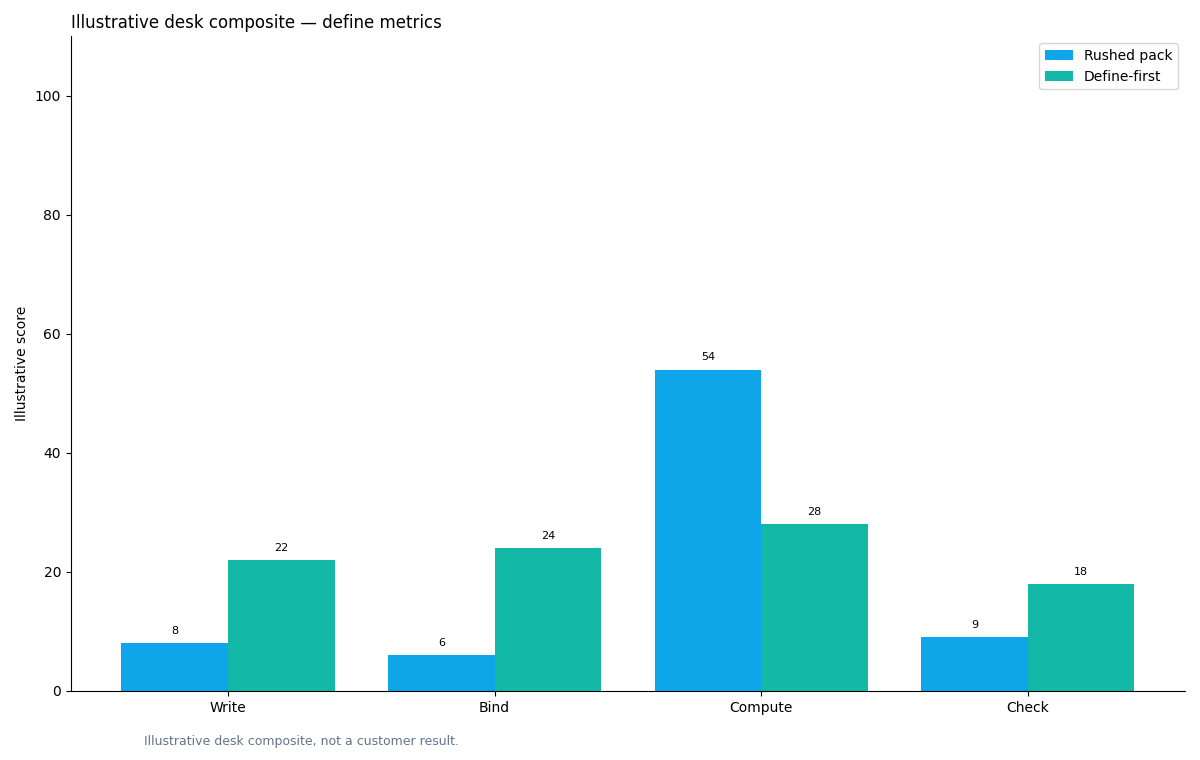
Figure. Teaching schematic. Not a measured study. Source: the protocol table above.
8 / 42 / 88 and 8,400 / 6,100 / 7,250 are a teaching sketch. Quote the protocol, not the bars.
OECD.AI policy work (table above) did not run this fixture. Write the sentence, not only a model trace.
Scorecard: defined sentence or improvised digit
| Signal | Define-first | Compute-first |
|---|---|---|
| Grain | Named before SQL | Inferred after the digit |
| Filter | In and out spoken | Hidden in a WHERE |
| Window | Timezone and cutoff | “This period” |
| define metrics | Outline object | Appendix after the slide |
| Conflict | Resolved or dual-labeled | Averaged |
| Path | Readable by operations | Hidden in SQL only |
If the define metrics row is an appendix, the pack is a draft.
Write inclusion and exclusion as separate clauses. “Paying tenants” is not enough if partner sandboxes share the same billing flag. Name the sandbox rule, the trial rule, and the internal-tenant rule. Those exclusions stop a hallway filter after compute.
Sort is part of the instruction. If you will show a top-ten, say whether the sort is rate or volume. Enterprise beside mid-market is valid only when both sides were written in the bind step. If mid-market silently uses a login window, you are decorating.
A later compile into a semantic catalog does not retire the method. The catalog is how a stable sentence travels. The method is how this week’s run stays honest when the catalog is missing or stale. You still define metrics in the outline.
Failure modes
The appendix definition
A pack that ships the digit, then tries to define metrics in a footnote, will fit the sentence to the number. That is reverse documentation. Bind first or do not quote the digit.
The hallway edit
Two reviewers rewrite the claim in Slack after the query ran. Each thinks the other accepted the same line. They accepted the same nickname. They did not define metrics together. Write the sentence in the outline where both can see the edit.
The skipped continue-signal
The agent defines nothing and computes because the ask sounded complete. Completeness of the question is not a bind. If no human continue-signal exists, you did not define metrics. You hoped.
A missing bind is an order failure, not a model failure. Do not buy a larger model to finish a sentence you refused to write.
Define the metric, then run the query
Bind the sentence on an authorized source, then ask. Open the outline before you accept the figure. This check uses only sources you authorize.
Commercial association: You do not need the workspace to complete the educational diagnosis on this page.
Open InfiniSynapseHow this page is sourced. William Zhu is cofounder of InfiniSynapse, public as GitHub @allwefantasy. Company self-description, not independent authority. No third-party prize is claimed. No personal LinkedIn is published. Evaluation basis: We evaluate (hands-on) by defining the metric on an authorized source, then asking the number—not the reverse. Protocol 2026-09-02, replayed 2026-09-03. Reviewed internally by analytics engineering · data platform · LLM security · editor. Editorial standards · corrections · publishing principles · About · Privacy · Terms. Contact zhuhl@infinisynapse.com. COI: InfiniSynapse sells an AI-native Data Agent; the banner is a commercial association. The educational diagnosis does not require it. Fact-check: ClickHouse intro, Snowflake query guides, Elasticsearch reference, WCAG 2.2, W3C WAI, OECD.AI. 8 / 42 / 88 is a teaching sketch. No external organization audited this page.
Frequently Asked Questions
When should I bind the sentence in the outline?
Bottom line: Before locate and calculate. If you define metrics after the digit exists, you will fit the sentence to the number.
Can a discovery note finish the method?
Bottom line: No. A discovery note names a candidate store. You define metrics only when grain, filter, and window are bound and editable.
Is a semantic catalog enough to skip the method?
Bottom line: A catalog compiles a stable contract. You still define metrics for this run so a reviewer can see the sentence before the digit.
Should I average two digits and write the sentence later?
Bottom line: No. Open both sentences. Define metrics as one bound claim or as two labeled claims. An average is a third unofficial sentence.
What on this page is citable?
Bottom line: Cite the protocol table, the write-bind frame, and the six-source comparison. Do not cite the chart bars or the 8,400 / 6,100 / 7,250 sketch as measured results.
Conclusion
Define metrics before analysis, then ask the number. Write grain, filter, and window. Bind the sentence. Two teams who define metrics after the first digit will invent two truths. Bind one, or label two. If you later use the workspace, open InfiniSynapse only with authorized, sanitized inputs.