Analysis Workflow: Pause, Then Number (2026)
By William Zhu & the InfiniSynapse Data Team · Published: 2026-09-02 · Last updated: 2026-09-03 · Last verified: 2026-09-03 · Next review: 2026-12-02 · Editorial standards · Corrections
Author credentials: William Zhu, Cofounder of InfiniSynapse. Public identity: GitHub @allwefantasy. Profile and review roles: editorial standards. This page is signed by a named person, not an anonymous editorial org. No personal LinkedIn is published. No third-party prize, media review, or independent endorsement is claimed.
Table of Contents
- TL;DR
- What an analysis workflow keeps in layers
- A four-layer audit framework
- Layered versus flat chat
- Tool landscape for visible layers
- How to walk the four layers
- Desk sample: first-party four-layer protocol
- Scorecard: layered workflow or flat digit
- Failure modes
- Frequently Asked Questions
- Conclusion
TL;DR
Direct answer: An analysis workflow has four audit layers: direction, steps, metric sentence, and number. Collapse them and reviewers only see a digit. Keep each layer visible, editable, and reusable. Bind grain, filter, and window before the fourth layer runs. The model can think. The harness decides whether the analysis workflow stays open.
What you'll learn:
- What an analysis workflow must keep as four separate layers
- How collapsing layers hides the only object a reviewer can edit
- How the analysis workflow differs from the mechanical analyst moves
- How to stop after each layer until a reviewer says continue
- A four-layer desk you can replay, not a customer case
- When a flat chat is not an analysis workflow
The hub order lives on metric definition. The mechanical moves live on data analysis workflow. The temperament object is the data agent harness. This page is the structure: an analysis workflow in layers a reviewer can audit.
What an analysis workflow keeps in layers
Key Definition: An analysis workflow is a four-layer working paper: direction (the decision), steps (locate / filter / join / calculate / check), metric (grain, filter, window), and number (the computed value plus trail). Each layer is inspectable, editable, and reusable. A collapsed bubble is not an analysis workflow.
Independent published context. The OWASP Top 10 for LLM Applications, the AWS Well-Architected Machine Learning Lens, and PostgreSQL documentation did not run this fixture.
| Cited source | What it owns | What tonight still needs |
|---|---|---|
| OWASP Top 10 for LLM | Hidden prompt and tools | Layer 2 visible |
| AWS ML Lens | Human-visible measurement | Continue before layer 4 |
| PostgreSQL docs | How layer 2 is encoded | Encoding is not the paper |
| Apache Airflow documentation | Scheduled graphs | A DAG is not four layers |
| OpenTelemetry | Traces a reviewer can open | An id per layer |
| UK NCSC zero-trust architecture | Access is explicit | Source in layer 1 |
An analysis workflow that cannot show layer 2 independently cannot be edited. A pack that cannot show layer 3 independently cannot be signed. A session that starts at layer 4 is a digit with folklore attached. Visibility is the first test. Editability is the second. Reuse is the third. Fail any of the three and the layers are decoration.
PostgreSQL documentation (above) will often encode layer 2. Encoding is not the analysis workflow. The requirement is that layer 2 stays named so a colleague can reopen one join without rereading a paragraph.
Apache Airflow documentation (table above) describes scheduled graphs. A graph is not an analysis workflow unless each layer remains a human object. Do not confuse a DAG with a working paper. A scheduled blob that no one can pause is still a collapse.
OpenTelemetry (table above) keeps traces layered so a reviewer can open one span. A pack that flattens to a paragraph has no span to open. Give each layer an id a reviewer can cite in a comment.
UK NCSC zero-trust architecture (table above) is a reminder that access is explicit. Layer 1 of an analysis workflow must say which source and why this table before later layers read it. Implied access is not a direction.
After the run, open SQL with explainable AI data analysis. That is layer 4’s trail. A semantic layer may later compile layer 3. Exploratory data analysis may occupy layer 1 while you are still mapping. None of those pages replace a session that keeps all four layers visible.
A four-layer audit framework
| Layer | Object | Edit test | Collapse failure |
|---|---|---|---|
| 1 Direction | The decision sentence | A reviewer restates it | A dashboard nickname |
| 2 Steps | Named mechanical moves | A colleague reopens one step | One giant query |
| 3 Metric | Grain, filter, window | Operations edits the sentence | A KPI title |
| 4 Number | Figure plus trail | The figure matches layer 3 | A digit that ends the meeting |
| Cross-cut | Source, table reason, sort, juxtaposition | Stated before layer 4 | Implied after the digit |
An analysis workflow is the table plus the rule that you do not enter layer 4 until layers 1–3 pass. Three product habits sit beside the table: business-question mapping; locate / filter / join / calculate / check; inspectable / editable / reusable. The analysis workflow is how those habits stay visible instead of collapsing into chat.
Read each row as a gate. Direction without a restatable decision is a nickname. Steps without a named key are a blob. A metric title without grain is a brand. A number that arrives first is a meeting-ender. The cross-cut row is not optional: source, table reason, sort, and juxtaposition must be spoken before compute.
A Data Agent is closer to operations and compliance than a Code Agent. An analysis workflow that only an engineer can unroll will not be signed. Write layers in business language. Keep person-level grains out of layer 3 on a segment pack.
Layered versus flat chat
Choose a layered analysis workflow if
The number will be quoted and someone will ask “which layer failed.” Keep four objects. That is an analysis workflow a reviewer can walk. Pause after each object. Do not let the model skip ahead because the SQL “looks fine.”
Choose a flat look if
You are privately mapping and will not quote. Label it flat. The moment a digit is reused, you owe four visible layers. A private look that leaks into Slack is already a quote.
Choose a mechanical-move page if
The failure is “we did not locate on purpose.” Use the sibling working-method page. This page stays on audit layers, not on the five-move ritual. Do not retitle that sibling as a locate-filter-join checklist. The sibling owns the moves. This page owns the layers.
Flat chat is the collapse: all four layers arrive as one paragraph. No one can edit layer 3 without rerunning folklore. Folklore is expensive. Layers are cheap.
Tool landscape for visible layers
Chat collapses an analysis workflow into prose. BI collapses it into a tile. Notebooks collapse it into a scroll. Schedulers collapse it into a graph. A harness that can stop after each layer is the working surface.
What each layer must expose
Layer 1: the decision. Layer 2: named steps. Layer 3: the sentence. Layer 4: the figure and the trail. Across all: source, why this table, filters, sort, juxtaposition. If a product cannot pause, it cannot host an analysis workflow. A continue-signal is part of the surface, not a courtesy.
What the surface must refuse
Write-back as a layer. Person-level grains in a segment pack. Model-benchmark theater. A preset KPI warehouse sold as layers. An analysis workflow is a working paper, not a catalog. This pillar does not buy a semantic layer and does not rank models.
InfiniSynapse’s published pattern matches the pause: ask, stop, continue per layer inside /tasks. Schema recall feeds layer 2 candidates. The reviewer still accepts each layer. You do not need the workspace to write the four objects on paper. The educational diagnosis is the pause.
How to walk the four layers
Direction, then steps
Input: a KPI ask. Acceptance: layer 1 is a decision a reviewer can restate, and layer 2 lists locate / filter / join / calculate / check. An analysis workflow that lists SQL before the decision is already collapsed. If layer 1 is a dashboard name, rewrite it as a decision before you name tables.
Metric, then a continue
Input: grain, filter, window. Acceptance: layer 3 is editable by operations. Layer 4 is still forbidden. The analysis workflow is waiting on a human. If operations cannot edit the sentence without opening a notebook, layer 3 has failed the edit test.
Number last
Input: continue. Acceptance: the figure matches layer 3 and the trail opens. If the figure is pretty and layer 3 drifted, the pack failed even if SQL ran. Pretty is not a gate.
Numbered work:
- Write layer 1 as one decision sentence.
- Name layer 2 as reopenable moves, including the join key.
- State source, table reason, filters, sort, juxtaposition.
- Bind layer 3: grain, filter, window, timezone.
- Wait for continue from a named reviewer.
- Run layer 4 and open the trail.
- Keep all four layers in the pack so the next run can reuse 1–3.
A pack that deletes layers 1–3 after the digit is a flat chat with extra history. Reuse is the reason the layers exist. If next week’s ask shares the same decision and sentence, do not rebuild folklore.
Desk sample: first-party four-layer protocol
Cite this protocol, not a 42-versus-18 figure or the line chart. That collapse is not an analysis workflow.
First-party method log (replayable):
| Field | Record |
|---|---|
| Operator | InfiniSynapse Data Team; William Zhu, GitHub @allwefantasy |
| First run | 2026-09-02 |
| Replay | 2026-09-03 |
| Input | Authorized, sanitized ticket-load pack; no people |
| Paths | Collapsed bubble vs four visible layers |
| Layers | 4 (direction, steps, metric, number) |
| Acceptance | Pause after 1–3; layer 3 editable; account grain |
| Fail | First-bubble 42; no pause; person-adjacent grain |
We labeled path A as collapsed and path B as layered, then replayed the fail on 2026-09-03. That reuse is why an analysis workflow keeps layers. Review: editorial standards.
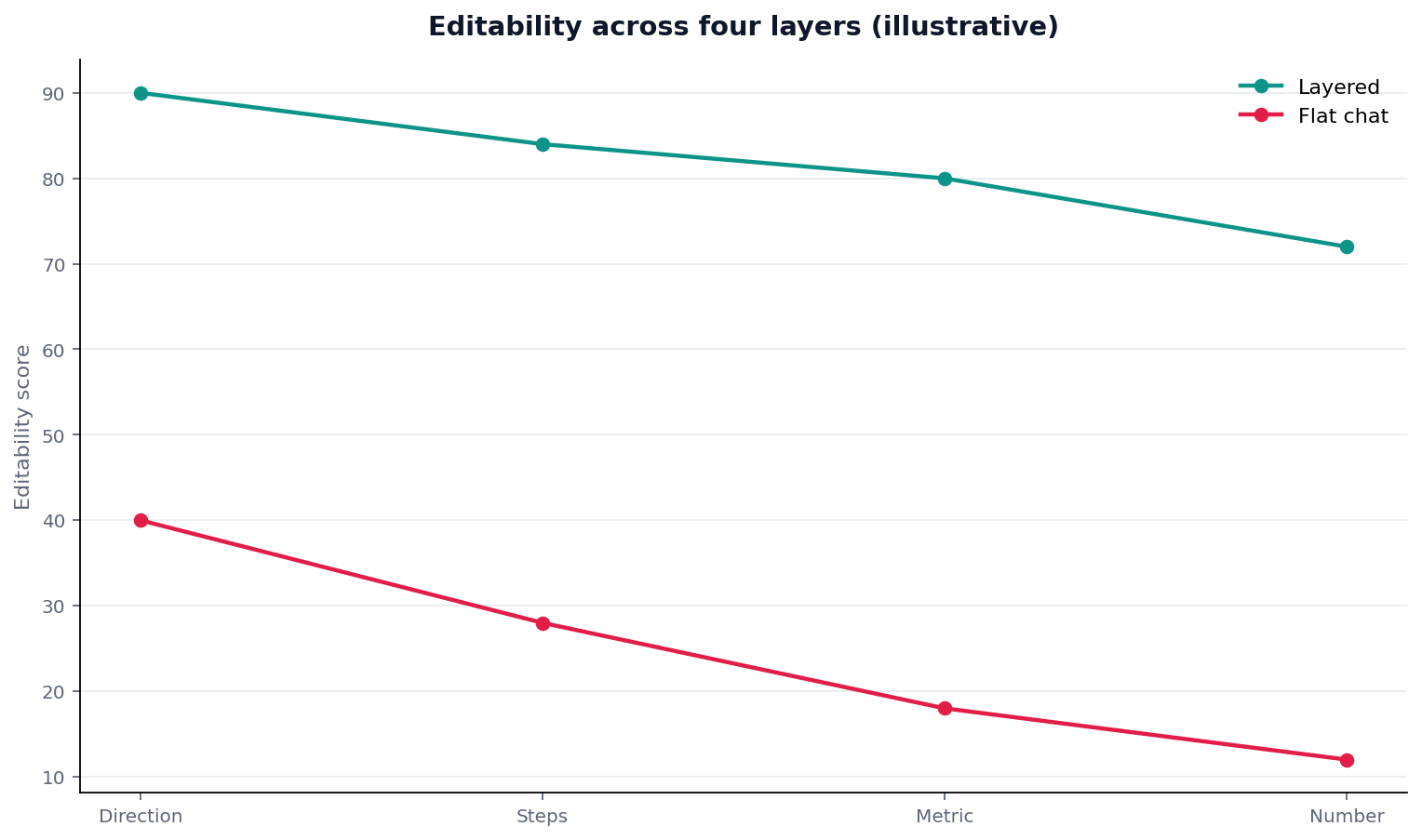
Figure. Teaching schematic. Not a measured study. Source: the protocol table above.
8 / 42 / 88 and 42 versus 18 are a teaching sketch. Quote the protocol. If you cannot edit layer 3, you do not have an analysis workflow.
Scorecard: layered workflow or flat digit
| Signal | Layered pack | Flat digit |
|---|---|---|
| Layer 1 visible | Yes | Buried in prose |
| Layer 2 named | Yes | One blob |
| Layer 3 editable | Yes | Implied |
| Layer 4 last | Yes | First |
| Pause | After each layer | None |
| Reuse | Layers 1–3 survive | Only the digit is copied |
If the analysis workflow column is flat, do not quote layer 4. Walk the four objects again. The scorecard is a refuse rule, not a style preference.
Failure modes
Collapse into a bubble
Four layers arrive as one paragraph. No one can edit the sentence. That is not an analysis workflow. Require a pause. If the product cannot pause, you are in a chat skin. Do not sign the digit.
Layer 2 without layer 3
Named SQL with no grain. Reviewers praise the structure and still sign the wrong entity. A pack that skips the metric layer is a pretty collapse. Force the sentence before continue.
Delete the working paper after the digit
Someone keeps the number and drops the layers. Next week the pack cannot be reused. Keep 1–3 with the file. A memo without layers is folklore with a date stamp.
Walk the four layers before you quote a KPI
Ask a KPI and stop after each layer until a reviewer says continue. This check uses only sources you authorize.
Commercial association: You do not need the workspace to complete the educational diagnosis on this page.
Open InfiniSynapseHow this page is sourced. William Zhu is cofounder of InfiniSynapse, public as GitHub @allwefantasy. Company self-description, not independent authority. No third-party prize is claimed. No personal LinkedIn is published. Evaluation basis: We evaluate (hands-on) by walking four layers (direction, steps, metric, number) and stopping until a reviewer continues. Protocol 2026-09-02, replayed 2026-09-03. Reviewed internally by analytics engineering · data platform · LLM security · editor. Editorial standards · corrections · publishing principles · About · Privacy · Terms. Contact zhuhl@infinisynapse.com. COI: InfiniSynapse sells an AI-native Data Agent; the banner is a commercial association. Fact-check: OWASP Top 10 for LLM, AWS ML Lens, PostgreSQL docs, Airflow docs, OpenTelemetry, UK NCSC zero-trust. No external organization audited this page.
Frequently Asked Questions
What four layers make the pack?
Bottom line: Direction, steps, metric, number. A pack that collapses those four into a paragraph cannot be edited or signed.
Is this the same as the analyst working method?
Bottom line: Related, not the same. The sibling page copies locate / filter / join / calculate / check. This page keeps those moves inside four audit layers.
Can I skip a layer if the model is confident?
Bottom line: No. Confidence is not a layer. A pack that skips layer 3 will ship the wrong grain with a clean trail.
Why pause after each layer?
Bottom line: A Data Agent is closer to operations than a Code Agent. An analysis workflow without pauses cannot be read or refused in time.
What on this page is citable?
Bottom line: Cite the protocol table, the four-layer frame, and the six-source comparison. Do not cite the line chart or the 42-versus-18 sketch.
Conclusion
An analysis workflow is four layers a reviewer can walk: direction, steps, metric, number. Leave every layer visible, editable, and reusable. Bind grain, filter, and window before the fourth layer. Collapse the layers and you only have a digit. The model can think. The harness decides whether the analysis workflow stays a working paper or becomes a bubble. State source, table reason, filters, sort, and juxtaposition before layer 4 so the analysis workflow remains a file operations can reopen next month.
InfiniSynapse describes itself on About. Privacy and Terms apply. If you later use the workspace, open InfiniSynapse only with authorized, sanitized inputs.