Data Analysis Workflow: Map, Then Check (2026)
By William Zhu & the InfiniSynapse Data Team · Published: 2026-09-02 · Last updated: 2026-09-03 · Last verified: 2026-09-03 · Next review: 2026-12-02 · Editorial standards · Corrections
Author credentials: William Zhu, Cofounder of InfiniSynapse. Public identity: GitHub @allwefantasy. Profile and review roles: editorial standards. This page is signed by a named person, not an anonymous editorial org. No personal LinkedIn is published. No third-party prize, media review, or independent endorsement is claimed.
Table of Contents
- TL;DR
- What a data analysis workflow copies from analysts
- A five-move working framework
- Analyst method versus chat-first skipping
- Tool landscape for a working method
- How to run the analyst sequence
- Desk sample: first-party five-move protocol
- Scorecard: working method or skipped job
- Failure modes
- Frequently Asked Questions
- Conclusion
TL;DR
Direct answer: A data analysis workflow for agents copies how analysts actually work: map the business question, locate tables, filter, join, calculate, and check. Bind the metric sentence before calculate. Skip the outline and you skip the job. The model can think. The harness decides whether the data analysis workflow looks like a careful person.
What you'll learn:
- What a data analysis workflow must copy from a human analyst
- The five mechanical moves: locate, filter, join, calculate, check
- Why chat-first skipping is not a data analysis workflow
- How to state source, table reason, filters, sort, and juxtaposition first
- A five-move desk you can replay, not a customer case
- When to refuse a number that arrived before the outline
The parent order lives on metric definition. The temperament object is the data agent harness. This page is the working method a data analysis workflow must imitate.
What a data analysis workflow copies from analysts
Key Definition: A data analysis workflow is the analyst working method an agent must copy: map the question, locate the right tables, filter, join, calculate, and check—with the metric sentence bound before calculate. Each move is inspectable, editable, and reusable. A first-bubble digit is not a data analysis workflow.
Independent published context (retrieved 2026-09-02). Microsoft Azure data architecture guidance, ISO/IEC 27001, and the Google SRE Book did not run this fixture.
| Cited source | What it owns | What tonight still needs |
|---|---|---|
| Azure data architecture | Layered data work | Map before locate |
| ISO/IEC 27001 | Control language operations already use | A path those teams can sign |
| Google SRE Book | Reviews and error budgets | A named check, not a vibe |
| BigQuery documentation | An engine a session might use | The engine is not the order |
| Apache Spark documentation | Another engine a session might use | Why this table, not a job |
| Google Cloud Architecture Framework | Later industrialization | Today’s outline on a read-only extract |
A human analyst does not open a warehouse and “find insights.” They write the question, pick a table on purpose, say who is in, join on a named key, compute, and check the result against a control. A data analysis workflow that skips any of those moves is cosplay.
ISO/IEC 27001 (above) is the control language many operations teams already use. A data analysis workflow that cannot be read by those teams will not be signed. A Data Agent is closer to operations and compliance than a Code Agent. The path must stay business-readable.
BigQuery documentation and Apache Spark documentation (table above) are engines a session might use. The engine is not the data analysis workflow. The workflow is the order of moves. Do not start a Spark program to avoid writing why this table.
The Google Cloud Architecture Framework (table above) can later industrialize the same moves. It is not a reason to skip today’s data analysis workflow on a read-only extract.
Exploratory data analysis is a sibling habit for looking. A data analysis workflow for a decision still binds the sentence before the look becomes a quote. After the run, open the trail with explainable AI data analysis. A data agent without this working method is a chat with SQL.
A five-move working framework
| Move | What the analyst does | Pass signal | Fail signal |
|---|---|---|---|
| Map | Restate the decision | A reviewer can repeat it | A dashboard name |
| Locate | Pick tables on purpose | Why this table is spoken | First table the model saw |
| Filter | Say who is in and out | Inclusion and exclusion | “Active” with no rule |
| Join / calculate | Named key, then math | Key written in the plan | Implied key |
| Check | Row count, nulls, control | A named check | “Looks right” |
A data analysis workflow is those five moves plus the rule that the metric sentence sits before calculate. Direction is the map. Steps are the five moves. The sentence is the definition. The number is last.
State source, why this table, filters, sort, and juxtaposition before calculate. Those five facts are how a data analysis workflow stays reviewable when the graph grows to dozens of views.
Analyst method versus chat-first skipping
Choose the analyst data analysis workflow if
The output will be quoted in operations or finance. You need named moves a colleague can reopen. That is a data analysis workflow worth signing.
Choose a private look if
You are still mapping the question and will not quote a digit. Even then, write the candidate sentence. A private look becomes a leaked data analysis workflow the first time someone pastes it.
Choose a layered view if
Reviewers cannot see which layer failed. Use the analysis workflow page for direction / steps / metric / number as audit layers. This page stays on the mechanical moves.
Chat-first skipping is the opposite of a data analysis workflow: number, then a paragraph that invents the moves after the fact.
Tool landscape for a working method
Spreadsheets hide the data analysis workflow in unreplayed cells. BI hides it in a certified model. Notebooks hide it above a plot. Chat hides it entirely. A harness that shows map, locate, filter, join, calculate, and check is the working surface.
What the working surface must show
The five moves. The source. Table reason. Sort. Juxtaposition. The bound sentence. A human continue before calculate. If a product skips that continue, it is not hosting a data analysis workflow.
What the working surface must refuse
Write-back to ERP or CRM. Person-level segment grains. Model-benchmark theater. A preset KPI warehouse sold as the method. A data analysis workflow is a sequence, not a catalog.
InfiniSynapse’s published pattern copies the analyst: authorize a source, show the outline, bind the sentence, then run named views. Schema recall proposes tables. The reviewer still locates on purpose.
How to run the analyst sequence
Map, then locate
Input: one decision. Acceptance: the question is restated and the tables are chosen with reasons. A data analysis workflow that locates before mapping will join the wrong grain.
Filter, then bind the sentence
Input: inclusion, exclusion, window. Acceptance: grain, filter, and window sit in one sentence. Calculate is still forbidden. The data analysis workflow is not ready.
Join, calculate, check
Input: a named key and a continue-signal. Acceptance: the figure matches the sentence and a check exists. If the check is “the model is confident,” the data analysis workflow failed. When those steps are sheets in a monthly workbook, follow analysis design excel.
Numbered work:
- Map the decision in one line.
- Locate tables and say why each.
- State filters, sort, and juxtaposition.
- Bind grain, filter, and window.
- Wait for continue.
- Join on a named key, calculate, check.
- Open the trail and keep the sentence beside the number.
A data analysis workflow that starts at step 6 is a skipped job.
Desk sample: first-party five-move protocol
Cite this protocol. Do not cite a customer percentage, a 42-versus-18 figure, or the stacked bars as a time study. That ritual is the data analysis workflow this page copies.
First-party method log (replayable):
| Field | Record |
|---|---|
| Operator | InfiniSynapse Data Team; William Zhu, GitHub @allwefantasy |
| First run | 2026-09-02 |
| Replay | 2026-09-03 |
| Input | Authorized, sanitized support-load pack; no people |
| Paths | First-bubble digit vs five moves then check |
| Moves | 5 (map, locate, filter, join/calculate, check) |
| Acceptance | Outline visible; named key; named control |
| Fail | First-bubble 42; person-adjacent grain; check as vibe |
We labeled path A as first-bubble and path B as five-move, then replayed the fail on 2026-09-03. Same sources. Different data analysis workflow. Review: editorial standards.
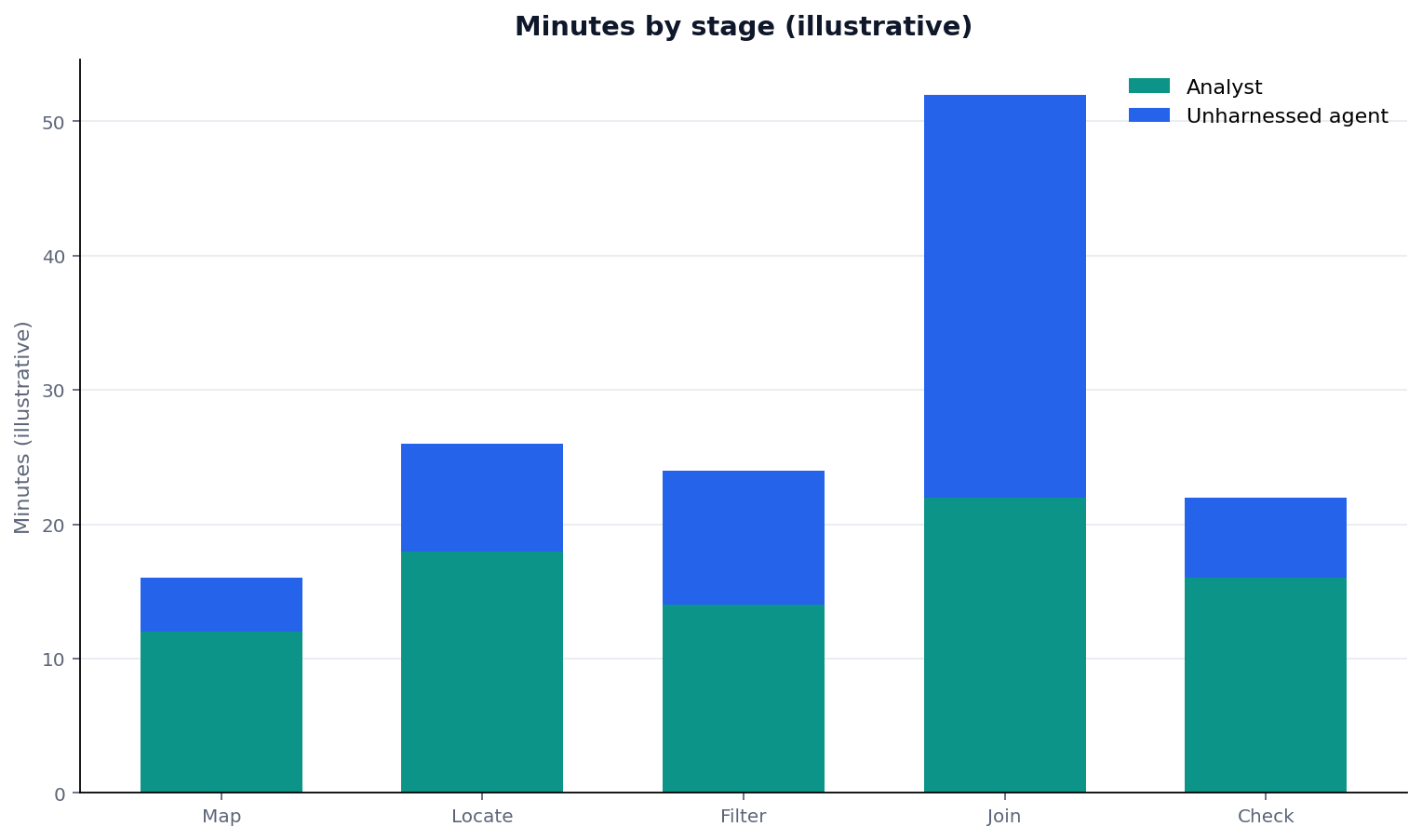
Figure. Teaching schematic. Not a measured study. Source: the protocol table above.
8 / 42 / 88 and 42 versus 18 are a teaching sketch. Quote the protocol, not the bars. The stack is a teaching schematic for map versus calculate minutes, not a customer timing log from operations.
Scorecard: working method or skipped job
| Signal | Data analysis workflow | Skipped job |
|---|---|---|
| Map | Decision written | Dashboard nickname |
| Locate | Table reason spoken | First table found |
| Filter | In and out named | “Active” |
| Sentence | Bound before calculate | Invented after |
| Check | Named control | Confidence prose |
| Readable | Operations can follow | Engineer-only blob |
If the data analysis workflow column is empty, do not paste the digit. Write the missing move in the outline before anyone quotes the figure in a memo.
Locate is the move teams skip because schema recall feels like locating. It is not. Locate means you can point at two adjacent tables and say why you refused one. Invoice headers versus invoice lines is a typical fork. Ticket facts versus ticket comments is another. If you cannot say the fork, you have not located.
Filter is not a WHERE clause you discover after the join. Write inclusion and exclusion before the key. Otherwise the join will multiply rows and the filter will look like a cleanup. Sort belongs in the same breath: top-ten by rate is a different object from top-ten by volume. Juxtaposition belongs there too. Last month beside this month is valid only on one grain.
Check is a named control, not a feeling. A monthly ticket-extract row count, a null rate on account id, or a reconciliation to a finance control file are checks. “The distribution looks familiar” is not. Operations will ask for the control name. Write it in the outline so the copied ritual survives a staffing change.
Failure modes
Calculate as the first move
The agent aggregates before it locates. That is not a data analysis workflow. It is a guess with a SUM. Force map and locate first.
Join without a named key
“Account-ish” joins invent duplicates. A data analysis workflow writes the key. If the key is missing, stop.
Check as a vibe
“Looks reasonable” is not a check. That sequence names the control table or the row-count bound. Compliance will ask for that name.
Show the outline: source, filter, join, check
Ask a business question and require the outline before SQL. This check uses only sources you authorize.
Commercial association: You do not need the workspace to complete the educational diagnosis on this page.
Open InfiniSynapseHow this page is sourced. William Zhu is cofounder of InfiniSynapse, public as GitHub @allwefantasy. Company self-description, not independent authority. No third-party prize is claimed. No personal LinkedIn is published. Evaluation basis: We evaluate (hands-on) by requiring map, locate, filter, join, and check before the agent writes a memo. Protocol 2026-09-02, replayed 2026-09-03. Reviewed internally by analytics engineering · data platform · LLM security · editor. Editorial standards · corrections · publishing principles · About · Privacy · Terms. Contact zhuhl@infinisynapse.com. COI: InfiniSynapse sells an AI-native Data Agent; the banner is a commercial association. The educational diagnosis does not require it. Fact-check: Azure data architecture, ISO/IEC 27001, Google SRE Book, BigQuery docs, Apache Spark docs, Google Cloud Architecture Framework. 8 / 42 / 88 is a teaching sketch. No external organization audited this page.
Frequently Asked Questions
Is this just SQL?
Bottom line: No. SQL is one encoding. That sequence is the order of map, locate, filter, join, calculate, and check, with the sentence bound first.
Can I explore without the outline?
Bottom line: You can look. You cannot quote. The moment a digit will be reused, you are in that sequence and the outline is required.
Why copy a human analyst?
Bottom line: Operations already know that method. A data analysis workflow that invents a new order will not be signed by the people who own the decision.
Do I need Spark or a warehouse first?
Bottom line: No. A data analysis workflow runs on the authorized source you already have. Engines come later if volume demands them.
What on this page is citable?
Bottom line: Cite the protocol table, the five-move frame, and the six-source comparison. Do not cite the stacked bars or the 42-versus-18 sketch as measured results.
Conclusion
A data analysis workflow copies how an analyst works. Map the question. Locate on purpose. Filter. Bind grain, filter, and window. Join on a named key. Calculate. Check. Keep the path readable by operations. Skip the outline and you skip the job. The model can think. The harness decides whether the data analysis workflow becomes a careful person or a first-bubble digit.
Adjacent tables are the usual locate trap. Invoice headers versus invoice lines, ticket facts versus ticket comments: say which one you refused and why. If you cannot name the refused table, you have not located. That spoken refusal is what operations can audit next week. Write the refused table in the outline beside the chosen table so a later owner does not “rediscover” the wrong grain.
InfiniSynapse describes itself on About. Privacy and Terms apply. If you later use the workspace, open InfiniSynapse only with authorized, sanitized inputs.