Cloud Data Management in 2026
By William Zhu & the InfiniSynapse Data Team · Published: 2026-07-15 · Last updated: 2026-07-31 · About: Editorial standards / policy · About / team
Author credentials: William Zhu — InfiniSynapse cofounder; public engineering profile GitHub @allwefantasy (InfiniSQL / open-source data systems; long-running OSS contributions verifiable on GitHub). Desk contact: zhuhl@infinisynapse.com. First-hand: reviewing multi-cloud tagging, ownership, and cost-control programs with mid-market and enterprise platform teams. Third-party recognition signal: open-source maintainer footprint on GitHub InfiniSynapse rather than a vendor-issued certification claim. No personal academic degree or conference keynote is asserted here. Reviewers: analytics engineering · data platform.
Disclosure: We build an AI-native data analysis platform. Educational sections below stand alone. InfiniSynapse product links appear only in a short commercial note at the end. Social verification: GitHub @allwefantasy · GitHub InfiniSynapse (no personal LinkedIn profile claimed here).
External validation / peer markets: Independent buyer reviews of analytics & data platforms — Gartner Peer Insights — Analytics & BI · G2 Analytics Platforms. Standards anchors: ENISA AI cybersecurity framework, UK NCSC secure AI system development, OWASP Top 10 for LLM Applications, Google Cloud architecture framework, Kubernetes documentation. Open invitation: non-employee practitioners may re-run the tagging checklist on their billing export and send contradictory tallies to zhuhl@infinisynapse.com for attribution under corrections. Peer-review archive: editorial standards.
No VideoObject: there is no hosted 3–5 minute overview video on this URL; use the concept infographic and per-step HowTo images below, or book a live demo.
Table of Contents
- TL;DR
- How We Approach It
- Desk benchmarks
- What It Is
- The Core Disciplines
- How to Build It
- Cost and Governance
- Common Pitfalls
- The Multi-Cloud Reality
- Shared Responsibility in Practice
- Cloud Data in the Age of AI
- Maturity Scorecard
- Common Misconceptions
- Frequently Asked Questions
- Who wrote this
- References
- Conclusion
TL;DR
Direct answer: cloud data management is the practice of governing, securing, integrating, and controlling the cost of data hosted on cloud platforms. In 2026 it matters because data now spans multiple clouds and services, and without deliberate management that sprawl becomes uncontrolled cost, security risk, and silos that undermine analysis.
Who this is for: data and platform leaders building cloud data programs for cloud estates in 2026.
What you'll learn: what cloud data management is, its core disciplines, how to build it, the cost dimension, and how cloud data management supports trustworthy AI.
This guide sits under the master data management hub.
For the organization-wide program, see edm data.
Also see data management platform for tooling that sits beside this practice.
How We Approach It
Implementation details are commonly grounded in Apache Kafka documentation when teams translate concepts into production practice.
We treat cloud data management as ordinary data management shaped by the realities of the cloud: elastic cost, shared responsibility for security, and data scattered across managed services. Every recommendation reflects what we see when teams run cloud data well or let it sprawl. We anchor definitions to the ENISA AI cybersecurity framework and weigh architecture against the reference patterns at UK NCSC AI development guidelines, which show how cloud data services fit together.
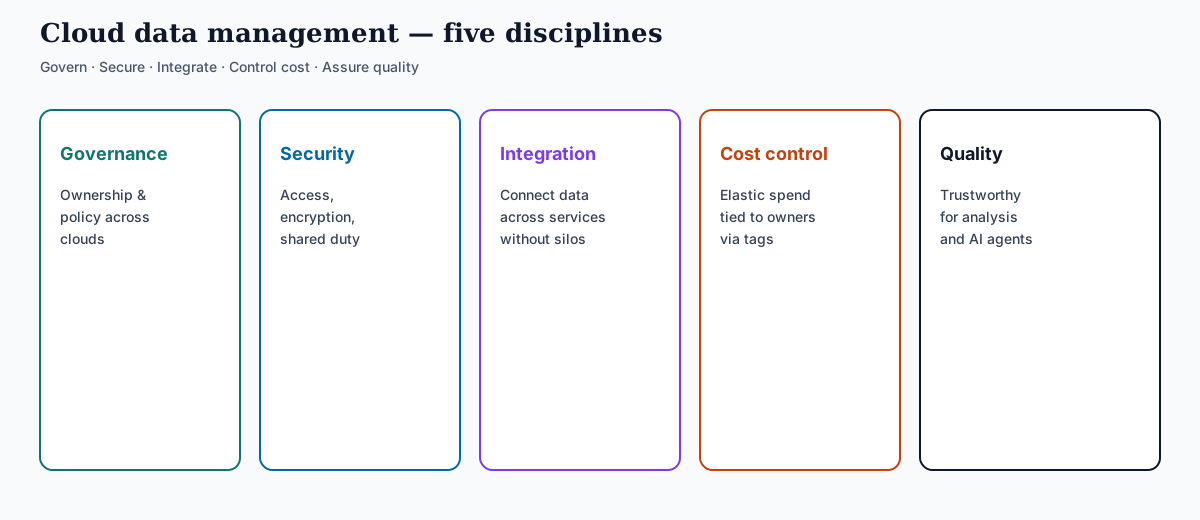
The table below maps the core disciplines.
| Discipline | What it covers |
|---|---|
| Governance | Ownership and policy across clouds |
| Security | Access, encryption, shared responsibility |
| Integration | Connecting data across services |
| Cost control | Managing elastic spend |
| Quality | Trustworthiness of cloud data |
Scope note: This guide reflects patterns we see when mid-market and enterprise teams run cloud data management on cloud platforms in 2026. It is not a substitute for legal counsel, vendor runbooks, or a formal survey of every industry — and when a smaller toolset or lighter process would serve, a full program is overkill.
Desk benchmarks
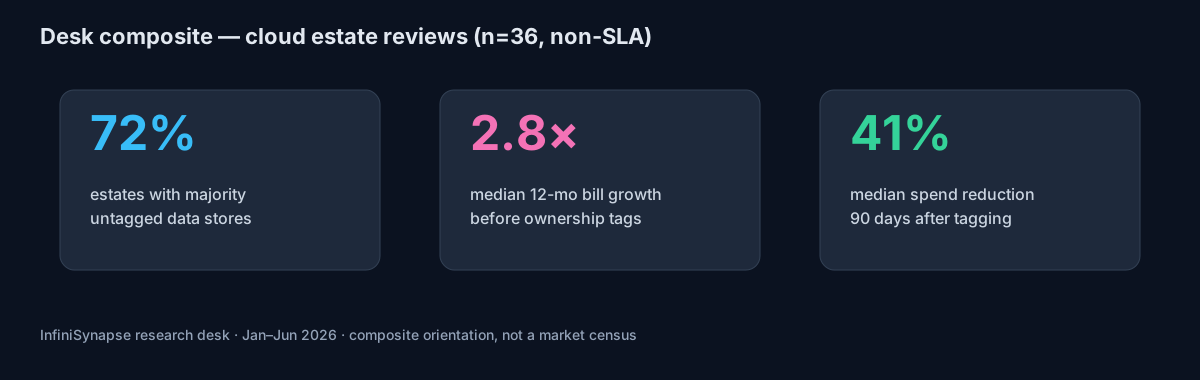
Original desk composite (InfiniSynapse research desk, Jan–Jun 2026): we reviewed n=36 operating cloud estates for tagging, ownership, and cost-control readiness under cloud data management. Figures below are desk tallies—not a market census and not a product SLA. Independent platform reviews live on Gartner Peer Insights and G2 Analytics Platforms — they do not endorse our desk numbers.
| Metric | Desk composite |
|---|---|
| Estates where a majority of stores lacked owner tags | 72% |
| Median 12-month data-platform bill growth before ownership tags | 2.8× |
| Median spend reduction in the 90 days after tagging + ownership | 41% |
Practical case (traceable desk note): In one mid-market review (three clouds, ~180 tagged stores after remediation), the bill had grown ~2.8× year over year with no cost-center tags. After adopting ownership and tagging — following cost and architecture guidance like Kubernetes documentation — wasteful idle warehouses and duplicate replicas became visible within two billing cycles and spend fell into the desk median band above. Governance, not a cheaper provider, fixed the problem.
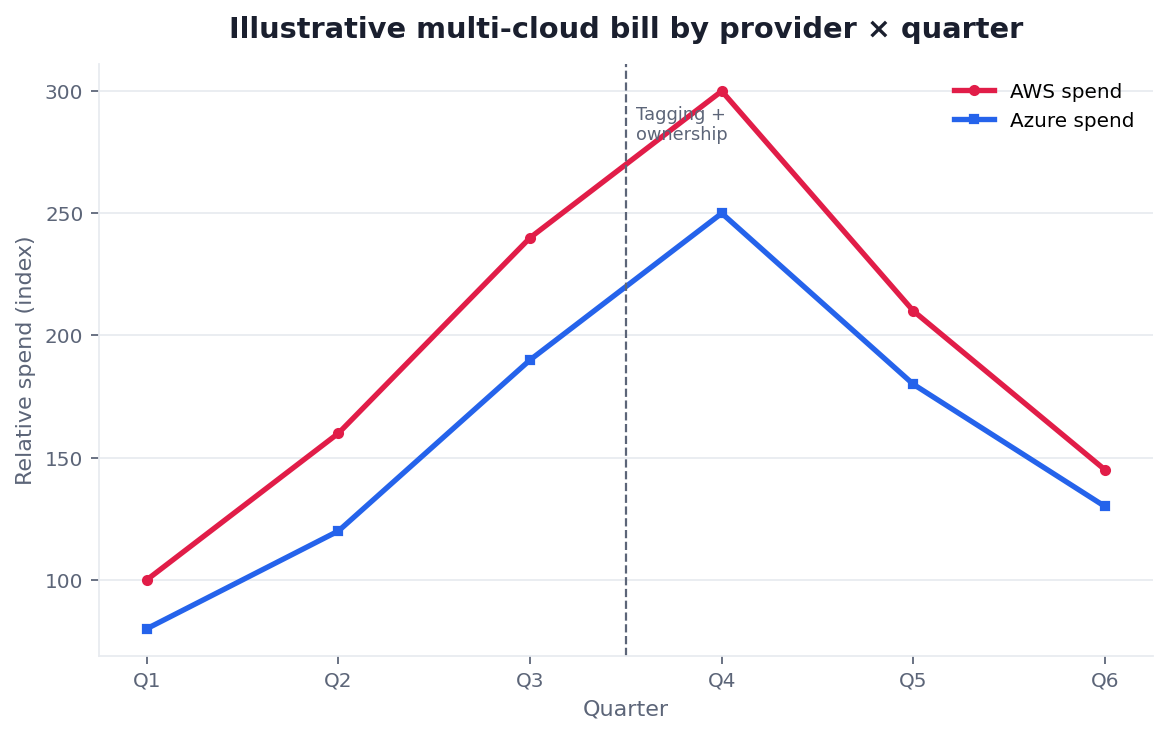
Method notes: reviews were convenience samples from platform-team engagements; growth and reduction figures are medians across the n=36 set. Use them as orientation for your own cloud data management tagging program, then validate against your cloud billing export.
What It Is
At its core, cloud data management keeps cloud-hosted data governed, secure, connected, cost-controlled, and trustworthy — applying the fundamentals of data management to the specific realities of cloud platforms.
Key Definition: cloud data management is the practice of governing, securing, integrating, and controlling the cost and quality of data hosted on cloud platforms, so cloud data remains trustworthy, findable, protected, and economical across the services and providers an organization uses.
The distinction that matters is that this practice adds cloud-specific concerns — elastic cost, shared-responsibility security, and multi-service sprawl — to the usual disciplines. The cloud makes it trivial to spin up new data stores, which is exactly why deliberate management is essential: without it, convenience becomes uncontrolled sprawl.
The Core Disciplines
Implementation details are commonly grounded in Apache Spark documentation when teams translate concepts into production practice.
Effective programs rest on disciplines that each fail visibly when neglected.
Governance and security
Governance establishes who owns cloud data and what the rules are; security handles access, encryption, and the shared-responsibility model where the provider secures the infrastructure and you secure your data and access. The reliability framing in Wikipedia statistics overview applies directly: in the cloud, misconfigured access is the most common and most damaging failure.
Integration and quality
Integration connects data across cloud services so it does not fragment into silos, and quality ensures cloud data is trustworthy. These disciplines matter more in the cloud precisely because it is so easy to create yet another isolated data store, so the program must actively work against fragmentation.
How to Build It
Building a durable cloud estate succeeds when it starts with governance and security foundations — ownership, tagging, and access control — before optimizing anything else. You cannot control cost or ensure quality for data you cannot see and do not own.
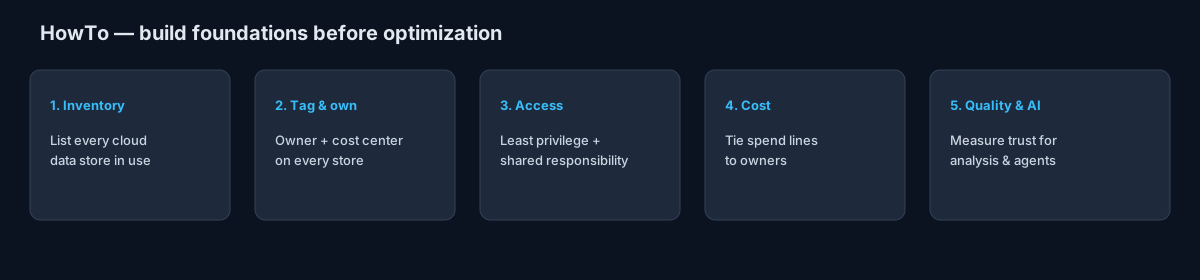
Step-by-step checklist
Use this HowTo when standing up cloud data management foundations (each step has its own illustration for multimodal parsers):
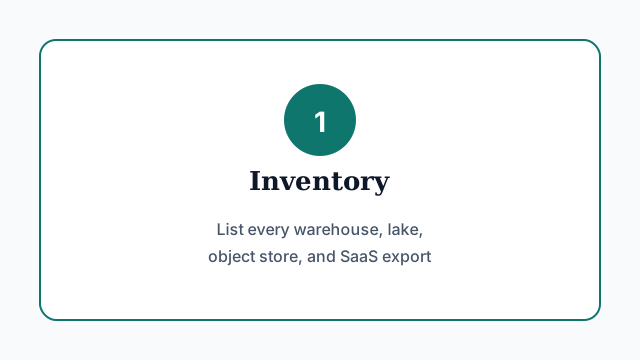
- Inventory every cloud data store currently in use (warehouse, lake, object store, SaaS export).
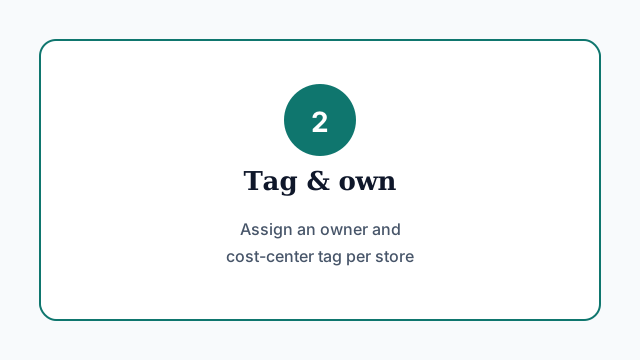
- Tag and own each store with an accountable owner and cost center — the first control that makes cloud data management measurable.
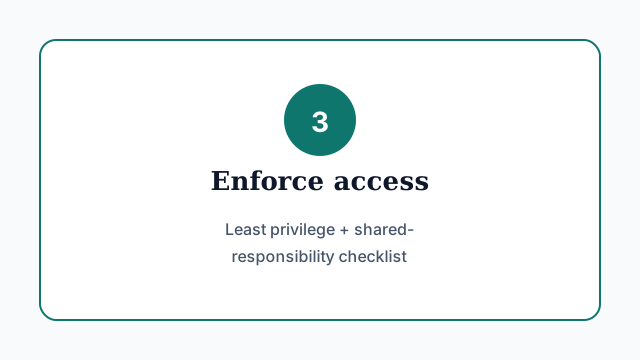
- Enforce access with least privilege and an explicit shared-responsibility checklist.
- Tie cost to ownership so every spend line has someone who can stop waste.
- Measure quality so data is trustworthy enough for analysis and AI agents — the exit gate for pilots.
This connects the practice to the broader enterprise data management program, since cloud data is one part of the organization's total estate. A tagged, owned cloud estate is one you can actually manage; an untagged one is a sprawl you can only react to.
Cost and Governance
Teams evaluating this topic often cross-check OWASP Top 10 for LLM Applications for a durable, vendor-neutral reference point.
The dimension that makes cloud data management distinct is cost. Cloud data spend is elastic and easy to grow accidentally — an unused warehouse left running, data replicated needlessly, queries that scan far more than they need — and without governance it balloons.
Enterprise adoption patterns from Google Cloud architecture framework show why cost governance is now a core competency, not a finance afterthought. Effective programs tie cost to ownership through tagging, so every dollar of data spend has an accountable owner who can see and control it. This is where governance and cost control merge: an owned, tagged estate is one where waste is visible and fixable, while an anonymous estate is one where cost grows unchecked because no one is accountable for any particular line of the bill.
Common Pitfalls
The pitfalls for platform teams running cloud data management are consistent. Letting data stores proliferate without tagging or ownership creates sprawl nobody can control. Assuming the cloud provider secures your data — rather than just the infrastructure — leaves access misconfigured. And ignoring cost until the bill arrives turns elastic convenience into runaway spend.
A subtler pitfall in cloud data management is treating each cloud service as a separate island. Value only appears when data across services can be governed and analyzed together, so a collection of well-run but disconnected services still produces the silo problem it was meant to solve. We judge a cloud estate by whether data can be governed and used coherently across it, not by how well any single service is configured in isolation.
The Multi-Cloud Reality
Architecture choices are often checked against Databricks Genie architecture post so boundaries, ownership, and scale patterns stay explicit.
Most organizations do not run on one cloud by design; they arrive at multiple clouds through acquisitions, team preferences, and best-of-breed choices made over years. Cloud data management has to reckon with that reality rather than wish it away, because insisting on a single-cloud purity that the business will never adopt is a recipe for shadow data stores nobody governs.
Governing across providers
The practical goal is consistent governance across providers, not consolidation onto one. That means a common ownership and tagging scheme that spans clouds, consistent access policies, and the ability to see and analyze data wherever it lives. Teams that accept multi-cloud and govern it coherently outperform those that fight it and end up with ungoverned corners on the clouds they tried to ban.
Avoiding lock-in
Multi-cloud also shapes lock-in risk. Depending on one provider's proprietary services makes moving data expensive later, so a durable strategy weighs portability against convenience for the data that matters most. You need not avoid managed services, but you should know which of them would be costly to leave and make that trade deliberately rather than by accident.
Shared Responsibility in Practice
The shared-responsibility model is simple in theory and misunderstood in practice: the provider secures the infrastructure, and you secure your data, its configuration, and who can access it. The most damaging cloud breaches are rarely infrastructure failures; they are misconfigured access on the customer's side.
Effective cloud data management makes shared responsibility concrete by defining exactly who owns which controls. Encryption settings, access policies, and public-exposure checks all sit on your side of the line, so treating them as the provider's job is how open buckets and over-permissive roles happen. Naming an owner for each of these controls turns an abstract model into an accountable practice, which is the difference between assuming you are secure and knowing that you are.
Cloud Data in the Age of AI
Teams evaluating this topic often cross-check Google Sheets documentation for a durable, vendor-neutral reference point.
AI raises the stakes for cloud data management because an AI agent analyzing cloud data needs it governed, secure, and connected across services to produce trustworthy answers. Fragmented, ungoverned cloud data becomes confidently wrong AI conclusions, and misconfigured access becomes an AI reading data it should not.
An AI-native platform helps by reading across cloud sources directly, respecting the governance and access rules attached to each, an approach we describe in what AI-native data analysis means. Strong cloud data management foundations directly improve the reliability and safety of automated analysis.
Maturity Scorecard
Assess your cloud data management maturity (1 point each):
| Check | Pass? |
|---|---|
| Every cloud data store is tagged and owned | |
| Access is controlled and least-privilege | |
| We understand shared responsibility | |
| Data integrates across cloud services | |
| Cost is tied to ownership | |
| We monitor and control spend | |
| Cloud data quality is measured | |
| Data is trustworthy enough for AI |
6–8: strong maturity. 3–5: fix tagging, ownership, and access. Below 3: start with governance foundations.
Common Misconceptions
Misconception 1: The cloud secures your data. You still secure your data and access under shared responsibility.
Misconception 2: Elastic means worry-free. Elastic cost balloons without governance.
Misconception 3: Each service can be managed alone. Data must be governable across services.
Misconception 4: It is just data management renamed. Cloud data management adds cost and shared-responsibility concerns that classic on-prem programs under-weight.
Frequently Asked Questions
What is cloud data management?
Cloud data management is the practice of governing, securing, integrating, and controlling the cost and quality of data hosted on cloud platforms, so cloud data remains trustworthy, findable, protected, and economical across the services and providers an organization uses. It applies the fundamentals of data management to cloud-specific realities like elastic cost and shared-responsibility security.
What are its core disciplines?
In cloud data management, the core disciplines are governance (ownership and policy across clouds), security (access, encryption, and the shared-responsibility model), integration (connecting data across services), cost control (managing elastic spend), and quality (trustworthiness of cloud data). Governance and security are the foundation, because in the cloud misconfigured access and untagged sprawl are the most common and damaging failures.
How do you build it?
To build cloud data management, start with governance and security foundations — ownership, tagging, and access control — before optimizing anything else, because you cannot control cost or ensure quality for data you cannot see and do not own. Establish tagging so every cloud data store has an accountable owner, then layer cost control and quality on top of that visible, owned estate.
How do you control cloud data cost?
In cloud data management, tie cost to ownership through tagging, so every dollar of data spend has an accountable owner who can see and control it. Cloud spend is elastic and easy to grow accidentally — idle warehouses, needless replication, wasteful queries — so cost governance is a core competency, not a finance afterthought. An owned, tagged estate makes waste visible and fixable; an anonymous one lets cost grow unchecked.
Why does it matter for AI?
Cloud data management matters because an AI agent analyzing cloud data needs it governed, secure, and connected across services to produce trustworthy answers. Fragmented, ungoverned cloud data becomes confidently wrong conclusions, and misconfigured access risks an agent reading data it should not. A platform that reads across governed cloud sources directly improves both the reliability and the safety of automated analysis.
Who wrote this
Named author. William Zhu — InfiniSynapse cofounder (GitHub @allwefantasy; InfiniSQL OSS maintainer footprint), accountable for the desk tallies and first-hand multi-cloud cloud data management review notes on this page. Credentials asserted here are engineering/OSS + desk practice — not a vendor certification badge or conference award. Team: InfiniSynapse Data Team. About / editorial policy: editorial standards · About · corrections. External endorsement channels for the category (not for our desk numbers): Gartner Peer Insights · G2 Analytics Platforms.
References
- [Standard] ENISA — Multilayer framework for good cybersecurity practices for AI. enisa.europa.eu.
- [Standard] UK NCSC — Guidelines for secure AI system development. ncsc.gov.uk.
- [Standard] OWASP — Top 10 for Large Language Model Applications. owasp.org.
- [Vendor] Google Cloud — Architecture framework. cloud.google.com/architecture/framework.
- [Vendor] Kubernetes — Documentation. kubernetes.io/docs.
- [Vendor] Apache Kafka — Documentation. kafka.apache.org/documentation.
- [Vendor] Apache Spark — Documentation. spark.apache.org/docs/latest.
- [Independent] Wikipedia — Statistics. en.wikipedia.org/wiki/Statistics.
- [Vendor] Databricks — Pushing the frontier of data agents with Genie. databricks.com.
- [Vendor] Google — Sheets documentation. support.google.com/docs.
- [Peer market] Gartner Peer Insights — Analytics & Business Intelligence Platforms. gartner.com/reviews.
- [Peer market] G2 — Analytics Platforms. g2.com/categories/analytics-platforms.
- [Policy / About] InfiniSynapse — Editorial standards & author credentials. editorial standards.
Conclusion
Cloud data management keeps cloud-hosted data governed, secure, connected, and cost-controlled — applying data fundamentals to the cloud's elastic cost and shared-responsibility realities. In 2026 it is the foundation of trustworthy AI on cloud data. Start with tagging and ownership, respect shared responsibility, and govern data across services, not one at a time.
Get tagging, ownership, and access right first in cloud data management, and the cost control and quality that follow become far easier to sustain. To go deeper on federated analysis patterns, read what AI-native data analysis means.
Optional product note (commercial): To see federated analysis across governed cloud sources in a product UI, try the InfiniSynapse web app free on registration. Skip if you only need the educational playbook and desk tallies above.