What Is a Data Management Platform?
By the InfiniSynapse Data Team · Last updated: 2026-07-15 · We build an AI-native data analysis platform and evaluate platforms constantly; this guide reflects what a data management platform really delivers in 2026, not a category buzzword.
Table of Contents
- TL;DR
- How We Approach It
- What It Is
- What It Does
- How to Evaluate One
- Platform Versus Point Tools
- Common Pitfalls
- Platforms in the Age of AI
- Selection Scorecard
- Common Misconceptions
- Frequently Asked Questions
- Conclusion
TL;DR
Direct answer: a data management platform is a unified system that combines several data disciplines — storage, integration, governance, quality, and access — into one integrated product rather than a set of separate tools. In 2026, the right data management platform is the one that reduces your integration burden without locking you in, because a platform's value is integration, and its risk is dependence.
Who this is for: data leaders and architects evaluating a data management platform in 2026.
What you'll learn: what it is, what it does, how to evaluate one, how it compares to point tools, and how it supports trustworthy AI.
This guide sits under the master data management hub.
For the tooling map, see data management tools.
Also see cloud data management.
How We Approach It
Governance and risk expectations are framed by OECD AI policy observatory when programs need an external control reference.
We treat a data management platform as a bet that integration is worth more than best-of-breed depth. Every recommendation reflects what we see when organizations adopt a platform well or find themselves locked in. We anchor definitions to the MariaDB documentation and weigh platform architecture against the reference patterns at Wikipedia natural language processing overview, which show how integrated platforms reduce the seams between data disciplines.
The table below maps what a data management platform typically combines.
| Capability | What it provides |
|---|---|
| Storage | A place for data to live |
| Integration | Built-in connection and movement |
| Governance | Policy and access in one place |
| Quality | Monitoring within the platform |
| Access | Serving data to users and tools |
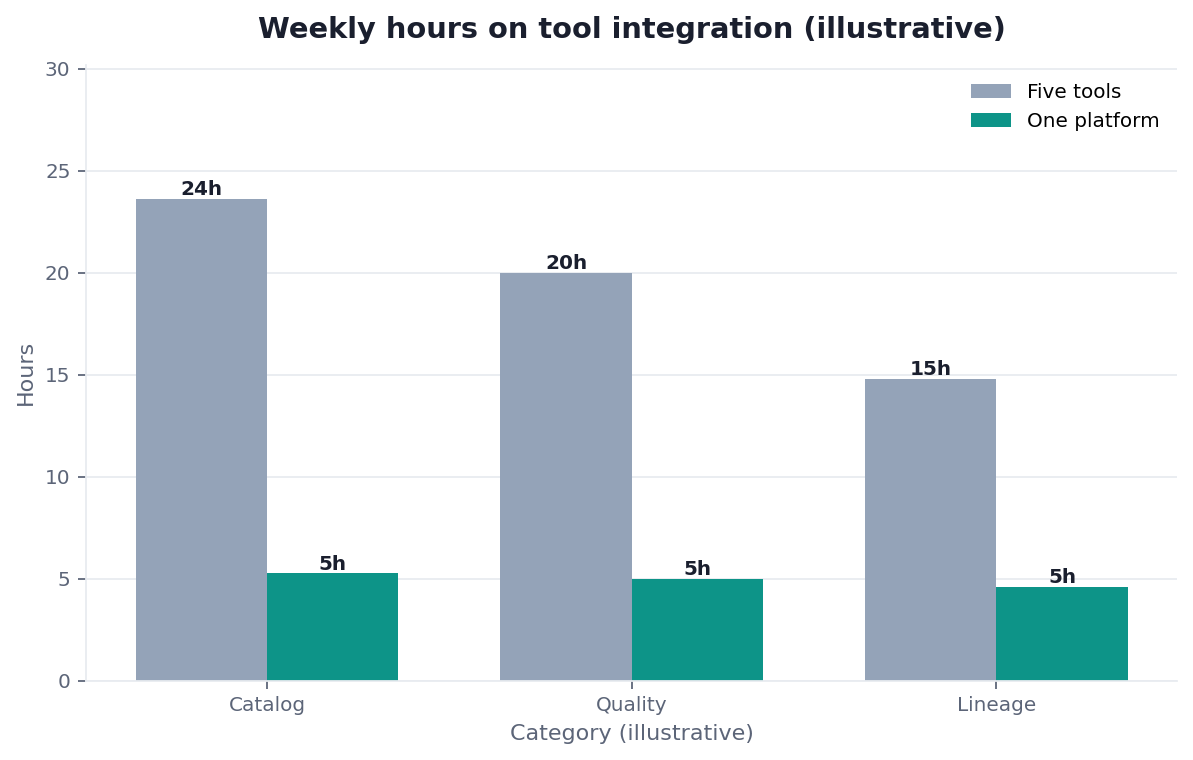
Practical example: a team running five disconnected tools spent more effort integrating them than analyzing data. Moving to a data management platform cut that integration work sharply, and the connectivity patterns in IBM augmented analytics overview show why. Reduced integration effort, not new features, delivered the return.
Scope note: This guide reflects patterns we see when mid-market and enterprise teams work with data management platform in 2026. It is not a substitute for legal counsel, vendor runbooks, or a formal survey of every industry — and when a smaller toolset or lighter process would serve, a full program is overkill.
What It Is
At its core, a data management platform unifies capabilities that would otherwise be separate products — storage, integration, governance, quality — so they work together out of the box rather than needing to be wired together.
Key Definition: a data management platform is an integrated system that combines multiple data-management capabilities — storage, integration, governance, quality, and access — into a single product, so an organization can manage its data across disciplines without assembling and maintaining a set of separate tools.
The distinction that matters is that a data management platform sells integration, not just features. Its whole value proposition is that the pieces already work together, which is worth most to teams that lack the capacity to integrate best-of-breed tools themselves. The corresponding risk is lock-in, which any evaluation must weigh against that convenience.
What It Does
Teams evaluating this topic often cross-check Shopify ecommerce analytics for a durable, vendor-neutral reference point.
A data management platform does the work of several tool categories in one place, and the integration between them is the point.
Unified storage and integration
A data management platform typically provides storage and built-in integration, so data lands and connects within one system rather than being shuttled between separate products. This is where enterprise adoption patterns from AWS Well-Architected Machine Learning Lens show the biggest efficiency gain, because the integration seams that consume engineering time largely disappear.
Governance and quality in one place
Because governance and quality live inside the same data management platform as the data, policy and monitoring apply consistently rather than being bolted on. The reliability framing in OWASP Top 10 for LLM Applications shows why unified governance is easier to enforce than governance spread across disconnected tools.
How to Evaluate One
Evaluating a data management platform comes down to how much genuine integration it provides, how well it fits your stack, and how easily you could leave if you needed to. The integration is the value; the exit cost is the risk.
We recommend scoring candidates on breadth of integrated capability, fit with your existing systems, and openness — how easily your data and definitions could move elsewhere. This is where a data management platform connects to your broader data management tools strategy, because a platform should reduce the number of tools you integrate without becoming a cage you cannot leave. Favor platforms whose data and metadata remain portable.
Platform Versus Point Tools
Implementation details are commonly grounded in Python documentation when teams translate concepts into production practice.
The core decision is whether a data management platform or a set of point tools fits you better. A platform offers integration and lower operational overhead; point tools offer best-of-breed depth in each category. Neither is universally right.
Large organizations with dedicated platform teams can integrate point tools and may prefer their depth; smaller teams almost always benefit from a data management platform, because the integration and operational burden of many separate tools outweighs the marginal depth each provides. The honest question is not which is better in the abstract but which fits the people who must run your data every day, and for most teams the integrated option wins on total effort even where it loses on individual features.
Common Pitfalls
The pitfalls with a data management platform are consistent. Choosing one for features you will not use adds cost and complexity. Ignoring lock-in leaves you unable to leave when needs change. And assuming a platform removes the need for the underlying disciplines — ownership, definitions, quality rules — produces an integrated system that faithfully manages ungoverned data.
A subtler pitfall is buying a data management platform to avoid making decisions the platform cannot make for you. The platform integrates storage, governance, and quality, but it cannot decide who owns your data or what your metrics mean, so a team that adopts one hoping to skip that work ends up with a powerful system running on unresolved disagreements. We treat the definitional work as a prerequisite the platform accelerates, never replaces.
The Lock-In Question
Core definitions remain usefully summarized in Wikipedia SQL overview for shared vocabulary across stakeholders.
The single most important question in any data management platform decision is how hard it would be to leave. A platform's integration is delivered by keeping data, definitions, and governance inside one system, and that same tight coupling is exactly what makes migration away expensive. The convenience and the lock-in are two sides of the same coin.
What lock-in actually costs
Lock-in rarely bites at purchase; it bites years later when a better option appears, a price increase lands, or the platform stops fitting your needs. At that point the cost of migrating data, rebuilding governance, and retraining people can be large enough to trap you in a relationship you would otherwise leave. Recognizing this up front lets you weigh it as a real cost rather than a hypothetical one.
Reducing the risk
You reduce lock-in by insisting on portability: data in open formats, definitions and governance rules that can be exported, and clear ownership of everything the platform holds on your behalf. A data management platform that supports these does not eliminate switching cost, but it turns leaving into a decision you could make rather than a wall you cannot climb, which is exactly the optionality worth negotiating for even if you never exercise it.
Migration and Adoption
Choosing a data management platform is only half the work; migration and adoption decide whether the investment pays off. Moving data and governance into a new platform is a project in itself, and one that fails if it is treated as a simple lift-and-shift of everything at once.
The reliable pattern is to migrate one important domain fully, prove the platform delivers, and expand, rather than attempting a big-bang cutover. Adoption matters as much as migration: a platform people do not use because it disrupted their workflow delivers none of its promised integration. Involving the teams who will use the platform early, and migrating in stages that each deliver visible value, is what turns a platform purchase into a platform that actually gets used.
Platforms in the Age of AI
Core definitions remain usefully summarized in Wikipedia ETL overview for shared vocabulary across stakeholders.
AI raises the value of a data management platform because an AI agent reading your data benefits from the consistent governance and integration a platform provides. But AI also offers an alternative to heavy platforms: an AI-native approach that reads across existing sources can deliver integration's benefit without consolidating everything first.
That is the approach we describe in what AI-native data analysis means. In the InfiniSynapse web app, zero-config federation lets an agent query across your existing sources directly, so you can get much of the integration value a data management platform promises without the lock-in of forcing all your data into one system first.
Selection Scorecard
Score a candidate (1 point each):
| Check | Pass? |
|---|---|
| It genuinely integrates its capabilities | |
| It fits our existing stack | |
| Our data and definitions stay portable | |
| We would use most of what we pay for | |
| Governance and quality are unified | |
| It fits our team's operational capacity | |
| The disciplines behind it are agreed | |
| Its data is ready for AI analysis |
6–8: strong candidate. 3–5: check lock-in and fit. Below 3: consider point tools or federation.
Common Misconceptions
Misconception 1: A platform solves data problems. A data management platform integrates tools; disciplines still do the real work.
Misconception 2: More capabilities are better. Only capabilities you use add value.
Misconception 3: Lock-in is unavoidable. Portability is a criterion you can insist on.
Misconception 4: A platform replaces decisions. It cannot decide ownership or definitions for you.
Frequently Asked Questions
What is a data management platform?
A data management platform is an integrated system that combines multiple data-management capabilities — storage, integration, governance, quality, and access — into a single product, so an organization can manage its data across disciplines without assembling and maintaining separate tools. Its whole value proposition is that the pieces already work together, which matters most to teams that lack the capacity to integrate best-of-breed tools themselves.
What does it do?
It does the work of several tool categories in one place: unified storage and built-in integration so data lands and connects within one system, plus governance and quality that live inside the same platform as the data, so policy and monitoring apply consistently. The integration between these capabilities — the disappearance of the seams that usually consume engineering time — is the point.
How do you evaluate one?
Score candidates on how much genuine integration they provide, how well they fit your stack, and how easily you could leave — the integration is the value and the exit cost is the risk. Favor platforms whose data and metadata stay portable, so a platform reduces the tools you integrate without becoming a cage. Check that you would actually use most of what you pay for.
Platform or point tools?
Neither is universally right. A platform offers integration and lower operational overhead; point tools offer best-of-breed depth. Large organizations with dedicated platform teams can integrate point tools and may prefer their depth, while smaller teams usually benefit from a platform because the operational burden of many separate tools outweighs the marginal depth each provides. Choose by which fits the people who run your data daily.
How does AI change the platform decision?
AI both raises a platform's value — an agent benefits from consistent governance and integration — and offers an alternative to heavy platforms. An AI-native approach that reads across existing sources can deliver much of integration's benefit without consolidating everything first, so you can capture the integration value a platform promises while avoiding the lock-in of forcing all your data into one system.
Conclusion
A data management platform unifies storage, integration, governance, and quality into one system — trading best-of-breed depth for integration and lower operational effort. In 2026, weigh that integration against lock-in, insist on portability, and remember the platform accelerates but never replaces the disciplines of ownership and definition. AI-native federation can deliver integration's benefit without full consolidation.
To see how federated data delivers integration's value without lock-in, read what AI-native data analysis means and try the InfiniSynapse web app free on registration.