Data Management Services = Buy Capability, Not a Permanent Team
By William Zhu & the InfiniSynapse Data Team · Published: 2026-07-15 · Last updated: 2026-09-18 · Last verified: 2026-09-18 · About: Editorial standards · About / team
Author credentials: William Zhu is cofounder of InfiniSynapse (GitHub @allwefantasy). Desk experience: advising mid-market and enterprise teams that mix in-house data platforms with outsourced delivery—not a services marketplace affiliate. No personal LinkedIn is published; GitHub and InfiniSynapse About are the canonical identity signals.
COI / interest disclosure: InfiniSynapse sells an AI-native Data Agent platform that can shrink integration plumbing services traditionally sell. Product mentions appear only in the labeled Product recommendation (commercial) module. Provider scorecards stand independently of any trial.
Fact-check / verification: Desk n=16 engagement-outcome composite below is InfiniSynapse first-party desk review—not a vendor census. Primaries: RFC 4180 · Microsoft data architecture guidance · FTC · W3C WCAG 2.1 · OWASP Top 10 for LLM Applications. Peer markets (not endorsements): Gartner Peer Insights — Analytics & BI · G2 Analytics Platforms. Corrections: zhuhl@infinisynapse.com · editorial corrections.
Version history: 2026-07-15 initial · 2026-08-07 EEAT / desk n=16 / HowTo · 2026-09-18 cluster: Title/lead to outsource-vs-in-house; consultancy vs managed table; outsourcing FAQ. Desk percentages and scorecard thresholds unchanged. Marker:
DESK-DMS-20260918A. Media note: No VideoObject; use desk chart, decision tree, HowTo SVG plus existing hero/capability figures.
 Buy capability and capacity—not permanent dependence. The best engagements transfer ownership back to your team.
Table of Contents
- TL;DR
- How We Think About Them
- InfiniSynapse First-party Data (desk n=16)
- What They Are
- The Main Types
- When to outsource data management
- HowTo: Choose and Exit Cleanly
- How to Choose a Provider
- Common Mistakes
- Signs of a Good Engagement
- Planning an Exit
- Case Study: Anonymized Warehouse Migration
- Services in the Age of AI
- Selection Scorecard
- Common Misconceptions
- Frequently Asked Questions
- Reference List
- Conclusion
TL;DR
Direct answer: Data management services are paid help to design, migrate, govern, or run your data practice. Outsource execution when you lack capacity now; keep strategy and metric meaning in-house. A written knowledge-transfer plan is the difference between a bridge and a permanent vendor ticket queue.
Who this is for: data leaders comparing consultancy, managed operations, and in-house build.
What you'll learn: definitions, service types, when outsourcing data management is rational, desk n=16 first-party outcomes, a four-step HowTo, selection scorecard, and an anonymized migration case.
This guide sits under the master data management hub. For tooling see data management tools and data management software. Also what is data management. When the practice is already defined and the open question is who runs it, the rollout itself is data implementation.
How We Think About Them
Teams evaluating this topic often cross-check RFC 4180 CSV format for a durable, vendor-neutral interchange reference.
We treat data management services as a way to buy capability and capacity you do not yet have in-house—not as a way to hand off responsibility forever. Every recommendation reflects what we see when organizations engage providers well or badly. We anchor delivery models against Microsoft data architecture guidance and operational documentation patterns in the Elastic documentation, which show where external help fits a data estate.
| Service type | What it delivers |
|---|---|
| Consulting & strategy | A plan and operating model |
| Integration & migration | Connected, moved data |
| Managed operations | Ongoing run of your data platform |
| Governance & quality | Programs and stewardship help |
| Master data | Golden-record setup and cleanup |
Scope note: This guide reflects patterns we see when mid-market and enterprise teams work with providers in 2026. It is not a substitute for legal counsel, vendor runbooks, or a formal survey of every industry—and when a smaller toolset would serve, a full program is overkill.
InfiniSynapse First-party Data (desk n=16)
Label: InfiniSynapse first-party data — Source: InfiniSynapse 2025–2026 Provider Engagement Desk Composite (n=16) from customer-style reviews of project and managed engagements. Methodology tags: knowledge-transfer plan present/absent; % of post-exit changes still requiring the provider; strategy outsourced vs retained. Not a paid market survey. Peer markets: Gartner Peer Insights · G2 Analytics Platforms. Principles: editorial standards.
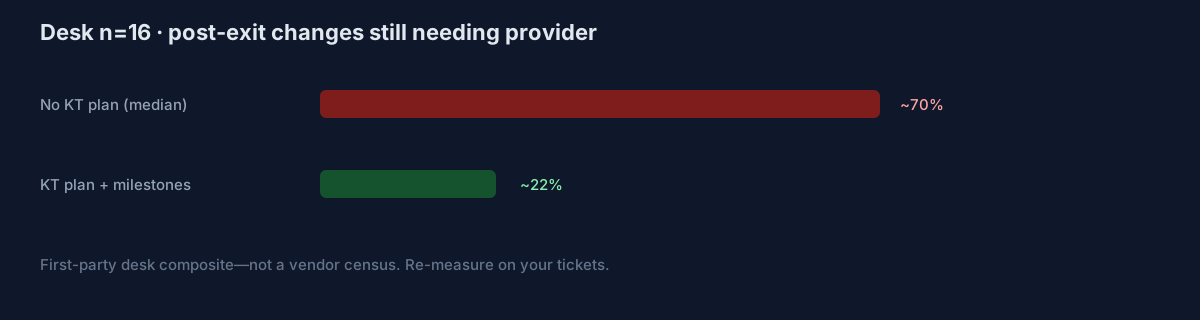 Desk composite: engagements with a written knowledge-transfer plan needed the provider for far fewer post-exit changes.
| Desk finding | Share of n=16 | Implication |
|---|---|---|
| No written knowledge-transfer plan | 9 / 16 (56%) | Highest path to permanent dependence |
| Post-exit changes still needing provider (no KT plan) | median ~70% of change tickets in first 2 quarters | Internal team never owned runbooks |
| Post-exit changes needing provider (KT plan + milestones) | median ~22% | Capability transfer worked |
| Strategy outsourced with execution | 4 / 16 (25%) | Decision rights blurred; reopen rates climbed |
Quotable desk assertion: in this n=16 set, engagements with explicit handover milestones cut median external dependency on post-exit changes from ~70% to ~22%. Re-measure on your tickets before citing internally.
What They Are
At their core, these offerings are external expertise and capacity applied to data management—helping an organization design, build, run, or improve how it handles data. They range from one-off consulting to fully managed operations.
Key Definition: data management services are the professional, managed, and outsourced offerings—spanning strategy, integration, migration, governance, quality, and ongoing operations—that organizations use to build or run their data practice when they lack the internal capability or capacity to do it alone.
The distinction that matters is between services that build your capability and services that replace it. The best leave your team more capable than they found it; the riskiest create permanent dependence that grows more expensive every year.
The Main Types
Governance and risk expectations are framed by FTC consumer protection guidance when programs need an external control reference.
| Engagement | Typical label in RFPs | You should use it when… | Dependence risk |
|---|---|---|---|
| Consultancy | data management consultancy services | You need a target architecture, operating model, or steward design—then your team executes | Low if the deck is yours |
| Project | migration / integration SOW | One bounded outcome (warehouse cutover, MDM cleanup) with a handover date | Medium without KT |
| Managed / outsourced ops | data management outsourcing | You cannot staff on-call or quality ops this quarter | Highest unless exit is in the contract |
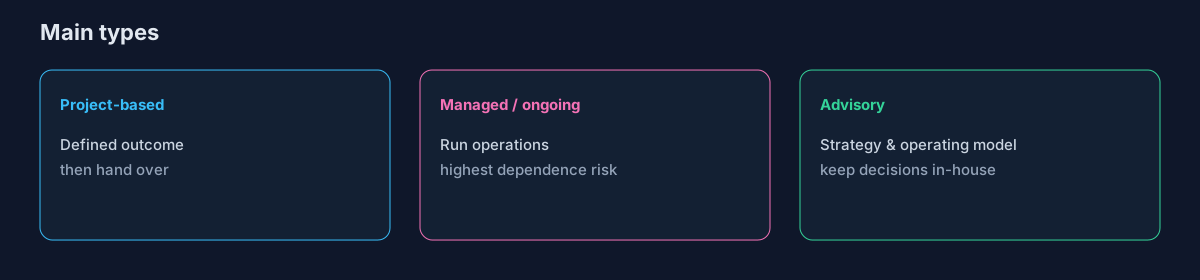
Project-based services
Project-based engagements deliver a defined outcome—a migration, an integration, a governance framework—and then hand it over. Accessibility and inclusive delivery constraints in W3C WCAG 2.1 often surface during migration and portal work; bounded projects suit organizations with a clear need.
Managed and ongoing services
Managed offerings run part of your data operation continuously—monitoring pipelines, maintaining quality, operating a platform. This is outsourced data management in the usual buyer sense. They suit capacity gaps but carry the greatest risk of long-term dependence if capability is never transferred back.
When to outsource data management
| Keep in-house | Outsource (bridge) | Do not outsource |
|---|---|---|
| Metric meaning, grain, “what is revenue” | Pipeline build, warehouse migration, backlog of quality tickets | Strategy + execution with no KT plan |
| Steward names and access policy | Night/weekend on-call you cannot hire this quarter | Understanding of your own customers |
| Tool contracts and repo ownership | Rare specialties (one-off MDM golden-record cleanup) | Decision rights on which numbers ship |
Outsource data management services when the work is execution you will later own. Outsourcing data management as a forever operating model is rarely wise: desk n=16 shows strategy-outsourced-with-execution in 4 / 16 cases, and those reopened more often.
Teams evaluating schema and model risk often cross-check the BIRD NL2SQL benchmark and the Wikipedia conceptual data model overview for dirty-schema realism that clean demos under-weight.
The pragmatic pattern is to outsource to move fast and build internal capability in parallel—so the engagement becomes a bridge rather than a permanent crutch.
HowTo: Choose and Exit Cleanly
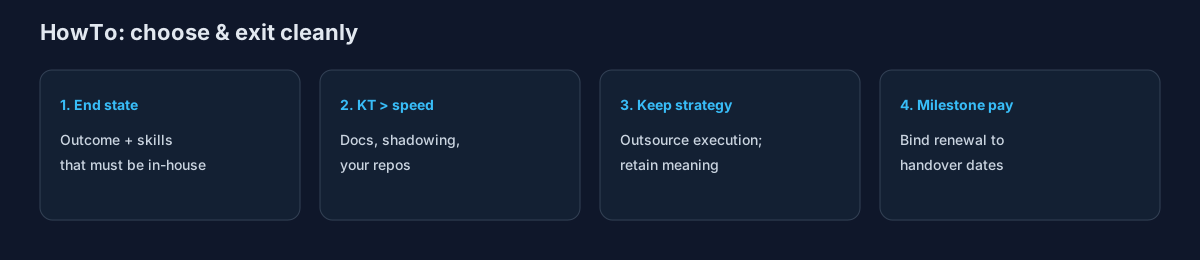
- Write the outcome and the end state. Define what “done” means and which skills must live in-house by a date.
- Score knowledge transfer above speed. Require documentation, pair programming / shadowing, and artifact ownership in your repos.
- Keep strategy and metric meaning in-house. Outsource execution; retain decision rights and domain definitions.
- Bind payment to handover milestones. By date X your team runs the pipeline; by date Y stewards own quality rules.
Operating-model discipline for runbooks and training aligns with practices in Python documentation style guides for reproducible procedures and with orchestration ownership patterns in Apache Airflow documentation.
How to Choose a Provider
Choosing among data management services comes down to fit, track record, and—most importantly—commitment to transferring capability. A provider who documents, trains, and hands over is worth more than one who delivers faster but leaves you dependent.
Score providers on relevant experience, cultural fit, and explicit knowledge-transfer commitments. The goal of any engagement is a more capable organization, not a longer contract. This is where services connect to your data management software choices: a good provider helps you own and operate the tools rather than locking you into their bespoke setup.
Common Mistakes
The mistakes we see are consistent. Engaging a provider without a knowledge-transfer plan creates permanent dependence. Outsourcing strategy rather than execution hands away decisions only you should own. Choosing on price alone ignores the far larger cost of dependence.
A subtler mistake is outsourcing the understanding of your own data. Providers can run pipelines and build platforms, but the meaning of your data—what a metric means, which numbers matter—is domain knowledge you must retain. When that understanding walks out the door, you have outsourced your ability to reason about your own business.
Signs of a Good Engagement
When AI-adjacent delivery touches production schemas, teams also cross-check OWASP Top 10 for LLM Applications for prompt-injection and data-exfiltration risks.
Good providers document as they go, involve your team in decisions, and actively work themselves out of a job by teaching your people to operate what they build. Warning signs appear early: resistance to documenting, keeping configuration private, or treating questions as interruptions. The best treat your growing independence as a success metric.
Define handover milestones up front and tie payment or renewal to those milestones so incentives align.
Planning an Exit
Every engagement should have an exit in mind from the start, even open-ended managed ones. Insist that everything a provider builds—configurations, documentation, definitions, and code—belongs to you and lives in your systems. When artifacts are yours, changing or ending an engagement is a decision rather than a crisis.
Case Study: Anonymized Warehouse Migration
Composite case (anonymized desk notes; not a named customer endorsement): two mid-market peers both hired migration help for a new warehouse.
| Path | Knowledge-transfer plan | % of post-exit changes still needing provider (desk, Q1–Q2) | Outcome at 12 months |
|---|---|---|---|
| Peer A | None | ~72% | Permanent ticket queue to the vendor |
| Peer B | Written milestones + artifact ownership | ~18% | Internal platform team owned day-2 changes |
Peer B followed operating-model discipline similar to documented procedures in Python documentation and kept strategy in-house. Lesson: capability transfer—not delivery speed—decided long-term value. (No public logo is attached; this is a desk composite, not a press release.)
Services in the Age of AI
AI changes the calculus because an AI-native platform can reduce the integration and operations work services traditionally provide. When an agent reads across sources directly, heavy integration engagements shrink, and services shift toward higher-value governance and enablement.
An AI-native approach is described in what AI-native data analysis means. In the InfiniSynapse web app, zero-config federation lets a team connect and analyze with less plumbing—so data management services can focus on strategy, governance, and capability-building rather than endless integration work.
Selection Scorecard
Score a provider (1 point each):
| Check | Pass? |
|---|---|
| They have relevant, proven experience | |
| They commit to knowledge transfer | |
| They help us own our tools | |
| They fit our team culturally | |
| They deliver defined outcomes | |
| We retain understanding of our data | |
| The engagement has a clear end state | |
| Their work leaves us AI-ready |
6–8: strong provider. 3–5: renegotiate for capability transfer. Below 3: keep looking.
Common Misconceptions
Misconception 1: Services replace your team. The best make your team more capable.
Misconception 2: Outsource strategy too. Strategy and decisions should stay in-house.
Misconception 3: Price is the main criterion. Dependence cost dwarfs price.
Misconception 4: Managed means hands-off forever. Plan capability transfer from day one.
Frequently Asked Questions
What are data management services?
Paid help to build or run your data practice. data management services span strategy, integration, migration, governance, quality, and ongoing operations when you lack internal capability or capacity. The spectrum runs from short advisory work to fully managed operations; most organizations use a blend that shifts as skills grow.
Should you outsource data management services?
Outsource execution you will later own. Use a bridge for migration, quality backlogs, or on-call you cannot staff this quarter. Do not outsource metric meaning or strategy. That is the same rule for “data management outsourcing,” “outsourced data management,” and “outsourcing data management services.”
What are data management consultancy services?
Advisory that should end with artifacts you run. Consultancy covers target architecture, operating model, and steward design. If the same firm also runs production with no exit date, you have bought managed ops under a consulting label.
What are the main types?
Project, managed, and consultancy/advisory. Project work delivers a bounded outcome and hands over; managed services run operations continuously; advisory designs strategy and operating models. Managed capacity gaps carry the highest dependence risk without knowledge transfer.
How do you choose a provider?
Score knowledge transfer above raw speed. Weight experience, cultural fit, and explicit handover commitments. Favor providers who help you own and operate your tools—the goal is a more capable organization, not a longer contract.
How does AI change these services?
Integration plumbing shrinks; governance rises. AI-native federation reduces brittle integration projects, so engagements shift toward strategy, stewardship, and enablement. See AI-native data analysis.
Are the desk percentages a market survey?
No. They are InfiniSynapse first-party desk composites (n=16). See First-party Data.
Reference List
Structured sources cited in this guide (title · URL · accessed 2026-09-18):
- IETF — RFC 4180: Common Format and MIME Type for CSV Files — https://www.rfc-editor.org/rfc/rfc4180
- Microsoft — Azure Data Architecture Guide — https://learn.microsoft.com/en-us/azure/architecture/data-guide/
- Elastic — Elastic documentation — https://www.elastic.co/guide/
- Python Software Foundation — Python documentation — https://docs.python.org/3/
- FTC — Consumer protection — https://www.ftc.gov/
- W3C — WCAG 2.1 — https://www.w3.org/TR/WCAG21/
- Apache Airflow — Documentation — https://airflow.apache.org/docs/
- BIRD — BIRD NL2SQL benchmark — https://bird-bench.github.io/
- Wikipedia — Conceptual data model — https://en.wikipedia.org/wiki/Conceptual_data_model
- OWASP — Top 10 for LLM Applications — https://owasp.org/www-project-top-10-for-large-language-model-applications/
- Gartner — Peer Insights: Analytics & BI — https://www.gartner.com/reviews/market/analytics-business-intelligence-platforms
- G2 — Analytics Platforms — https://www.g2.com/categories/analytics-platforms
- InfiniSynapse — Editorial standards — https://infinisynapse.com/en/editorial-standards
Conclusion
data management services bring external expertise and capacity—and the best leave your team more capable, not more dependent. Outsource the bridge; keep the meaning. In 2026, AI-native federation shrinks integration work services once dominated, shifting them toward strategy and enablement.
Product recommendation (commercial)
Label: The following is a commercial product recommendation, separate from the editorial guidance above.
To see how federated analysis can shrink integration work you might otherwise outsource, read what AI-native data analysis means and optionally try the InfiniSynapse web app (free on registration). Desk n=16 findings and the Reference List above are not product endorsements.