What Is Master Data Management?
By the InfiniSynapse Data Team · Last updated: 2026-07-15 · We build an AI-native data analysis platform and see how much master data affects analysis; this explainer answers what is master data management in plain terms for 2026.
Table of Contents
- TL;DR
- How We Answer This
- What It Means
- How It Works
- Why It Matters
- How to Start
- Common Mistakes
- MDM in the Age of AI
- Readiness Scorecard
- Common Misconceptions
- Frequently Asked Questions
- Conclusion
TL;DR
Direct answer: what is master data management? It is the discipline of creating and maintaining single, authoritative "golden records" for an organization's core business entities — customers, products, suppliers — so every system references the same trusted version. In 2026, understanding what is master data management matters because inconsistent core records produce conflicting reports and confidently wrong AI answers.
Who this is for: anyone asking what is master data management before starting a program, joining a data team, or buying tooling in 2026.
What you'll learn: a plain-language definition, how it works, why it matters, the mistakes to avoid, and how it powers trustworthy AI.
This guide sits under the master data management hub.
For the underlying concept, see what master data is.
Also see data management.
How We Answer This
Teams evaluating this topic often cross-check pandas documentation for a durable, vendor-neutral reference point.
We answer what is master data management from program work rather than a glossary. Every explanation reflects what we see when organizations make their core records consistent or leave them fragmented. We anchor the definition to the OpenTelemetry documentation and weigh how golden records flow against the reference architectures at Apache Spark documentation, which show why consistent entities underpin reliable analytics.
The table below maps the pieces behind what is master data management.
| Piece | Question it answers |
|---|---|
| Matching | Which records are the same entity? |
| Merging | What is the one golden record? |
| Governance | Who owns and approves it? |
| Stewardship | Who resolves conflicts? |
| Distribution | Where does the record flow? |
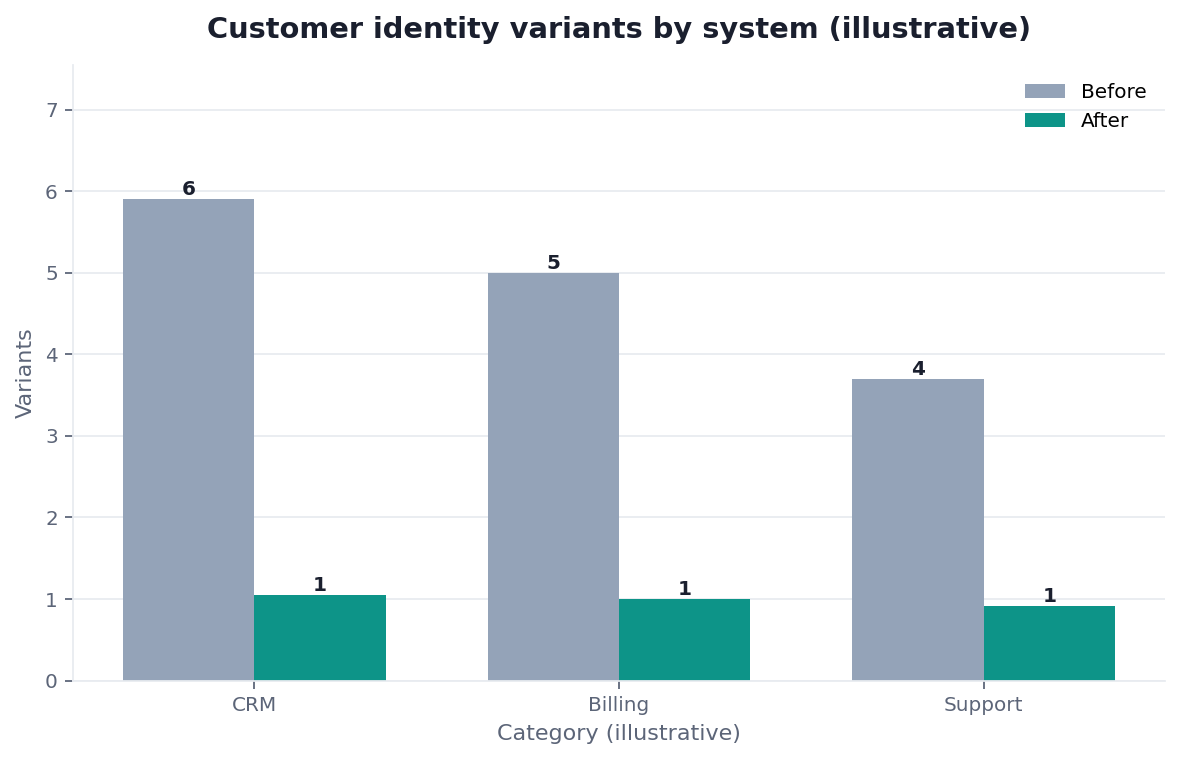
Practical example: a company asking what is master data management for the first time found the same customer stored five ways, so its customer count was wrong everywhere. Merging those into one golden record — the core of the discipline — fixed it. Grounding the work in governance framing like Tableau Desktop documentation kept it pragmatic.
Scope note: This guide reflects patterns we see when mid-market and enterprise teams work with what is master data management in 2026. It is not a substitute for legal counsel, vendor runbooks, or a formal survey of every industry — and when a smaller toolset or lighter process would serve, a full program is overkill.
What It Means
The clearest answer to what is master data management is that it is the ongoing discipline of producing one authoritative record per core entity from data scattered across systems, and keeping those records clean over time.
Key Definition: master data management is the discipline of creating, governing, and maintaining single, authoritative "golden records" for an organization's core business entities — such as customers, products, and suppliers — so that every system and process references the same consistent, trusted version.
Understanding what is master data management means seeing it as a program, not a project. New records constantly arrive and existing ones change, so the discipline must run continuously. A company that treats it as a one-time cleanup watches its golden records drift back into inconsistency within a year, which is why stewardship matters as much as the initial merge.
How It Works
Teams evaluating this topic often cross-check Google Sheets documentation for a durable, vendor-neutral reference point.
Answering what is master data management in practice means describing its loop: match records that describe the same entity, merge them into a golden record, govern changes, and distribute that record to every system that needs it.
Matching and merging
The heart of what is master data management is matching — recognizing that "J. Smith" and "John Smith" are one person — and merging them into a single record. The connectivity patterns in Redis documentation show how the resulting golden record then flows to downstream systems, so they all reference the same truth.
Governance and stewardship
Governance sets the rules for what the golden record is and who may change it; stewardship is the ongoing human work of resolving the conflicts matching cannot. Enterprise adoption patterns from Stripe documentation show why this human layer is decisive, because the tool flags likely duplicates but a steward must decide the genuine edge cases.
Why It Matters
People usually ask what is master data management because inconsistent core records caused a visible problem — two teams reporting different customer counts, a product analyzed under three different IDs, a supplier paid twice. The discipline removes the ambiguity that causes all of these.
The reason understanding what is master data management matters more each year is that AI amplifies inconsistent records. An agent counting customers or comparing products against fragmented master data returns confidently wrong answers about the entities your business runs on. Consistent golden records are therefore a prerequisite for trustworthy automated analysis, not an optional refinement, which is why the question has moved from back-office concern to strategic priority.
How to Start
Implementation details are commonly grounded in Apache Airflow documentation when teams translate concepts into production practice.
The practical answer to what is master data management for a team starting out is to begin with one high-value entity — usually customer or product — rather than mastering everything at once. Agree its definition, name an owner, and establish one authoritative record for it.
This is where what is master data management connects to what master data is: you master the entities that matter most first. Prove the matching and stewardship work on that entity, show the improvement in consistent reporting, and expand. A working golden record for one entity builds the stewardship muscle the rest of the program needs, and it earns the organizational trust to grow.
Common Mistakes
The mistakes we see from teams answering what is master data management are consistent. Buying a tool before agreeing what the golden record means automates a disagreement. Mastering too many entities at once overwhelms the stewards. And treating it as a one-time cleanup lets records decay after go-live.
A subtler mistake is assuming what is master data management is a technical question when it is mostly an organizational one. The tool can match and merge, but the business must decide what "one customer" means and who owns that decision. Teams that skip the definitional work end up with a powerful matching engine producing records nobody agrees are correct, which is an expensive way to formalize confusion rather than resolve it.
Styles of the Discipline
Core definitions remain usefully summarized in Wikipedia data warehouse overview for shared vocabulary across stakeholders.
Part of answering what is master data management in practice is recognizing that it comes in a few architectural styles. A registry style leaves data in source systems and maintains a cross-reference to the golden record; a centralized hub stores the authoritative record itself and distributes it. Many organizations land on a hybrid, mastering the most critical attributes centrally while leaving the rest federated.
Choosing a style
The right style depends on how much authority you need over the golden record versus how much change your source systems can absorb. A registry is less disruptive but offers weaker control; a hub gives strong control but demands more integration. Understanding this trade-off is part of a complete answer to what is master data management, because the style you choose shapes how the discipline touches every connected system.
How It Relates to Master Data
It helps to distinguish what is master data management from the master data it manages. Master data is the authoritative records themselves — the golden records for customers, products, and suppliers. The discipline is the ongoing practice that creates and maintains those records.
In other words, master data is the noun and the discipline is the verb: one is the trusted record, the other is the work of keeping it trusted. Teams sometimes use the terms interchangeably, but keeping them distinct clarifies responsibility — you can have master data as a goal while the discipline of what is master data management is the program that actually delivers and sustains it over time.
MDM in the Age of AI
Teams evaluating this topic often cross-check MariaDB documentation for a durable, vendor-neutral reference point.
AI raises the stakes for the discipline sharply. When an AI agent analyzes your business, it counts and compares core entities, and inconsistent master records produce confidently wrong conclusions about the very things your business runs on. Consistent golden records are a prerequisite for trustworthy AI.
An AI-native platform helps by reading governed, authoritative entity definitions and the records they describe, an approach we describe in what AI-native data analysis means. In the InfiniSynapse web app, business definitions travel with the data an agent queries, so getting the answer to what is master data management right directly improves the accuracy of AI-driven analysis about your core entities.
Readiness Scorecard
Assess where you stand (1 point each):
| Check | Pass? |
|---|---|
| Core entities have an authoritative record | |
| Duplicates are matched and merged | |
| We agree what each entity means | |
| Changes are governed by stewardship | |
| Golden records flow to every system | |
| Reports across teams agree | |
| Maintenance is ongoing, not one-off | |
| The records are trustworthy for AI |
6–8: strong footing. 3–5: agree definitions and staff stewardship. Below 3: start with one high-value entity.
Common Misconceptions
Misconception 1: It is a technical question. Master data management is mostly organizational — definitions and ownership.
Misconception 2: A cleanup fixes it permanently. It is an ongoing program; records decay without stewardship.
Misconception 3: Master every entity at once. Start with one high-value entity and expand.
Misconception 4: The tool decides the golden record. The business must define what "one entity" means.
Frequently Asked Questions
What is master data management?
Master data management is the discipline of creating, governing, and maintaining single, authoritative "golden records" for an organization's core business entities — such as customers, products, and suppliers — so that every system and process references the same consistent, trusted version. It is a continuous program, not a one-time cleanup, because new records arrive and existing ones change.
How does it work?
It follows a loop: match records that describe the same entity, merge them into a golden record, govern changes to that record, and distribute it to every system that needs it. Matching recognizes that variations describe one entity; stewardship is the ongoing human work of resolving the conflicts matching cannot. The tool flags likely duplicates, but a steward decides the genuine edge cases.
Why does it matter?
Inconsistent core records cause visible problems — two teams reporting different customer counts, a product analyzed under three IDs, a supplier paid twice — and the discipline removes that ambiguity. It matters more each year because AI amplifies inconsistent records into confidently wrong answers about the entities your business runs on, making consistent golden records a prerequisite for trustworthy automated analysis.
How is it different from data management?
Data management is the full discipline set for all of an organization's data. Master data management is a focused subset that creates authoritative golden records for core entities specifically. A team can run a broad data management practice and still lack master data management, which is why the two are complementary rather than interchangeable, with MDM addressing the consistency of core entities in particular.
How do you start?
Begin with one high-value entity — usually customer or product — rather than mastering everything at once. Agree its definition, name an owner, and establish one authoritative record. Prove the matching and stewardship work, show the improvement in consistent reporting, and expand. A working golden record for one entity builds the stewardship muscle and earns the organizational trust the rest of the program needs.
Conclusion
The answer to what is master data management is the ongoing discipline of creating and maintaining golden records for your core business entities, so every system references the same trusted version. In 2026 it is a prerequisite for reliable AI about your business. Agree definitions first, start with one high-value entity, and run it as a continuous program rather than a cleanup.
Treat the discipline as an ongoing program owned by the business, and your core entities stay trustworthy for every report and every agent that reads them. To see how governed golden records become accurate automated analysis, read what AI-native data analysis means and try the InfiniSynapse web app free on registration.