Gemini CLI Data Analysis: Start, Then Audit
By William Zhu (independent public engineering profile: GitHub @allwefantasy; no personal LinkedIn) & the InfiniSynapse Data Team · Published: 2026-08-22 · Last updated: 2026-08-28 · Last verified: 2026-08-28 · Next review: 2026-11-28 · About · Editorial standards · Privacy · Publishing terms · Corrections
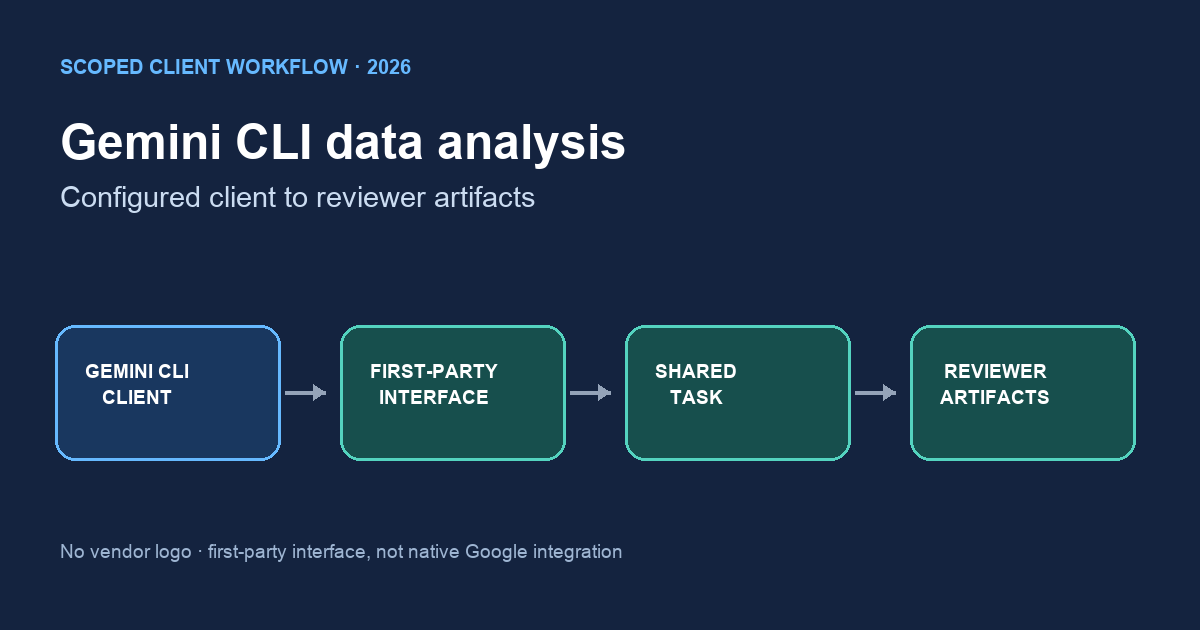
Table of Contents
- TL;DR
- What gemini cli data analysis actually is
- A same-skill, same-timeline framework
- How Gemini differs from a local printout
- Tool landscape for Gemini as a caller
- Implementation steps from shared Skill to first trail
- Desk sample: Gemini start, web trail (InfiniSynapse desk log)
- Selection scorecard
- Failure modes that leak or stall
- Frequently Asked Questions
- Conclusion
TL;DR
We evaluate caller reuse at the InfiniSynapse desk on sanitized composites; first-party figures on this page are desk log GEM-WEB-TRAIL-20260822, not customer uplifts and not a third-party bake-off.
Direct answer: gemini cli data analysis uses Gemini CLI as a separately configured client. The optional agent_infini interface, instructions, and /tasks workspace are InfiniSynapse components—not native Google features or an official integration.
Download evidence: desk log · aggregate CSV · verify script. These files record this desk run as a first-party sanitized composite.
What you'll learn:
- Why the workflow fails when the Skill is forked
- How Gemini calls a separately configured first-party interface
- Where to look after the process exits
- Desk log
GEM-WEB-TRAIL-20260822, of a Gemini start with a teammate audit - Failure modes that make the caller look unique while it is another client
Google’s Gemini CLI documentation describes the official terminal agent, and the official Gemini CLI repository exposes its implementation and releases. The authentication guide defines Google-supported login paths. None documents or endorses InfiniSynapse. Retrieved 2026-08-28.
What gemini cli data analysis actually is
Key Definition: In this article, gemini cli data analysis is a first-party operational pattern: configure Gemini authentication and sandboxing, issue a scoped credential, start a goal, and let another reviewer inspect persistent task artifacts.
Gemini CLI sandboxing constrains commands, and trusted folders constrain workspace trust. Gemini CLI MCP documentation covers external tool configuration. These controls do not make the first-party interface native.
Author qualifications and accountability
William Zhu is an InfiniSynapse cofounder. His public GitHub profile and repositories auto-coder, byzer-llm, and BYZER-RETRIEVAL verify identity and engineering work. They do not validate this method or desk log. No degree, customer case, media review, certification, Google recognition, or external assessment is claimed. 2026 WAIC Future Tech OPC Excellence Award (homepage; not a review). 2026-07-29 attestation.
Internal terms this page uses: the client instructions are reviewed separately for Gemini CLI. The task timeline is a first-party web record. A credential policy defines minimum scope and revocation; it never means one shared secret.
Gemini CLI is a fine place to type a goal if that is where you already live. The pattern is not “Gemini read a CSV and printed a paragraph.” That is a session. Used well, gemini cli data analysis lists sources, enables retrieval, starts a task, and then goes quiet so a reviewer can open the trail. The shared CLI both clients invoke is the same contract.
Spider 2.0 and the BIRD benchmark paper illustrate enterprise text-to-SQL complexity. They do not test this workflow or validate its artifact counts.
For gemini cli data analysis, those benchmarks motivate SQL review rather than a product-performance claim.
AI for data analysis already separated copilots from agents. Gemini sits on the copilot-shaped side of the CLI until gemini cli data analysis calls a system that can see bound sources.
Review Gemini-specific instructions
Gemini CLI does not naturally inherit Cursor, Claude Code, or Codex instructions. Adapt and review each client configuration against the same authorization policy and task schema.
Same timeline, not a local log
The trail is the task timeline: plan, steps, SQL, files. A run that only leaves stdout has no teammate interface. A reviewer should not need your terminal scrollback.
Reliable gemini cli data analysis records client metadata while keeping evidence independently accessible.
A same-skill, same-timeline framework
| Piece | Owner | What “good” looks like |
|---|---|---|
| Gemini CLI | You | States a standing goal |
| Instructions | Client owner | Reviewed Gemini-specific configuration |
| First-party CLI | InfiniSynapse | Separately installed and pinned |
| Credential | Named owner | Minimum scope and independent revocation |
| Timeline | Web workspace | Steps a non-Gemini user can read |
gemini cli data analysis is the first row plus the last row. Everything in the middle should already exist.
Issue credentials under one policy: minimum scope, named owner, no frontend exposure, and independent revocation.
Every gemini cli data analysis credential should document its owner, environment, scope, and revoke path.
Keys stay in the console
Store the scoped value only in an approved local secret mechanism. Never reuse another person’s, device’s, environment’s, or client’s secret.
Retrieval stays bound
rag enable against a pack bound to the source. Data governance still decides what may be stored in that pack. gemini cli data analysis does not get a private dump of the shared drive.
How Gemini differs from a local printout
A printout is a conversation. A timeline is an incident record. gemini cli data analysis chooses the timeline. That is why the pattern refuses to treat stdout as the record, even when the binary that typed the goal is Gemini.
People who will never install Gemini still need what is data management to make sense of sources, and they still need a dashboard artifact they can open. The caller is optional. The trail is not.
Review gemini cli data analysis artifacts against the goal and source permissions, not client branding.
Tool landscape for Gemini as a caller
Gemini CLI. Native authentication, sandboxing, trusted folders, tools, extensions, and MCP remain Google-defined capabilities.
Cursor / Claude Code. Separate clients with independently reviewed instructions and credentials.
Codex. Another separately configured client under the same policy.
Web Chat. Teaching surface for people who will not install a CLI. That door is not a substitute for gemini cli data analysis on a machine that already has Gemini.
InfiniSynapse connects the database you already have. Gemini does not migrate it. Private deployment and desktop exist; this page’s check still starts on the web console so the trail is visible.
Zero-config against a replica you already run is enough. The product is a professional data analyst, not a ChatBI box that only emits SELECT. Multimodal inputs and 100+ file formats still land as task artifacts when you attach files the product already accepts. Gemini does not become a new ingestion bus, and it does not write definitions back into production.
Whether db ls or retrieval exposes a source depends on first-party CLI configuration, credential scope, and authorization—not Gemini model capability.
Chat with your data is the same habit with a different door. gemini cli data analysis is the CLI door. Self-service analytics still applies for reviewers who will only ever use /tasks.
In practice, gemini cli data analysis succeeds when reviewers can inspect the trail without the originating terminal.
Do not special-case Gemini
Do not invent a Gemini-specific warehouse. Use explicit source authorization, separately scoped credentials, and a persistent first-party task.
Implementation steps from shared Skill to first trail
- Configure authentication and sandboxing. Record Gemini CLI version, auth mode, sandbox, trusted folder, and config. Expected result: Tool boundaries are explicit.
- Issue a scoped credential. Assign it to one person, device, and environment without publishing its value. Expected result: It can be revoked independently.
- Configure the first-party interface. Record CLI and instruction hash and source permissions. Expected result: Source visibility matches granted scope.
- Start a goal. Record goal, disclosed SQL hints, run ID, timestamps, and status. Expected result: One identifiable task begins.
- Review SQL and artifacts. Record SQL, memo, chart, and verification hashes. Expected result: Evidence is inspectable.
- Have a teammate reopen it. Preserve all failures and wall clock. Expected result: A teammate without Gemini opens the task.
Those six steps define the scoped gemini cli data analysis method on a new machine.
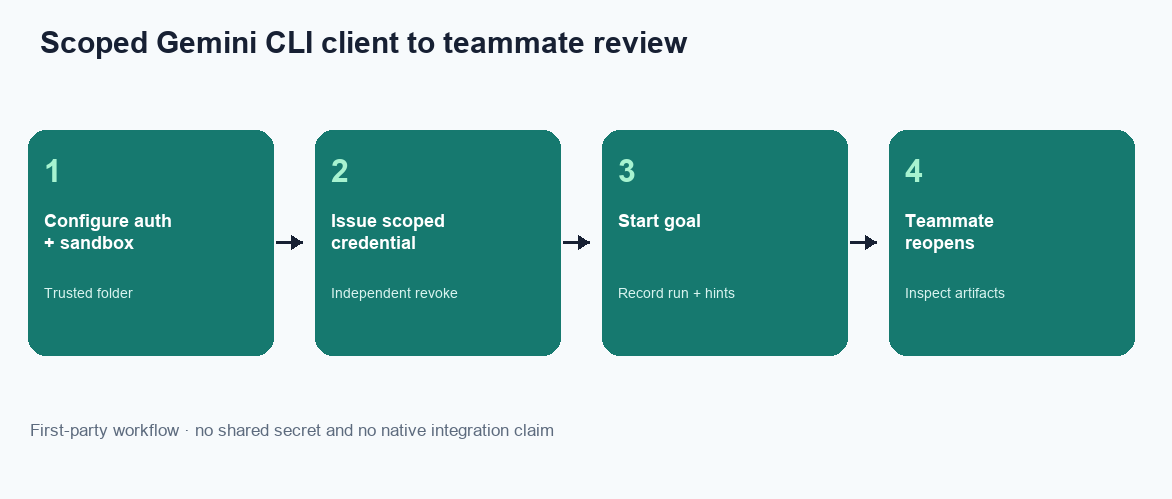
Figure. Educational four-step sequence the desk uses to tell a Gemini printout from a shared trail. Expected result after step 6: a teammate who has never installed Gemini opens /tasks and finds the same plan, SQL, memo, and chart the printout claimed were done. Not a product screenshot or a customer SLA.
Confirm the machine image already has agent_infini. A second install path “for Gemini nightlies” is how two versions start two different tasks. Pin the binary. Copy the Skill. Leave the warehouse alone.
Standing goals use the same nouns
Write the standing goals on one shared page before Gemini types anything: weekly ops pack, experiment readout, finance exception list. gemini cli data analysis should start those goals with the same nouns Cursor already uses. If Gemini invents a new name for “active store,” the bind failed. Fix the pack. Do not add a Gemini glossary. The educational diagnosis is whether a reviewer can find last week’s pack without asking which binary started it.
Exploratory data analysis still happens after the aggregate exists. Gemini does not get a private explore dialect. If the Skill lists task new, db ls, and rag enable without branding, gemini cli data analysis is ready. If the Skill mentions only Gemini verbs, it is a fork—delete it.
Attach the Skill, then stop typing Python
Gemini will improvise if the Skill is missing. Improvisation is how URIs appear in logs. gemini cli data analysis should prefer task new over a handwritten client.
Audit the trail before you call it done
The first successful gemini cli data analysis run is the one you can reopen without Gemini. Click the task. Read the plan. Open the SQL. Download the file. If those three things fail, the printout was entertainment.
Desk sample: Gemini start, web trail (InfiniSynapse desk log)
This is a first-party InfiniSynapse desk log of gemini cli data analysis, not a named-logo customer case and not an uplift claim. Run ID: GEM-WEB-TRAIL-20260822. Date: 2026-08-22 (Wednesday). Operator: InfiniSynapse Data Team. Source: a read-only replica the desk is authorized to read. Goal asked twice: “same experiment readout as last week.” Download the same numbers as desk log GEM-WEB-TRAIL-20260822.
Wednesday, an engineer started that goal from Gemini CLI. The CLI created a task.
| Retrieval state | Task timeline | Memo | Chart | A/B language |
|---|---|---|---|---|
| Gemini local only | 0 | 0 | 0 | 0 |
| First-party shared task | 1 | 1 | 1 | 1 |
Twenty minutes later (wall-clock; warehouse time excluded) the timeline held a Markdown memo, one chart, and a slice a reviewer could check. Cite this table only as first-party desk log GEM-WEB-TRAIL-20260822; its honest claim is limited to artifact counts and wall clock.
The next week, Cursor started the same goal. The trail shape did not change. A third check started the same readout from the terminal CLI with no Gemini binary on the machine. The folder still matched. Callers vary; the trail does not.
The reviewer checked three objects: the retrieved passage for the experiment grain, the SQL against the replica, and the chart file. None of those objects named Gemini. The extract was a file, not a write-back.
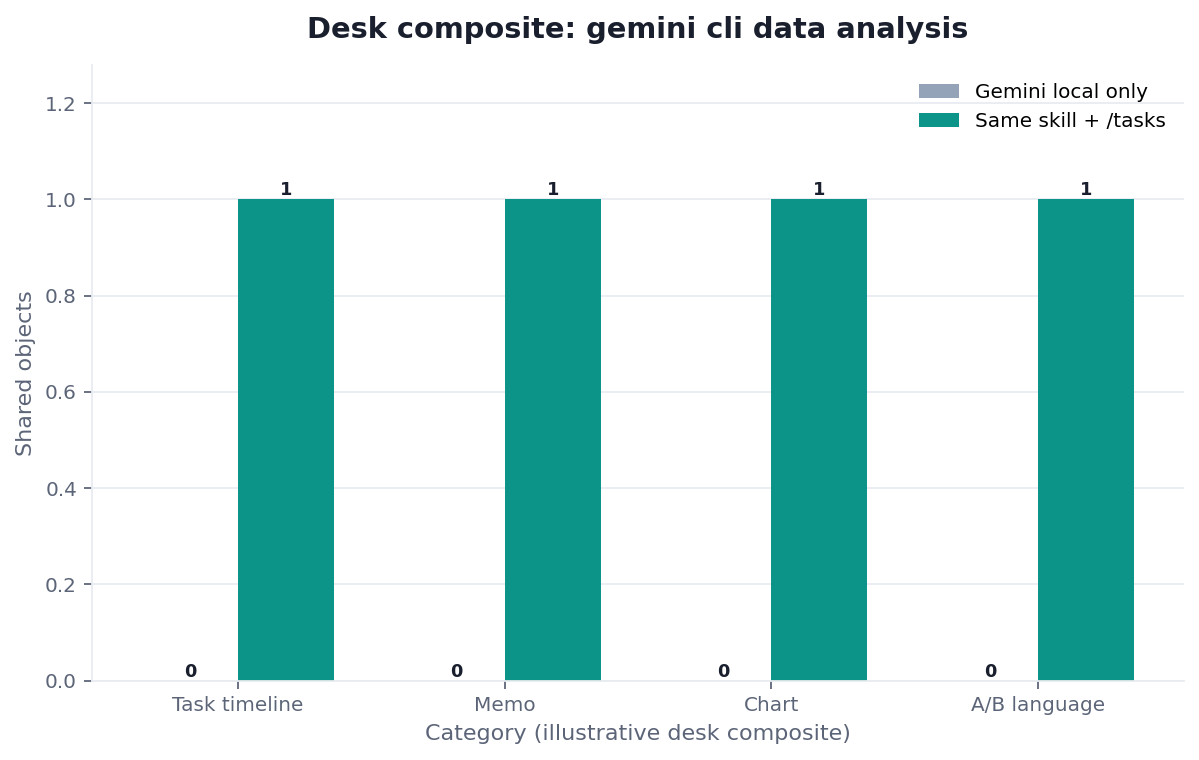
Figure. InfiniSynapse desk log GEM-WEB-TRAIL-20260822: Wednesday Gemini CLI; teammate opened /tasks without Gemini. Local-only left 0 / 0 / 0 / 0; shared skill left 1 / 1 / 1 / 1. Published context: the independent sources linked in the body. Not a customer experiment, SLA, or official benchmark.
Evidence boundaries and external validation status
Desk log GEM-WEB-TRAIL-20260822, its Markdown file, and aggregate CSV are first-party sanitized demo evidence. They are not a customer case, benchmark, third-party dataset, Google test, certification, media evaluation, or endorsement. No independent party had reproduced the run as of 2026-08-28.
Replication should disclose Gemini CLI version, authentication, sandbox, trusted folder, and config; CLI and instruction hash; credential scope without its value; source permissions; goal and SQL hints; run ID, timestamps, and status; SQL and artifact hashes; local-only baseline; all failures; wall clock; and conflicts of interest.
Accordingly, gemini cli data analysis results here remain first-party observations awaiting independent replication.
| Evidence class | What you can cite | What you cannot claim |
|---|---|---|
| Desk log on this page | Same trail across clients, artifact counts 0/0/0/0 → 1/1/1/1, ~20 min wall-clock, run ID, downloadable log | Customer uplift %, vendor bake-off win, named-logo case |
| Markdown and aggregate CSV | Two observations, method, counts, teammate flag | Raw, source, customer, or third-party data |
| Google documentation | Native authentication, sandboxing, trusted folders, and MCP | Native agent_infini or /tasks support |
| Research and standards | SQL complexity, provenance, tracing, secure development, and risks | Independent validation of this workflow |
How to cite this page
Page: Zhu, W., & InfiniSynapse Data Team. (2026). Gemini CLI Data Analysis: start, then audit. InfiniSynapse
Run: InfiniSynapse Data Team. (2026). Desk log GEM-WEB-TRAIL-20260822 (sanitized composite)
Neither is an audit. Cite artifact counts. No independent reproduction exists. Send contradictions to zhuhl@infinisynapse.com.
Selection scorecard
| Criterion | Weak caller use | Strong caller use |
|---|---|---|
| Instructions | Unreviewed copied setup | Gemini-specific reviewed configuration |
| Identity | Shared team secret | Scoped credential with independent revoke |
| Evidence | Local printout | Web timeline |
| Sources | Extra URI | One authorized list |
| Review | “Ask the Gemini user” | Anyone opens /tasks |
Score gemini cli data analysis the same way you scored Cursor. If a pitch cannot show the same timeline Cursor already uses, score it as a fork. If it can show the timeline but wants the key in application code, stop. A local printout that recites SQL is still a copilot. A timeline that a Cursor user can download is the analyst object.
Review client instructions as code: pin versions, hash changes, and test only within the authorized source policy.
Failure modes that leak or stall
These three failures make the caller look unique while it is another client. A Gemini-only key in application code is the same class of secret exposure the OWASP Top 10 for LLM Applications flags; keep the console key instead.
Forked Skill
A well-meaning engineer copied another client’s instructions without review. Replace them with a Gemini-specific, tested configuration.
Gemini as the warehouse
People ask Gemini to hold state. The warehouse already exists. gemini cli data analysis starts a task against it. It does not become a store.
Printout as the trail
The CLI printed a confident paragraph. The task failed later. Nobody opened the timeline. Make “open /tasks” part of done for gemini cli data analysis.
Before production use, check that the credential is scoped and revocable, source visibility matches permissions, a teammate can open the task, and artifacts have hashes.
The practical gemini cli data analysis acceptance test is teammate access to the recorded evidence.
W3C PROV-O supports task and artifact provenance, while OpenTelemetry traces supports invocation chains. NIST SSDF SP 800-218 and the NIST AI RMF provide secure-development and AI-risk context. None tested this demo.
UK NCSC secure AI guidance, the OWASP GenAI/LLM Top 10, and GitHub secret scanning support lifecycle, threat, and secret controls. They do not certify InfiniSynapse.
Related guides: Cursor Data Analysis, Codex Data Analysis, Claude Code Features, Claude Code Install, Claude Coding, MCP for Data Analysis, Data Knowledge Base, Knowledge Base vs Semantic Layer, Natural Language to SQL, and Data Visualization.
When the next missing object is not this page, open Codex Data Analysis via the Same CLI when Codex calls the same CLI the IDE already uses, API Key for a Data Agent when Create the key in the task console; never ship it to a browser, or IDE vs Web Data Analysis when The IDE starts work; the web trail is what you share.
Start the Gemini job, then audit the trail
Start the standing goal from Gemini CLI, then confirm the web timeline shows the same steps and files another client would leave. This check uses only sources you authorize.
Commercial association: You do not need the workspace to complete the educational diagnosis on this page.
Open InfiniSynapseSourcing and accountability. William Zhu’s editorial profile and GitHub record verify identity and engineering work. Google documents Gemini CLI; other cited sources provide research and control frameworks. None validates InfiniSynapse. 2026 WAIC Future Tech OPC Excellence Award (homepage; not a review). COI: InfiniSynapse sells the first-party interface and workspace evaluated here.
Frequently Asked Questions
Does Gemini need a different Skill?
Bottom line: Gemini CLI needs its own reviewed instructions and config. It may follow the same policy and task schema without inheriting another client’s setup.
Where should I look after Gemini exits?
Bottom line: The web task timeline. gemini cli data analysis that only leaves a printout has no shared record.
Where do I put the API key?
Bottom line: Create it under API Key Management in the task console. Keep it in a local, gitignored environment. Never put it in frontend code. gemini cli data analysis inherits that rule.
What if I do not want to install Gemini?
Bottom line: Use Cursor, Claude Code, Codex, the terminal CLI, or web Chat with the same sources and the same goal. Gemini is a client, not a requirement. The educational diagnosis does not depend on the second client being installed.
Does Google’s Gemini CLI documentation replace the same-trail rule?
Bottom line: No. Gemini CLI docs describe the terminal agent. They do not decide whether a teammate can open the same /tasks folder.
Is a Gemini-only Skill the right way to make the model understand verbs?
Bottom line: Use Gemini-specific reviewed instructions under the shared policy; never copy another client’s secret or assume identical configuration.
Conclusion
gemini cli data analysis is useful when authentication, sandboxing, source authorization, credentials, and review evidence remain explicit. Treat the work as unfinished until another reviewer can inspect the recorded artifacts.