agent infini CLI: task new, db ls, rag enable
By William Zhu (independent public engineering profile: GitHub @allwefantasy; no personal LinkedIn) & the InfiniSynapse Data Team · Published: 2026-08-22 · Last updated: 2026-09-14 · Last verified: 2026-09-14 · Next review: 2026-12-14 · About · Editorial standards · Privacy · Publishing terms · Corrections
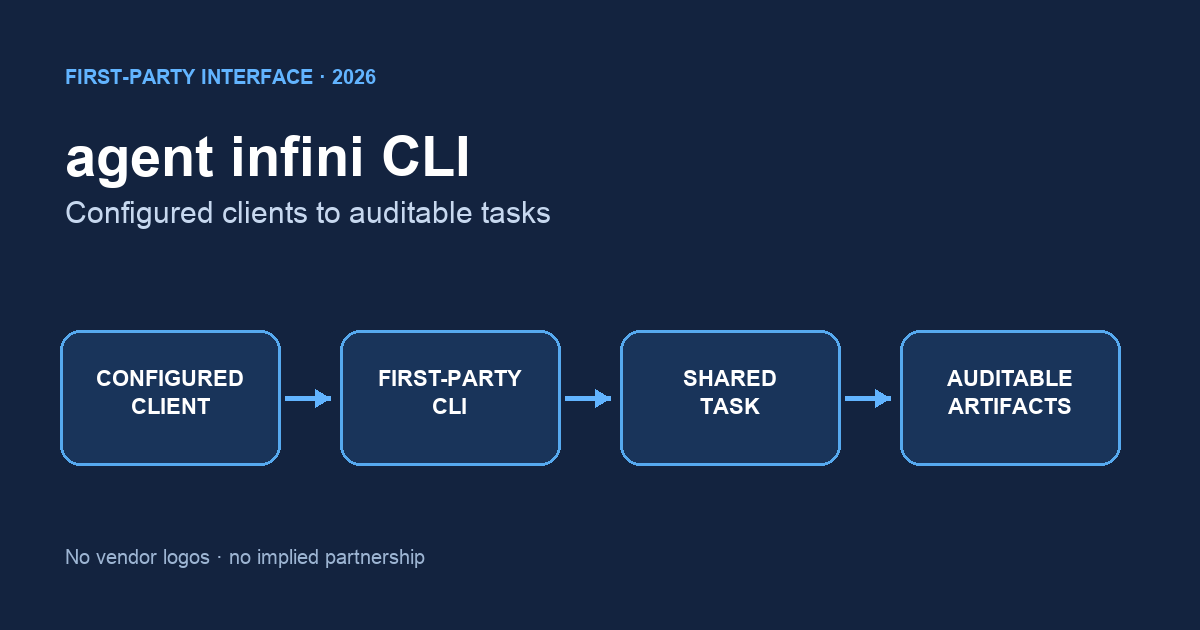
Table of Contents
- TL;DR
- What is agent_infini?
- How do you install the agent_infini CLI?
- What commands does agent infini expose first?
- What does
task newdo? - What does
db lsdo? - How do Cursor or Claude Code call the CLI?
- Is agent_infini a data agent CLI or just a chat wrapper?
- agent_infini vs MCP for data analysis — which door?
- How does the CLI differ from the InfiniSynapse web app?
- Can you run a data agent from the terminal with no IDE?
- Where does agent_infini read the API key?
- Is this the same as an API key for a data agent?
- How do you debug a failed
task new? - A CLI-as-contract framework
- Selection scorecard
- Failure modes that leak or stall
- Frequently Asked Questions
- Conclusion
TL;DR
We evaluate CLI starts at the InfiniSynapse desk on sanitized composites; first-party figures on this page are desk log AI-CLI-SHELL-20260822, not customer uplifts and not a third-party bake-off.
Direct answer: agent infini is an InfiniSynapse first-party CLI for listing authorized sources, enabling bound retrieval, and starting shared analysis tasks. A configured client may invoke the installed binary when shell or tool permissions allow; it is not native Anthropic, Cursor, OpenAI, or Google functionality.
Download evidence: desk log · aggregate CSV · verify script. These files record this agent infini desk run as a first-party sanitized composite.
What you'll learn: how to install agent infini, which verbs come first (db ls, rag enable, task new), how the CLI differs from MCP and the web app, where the key lives, and desk log AI-CLI-SHELL-20260822.
Anthropic’s Claude Code overview (retrieved 2026-08-28) documents command and tool use, while its security guidance (retrieved 2026-08-28) describes permission controls. These pages support the limited claim that a configured client can invoke commands; they do not mention or endorse this CLI. The parent pattern is Claude Code data analysis.
What is agent_infini?
Key Definition: agent infini is the first-party agent_infini CLI and client-specific instructions used to start data-agent tasks. Each client must be configured separately. Instructions may be shared as policy, but API keys must not be copied between tools.
Cursor Agent documentation (retrieved 2026-08-28), the official OpenAI Codex repository (retrieved 2026-08-28), and the official Gemini CLI repository (retrieved 2026-08-28) describe their respective clients. They establish client command capabilities only. None documents native support for this first-party interface.
William Zhu is an InfiniSynapse cofounder. His public GitHub profile and repositories auto-coder, byzer-llm, and BYZER-RETRIEVAL verify identity. They do not validate the CLI or desk log. Homepage 2026 WAIC recognition is company recognition, not a review.
The CLI is not a second warehouse. It does not compile a metric mart. It does not write definitions back into production. It starts a professional data-analyst task against sources you already connected, then leaves evidence in /tasks.
The OpenTelemetry traces specification (retrieved 2026-08-28) provides a model for spans. Record client invocation, CLI command, task ID, timestamps, status, and artifact creation as related events. W3C PROV-O (retrieved 2026-08-28) distinguishes entities, activities, and agents. Neither organization tested this workflow.
If you live in Cursor first, continue in cursor data analysis. If the next client is Codex, use Codex data analysis on the same CLI.
The CLI is the contract. Configure instructions once per client; do not assume one vendor’s Skill format works in another. Share allowed verbs and source policy, never the API key. That is also why self-service analytics still matters: non-engineers will never type task new, but they should land on the same artifacts the CLI created.
How do you install the agent_infini CLI?
Install the CLI as a pinned binary on the laptop image or container, then point it at a gitignored environment. This page does not publish a public download URL. Confirm agent_infini is callable on the approved image. A binary that “works on my machine” with a random nightly is how two engineers start two different tasks for the same goal. Version it the way you version kubectl.
- Create a console key. Store it in a local gitignored environment. Expected result: One revocable credential exists outside the repository.
- Install the first-party CLI. Confirm
agent_infiniis available without claiming a public binary URL. Expected result: The approved interface is callable. - Configure client instructions. Grant only required shell or tool permissions. Expected result: The chosen client can invoke approved verbs.
- Run
db ls. Fix missing connections in the product, not by pasting a URI. Expected result: Only authorized sources appear. - Run
task new. Use a standing analysis goal and record the task ID. Expected result: A shared task starts. - Open the shared task. Inspect status, SQL, artifacts, and retrieval; replay when needed. Expected result: A teammate can audit the same evidence.
You can complete the educational diagnosis without installing: write the three verbs you would allow and where the key would live. Before enabling the CLI, confirm the client’s permission prompt shows the command it will run.
The NIST Secure Software Development Framework (retrieved 2026-08-28) supports versioned, integrity-aware software practices; record the CLI and instruction version or hash used for a run.
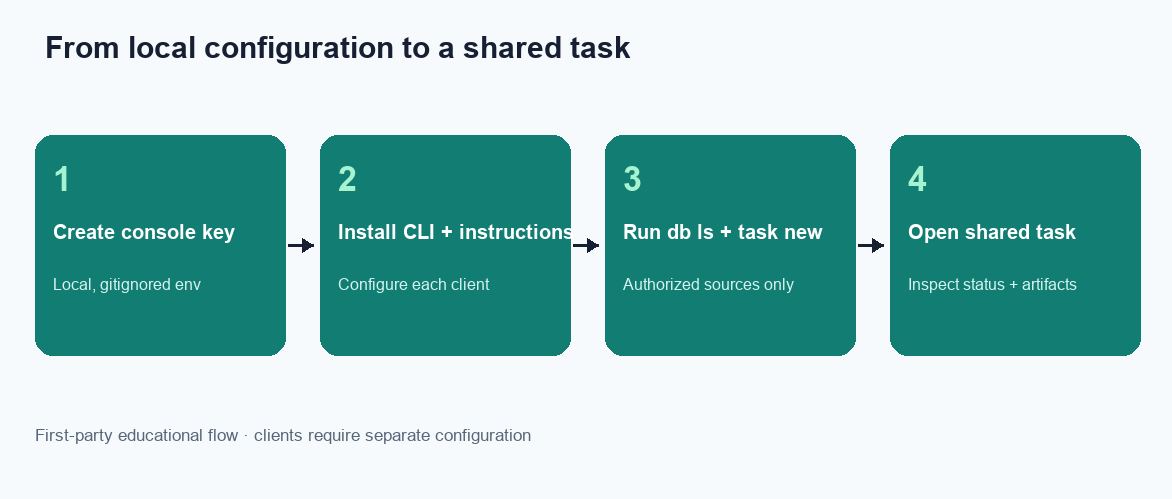
Figure. Educational sequence for distinguishing stdout from a shared task. Expected result: steps, SQL, and artifacts exist in /tasks for someone who was not looking at your terminal.
What commands does agent infini expose first?
The useful surface of the CLI is small on purpose. Do not begin with a handwritten join.
| Verb | What it does | Done looks like |
|---|---|---|
db ls | Lists authorized sources the key can see | The list matches the console, not a pasted URI |
rag enable | Binds retrieval to the source you will query | Notes sit next to that source, not a dump of every file |
task new | Starts a standing analysis goal | A task ID exists in /tasks |
If the Skill is missing, the editor will improvise. Improvisation is how connection strings appear in transcripts. Prefer these three verbs. Prefer the pinned CLI over a handwritten client.
What does task new do?
Bottom line: task new starts a standing analysis goal and writes a task id into /tasks. That id is the audit object. Stdout “done” is not.
Do not pass a handwritten join as the whole job. State the decision and the authorized source. Read the generated SQL after the run.
What does db ls do?
Bottom line: db ls lists authorized sources the key can see. The list must match the console. If it is empty, fix the connection in the product—do not paste a URI into the prompt.
How do Cursor or Claude Code call the CLI?
Bottom line: They invoke the installed agent_infini binary when shell or tool permissions allow. Neither vendor ships this CLI. Cursor chrome hops cursor data analysis. Claude hops the claude code analysis hub. Configure each client separately; do not copy the key.
Is agent_infini a data agent CLI or just a chat wrapper?
The CLI is a data-agent door, not a chat wrapper. A chat paste dies with the thread. The CLI starts an object another person can open. That is the difference, and it is enough.
The parent definition lives on what is a data agent: plan, retrieve, query, write artifacts, leave an audit trail. The CLI is one entry with parity against the web app and the API. It is not ChatBI. It is not NLP2SQL. Natural language to SQL is a useful comparison and a bad interface. Do not ask it to “write the join.” Ask it to start the pack. Read the SQL in the workspace later.
You can still use web Chat for the same goal. The CLI exists so coding agents do not become a second, invisible chat. Organization memory is the bound pack plus the task folder, not a scrollback buffer.
agent_infini vs MCP for data analysis — which door?
MCP is a tool-contract protocol an IDE host can call. The first-party CLI starts the same InfiniSynapse task. They are different doors. Both must land on one task id, or you are debugging chat logs.
Use MCP for data analysis when the host already speaks MCP and you want portable tool schemas. Use the CLI when the client should invoke pinned verbs (db ls, task new) without standing up a second server. Do not run both as two stores of truth. If MCP lists schemas and the CLI starts /tasks, the audit object is still the task, not the MCP span.
How does the CLI differ from the InfiniSynapse web app?
The web app is the human door. The CLI is the editor and terminal door. The audit object does not change. Create the key at app.infinisynapse.com/tasks. Open the same id after the CLI exits.
Bare terminal. Valid. An engineer can run the CLI with no IDE. The web task is still the record.
Cursor and Claude Code. Each can invoke an installed executable when separately configured and permitted. Neither ships this CLI. Editor chrome lives on cursor data analysis and the hub—not here.
Codex and Gemini CLI. Each requires its own client instructions. Apply the same key policy. Do not copy the secret between clients.
Web-only Chat. Correct for people who will never install a CLI. The educational diagnosis on this page does not require the binary.
Treat the laptop as a thin client. Sources, binds, and downloads live in the product. The split between a start surface and a share surface is IDE vs Web Data Analysis.
Can you run a data agent from the terminal with no IDE?
Yes. This is a first-party InfiniSynapse desk log of the CLI from a plain shell, not a named-logo customer case and not an uplift claim. Run ID: AI-CLI-SHELL-20260822. Date: 2026-08-22. Operator: InfiniSynapse Data Team. Source: a read-only replica the desk is authorized to read. Goal asked twice: “same ops pack as last week.”
An engineer ran the interface from a plain shell on Monday: db ls, then task new. No IDE was open. About 20 minutes later (wall-clock; warehouse time excluded) the workspace held a Markdown memo, two charts, and a CSV. A teammate opened /tasks and reviewed the memo.
| Retrieval state | db ls | task new | Memo + charts | CSV extract |
|---|---|---|---|---|
| Shell only, no IDE | 1 | 1 | 0 | 0 |
| CLI → /tasks pack | 1 | 1 | 3 | 1 |
This CLI observation is limited to artifact retention in the sanitized demo. Wall-clock was 20 minutes (warehouse time excluded). Method and verb counts are in the downloadable desk log AI-CLI-SHELL-20260822. Do not cite it as customer ROI. The supported claim is that the shared task made the pack reopenable.
The aggregate observations CSV contains only the two rows shown above and the teammate-audit flag.
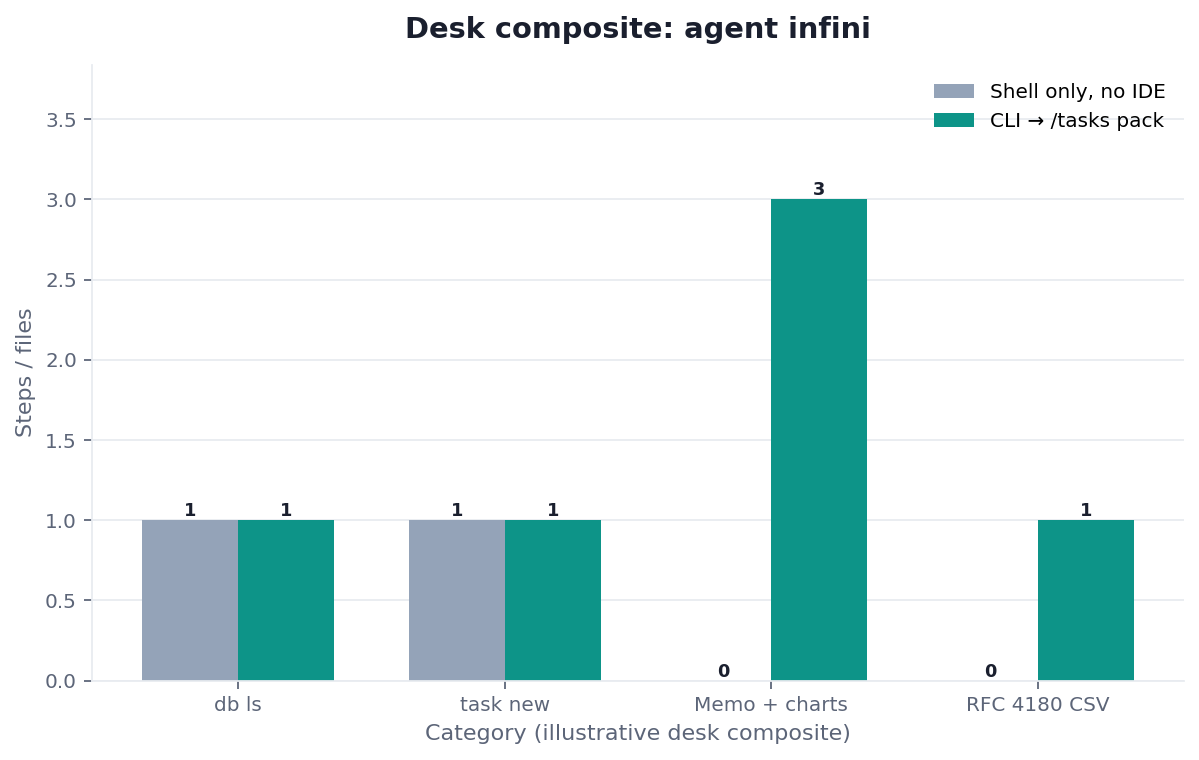
Figure. InfiniSynapse desk log AI-CLI-SHELL-20260822: Monday CLI start, ~20-minute wall clock, teammate audit in /tasks. Not a customer experiment, SLA, or official benchmark.
Desk log AI-CLI-SHELL-20260822 is first-party sanitized-composite evidence. No independent reproduction existed as of 2026-08-28. Send contradictions to zhuhl@infinisynapse.com.
Where does agent_infini read the API key?
The binary is not a secret store. The CLI should read INFINI_API_KEY from the environment, the same way aws reads a profile. Create the key under API Key Management in the task console. Issue and rotation live on API Key for a Data Agent. If someone commits the key next to the Skill, revoke it. Rotation happens in the console, not in a pull request titled “fix env.”
Is this the same as an API key for a data agent?
Bottom line: No. That page is how you issue and rotate the key. This page is who reads it (agent_infini from a gitignored env) and which verbs run after.
How do you debug a failed task new?
Bottom line: Check four things before you rewrite the Skill: the key is in the local env (not git), db ls is not empty, the client permission prompt shows agent_infini, and you opened /tasks instead of trusting stdout. Empty source list is a product connection problem. Permission denied is a client allowlist problem. A zero exit with no task id is an unread run.
GitHub push protection (retrieved 2026-08-28) can block supported secret patterns before they enter a repository, but it does not replace revocation. The UK NCSC secure AI development guidance (retrieved 2026-08-28) and the OWASP GenAI/LLM Top 10 (retrieved 2026-08-28) cover secret handling and prompt injection. Treat client instructions and retrieved text as untrusted inputs; neither organization tested this demo.
A CLI-as-contract framework
| Piece | Owner | What “good” looks like |
|---|---|---|
| CLI | Shared | agent_infini installed; version pinned on the image |
| Skill | Per editor | Cursor / Claude Code / Codex / Gemini taught the same verbs |
| API key | Task console | Created under API Key Management; local env only |
| Sources | Product | db ls matches what you meant to attach |
| Retrieval | Bound pack | rag enable against notes tied to that source |
| Artifacts | Task workspace | Files reopenable without the terminal |
The CLI is the middle rows. The IDE is optional. The console is not.
RAG is a bind, not a dump
rag enable only helps when a knowledge base is bound to the source you will query. The CLI will not invent a semantic layer for you. If you wanted compiled measures, that is a semantic layer conversation. For this interface, retrieval configuration belongs to the shared task record, not an undocumented client prompt.
The NIST AI Risk Management Framework (retrieved 2026-08-28) supports mapping, measuring, managing, and governing the resulting AI workflow. It does not evaluate this CLI.
Selection scorecard
| Criterion | Weak CLI use | Strong CLI use |
|---|---|---|
| Trigger | “Write SQL in the shell” | “Start this standing goal” |
| Identity | Key in repo or prompt | Key in console + local env |
| Evidence | stdout prose | Task steps and downloads |
| Clients | One script per editor | One CLI, many Skills |
| Sources | URI in the command line | Connected sources only |
If a pitch for the CLI cannot show the web timeline, score it as a local toy. Assess it by authorized source visibility, task status, and reproducible artifacts—not by terminal fluency.
Failure modes that leak or stall
Missing Skill, invented Python
Without a Skill, editors write their own client. That client will eventually print a URI. Install the Skill. Let the published verbs own the call.
URI in the prompt
If db ls is empty, fix the connection. Do not paste a warehouse URI into the same line as the binary. The CLI should discover sources, not decrypt them.
Stdout as the record
The process printed “done.” The task failed two steps later. Nobody looked. Make “open /tasks” part of the definition of done.
Before you call the setup production-ready, check four things: the key is not in git, db ls matches authorized sources, a teammate can open the last task without your shell, and the artifacts are files. Connect only read-only or sanitized sources.
When the next missing object is not this page, open Gemini CLI Data Analysis for that client, or IDE vs Web Data Analysis when the IDE starts work and the web trail is what you share.
Create a key, then run the same goal from the CLI
Create a key in the task console, run the standing goal from the CLI, and confirm the steps and files match. This check uses only sources you authorize.
Commercial association: You do not need the workspace to complete the educational diagnosis on this page.
Open InfiniSynapseSourcing and accountability. William Zhu is an InfiniSynapse cofounder; his GitHub profile and linked repositories provide a verifiable engineering record. 2026 WAIC Future Tech OPC Excellence Award (homepage; not a review). The desk log and aggregate CSV preserve this first-party run. COI: InfiniSynapse sells the interface described here. External client documents and standards do not validate it.
Frequently Asked Questions
How do you install the agent_infini CLI?
Bottom line: Pin the approved agent_infini binary on the image, create a console key, and point the process at a gitignored environment. This page does not publish a public download URL.
Do I need an IDE to use agent infini?
Bottom line: No. The CLI runs in a terminal. Cursor, Claude Code, Codex, and Gemini are clients. The web task is the shared record either way. agent infini does not require an editor window.
What commands does agent infini expose first?
Bottom line: db ls, rag enable, and task new. List authorized sources, bind retrieval if you have a pack, then start the standing goal.
Is agent_infini a data agent CLI or just a chat wrapper?
Bottom line: A data-agent door. It starts a shared task with a plan, SQL, and files. A chat wrapper that only prints SELECT is a different product.
agent_infini vs MCP for data analysis — which door?
Bottom line: MCP is a host tool contract. The first-party CLI starts the same task. Use one task id. Do not keep two stores of truth.
Where does agent infini keep the API key?
Bottom line: It should not keep it. Create the key under API Key Management in the task console. Point the binary at a local, gitignored environment. Never put the key in frontend code.
What does task new do?
Bottom line: It starts a standing analysis goal and writes a task id into /tasks. That id is the audit object. Stdout “done” is not.
What does db ls do?
Bottom line: It lists authorized sources the key can see. The list must match the console. An empty list is a product connection problem, not a prompt problem.
How do Cursor or Claude Code call the CLI?
Bottom line: They invoke the installed agent_infini binary when shell or tool permissions allow. Neither vendor ships this CLI. Configure each client separately; do not copy the key.
Is this the same as an API key for a data agent?
Bottom line: No. That page is how you issue and rotate the key. This page is who reads it and which verbs run after.
How do you debug a failed task new?
Bottom line: Check the key in a gitignored env, a non-empty db ls, a permission prompt that shows agent_infini, and an open /tasks record. Do not treat a zero exit as evidence.
Is stdout the record?
Bottom line: No. The record is the task in /tasks: steps, SQL, and downloads. A zero exit with an unread task is not shared evidence.
Conclusion
The CLI is useful when every editor stops growing a private integration. Install the pinned binary, keep the key out of the repo, state a goal, and open the task your teammates can see. When you are ready to run that check on an authorized source, start from InfiniSynapse and create the key before the first verb.