Claude Coding: Start a Goal, Then Audit
By William Zhu (independent public engineering profile: GitHub @allwefantasy; no personal LinkedIn) & the InfiniSynapse Data Team · Published: 2026-08-22 · Last updated: 2026-09-14 · Last verified: 2026-09-14 · Next review: 2026-12-14 · About · Editorial standards · Privacy · Publishing terms · Corrections
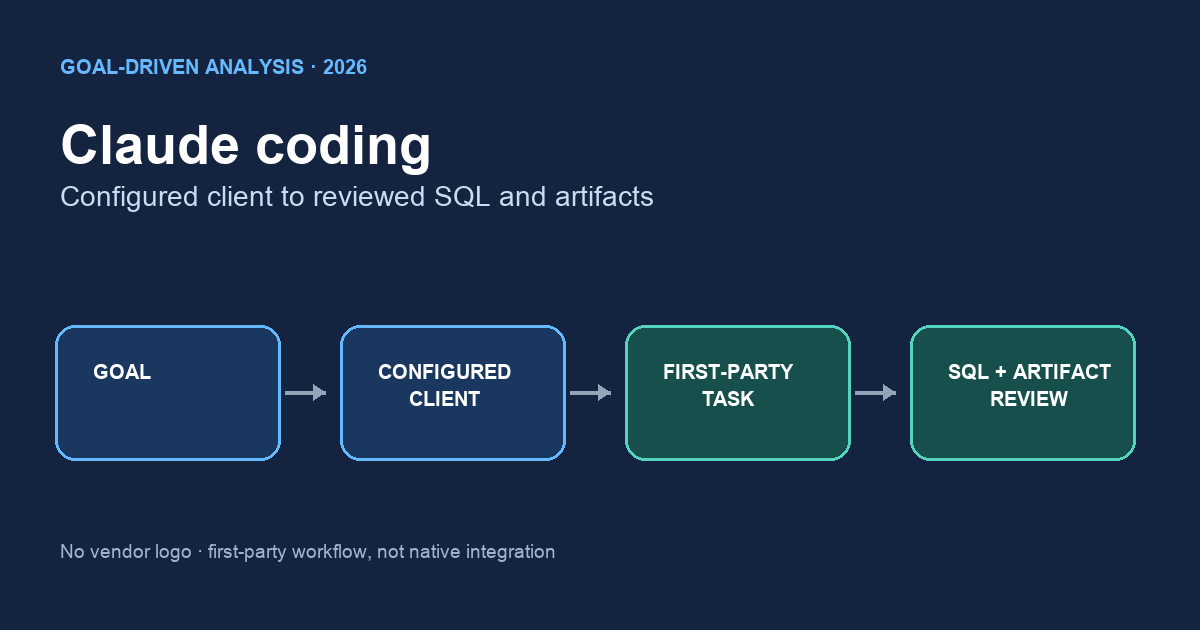
Table of Contents
- TL;DR
- What is claude coding?
- Is claude coding the same as Claude Code?
- Claude coding vs Cursor?
- Should you paste SQL into Claude?
- Is this a Claude Code tutorial?
- Is this the same as Claude Code data analysis?
- A long-task framework
- Claude coding vs autocomplete?
- Tool landscape for the same long task
- How do you start claude coding for analysis?
- Desk sample: snippet versus pack (InfiniSynapse desk log)
- How to cite this page
- Selection scorecard
- Failure modes that turn coding into paste
- Frequently Asked Questions
- Conclusion
TL;DR
We evaluate goal-first task evidence at the InfiniSynapse desk on sanitized composites; first-party figures on this page are desk log CC-CODING-PACK-20260822, not customer uplifts or a third-party benchmark.
Direct answer: In speech, claude coding means writing code with Claude or Claude Code. This page is the analysis cut: start a standing goal, review the SQL after the run, and keep a pack in /tasks. Do not paste a SELECT as the whole job. agent_infini, Skills, and /tasks are not native Anthropic features.
Download evidence: desk log · aggregate CSV · verify script. These files record this claude coding desk run as a first-party sanitized composite.
What you'll learn:
- Why this workflow fails when every prompt is a SELECT
- How a standing goal, a Skill, and a shared task id replace the paste
- Where the API key lives—task console, never a frontend
- Desk log
CC-CODING-PACK-20260822, of snippet week versus pack week - Failure modes that turn the editor into a paste buffer with extra tokens
Anthropic’s Claude Code overview (retrieved 2026-08-28) defines its native coding capabilities. Common workflows (retrieved 2026-08-28) describes repository and command use, while security guidance (retrieved 2026-08-28) documents permissions and trust boundaries. These pages do not validate InfiniSynapse or prescribe this analysis method.
What is claude coding?
Key Definition: People say claude coding when they mean coding with Claude. In this article it is a first-party analysis method: define a goal, configure source scope and permissions, run a task, review generated or supplied SQL, and preserve artifacts. SQL hints may be supplied in controlled cases, but handwritten SQL must not be the sole input or final evidence.
Claude Code hooks (retrieved 2026-08-28) and MCP documentation (retrieved 2026-08-28) support precise claims about lifecycle commands and external tools. They do not make agent_infini or /tasks native integrations.
Is claude coding the same as Claude Code?
Bottom line: No. What is Claude Code is the product. This page is the analysis usage: goal in, pack out. Features and install live on sibling guides.
Claude coding vs Cursor?
Bottom line: Same anti-snippet rule, different client. Cursor hops cursor data analysis. Do not assume one Skill or key transfers.
Should you paste SQL into Claude?
Bottom line: No. SQL is the audit after the run, not the prompt. A pasted SELECT turns the editor into a formatter.
Is this a Claude Code tutorial?
Bottom line: No. Tutorials hop Claude Code features and how Claude Code works. Install hops Claude Code install.
Is this the same as Claude Code data analysis?
Bottom line: No. The cluster map lives on claude code analysis. This page is the long-task / no-paste method.
Author qualifications and accountability
William Zhu is an InfiniSynapse cofounder. His public GitHub profile and repositories auto-coder, byzer-llm, and BYZER-RETRIEVAL verify identity and engineering work. They do not independently validate this method, product, or desk log. No degree, customer, media review, certification, Anthropic recognition, or independent assessment is claimed. The homepage records a 2026 WAIC Future Tech OPC Excellence Award; company recognition, not a review. 2026-07-29 attestation.
Internal terms this page uses: a snippet is one SELECT. A pack is the shared folder in /tasks. The audit is reading the generated SQL after the run.
If you live in Cursor, cursor data analysis is the same anti-snippet rule. The verbs live in the agent infini CLI.
A long task, not a snippet
A snippet is one statement. A long task can profile, join, chart, and memo. A workflow that only emits snippets will never produce a pack a teammate can reopen. Exploratory data analysis belongs inside the task. The editor is not the exploration scratchpad for production grains.
For claude coding, the goal should identify the decision and expected outputs before query details.
Goals first, SQL reviewed
State the outcome and source scope before prescribing a query. In controlled cases, provide SQL constraints or an existing query for review. Do not treat handwritten SQL as the only input or the final evidence. Always inspect the executed SQL and resulting artifacts. See natural language to SQL for the narrower query-generation pattern.
A long-task framework
| Piece | Owner | What “good” looks like |
|---|---|---|
| Goal | You | Standing pack sentence |
| IDE caller | IDE agent | Calls task new; does not invent the join |
| Data agent | Shared task | Plan, retries, SQL, files |
| SQL | /tasks | Readable audit, not the prompt |
| Key | Console | Issued in /tasks; gitignored env |
Spider 2.0 (retrieved 2026-08-28) evaluates language models on complex enterprise text-to-SQL workflows. Its task design illustrates schema, dialect, and workflow challenges; it does not test this method or validate the desk log. The BIRD benchmark paper (retrieved 2026-08-28) provides additional text-to-SQL research context, not product endorsement.
Goal in, artifacts out
The workflow takes a goal in and should leave Markdown, charts, and extracts out. Multimodal inputs and 100+ file formats still land as artifacts. AI-native boards generated as task files still download. Organization memory is the bound knowledge base plus that folder. A snippet in a chat is not memory.
SQL is the audit, not the interface
Open the SQL after the run and review grain, joins, filters, and permissions. If a supplied query was used, preserve it and distinguish it from generated changes.
Claude coding vs autocomplete?
Autocomplete completes the line you already started. Claude coding for analysis should start a job you have not micro-managed. AI for data analysis split copilots from agents. Autocomplete is the copilot. The long task is the agent. If your team uses it only as autocomplete, you purchased a noisy plugin.
Chat with your data is the web-native path. Users may supply query constraints when authorized, but the review and evidence requirements remain.
Standing packs versus one SELECT
A standing pack can be repeated from a goal and recorded source scope. Preserve any query hints and the final executed SQL so changes remain reviewable.
Tool landscape for the same long task
| Client | Good long-task use | Bad paste use |
|---|---|---|
| Claude Code | Goal → Skill → /tasks | Paste SELECT, ship screenshot |
| Cursor / Codex / Gemini | Separately configured clients | Assuming one Skill transfers automatically |
| Web Chat | Same goal | Chat as the only deliverable |
| Local notebook | Optional after files exist | Notebook as the secret warehouse |
InfiniSynapse is a professional data analyst, not NLP2SQL and not ChatBI. Zero-config against a database you already run is the product fact. A preset metric mart is not. Private deployment and desktop exist; the educational CTA stays on the web app. Self-service analytics users should still receive the pack claude coding started.
Codex data analysis and Gemini CLI data analysis require their own settings, instructions, and permissions. They may follow the same policy, but must not copy a secret into those instructions.
If the laptop image is blocked, start the goal in Chat. Prove the source. Add the IDE later. The long task does not require the snippet muscle.
How do you start claude coding for analysis?
- Define the goal. State the decision, outputs, and whether authorized SQL hints will be supplied. Expected result: The task scope is explicit.
- Configure source and permissions. Use a separately configured first-party interface and minimum access. Expected result: Only authorized sources and tools are visible.
- Record the baseline. Preserve client/version, settings hash, snippet baseline, and failure state. Expected result: The comparison conditions are disclosed.
- Run the task. Record goal, SQL hints, run ID, timestamps, and status. Expected result: One identifiable task completes or fails visibly.
- Review the SQL. Inspect grain, joins, filters, permissions, and generated SQL hash. Expected result: The query is approved or rejected with reasons.
- Download and verify artifacts. Record hashes, all failures, wall clock, and partner access. Expected result: Another reviewer can inspect the same evidence.
You can begin by writing the goal and listing any SQL constraints that reviewers should preserve.
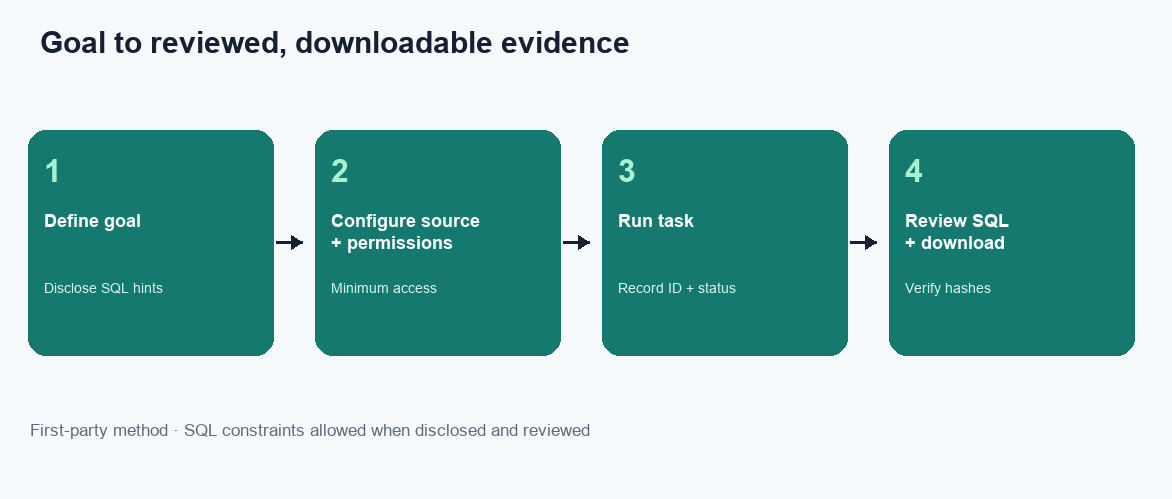
Figure. Educational four-step sequence the desk uses to tell a snippet week from a shared pack. Expected result after step 6: /tasks holds a SQL plan, a Markdown memo, two charts, and a CSV a teammate can open without your IDE. Not a product screenshot or a customer SLA.
Record the policy in client-specific instructions: goal first, authorized source scope, SQL hints disclosed, generated SQL reviewed, and artifacts retained. Configure every client separately.
A defensible claude coding run preserves both supplied constraints and generated changes.
Create the key in the console
Never frontend. claude coding does not need a browser token. See API key for a data agent. Revoke anything that appeared in VITE_ or NEXT_PUBLIC_.
Ask for the job, then read the SQL
That order is the whole method. IDE vs web data analysis is the share rule: the web trail is what you send. claude coding that ends in a terminal snippet failed the share rule.
Desk sample: snippet versus pack (InfiniSynapse desk log)
This is a first-party InfiniSynapse desk log of a claude coding goal-first task method, not a customer case or uplift claim. Run ID: CC-CODING-PACK-20260822. Date: 2026-08-22. Operator: InfiniSynapse Data Team. Source: a read-only sanitized replica. The historical goal wording referenced avoiding a pasted SELECT; this article does not treat that as a universal ban.
Week one of claude coding was snippet week. Engineers pasted incomplete joins. The editor completed them. Reviews were screenshots. Week two banned paste. The standing goal ran through task new.
| Retrieval state | SQL plan | Markdown memo | Charts | CSV extract |
|---|---|---|---|---|
| Snippet week (paste + screenshots) | 0 | 0 | 0 | 0 |
Pack week (goal + /tasks) | 1 | 1 | 2 | 1 |
About 20 minutes later (wall-clock; warehouse time excluded) /tasks held a memo, two charts, and a CSV. A partner who does not write SQL opened the statement.
The method and artifact counts are in the downloadable desk log. The aggregate CSV contains exactly two observations plus partner-opened-SQL state.
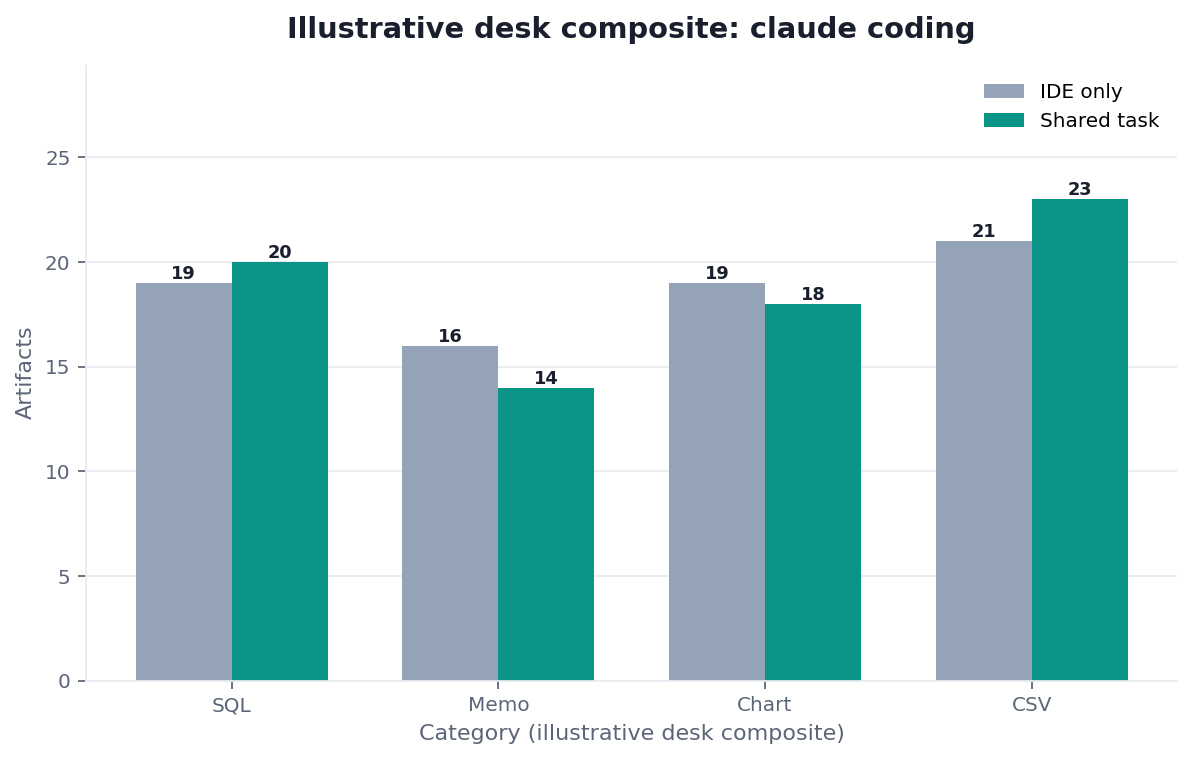
Figure. InfiniSynapse desk log CC-CODING-PACK-20260822: the snippet baseline produced no files; the goal-first task wrote SQL 1 / memo 1 / charts 2 / CSV 1. Not a customer experiment or independent benchmark.
Evidence boundaries and external validation status
Desk log CC-CODING-PACK-20260822, its Markdown file, and aggregate CSV are first-party sanitized demo evidence. They are not a customer case, independent benchmark, third-party dataset, Anthropic or Spider test, certification, media evaluation, or endorsement. No independent party had reproduced the run as of 2026-08-28.
This desk sample cannot establish that claude coding outperforms another client or workflow.
Replication should disclose client/version; CLI, Skill, and settings hash; permissions and source scope; goal and whether SQL hints were supplied; run ID, timestamps, and status; generated SQL and hash; artifacts and hashes; snippet baseline; all failures; wall clock; and conflicts of interest.
| Evidence class | What you can cite | What you cannot claim |
|---|---|---|
| Desk log on this page | Paste ban, artifact counts 0/0/0/0 → 1/1/2/1, ~20 min wall-clock, run ID | Customer speedup %, official EEAT score, named-logo case |
| Markdown and aggregate CSV | Two observations, method, artifact counts, partner-opened flag | Raw, source, customer, or third-party data |
| Anthropic documentation | Native client capabilities and permission controls | Native agent_infini or /tasks support |
| Research and standards | Enterprise SQL challenges, provenance, tracing, and risks | Independent validation of this workflow |
| Homepage recognition | 2026 WAIC Future Tech OPC Excellence Award on the homepage | That WAIC, Spider, or Anthropic scored this article |
How to cite this page
Page: Zhu, W., & InfiniSynapse Data Team. (2026). Claude Coding: start a goal, then audit. InfiniSynapse
Run: InfiniSynapse Data Team. (2026). Desk log CC-CODING-PACK-20260822 (sanitized composite)
Neither is an audit. Cite the artifact counts. No independent reproduction exists. Send contradictions to zhuhl@infinisynapse.com.
Selection scorecard
| Criterion | Weak use | Strong use |
|---|---|---|
| First prompt | SELECT or table dump | Standing goal |
| Duration | One completion | Long task |
| SQL role | Interface | Audit |
| Identity | Key in prompt or UI | Key in /tasks |
| Share | Snippet gist | Downloadable files |
If a pitch for claude coding shows completions and no task id, score a plugin. If it shows an id but wants the key in application code, stop.
Score the first prompt the same way you score a pull request title. If it names a table and a join, fail it. If it names a decision and a source the product already lists, keep it. A good title is repeatable next Monday without opening the gist.
Failure modes that turn coding into paste
These are the ways a team says they do claude coding and still pastes SQL.
SQL in the prompt
The original sin. claude coding becomes a formatter. Delete the statement. Ask for the pack. Read the generated SQL after.
Keys in the frontend
A “coding demo” that starts tasks from the browser publishes the token. Revoke. claude coding never required that. Data governance will ask where the secret lives.
Chat as the only deliverable
A paragraph is not a pack. claude coding that never writes files fails the teammate test. Download the workspace artifacts.
Before you call claude coding production-ready, check four things: the key is not in git, any supplied SQL is disclosed, a teammate can open the last task, and artifacts are files.
W3C PROV-O (retrieved 2026-08-28) models entities, activities, and agents for provenance. OpenTelemetry traces (retrieved 2026-08-28) models spans and causal relationships. NIST AI RMF (retrieved 2026-08-28) supports governance and risk measurement, while NIST SSDF SP 800-218 (retrieved 2026-08-28) supports secure software practices. None tested this demo.
UK NCSC secure AI guidance (retrieved 2026-08-28) addresses secure design through operation, and the OWASP GenAI/LLM Top 10 (retrieved 2026-08-28) covers risks such as prompt injection and sensitive-information disclosure. Apply them as external guidance, not certification.
Related guides: Claude Code Features, Claude Code Install, What Is Claude Code, How Claude Code Works, MCP for Data Analysis, Data Knowledge Base, and Knowledge Base vs Semantic Layer.
Ask Claude to start the analysis job, not invent SQL
Create a key in the task console, start one standing goal from the IDE, and read the SQL in /tasks instead of pasting a SELECT. That is claude coding for analysis. This check uses only sources you authorize.
Commercial association: You do not need the workspace to complete the educational diagnosis on this page.
Open InfiniSynapseSourcing and accountability. William Zhu’s editorial profile and GitHub record verify identity and engineering work. Anthropic documents native client capabilities; Spider, BIRD, W3C, OpenTelemetry, NIST, NCSC, and OWASP supply external research or frameworks. None validates InfiniSynapse. 2026 WAIC Future Tech OPC Excellence Award (homepage; not a review). COI: InfiniSynapse sells the first-party interface and workspace evaluated here.
Frequently Asked Questions
What is claude coding?
In speech it means coding with Claude. This page is the analysis cut: goal in, reviewed SQL, pack in /tasks.
Is claude coding the same as Claude Code?
No. Claude Code is the product. This page is the long-task usage.
Claude coding vs autocomplete?
Autocomplete finishes the line you started. Analysis work starts a job you have not micro-managed.
Claude coding vs Cursor?
Same anti-snippet rule, different client. Cursor has its own guide.
How do you start claude coding for analysis?
Define the goal, configure source and permissions, run the task, review SQL, download artifacts. Install hops the install page.
Should you paste SQL into Claude?
No. SQL is the audit after the run, not the prompt.
Is this a Claude Code tutorial?
No. Features, how-it-works, and install are sibling pages.
Is this the same as Claude Code data analysis?
No. The cluster map is the hub. This page is the no-paste method.
Can I still read the SQL?
You must. Open it in /tasks. Reject packs you cannot read.
Does Anthropic prescribe this goal-first policy?
No. Anthropic documents the editor. The pack filter is a first-party method.
Conclusion
claude coding for analysis is a long task, not a snippet. Ask Claude to start the job. Do not paste SQL. Keep the key out of the repo and open the task your teammates can see. When you are ready to run that check on an authorized source, start from InfiniSynapse and treat the work as unfinished until the SQL lives in /tasks.