Weekly Dashboard Refresh: Inspect, Then Rerun
By William Zhu (independent public engineering profile: GitHub @allwefantasy; no personal LinkedIn) & the InfiniSynapse Data Team · Published: 2026-08-22 · Last updated: 2026-08-29 · Last verified: 2026-08-29 · Next review: 2026-11-29 · About · Editorial standards · Privacy · Publishing terms · Corrections
Table of Contents
- TL;DR
- What a weekly dashboard refresh is supposed to be
- A rerun-not-redraw framework
- How a rerun differs from a weekend redraw
- Tool landscape for recurring boards
- Implementation steps from last week to this week
- Desk sample: Sunday redraw versus Monday rerun (InfiniSynapse desk log)
- Selection scorecard
- Failure modes that look like a refresh
- Frequently Asked Questions
- Conclusion
TL;DR
We evaluate these patterns at the InfiniSynapse desk on sanitized composites; first-party figures on this page are desk log AIDB-RERUN-20260822, not customer uplifts and not a third-party bake-off.
Direct answer: A weekly dashboard refresh may be a scheduled dataset refresh, extract refresh, cache or PDT rebuild, streaming update, or regenerated report. This page proposes a versioned operational-pack rerun as one alternative to manual redraw—not the only valid refresh method.
Download evidence: desk log · aggregate CSV · verify script. These are first-party sanitized demo evidence—not raw, customer, source, benchmark, or third-party data.
What you'll learn:
- Why the refresh process fails when the sentence changes
- How a rerun differs from a designer weekend
- A framework that treats last week’s pack as the contract
- Desk log
AIDB-RERUN-20260822, of a Sunday redraw versus a Monday rerun - Scorecard rows and three failures that still look like a refresh
Official refresh mechanisms differ. Power BI scheduled refresh, Tableau extract refresh, Looker datagroups, Grafana provisioning, and Grafana alerting document their own update, cache, version, and notification paths. None tested this desk run. Retrieved 2026-08-29.
Choose the weekly dashboard refresh mechanism that matches the governed asset and its service expectations.
Data workflow controls add another layer: dbt source freshness, dbt snapshots, dbt artifacts, Dagster freshness policies, Airflow backfill, DVC, lakeFS versioning, PROV-O, and RO-Crate address freshness, snapshots, artifacts, reruns, or provenance. They support disciplined versioning; they do not validate 1/1/0 → 0/1/1 or 21 minutes.
Author qualifications and accountability
William Zhu is an InfiniSynapse cofounder. GitHub @allwefantasy, auto-coder, byzer-llm, BYZER-RETRIEVAL, and the InfiniSynapse organization verify public project activity—not education, BI certification, customers, or independent evaluation.
This page is first-party. The authors sell the workflow. It is not an independent review. 2026 WAIC Future Tech OPC Excellence Award (homepage; not a review). 2026-07-29 attestation.
Internal terms this page uses: a frozen sentence is the invite you reuse. A weekend redraw is a designer Sunday. A comparable pack is two folders you can diff. The refresh is the rerun; it is not a new adjective each weekend.
An AI-native dashboard is a task artifact. The cadence is how that artifact becomes a habit. Chat is the trigger once. The archive is the workspace every week after.
The AI dashboard generator hub already says rerun the same goal. This page isolates the operating habit: stop redrawing. Start comparing packs. A cadence you cannot diff is a slideshow.
Frozen sentence, moving window
The sentence stays. The dates move, or the source itself moves because it is live. That is a proper rerun. If the sentence grows a new adjective every Sunday—“also show a map,” “make it executive,” “add a funnel”—you commissioned a new board. Definitions will drift even if the tiles look familiar.
For this operational-pack pattern, the weekly dashboard refresh pins more than prose: it also pins definitions, parameters, configuration, and output identity.
How you generate a dashboard from natural language still matters. Write the invite once. Reuse it. A shopping list will make every rerun a mall directory again.
Self-service analytics benefits from documented definitions, permissions, ownership, and repeatable execution; outcomes are not determined by whether one analyst initially built the workflow.
Last week’s pack is the contract
File last week’s files. This week’s comparison is a recurring refresh, not a vibe. If “miss” changed filters, the packs will disagree. That disagreement is the point. Catch it before the meeting, not in the follow-up email.
A rerun-not-redraw framework
| Stage | Input | Output you keep |
|---|---|---|
| Contract | Frozen goal + bound definitions | The sentence you will not rewrite |
| Sources | Same authorized connections | Live data, not a new mart |
| Rerun | Same task goal | New plan + new figures |
| Diff | This pack vs last pack | What moved, what drifted |
| Attach | Downloaded files | The pack you can send |
A weekly dashboard refresh that skips “diff” is a redraw with extra steps. Open both packs. If only the window moved, you refreshed. If the definition moved, you have a meeting before the meeting.
What you are allowed to change
You may change the date window if the sentence names “last seven days” against a live source. You may change a source connection if the replica moved and the owner approved it. You may not change “miss,” “active,” or “margin” in a weekly dashboard refresh without treating that as a new commission.
Bind those words. Organizational analysis memory is where approved language survives the next analyst. A weekly dashboard refresh without that memory will invent a fluent synonym and look consistent.
How a rerun differs from a weekend redraw
A manual redraw can be controlled or uncontrolled, and a scheduled rerun can also drift. Changing layout need not break comparability; changing a metric, grain, or filter requires an explicit version and change log.
Accordingly, a weekly dashboard refresh can include a reviewed layout revision while preserving a comparable metric contract.
Dashboard products can refresh datasets, extracts, caches, semantic models, streams, or rendered reports. The first-party pattern here is a versioned operational pack.
Redraws hide drift
New adjectives hide new filters. People think they improved the board. They changed the grain. A weekly dashboard refresh that allows free-text redesign every Sunday will not be comparable in week four. Freeze the text.
Reruns expose drift
When the sentence is frozen, a changed number has two honest causes: the world moved, or a source changed. That is a useful meeting. A cadence that cannot tell those apart is a slideshow.
Exploratory data analysis is allowed when the question is new. It is not a weekly dashboard refresh. Finish exploration, freeze the sentence, then start the cadence.
Tool landscape for recurring boards
Designer weekends. Humans rebuild slides. This is the weekly dashboard refresh most teams still run. It does not scale and it does not diff.
BI scheduled refresh. Appropriate for governed models, high reuse, SLAs, RLS, and persistent assets. It is a legitimate weekly refresh.
In those environments, the scheduler—not a prompt—is the primary weekly dashboard refresh control.
First-party task reruns. This demo used authorized read-only sources and no writeback. It records the prompt, parameters, query or transform version, source freshness, and manifest. It does not establish that general AI reruns avoid warehouses or semantic layers.
Designer weekends
Honest labor. Poor cadence. If the only weekly dashboard refresh is a person, the board dies when that person is out. Write the sentence so someone else can rerun it.
Agent reruns
This is one first-party path. High-reuse, governed scenarios may be better served by modeled assets and a BI scheduler. Comparability depends on versioned definitions and manifests.
If last week used two sources, this week uses the same two. Do not silently drop a notes file and still call it a weekly dashboard refresh.
Implementation steps from last week to this week
- Record the goal, definitions, parameters, and previous manifest. Expected result: the baseline is versioned.
- Verify source schema, snapshot, access, and freshness. Expected result: input state is attributable.
- Pin semantic model, metric, grain, join, filter, and timezone versions. Expected result: definition drift is explicit.
- Run the scheduler or pack workflow and retain status, errors, and query versions. Expected result: execution is inspectable.
- Hash outputs and write the artifact manifest. Expected result: the weekly pack is identifiable.
- Compare, review accessibility and retention, then publish or send. Expected result: reviewers can explain every change.
These six steps are the whole proof. You can complete the educational diagnosis at step 1: confirm the sentence is still the meeting. That is a weekly dashboard refresh. Redrawing tiles on Sunday is not.
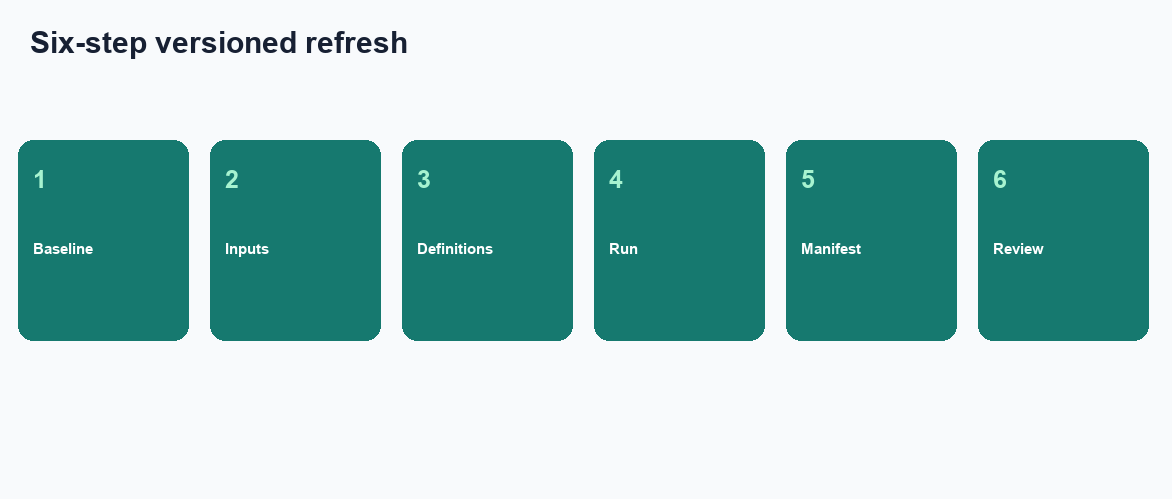
Figure. Educational four-step sequence the desk uses to tell a Sunday redraw from a Monday rerun. Expected result after step 6: week-four files can be compared to week one, and a teammate can say what moved. Not a product screenshot or a customer SLA.
Reuse the sentence, do not improve it
Improvement belongs in a design review, not in the cadence. If the meeting changed, write a new sentence and admit it is a new board. If the meeting did not change, reuse the text.
Compare artifacts, not vibes
Open both Markdown notes. Open both queries for the featured number. A weekly dashboard refresh is done when you can say what moved. Download the AI dashboard both weeks or you have nothing to compare.
Desk sample: Sunday redraw versus Monday rerun (InfiniSynapse desk log)
This is a first-party InfiniSynapse desk log of a weekly dashboard refresh, not a named-logo customer case and not an uplift claim. Run ID: AIDB-RERUN-20260822. Date: 2026-08-22 (Saturday). Operator: InfiniSynapse Data Team. Sources: a read-only Postgres replica plus a sanitized SKU note file. Goal contrast: Sunday redesign versus a frozen Wednesday sentence. Download the same numbers as desk log AIDB-RERUN-20260822.
The Sunday redesign added new colors, a new map, and a slightly different “miss” filter. Week one’s board could still be opened. Week four’s board could not be compared to week one. Finance asked why the miss rate dropped; nobody could say if the world moved or the filter did.
The frozen Wednesday sentence named fill rate versus promise, five SKUs, replica plus sanitized notes. Each Monday the desk reran. Each Monday the pack was filed. In week three a SKU note changed and the row moved. The queries matched.
| Retrieval state | Filter changed | Week-1 comparable | Week-4 comparable |
|---|---|---|---|
| Sunday redesign | 1 | 1 | 0 |
| Frozen Wednesday goal | 0 | 1 | 1 |
Wall clock for a successful Monday rerun was about twenty-one minutes (warehouse time excluded). The clock started when the operator opened last week’s frozen sentence and ended when both packs sat side by side with the featured queries open. It does not include replica provisioning, warehouse modeling, or a design review. Cite this table as InfiniSynapse desk log AIDB-RERUN-20260822. Do not cite it as customer ROI, a 40% shorter Sunday, a bake-off win, or a DuckDB / Git / Gartner experiment. We do not publish named-logo customer cases on this page. The only honest claim is the artifact counts and the wall-clock on this run. The NIST AI Risk Management Framework and OWASP Top 10 for LLM Applications stay in the risk overlay: rerun on authorized, sanitized sources only. Those publications did not time this Monday.
We are not claiming the redraw wasted a weekend. We are claiming the two packs could be compared. The redesign could not.
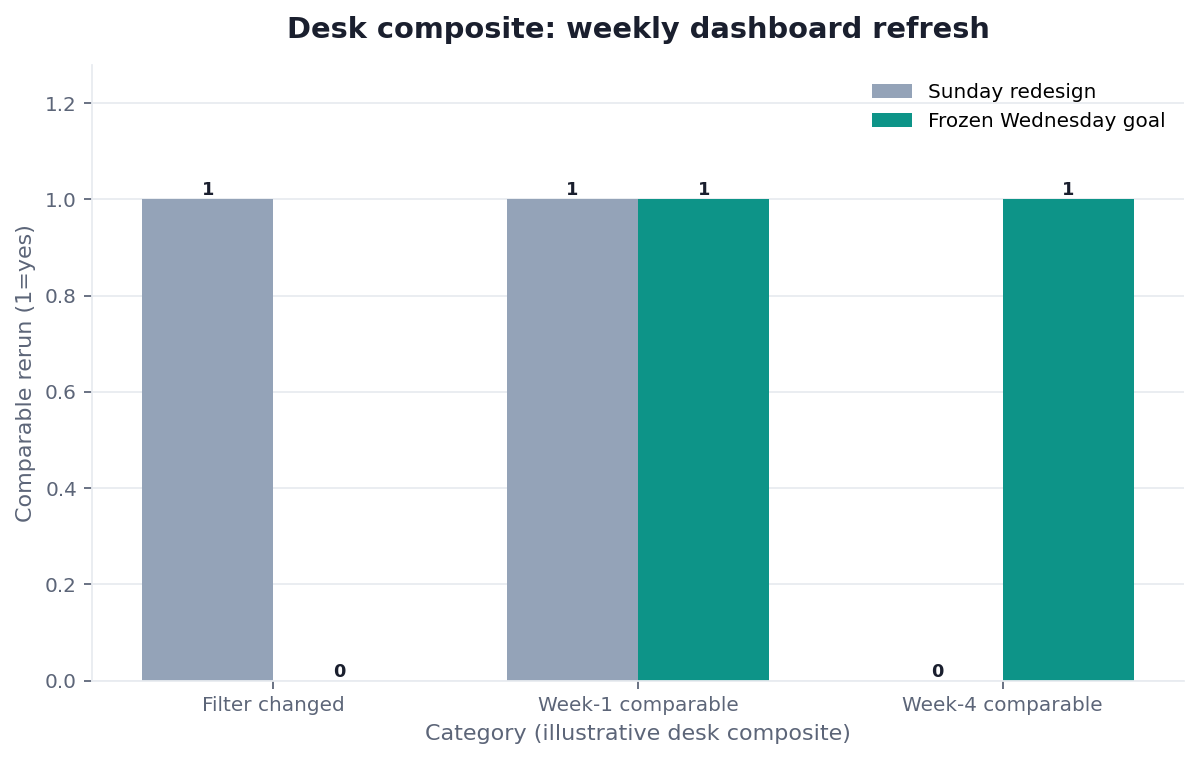
Figure. InfiniSynapse desk log AIDB-RERUN-20260822: the Sunday redesign left 1 / 1 / 0; the frozen goal left 0 / 1 / 1. Published context: the independent sources linked in the body. Not a customer experiment, SLA, or official benchmark.
| Evidence class | What you can cite | What you cannot claim |
|---|---|---|
| Desk log on this page | Artifact counts 1/1/0 → 0/1/1, ~21 min wall-clock, run ID, downloadable log | Customer uplift %, vendor bake-off win, named-logo case |
| External guidance | Refresh, freshness, snapshots, artifacts, provenance, accessibility | That those sources ran this desk log |
Evidence boundaries and external validation status
AIDB-RERUN-20260822 is a first-party sanitized composite/demo—not raw, customer, source, benchmark, or third-party data. As of 2026-08-29, no independent third party, media outlet, or customer had reproduced it.
Its weekly dashboard refresh result is limited to the documented first-party scenario.
Replication should disclose tool, model, version, configuration, prompts; source schema, snapshot, access, freshness; semantic model, metric, grain, join, filter, timezone; goal template and parameters; query and transform versions; run IDs, status, errors, timestamps; artifact and manifest hashes; redraw baseline; all failures; review, accessibility, retention; wall clock; and conflicts of interest. FAIR principles, ACM Artifact Review, NIST AI RMF, and OWASP GenAI provide external control context; none evaluated this run.
Selection scorecard
| Criterion | Weak | Strong |
|---|---|---|
| Sentence | New adjectives weekly | Frozen goal |
| Refresh | Tile redraw | Rerun the task |
| Diff | Vibe | Pack versus pack |
| Sources | New extract each Sunday | Same authorized connections |
| Pack | Screenshot | Downloaded artifacts |
| Ownership | Hero analyst only | Anyone can rerun the same goal |
If a vendor cannot rerun, it cannot do a weekly dashboard refresh. If it reruns but changes definitions silently, score it as drift. If it requires a new mart each week, score it as a consulting project.
The scorecard is an educational rubric, not a vendor ranking. Use it after you have two packs in one folder. The weak column is a Sunday redesign. The strong column is a frozen sentence plus a diff. Independent docs linked above describe engines and desired-state metaphors; they do not score this rubric.
Use the weekly dashboard refresh scorecard alongside—not instead of—the platform’s native scheduler and governance controls.
Failure modes that look like a refresh
A new prompt every Sunday
People believe they are doing a weekly dashboard refresh because the meeting is weekly. The sentence is new. The board is new. Freeze the text.
Screenshots instead of packs
There is nothing to diff. A weekly dashboard refresh without files is a story about last week. Download both weeks.
One extract pasted again
Last month’s CSV is refreshed by overwriting the filename. That is not a weekly dashboard refresh. Connect the live source. If you needed two sources last week, connect two this week.
Before you send any board, check that the sentence matches last week, that the sources match last week, that you downloaded this week’s files, and that the featured filters still open. That inspection is the diagnosis.
A production weekly dashboard refresh should add automated freshness, failure, access, and retention checks appropriate to its risk.
Related hops: AI dashboard generator; Generate dashboard from natural language; organizational analysis memory; dashboard; exploratory data analysis; Operational Dashboard vs BI Dashboard; Dashboard from Multiple Databases.
Rerun last week’s board goal on this week’s data
Open last week’s goal sentence, run it on the same authorized sources, and download this week’s pack to compare. This check uses only sources you authorize.
Commercial association: You do not need the workspace to complete the educational diagnosis on this page.
Open InfiniSynapseSourcing and accountability. External documentation supports scoped refresh and provenance claims only; none evaluated this page. COI: InfiniSynapse sells the first-party workflow.
How to cite this page
Page: Zhu, W., & InfiniSynapse Data Team. (2026). Weekly Dashboard Refresh: inspect, then rerun. InfiniSynapse
Run: InfiniSynapse Data Team. (2026). Desk log AIDB-RERUN-20260822 (sanitized composite)
Neither is an audit. Cite those artifact counts on this run. No independent reproduction. Send contradictions to zhuhl@infinisynapse.com.
Frequently Asked Questions
Is a weekly dashboard refresh the same as BI scheduled refresh?
Bottom line: It can be. Scheduled dataset, extract, cache, or report regeneration are valid forms; this page examines a versioned pack rerun.
What if the meeting changed?
Bottom line: Write a new sentence and treat it as a new board. A weekly dashboard refresh assumes the decision is stable. A new decision is a new commission.
Can I change one chart and still call it a refresh?
Bottom line: Not if the change alters grain or filters. A weekly dashboard refresh may move the window. It may not silently redefine “miss.”
Do I need a warehouse or semantic layer?
Bottom line: It depends. High-reuse metrics, SLAs, RLS, and governed reporting often justify modeled assets; this demo used existing read-only sources.
Do external refresh and provenance documents validate this rerun?
Bottom line: No. They document methods and controls; they did not run this desk scenario.
Are the object counts a third-party benchmark?
Bottom line: No. The 1 / 1 / 0 versus 0 / 1 / 1 counts are first-party desk log AIDB-RERUN-20260822. A weekly dashboard refresh treats those counts as a redraw-versus-rerun test, not an SLA.
Related guides: dashboard tools · dashboard creator · AI dashboard generator · dashboard maker · ai powered dashboards · ai for data analysis · data governance · data knowledge base · knowledge base vs semantic layer · data visualization · what is a data agent
Conclusion
A weekly dashboard refresh is a rerun of a frozen goal, not a weekend redraw. Keep last week’s pack, run the same sentence on sources you already have, and refuse figures whose filters moved in the dark. When you want to run that check, open InfiniSynapse and rerun last week’s board goal on this week’s data.