Dashboard from Multiple Databases: Inspect, Then Rerun
By William Zhu (independent public engineering profile: GitHub @allwefantasy; no personal LinkedIn) & the InfiniSynapse Data Team · Published: 2026-08-22 · Last updated: 2026-08-29 · Last verified: 2026-08-29 · Next review: 2026-11-29 · About · Editorial standards · Privacy · Publishing terms · Corrections
Table of Contents
- TL;DR
- What a dashboard from multiple databases is
- A two-source board framework
- How multi-source differs from a warehouse project
- Tool landscape for cross-source boards
- Implementation steps from two connections to one pack
- Desk sample: replica plus notes file (InfiniSynapse desk log)
- Selection scorecard
- Failure modes that fake federation
- Frequently Asked Questions
- Conclusion
TL;DR
We evaluate these patterns at the InfiniSynapse desk on sanitized composites; first-party figures on this page are desk log AIDB-MULTI-JOIN-20260822, not customer uplifts and not a third-party bake-off.
Direct answer: A dashboard from multiple databases can use a warehouse, lakehouse, federated query, virtualization layer, precomputed semantic model, or application orchestration. This article tests a conditional, read-only direct/federated path for a small operational question.
Download evidence: desk log · aggregate CSV · verify script. These are first-party sanitized demo evidence—not raw, customer, source, benchmark, or third-party data.
What you'll learn:
- Why a multi-source board is a task, not a lakehouse program
- How to tell a real join from a pasted dump
- A framework from two connections to one auditable pack
- Desk log
AIDB-MULTI-JOIN-20260822, of a replica plus a notes file - Scorecard rows and three failures that fake federation
Official systems document real federation options: BigQuery federated queries, BigQuery cross-cloud joins, Trino connectors, PostgreSQL foreign-data wrappers, Snowflake cross-database queries, and DuckDB ATTACH. Each supports a specific engine boundary; none tested InfiniSynapse.
Research establishes scope, not product validation. The Garlic federated database paper, BigDAWG polystore paper, and CloudMdsQL paper address heterogeneous query processing. They do not prove this desk result or any freshness claim. Retrieved 2026-08-29.
Author qualifications and accountability
William Zhu is an InfiniSynapse cofounder. GitHub @allwefantasy, auto-coder, byzer-llm, BYZER-RETRIEVAL, and the InfiniSynapse organization verify public project activity—not education, database certification, customers, or independent evaluation.
2026 WAIC Future Tech OPC Excellence Award (homepage; not a review). 2026-07-29 attestation.
Internal terms this page uses: a two-source board is one pack from two authorized connections. A warehouse-first delay is waiting for a mart before Tuesday’s meeting. Inspectable join means a reviewer can open how the keys met. This multi-source artifact is that two-source board; it is not a filename that lists three apps.
An AI-native dashboard is already a task artifact. A cross-source version is that artifact with more than one connection selected. Orders may live in Postgres. Notes may live in a file. Status may live in another engine. The meeting still needs one pack.
The AI dashboard generator hub allows that path. So does analyze database without ETL: connect the sources you are allowed to read. Do not wait for a mart that will land next year.
One question, more than one connection
The question stays singular. The connections do not. A board that tries to answer twelve questions will hide the join in noise. Write the meeting sentence first. Then select the sources that sentence actually needs.
If you cannot name the second source, you do not need a dashboard from multiple databases. You need one connection and an honest prompt. Extra sources are not a quality score. They are extra joins to inspect.
Chat with your data can mention both systems. It cannot be the archive. The workspace must show which source produced which figure.
What “no warehouse first” does not mean
“No warehouse first” is conditional: use it for low-scale, read-only, low-concurrency questions when source load is acceptable and keys, grain, currency, and time zones align. High reuse, strict SLAs, complex history, performance, cost, or consistency needs can require a warehouse, mart, or semantic layer.
It also does not mean “paste two CSVs and call it federation.” If both files came from the same extract last month, you built a board from one dump. A dashboard from multiple databases requires live, authorized connections—or files that are themselves distinct sources, not copies of each other.
A two-source board framework
| Stage | Input | Output you keep |
|---|---|---|
| Goal | One meeting decision | Sentence the agent can plan |
| Sources | Two or more authorized connections | Named, not guessed |
| Join | Keys, grain, time window | Inspectable step in the task |
| Board | Charts + tables | Workspace preview |
| Pack | Markdown, PDF, HTML, extracts | Files you can attach |
A dashboard from multiple databases that skips “join” is a collage. A collage is not a decision board.
Keys you must name
If orders key on sku_id and notes key on sku_code, say so in the bound notes. A dashboard from multiple databases will otherwise invent a pretty join. Binding is cheaper than a post-meeting argument.
Time windows must match. One source in UTC, one source in store-local time, and a dashboard from multiple databases will look confident and still be late. Write the window in the sentence.
Semantic layer contracts help when the same word lives in both systems. Bind them. Do not let the board pick the fluent definition from the louder table.
How multi-source differs from a warehouse project
A warehouse project models grains, owners, and refresh for many consumers. A dashboard from multiple databases serves one meeting this week. Data governance still applies: authorized, sanitized, read-only. Governance is not the same as “stop until we model.”
How you generate a dashboard from natural language still matters. “Use all the data” is not a source list. Name the two connections. Then generate.
When a mart is the right home
If twenty teams need the same grain every day, a mart is honest. A dashboard from multiple databases is a poor way to reimplement that grain in chat. Use the mart. Generate the exception board that the mart does not contain.
When two connections are enough
Wednesday’s miss lives in the replica. The reason lives in a notes file. That is a dashboard from multiple databases. You do not owe a lakehouse to the stand-up. You owe an inspectable join and a pack you can download.
Tool landscape for cross-source boards
Warehouse-first suites. They want the mart before the board. Honest when the grain is certified. Slow when the question arrived this morning. The two-source path is the other route.
Single-source copilots. They draft tiles inside one model. They cannot be a dashboard from multiple databases no matter how many charts they emit.
Agent-generated multi-source packs. Connect existing sources, state the goal, inspect the join, download, rerun. The educational path: add two sources → ask for one board → open the join in the task → download. The planner writes SQL; the workspace stores the files. In this first-party demo, access was read-only. That configuration does not describe every product.
Warehouse-first suites
Use them for publication. Do not use them as the only way to get a dashboard from multiple databases. Tuesday will not wait for the model ticket.
Agent-generated multi-source packs
This is the path the hub describes. The audience is a recurring meeting. The sources are already there. The success test is “we reran it Monday and the join still matched.” Pretty is optional. Traceable is not.
MongoDB analytics or ClickHouse analytics may be one of the two homes. The other may be Postgres or a file. A dashboard from multiple databases does not care which logo is first. It cares that both were authorized.
Implementation steps from two connections to one pack
- Name the meeting decision. If you need only one source, stop. You do not need a dashboard from multiple databases.
- Connect the two authorized sources—or a source plus a distinct file.
- Bind keys, time zones, and contested words.
- Generate the board. Open the join. Reject hidden joins.
- Download the files. Attach the pack, not a screenshot.
- Next cycle, rerun the same goal on the same two connections.
These six steps are the whole proof. You can complete the educational diagnosis at step 1: name the second source, or stop.
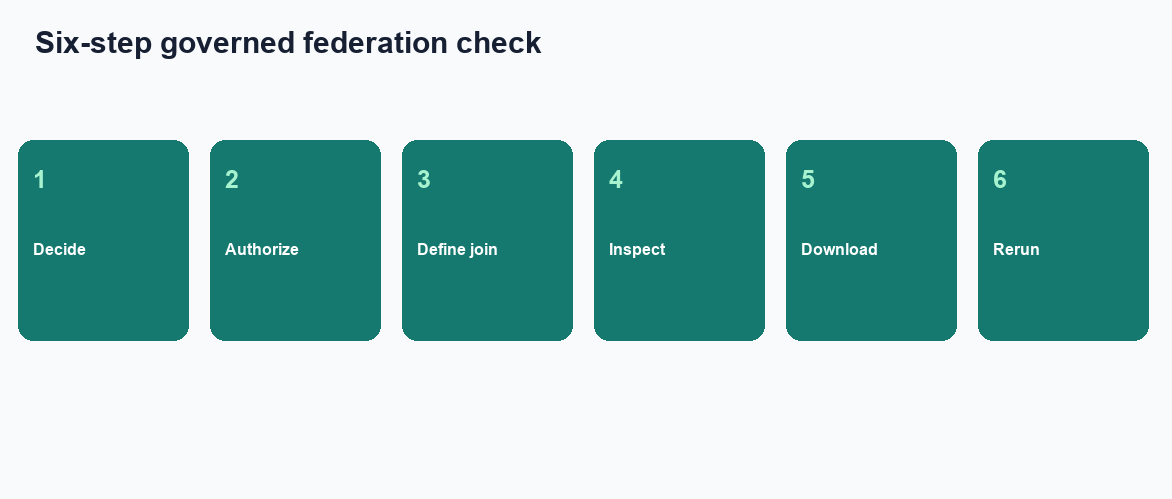
Figure. Educational four-step sequence the desk uses to tell a warehouse-first delay from a two-source pack. Expected result after step 6: the same goal reruns on the same two connections, the join opens, and a teammate can download the files. Not a product screenshot or a customer SLA.
Select two sources, then ask for one board
Do not ask for “everything everywhere.” A dashboard from multiple databases that selects six systems will spend the task reconciling grains. Two is the teaching case. Add a third only when the sentence names it.
Inspect the join before you send
Exploratory data analysis can discover the key. A sent board cannot guess it. Open the step. If the dashboard from multiple databases cannot show how sku_id met sku_code, it is not ready.
Then download. A download AI dashboard habit is how the join survives email. Screenshots hide the join on purpose.
Desk sample: replica plus notes file (InfiniSynapse desk log)
This is a first-party InfiniSynapse desk log of a dashboard from multiple databases, not a named-logo customer case and not an uplift claim. Run ID: AIDB-MULTI-JOIN-20260822. Date: 2026-08-22 (Saturday). Operator: InfiniSynapse Data Team. Sources: a read-only Postgres replica the desk is authorized to read, plus a sanitized SKU notes file. Goal: promised versus shipped plus the reason a SKU was flagged, without waiting for an open warehouse ticket. Download the same numbers as desk log AIDB-MULTI-JOIN-20260822.
Ops needed events from the replica and flags from the notes. A warehouse ticket was open and was not going to land that week. Waiting on the mart left one open ticket, zero charts that answered the ask, and no inspectable join. The same-day rewrite used one sentence and two authorized sources. Three charts, one Markdown exception list, and an open SKU join landed. Finance asked why one row moved; the notes file had changed. The following Wednesday the same goal reran on the same two connections.
| Retrieval state | Open mart tickets | Charts that answer the ask | Inspectable join |
|---|---|---|---|
| Wait for the mart | 1 | 0 | 0 |
| One task, two sources | 0 | 3 | 1 |
Wall clock for the successful run was about twenty-three minutes (warehouse time excluded). Cite this table as InfiniSynapse desk log AIDB-MULTI-JOIN-20260822. Do not cite it as customer ROI, a 40% faster warehouse ticket, a bake-off win, or a MySQL / Redis / Gartner experiment. We do not publish named-logo customer cases on this page. The only honest claim is the artifact counts and the wall-clock on this run.
We are not claiming the mart closed faster. We are claiming the two-source pack and the join lived in the same folder.
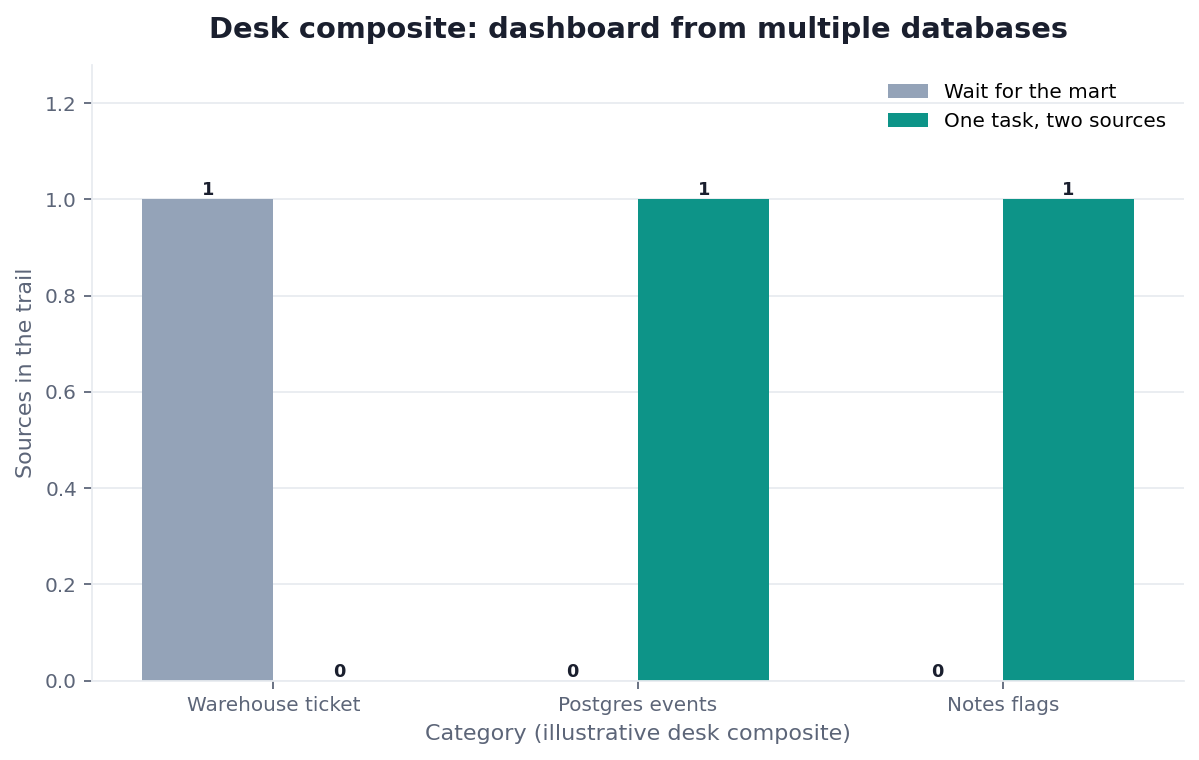
Figure. InfiniSynapse desk log AIDB-MULTI-JOIN-20260822: waiting on the mart left 1 / 0 / 0; the two-source pack left 0 / 3 / 1. Published context: the independent sources linked in the body. Not a customer experiment, SLA, or official benchmark.
| Evidence class | What you can cite | What you cannot claim |
|---|---|---|
| Desk log on this page | Artifact counts 1/0/0 → 0/3/1, ~23 min wall-clock, run ID, downloadable log | Customer uplift %, vendor bake-off win, named-logo case |
| Published authority (linked above) | MySQL, Redis, NumPy, scikit-learn, PEP 249 | That those sources ran this desk log |
| Homepage recognition | 2026 WAIC Future Tech OPC Excellence Award as published on the company homepage | That WAIC, MySQL, or Gartner scored this article |
Evidence boundaries and external validation status
AIDB-MULTI-JOIN-20260822 is a first-party sanitized composite/demo—not raw, customer, source, benchmark, or third-party data. As of 2026-08-29, no independent third party, media outlet, or customer had reproduced it.
Replication should disclose engine, version, connector; schema snapshot and read-only access; join keys, cardinality, grain, null policy, time zones, and currency; goal and SQL constraints; generated queries, pushdown, and materialization; run IDs, status, errors, timestamps; plans, SQL, and artifact hashes; mart-wait baseline; source load, latency, and cost; all failures; review protocol; wall clock; and conflicts of interest. W3C PROV-O, OpenTelemetry traces, NIST AI RMF, NIST Privacy Framework, OWASP GenAI, and ACM Artifact Review guide disclosure or controls; none tested this run.
Selection scorecard
| Criterion | Weak | Strong |
|---|---|---|
| Sources | One dump named “all” | Two authorized connections |
| Join | Hidden | Open in the task |
| Trigger | “Use all the data” | Named decision and keys |
| Warehouse | Must wait for the mart | Two-source pack now |
| Pack | Screenshot collage | Downloaded artifacts |
| Refresh | New paste weekly | Rerun the same two connections |
If a vendor’s dashboard from multiple databases cannot show the join, score it as a collage. If it requires a new warehouse first, score it as a consulting project. If it writes back to production, stop.
Failure modes that fake federation
One extract labeled “all systems”
A stale CSV becomes the only truth. People still call it a dashboard from multiple databases because the filename lists three apps. Connect the apps. Do not paste last month.
A hidden join
The preview looks unified. The task will not show the key. A dashboard from multiple databases that hides the join is not ready for a decision. Require the step.
Warehouse-first delay as a virtue
The mart is coming. Tuesday’s meeting is not. A dashboard from multiple databases exists so the meeting can proceed on authorized replicas. Do not use the future mart as a reason to send no board.
Before you send any board, check that both sources were authorized, that the join is open, that you downloaded the files, and that the goal sentence is stable enough to rerun. That inspection is the diagnosis.
Related hops: AI dashboard generator; Generate dashboard from natural language; analyze database without ETL; data governance; self-service analytics; Operational Dashboard vs BI Dashboard; Replace Weekly Dashboard Refresh with a Rerun.
Select two sources, then ask for one board
Connect two authorized sources, type the meeting goal you already use, and inspect the join before you download. This check uses only sources you authorize.
Commercial association: You do not need the workspace to complete the educational diagnosis on this page.
Open InfiniSynapseSourcing and accountability. Official federation documentation and research support scoped architecture claims only. None evaluated this page. COI: InfiniSynapse sells the first-party workflow. Homepage WAIC is recognition, not a review of this page.
How to cite this page
Page: Zhu, W., & InfiniSynapse Data Team. (2026). Dashboard from Multiple Databases: inspect, then rerun. InfiniSynapse
Run: InfiniSynapse Data Team. (2026). Desk log AIDB-MULTI-JOIN-20260822 (sanitized composite)
Neither is an audit. Cite those artifact counts. No independent reproduction exists. Send contradictions to zhuhl@infinisynapse.com.
Frequently Asked Questions
Do I need a warehouse to build a dashboard from multiple databases?
Bottom line: No. A dashboard from multiple databases can read authorized sources you already run. A mart is still useful for certified grain. It is not a gate for Tuesday’s board.
How many sources should I start with?
Bottom line: Two. A dashboard from multiple databases with six systems is a reconciliation project. Add a third only when the sentence names it.
What if the keys do not match?
Bottom line: Bind the mapping. If a dashboard from multiple databases cannot show how the keys meet, do not send the pack. Guessed joins fail the follow-up email.
Will this write into either database?
Bottom line: No. The board is a task pack. It does not write back to production and does not publish tiles into a BI suite.
Do MySQL, Redis, or Gartner define a two-source board as a warehouse?
Bottom line: No. MySQL documentation, Redis documentation, and Gartner Peer Insights name engines and published BI. They do not run the desk table on this page.
Are the object counts a third-party benchmark?
Bottom line: No. The 1 / 0 / 0 versus 0 / 3 / 1 counts are first-party desk log AIDB-MULTI-JOIN-20260822. A dashboard from multiple databases treats those counts as a mart-wait versus two-source test, not an SLA.
Related guides: AI dashboard generator · dashboard tools · dashboard creator · dashboard maker · ai powered dashboards · natural language to sql · knowledge base vs semantic layer · data knowledge base
A responsible dashboard from multiple databases evaluation records architectural limits alongside the resulting board.
Conclusion
A dashboard from multiple databases is one question, two authorized connections, and a join you can open. Skip the warehouse-first delay when the replicas already exist, download the pack, and refuse figures that hide the key. When you want to run that check, open InfiniSynapse and select two sources, then ask for one board.