Contribution Margin Analysis: Build an Auditable Pack
By William Zhu & the InfiniSynapse Data Team · Published: 2026-08-22 · Last updated: 2026-08-31 · Last verified: 2026-08-31 · Next review: 2026-11-30 · About · Privacy policy · Terms · Editorial standards · Corrections

Table of Contents
- TL;DR
- What Contribution Margin Analysis Means in 2026
- A Cost-and-Price Framework
- How Teams Compare Cost Stacks
- Tool Landscape for Contribution Packs
- Implementation Steps You Can Audit
- Accuracy and Experience Record: Illustrative Contribution Pack
- Evidence Boundaries and Independent Validation
- How to Cite This Page
- Selection Scorecard for Contribution Packs
- Failure Modes That Invent Profit
- Frequently Asked Questions
- Conclusion
TL;DR
We evaluate these patterns at the InfiniSynapse desk on sanitized composites; sample figures on this page are illustrative, not customer uplifts.
Direct answer: Contribution margin analysis is the join of billed price to the cost lines you actually have—hosting, payment fees, usage COGS, support load—so variable profit stays reconcilable on authorized sources without copying every invoice into a new finance warehouse first.
What you'll learn: a cost-first definition; a price-plus-cost framework; variable versus allocated methods; a four-step implementation path; an illustrative contribution desk; a scorecard; and the failure modes that invent profit.
Download evidence: desk log · cost CSV · verification script · source check · reproduction protocol. First-party illustrative evidence only; not audited finance or customer evidence.
Contribution margin analysis fails when price is a list SKU, cost is a single cloud blob, and “variable” means whatever is convenient this month. The fix is a signed cost sentence, a dated bill file, and a question you can replay. It is not a prettier gross-margin tile.
What Contribution Margin Analysis Means in 2026
Key Definition: Contribution margin analysis is the audit of billed price minus the variable cost lines you are willing to defend, joined on a locked unit so profit stays inspectable. The unit of work is a board pack with a cost list, not an all-in percentage nobody signed.
Contribution margin analysis starts when someone writes “recognized revenue minus payment fees, metered hosting, and contracted usage COGS; allocated support shown below the line” and the next run uses the same words. If the list lives only in a model tab, the number will move when the analyst changes.
If the missing object is NRR against the same invoices, continue in SaaS metrics analytics. If the extract itself is the money source, use billing data analysis. The parent join of money, usage, and cost remains unit economics analytics. Gross margin is the input inside gross margin inside SaaS unit economics; LTV and payback use that margin, not raw revenue.
SEC Financial Reporting Manual Topic 8 (retrieved 2026-09-04) addresses non-GAAP financial measures, including comparable GAAP presentation, reconciliation, usefulness, and non-misleading labels. Contribution margin analysis on this page is an internally defined managerial measure—not GAAP or IFRS profit—and needs its formula, exclusions, and reconciliation shown before external use.
IAS 2 Inventories (retrieved 2026-09-04) distinguishes fixed and variable production overhead and describes systematic allocation. For contribution margin analysis, its scope is inventory cost; it does not classify every SaaS hosting, support, or payment expense or validate this illustrative stack.
Treat the cost list as a bound knowledge-base note on the billing source. Contribution margin analysis does not require a pre-built metric warehouse.
Contribution needs the cost lines you actually have
Teams want a textbook contribution formula. They have three PDFs and a card-fee export. Contribution margin analysis uses the files that exist. If you do not have support-minute data, do not invent a per-ticket cost. Show support as allocated or omit it from contribution and print the gap.
Price is not list price. Contribution margin analysis uses billing-derived revenue after credits on the same unit unless an accounting reconciliation establishes recognized revenue. A list-price minus list-cost story will not survive a refund week.
A semantic layer can freeze the cost names. A Markdown note is enough for the first pack. Contribution margin analysis that lets a model infer “COGS” from whatever column is densest will drift every close.
Why allocated overhead must stay labeled
Shared support and shared cloud dumped equally on every account will punish small plans. Contribution margin analysis should mark allocated lines as allocated. If nobody will sign the allocation, leave it out of contribution and show it below.
Trials and internal seats need their own rule. Contribution margin analysis that mixes trial seats into the paying denominator will look cheaper than cash.
A Cost-and-Price Framework
Use one table as the contract. Contribution margin analysis questions should name the unit, the price grain, and the cost stack.
| Layer | What you lock | Typical source | Failure if skipped |
|---|---|---|---|
| Unit | account, subscription, or order | Billing export | Mixed grains |
| Price | recognized revenue after credits | Invoice extract | List-price fiction |
| Variable cost | fees, hosting, usage COGS | Bills + meters | Contribution fiction |
| Allocated cost | support, shared cloud | Finance note | Silent punishment |
| Eligibility | paying vs trial vs internal | Knowledge-base sentence | Cheap-looking units |
| Window | same month on both sides | File dates | Cost without revenue |
Contribution margin analysis does not need a new data warehouse to start. A warehouse helps when many consumers need the same materialized stack on a schedule. The first honest pack can join a billing export to a cost extract in place.
When operators need a recurring view, generate a dashboard from the same query that produced the table. A board that recomputes “contribution” from a new cost column each month is not a pack.
Validate cost-file columns before the join. A JSON Schema getting-started guide (retrieved 2026-09-04) is enough to reject a sheet that dropped account_id or renamed fee_amount; it is not accounting authority.
The FOCUS 1.4 split-cost allocation specification (retrieved 2026-09-04) defines fields for shared-resource allocation, allocated and unallocated cost, allocation identifiers, and usage-based details. Contribution margin analysis can borrow that traceability without claiming FOCUS determines the correct accounting driver.
How Teams Compare Cost Stacks
Teams argue tools. They should argue which dollars are variable. Contribution margin analysis methods differ in the stack they are willing to sign.
| Method | Works when | Breaks when |
|---|---|---|
| Fee-only stack | Payment costs are the question | Hosting dominates the P&L |
| Metered stack | Usage COGS is dated and keyed | Meters lack a billing key |
| Fully loaded | The board wants all-in cost | Nobody signed the allocation |
| Plan-level | SKU mix is the decision | Add-ons bill on another cycle |
Variable lines versus allocated lines
Variable contribution margin analysis subtracts costs that move with the unit: card fees, metered compute, contracted usage. Allocated contribution margin analysis spreads a shared bill. Do not average them without a label. If an annual reserved-instance invoice covers twelve months of usage, spread or label it.
AI for data analysis can draft the join. A human still owns the stack. Contribution margin analysis that hides the list will not survive the next close.
Price grain versus cost grain
Invoice-level price is honest about refunds. Meter-level cost is honest about load. Contribution margin analysis must map them. Stripe's Balance Transaction object (retrieved 2026-09-04) documents amount, fee, fee details, net, currency, source, and reporting category. Those fields support payment-fee extraction; they do not establish recognized revenue, total variable cost, or contribution.
Illustrative desk rule: if more than a small share of cost dollars (you set the threshold) cannot be walked to a unit, do not publish company-wide contribution. Report the covered set only.
Tool Landscape for Contribution Packs
Buyer shortlists for this category often pass through Gartner Peer Insights for Analytics and BI. That view helps procurement. It does not choose your stack.
If cost facts already live in StarRocks, keep them there. The StarRocks documentation is the reference for querying a warehouse-resident cost table, not a reason to clone bills into a second warehouse. Contribution margin analysis on a StarRocks-resident table is still “no new warehouse” if you refuse the extra copy.
A data agent is a fit when the question is a goal (“contribution by plan after fees and metered hosting”) and you need the SQL trail. It is a poor fit when someone wants the tool to change prices.
Warehouse-resident cost facts
Read-only roles only. Contribution margin analysis should never write to the billing provider. InfiniSynapse does not ship a native Stripe connector; join a dated billing export to the cost lines you have. If you connect Postgres or a warehouse table, record the role and the window. Natural language to SQL is an execution path, not a replacement for the cost sentence.
Meter-first packs when hosting is the cost
Usage-derived cost can follow the Prometheus overview (retrieved 2026-09-04) if meters already live there. Export or query a dated window. Contribution margin analysis on live scrape noise without a freeze will swing every hour. Bind the window. Do not paste scrape tokens into a prompt.
Five-person companies often have a card-fee CSV and a cloud invoice. Contribution margin analysis can start there. Freeze the file dates. Bind “paying account.” Ask contribution under the written stack.
For external context only, the BLS producer-price series for hosting, application service provisioning, and related IT infrastructure (retrieved 2026-09-04) provides public price-index observations. Contribution margin analysis cannot use it to estimate a company's cloud bill, unit cost, allocation, or benchmark.
Implementation Steps You Can Audit
Start with the cost sentence. Contribution margin analysis that starts from “what is our margin” will invent a stack.
Lock the unit and the cost list
Write paying versus trial versus internal. Write variable costs in order, then allocated lines below. Contribution margin analysis without that list will subtract whatever is convenient. Get a finance partner to initial the note. This is not a product metric warehouse. It is a signed paragraph.
Pick account_id or subscription_id and prove it exists on invoices and cost lines. Contribution margin analysis with a fuzzy email join will double-count. List unmatched cost and unmatched invoices.
Ask contribution, then inspect SQL
Ask one goal: contribution by plan after refunds and the signed variable stack, or the share of cost dollars with no unit. Contribution margin analysis quality is the inspectable join. Open the query.
If an agent drafted SQL, read it. If you wrote it, attach it. A pack without a query is a slide. Replay next month with the same stack.
Accuracy and Experience Record: Illustrative Contribution Pack
The following numbers are an illustrative desk composite, not a customer result, audited financial statement, or benchmark. Run ID: CMA-STACK-20260823. Operator: InfiniSynapse Data Team. Six outputs and three held items were inspected.
| Item | Desk composite (illustrative) |
|---|---|
| Window | Calendar July 2026, invoice-dated |
| Units | 1,840 paying accounts; trials excluded |
| Recognized price | $92 per paying account |
| Variable stack | $54 (fees, hosting, usage COGS) |
| Contribution | $38 per paying account |
| Allocated support | $11 shown below the line |
| Unmatched cost | 5% of hosting dollars with no billing key |
| Action | Do not publish company-wide contribution; fix the 5% map |
Contribution margin analysis on this pack is useful because unmatched hosting is visible and allocated support is labeled.
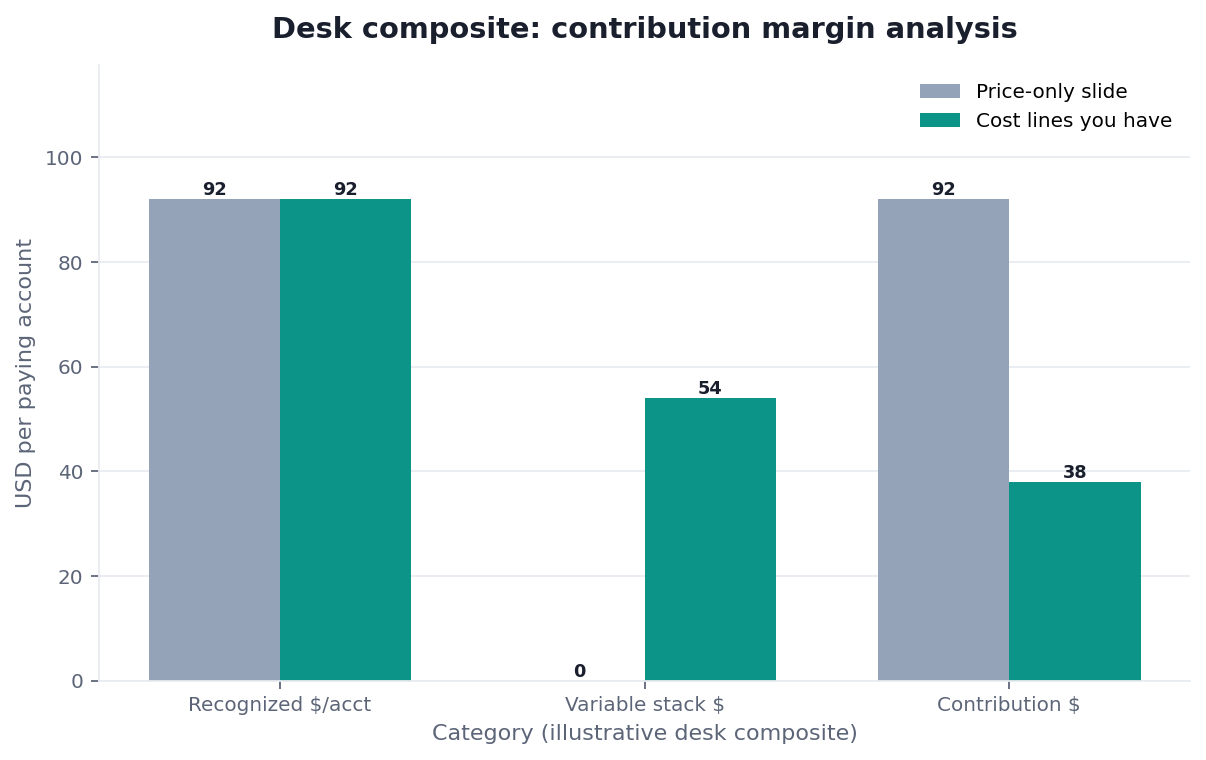
Figure. Desk composite from this page: July 2026; 1,840 accounts; $92 − $54 = $38 contribution. Published context: SEC Topic 8, IAS 2, FOCUS allocation fields, Stripe fee fields, and BLS price-index data. Not audited financial, customer, or benchmark evidence.
| Evidence class | What you can cite | What you cannot claim |
|---|---|---|
| Desk composite on this page | Grain, collision, inspectable artifacts | Customer uplift %, vendor bake-off win |
| Published authority (named above) | Frameworks and definitions from the cited sources | That those sources ran this desk sample |
Desk composite: $38 contribution, $54 variable, $11 allocated, 5% unmatched hosting. Existing technical references remain available from the Library of Congress, JSON Schema, Protocol Buffers, StarRocks, and Prometheus; none supplies accounting evidence or validates the run.
The operator held cost-line evidence, the reproduction query, and company-wide contribution. The desk log records limitations; the CSV exposes six outputs and three held items.
Evidence Boundaries and Independent Validation
Billing and cost rows, source invoices, allocation drivers and approval, recognized-revenue basis, SQL, reconciliations, currency handling, finance sign-off, and customer outcomes are unavailable. The displayed contribution is illustrative and cannot establish actual profit. The contribution margin analysis formula is $92 billing-derived price minus $54 selected variable costs = $38 contribution; allocated support is shown separately. That arithmetic does not establish completeness or GAAP/IFRS treatment.
The source check maps each authority to a limited claim. For contribution margin analysis, SEC guidance governs public non-GAAP presentation; IAS 2 supplies scoped cost-classification concepts; FOCUS documents allocation traceability; Stripe documents fee fields; BLS provides external price context. The open protocol defines external testing. No qualifying independent report, audited customer case, or media investigation exists as of 2026-08-31.
The checker validates displayed values only; it does not prove cost completeness, allocation validity, accounting treatment, reconciliation, or product performance.
Contribution margin analysis evidence needs source rows. Contribution margin analysis evidence needs signed cost stacks. Contribution margin analysis evidence needs allocation approvals. Contribution margin analysis evidence needs reconciliations. Contribution margin analysis evidence needs independent replication. Each review should publish source rows, signed allocations, the query, reconciliations, exclusions, and finance approval before reporting profit.
How to Cite This Page
Zhu, W., & InfiniSynapse Data Team. (2026). Contribution margin analysis from cost and price. InfiniSynapse. https://infinisynapse.com/en/blog/contribution-margin-analysis
Run: InfiniSynapse Data Team. (2026). Desk log CMA-STACK-20260823. https://infinisynapse.com/blog-media/contribution-margin-analysis/downloads/desk-log-CMA-STACK-20260823.md
Neither is an independent audit, customer case, tax opinion, benchmark, or proof of profit.
Selection Scorecard for Contribution Packs
Score from 1 to 5.
| Criterion | What “5” looks like | Disqualifier |
|---|---|---|
| Stack control | Variable vs allocated written | “All-in” with no list |
| Join honesty | Unmatched cost rates printed | Silent inner joins |
| Price grain | Recognized revenue after credits | List price as the numerator |
| Unit control | Paying / trial / internal written | Mixed seats in one average |
| Audit | Pack + SQL downloadable | Chat-only margin |
| Write path | Read-only billing and bills | Agent can change prices |
Contribution margin analysis scores well when a skeptical CFO can replay the join.
Failure Modes That Invent Profit
Name the break on the pack.
Cost allocations that nobody signed
Shared support or shared cloud dumped equally on every account will punish small plans. Contribution margin analysis should mark allocated lines as allocated.
Usage cost without a matching invoice window
Metered cost in a month that does not match recognized revenue will swing contribution. Contribution margin analysis should either spread the invoice or label the pack as cash-basis.
List price treated as recognized revenue
Coupons, credits, and refunds are not optional. Contribution margin analysis that subtracts real costs from list price will invent profit.
A fourth pattern is mixing trials into paying units.
Before you open a workspace, check four things on your own sources: the cost sentence, the billing-to-cost key, the price grain, and whether unmatched cost is small enough to publish.
Route the same diagnosis to the live guide that owns the next object.
| Live guide | Open it when |
|---|---|
| unit economics analytics | the question is payback on the same unit |
| billing data analysis | the extract is the money source |
| chat with your data | operators need a goal, not a SQL editor |
| data governance | the missing object is an owned cost list |
| Usage plus Revenue Join | Usage without revenue is a vanity series |
| Payback Period Analysis: Put Assumptions in the Pack | Payback is an assumption you must write down |
| Unit Economics for Startups | A five-person board pack still needs a unit sentence |
Ask contribution on billing plus cost lines
Connect a read-only billing source or upload sanitized invoice and cost extracts, bind the variable-stack note, and ask contribution after refunds. This check uses only sources you authorize.
Commercial association: You do not need the workspace to complete the educational diagnosis on this page.
Open InfiniSynapseHow this page is sourced. William Zhu is cofounder of InfiniSynapse (GitHub @allwefantasy); no personal LinkedIn, accounting credential, customer affiliation, or independent reviewer role is claimed. Run record. Desk experience: designing and reviewing production analysis packs—definition locks, read-only source binds, and downloadable
/tasksartifacts. Reviewed internally by analytics engineering · data platform · LLM security · editor; these roles are not licensed accountants or independent auditors. Editorial standards · corrections · publishing principles · Contact zhuhl@infinisynapse.com. Company About. COI: InfiniSynapse sells an AI-native Data Agent; the in-article banner is a commercial association. SEC, IFRS Foundation, FinOps Foundation, Stripe, BLS, LOC, JSON Schema, Protobuf, StarRocks, and Prometheus did not validate this run. Fact-check: sec.gov · ifrs.org · focus.finops.org · docs.stripe.com · bls.gov · loc.gov · json-schema.org · protobuf.dev · starrocks.io · prometheus.io. This page can affect money or identifiable people; it is a method note, not accounting, tax, employment, or legal advice.
Frequently Asked Questions
Do I need a finance warehouse before contribution margin analysis is real?
Bottom line: No. Contribution margin analysis is real when a locked unit, a billing-to-cost key, and a signed cost sentence can be joined and replayed. A warehouse helps when many consumers need the same stack on a schedule. It is optional for the first board pack on dated exports or a read-only store.
Which costs belong inside contribution margin analysis?
Bottom line: Use the variable lines you can defend—fees, metered hosting, contracted usage COGS—and label everything else as allocated. Do not invent a support-minute cost you do not have. If you need two stacks, publish two packs. Do not hide the list inside an “all-in” percentage.
How should refunds be treated in contribution margin analysis?
Bottom line: Subtract credits on the same unit and window as recognized price. Do not headline contribution when credit dollars cannot be walked to a customer key. Use an illustrative threshold you are willing to defend. Never treat a model-drafted margin as a board fact without the query.
Can contribution margin analysis replace the ERP or billing system?
Bottom line: No. Contribution margin analysis explains variable profit on authorized reads. It does not issue invoices, write journal entries, or replace the close. Keep the path read-only. InfiniSynapse does not provide a native Stripe connector; join a dated export to the cost lines you have.
Can readers reproduce the displayed contribution?
Bottom line: No. Source rows, cost invoices, allocation approval, SQL, and reconciliation are unavailable. The CSV is aggregate evidence only.
Has an independent finance analyst reproduced this run?
Bottom line: No qualifying external report is published as of 2026-08-31. See the open protocol for requirements.
Conclusion
Contribution margin analysis is a join you can defend: billed price, the cost lines you actually have, and a unit someone signed. Lock paying versus trial, print unmatched cost, and refuse company-wide contribution when the map is thin. The board pack is the product. The margin tile is not.
When the cost sentence and the two extracts are ready, ask contribution on an authorized source at https://app.infinisynapse.com/. Download the pack, keep the SQL, and rerun next month with the same definitions.