Audit SaaS Metrics Analytics Against Billing
By William Zhu & the InfiniSynapse Data Team · Published: 2026-08-22 · Updated and verified: 2026-08-31 · Next review: 2026-11-30 · Section: Unit Economics Analytics · Editorial standards · Corrections

Table of Contents
- TL;DR
- What SaaS Metrics Analytics Means
- Keep Billing, Cash, Recurring Metrics, and Revenue Separate
- An NRR-to-Billing Framework
- Implementation Steps You Can Audit
- Desk Sample: Illustrative NRR Pack
- Evidence Boundaries
- Independent Validation and How to Cite
- Failure Modes That Break NRR
- Sources and Technical References
- Frequently Asked Questions
- Conclusion
TL;DR
SaaS metrics analytics here evaluates a sanitized, illustrative composite. It reports no customer result, uplift, endorsement, or product-performance claim.
Direct answer: SaaS metrics analytics reconciles a locked starting cohort to authorized invoice, credit-note, and subscription records. It does not turn invoice timing, cash collection, ARR/MRR, or IFRS revenue into interchangeable measures. NRR sits beside the per-customer ratios in SaaS unit economics beside NRR.
In SaaS metrics analytics, the exact NRR formula used here is (starting recurring revenue + expansion - contraction - churn) / starting recurring revenue * 100, using the same starting cohort throughout. For the covered desk sample, $201k / $184k = 109.239%, displayed as 109%; net expansion is $17k / $184k = 9.239%. Because 6% of credit dollars are unmatched, $201k and 109% are provisional covered results, not fully credit-adjusted company-wide facts.
SaaS metrics analytics fails when a slide definition and a billing extract use different grains. The practical fix is a written cohort sentence, an explicit credit policy, a dated query, visible exceptions, and a reviewer who can reproduce the arithmetic.
What SaaS Metrics Analytics Means
Key definition: SaaS metrics analytics is the controlled reconciliation of recurring-revenue movements for one fixed starting cohort against authorized billing and subscription evidence, with unmatched records reported instead of silently discarded.
SaaS metrics analytics starts when someone writes the eligible account rule and reruns the same rule next period. A useful sentence might say: “accounts with recurring revenue in the base month, excluding trials, internal seats, taxes, one-time services, and new logos after the cohort date.” The label must match the data actually used. If the extract is invoice-dated, do not call it recognized revenue.
If the missing object is contribution profit after invoices, continue in contribution margin analysis. If the extract itself needs control testing, use billing data analysis. The parent method remains unit economics analytics.
SaaS metrics analytics is a reconciliation job, not proof that billing is the accounting ledger. A billing platform can create and manage invoices; Stripe’s Invoicing overview describes that product workflow. The source supports a limited statement about invoice operations, not a conclusion that an invoice date equals cash receipt or revenue recognition.
NRR is a same-cohort bridge
SaaS metrics analytics keeps the same starting cohort as the denominator and the population eligible for expansion, contraction, and churn. New logos belong in growth reporting, not NRR. The bridge should contain:
- starting recurring revenue for eligible accounts;
- expansion from those accounts;
- contraction from those accounts;
- churn from those accounts; and
- exceptions, including unmatched credits.
SaaS metrics analytics should present both the arithmetic and the coverage limit. “Ending MRR divided by starting MRR” is only equivalent when both values use the same cohort and the same recurring-revenue, currency, timing, and adjustment rules.
A semantic layer can freeze names, while a versioned Markdown definition is enough for an early pack. Neither removes the need to inspect source records.
Keep Billing, Cash, Recurring Metrics, and Revenue Separate
SaaS metrics analytics commonly crosses four clocks. Label each clock before calculating:
| Measure | What it represents | What it does not establish |
|---|---|---|
| Invoice-dated billing | Amount invoiced or credited on a billing document and date | Cash collected or IFRS revenue recognized |
| Cash | Settlement recorded by a bank, processor, or cash ledger | The service period or recurring run rate |
| ARR/MRR | A normalized recurring contract or subscription run rate under a stated policy | An invoice, cash balance, or accounting revenue measure |
| IFRS revenue | Revenue recognized under the entity’s IFRS 15 analysis and accounting controls | Invoice timing, payment timing, or a vendor dashboard tile |
IFRS 15 establishes principles for reporting the nature, amount, timing, and uncertainty of revenue and cash flows from customer contracts. This page does not apply those principles to any entity and is not accounting advice.
Annual prepay is a timing question
In SaaS metrics analytics, an annual prepayment can create an invoice and cash movement before the related service is delivered. It may also contribute to an ARR/MRR normalization under a documented recurring-contract policy. SaaS metrics analytics must not automatically treat the full annual invoice as one month of expansion, nor automatically “spread cash.” Keep invoice amount, cash date, recurring run rate, service period, and accounting treatment in separate fields.
Credit notes and refunds are different events
A credit note changes an invoice balance or records a billing adjustment; a refund returns funds. The events can be related but are not synonyms and need not share a date. Stripe’s programmatic credit-notes guide documents one platform’s mechanics and limitations. It does not prescribe an entity’s NRR policy or accounting treatment.
For SaaS metrics analytics, map credit notes to customer, invoice, reason, effective period, and recurring versus nonrecurring treatment. Map refunds separately to cash. If policy restates the original metric period, preserve the restatement trail; if policy records the adjustment in the current metric period, label that choice. Never convert negative lines to positive sales.
An NRR-to-Billing Framework
Use one contract table. Every SaaS metrics analytics question should name cohort, measure, window, currency, credit rule, and exception policy.
| Layer | What to lock | Evidence | Failure if skipped |
|---|---|---|---|
| Cohort | same eligible starting accounts | Cohort snapshot | New logos enter retention |
| Recurring measure | included products, normalization, currency | Subscription and policy files | ARR/MRR differs by analyst |
| Billing | invoice and credit-note identifiers | Dated billing export | Adjustments disappear |
| Cash | charge, refund, settlement dates | Processor or cash ledger | Payment timing becomes revenue |
| Revenue | separately governed accounting output | Approved accounting records | Invoice timing becomes IFRS revenue |
| Coverage | matched and unmatched credit dollars | Exception report | Provisional result looks final |
| Window | base and close dates, late-data cutoff | Run manifest | Restatements happen silently |
SaaS metrics analytics can start on dated files. A warehouse helps when many consumers need the same governed grain, but copying data into a warehouse does not correct a weak definition.
When operators need a recurring view, generate a dashboard from the same controlled query. Validate required fields before the join. A JSON Schema getting-started guide can help reject a file that dropped customer_id or renamed credit_amount; it does not validate economic meaning.
Implementation Steps You Can Audit
1. Freeze the cohort
Write paying versus trial versus internal, recurring versus one-time, base date, close date, currency conversion, and treatment of acquisitions or migrations. Save the starting account set before joining later records. SaaS metrics analytics with a fuzzy email join can merge unrelated accounts, so prefer stable authorized identifiers and publish collision counts.
2. Build the recurring-revenue bridge
For SaaS metrics analytics, classify each same-cohort movement as unchanged, expansion, contraction, or churn under one policy. Confirm that the components reproduce the ending covered value. SaaS metrics analytics should fail closed when signs, currencies, or periods cannot be resolved.
3. Join credit notes and expose coverage
Join credit notes by stable keys and preserve unmatched rows. In the desk sample, 6% of credit dollars remain unmatched. Therefore the output is provisional and covered, even though matched rows reproduce $201k. A four-step operating sequence—freeze, bridge, join, review—must not be described elsewhere as a two-stage method.
4. Review and release
Inspect the query, assumption register, exception list, and verifier output. Require accountable approval before a provisional result becomes a controlled internal metric. SaaS metrics analytics quality is the inspectable chain, not the polish of the chart.
Desk Sample: Illustrative NRR Pack
The SaaS metrics analytics values below are illustrative aggregates only. They are not customer data, an observed benchmark, an endorsement, or evidence of software performance.
| Item | Illustrative desk value |
|---|---|
| Starting cohort | 410 covered accounts |
| Starting recurring revenue | $184,000 |
| Expansion | $30,000 |
| Contraction | $8,000 |
| Churn | $5,000 |
| Ending covered recurring revenue | $201,000, provisional |
| Exact NRR | 201 / 184 = 109.239% |
| Display NRR | 109% |
| Net expansion | 17 / 184 = 9.239% |
| Credit-dollar exception | 6% unmatched |
| Release status | Covered cohort only; not fully credit-adjusted |
The bridge is $184k + $30k - $8k - $5k = $201k. SaaS metrics analytics can verify that equation, but it cannot infer the effect of unmatched credits. The unknown records could change classification or value; the result must stay provisional until resolved or bounded under an approved policy.
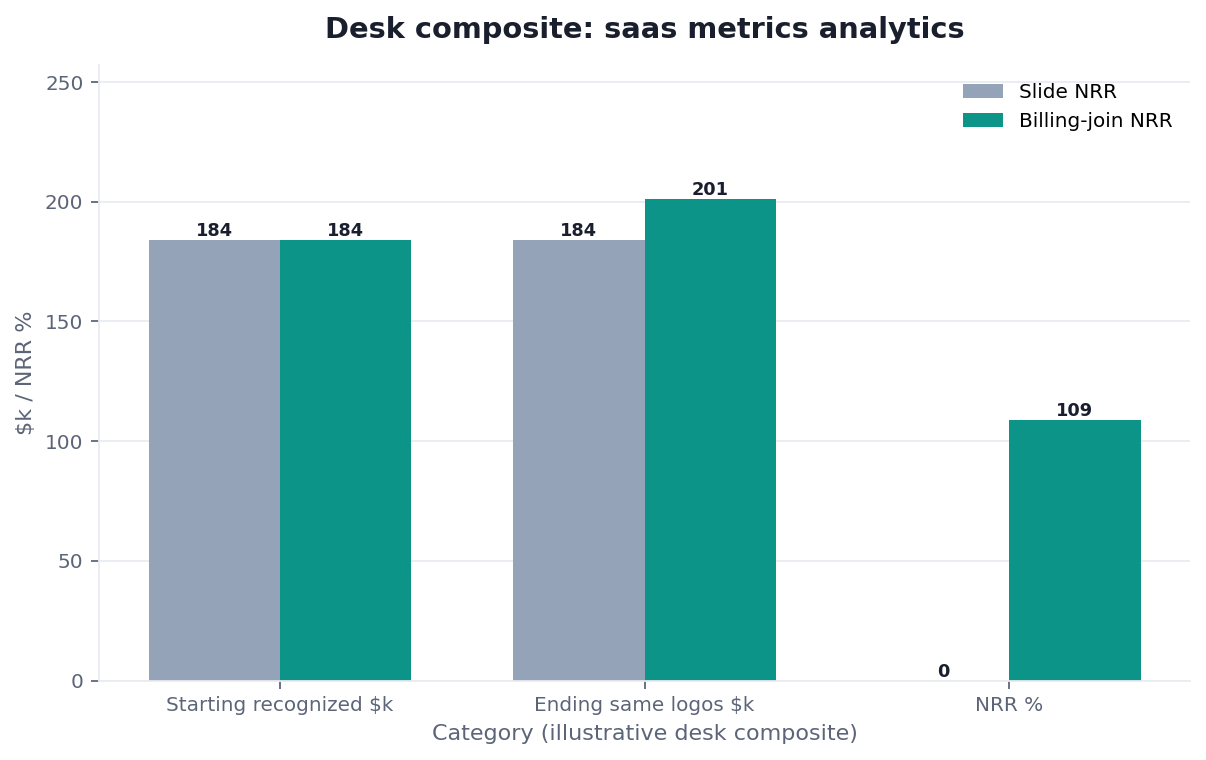
Figure. Left panel: same-cohort recurring-revenue dollars, $184k starting and $201k covered ending. Right panel: 100% slide baseline and 109% provisional billing-join NRR. Dollar and percent axes are separate. Six percent of credit dollars are unmatched.
SaaS metrics analytics on this pack is useful because its limitation remains visible. Download the assumption register, desk sample, Python verifier, independent reproduction protocol, and external source check.
Evidence Boundaries
| Evidence class | Supports | Does not support |
|---|---|---|
| Illustrative aggregate CSV | Displayed arithmetic and exception flag | Customer outcomes, market benchmarks, or causal effects |
| First-party verifier | Deterministic checks on supplied aggregates | Completeness or authenticity of source systems |
| Figma FY2025 release filed with the SEC | How that issuer presents specified metrics and non-GAAP information | A universal NRR definition or this desk sample |
| SEC non-GAAP interpretations | SEC staff interpretations for non-GAAP financial measures | Approval of this metric, article, or software |
| Stripe documentation | Stripe invoice and credit-note product mechanics | Accounting advice or a required NRR policy |
| IFRS 15 page | High-level standard scope and principles | Entity-specific recognition conclusions |
SaaS metrics analytics must keep authority proportional to the source. Figma’s FY2025 SEC-filed release is an issuer-specific filing exhibit. It may illustrate disclosed terminology, but it does not establish a universal formula or validate InfiniSynapse.
The SEC’s non-GAAP interpretations provide staff guidance on presenting non-GAAP measures. They do not endorse this page, and NRR treatment still depends on context and applicable controls.
Independent Validation and How to Cite
No qualifying independent SaaS metrics analytics reproduction had been received as of 2026-08-31. Internal review and running the supplied verifier are first-party checks, not independent validation.
To reproduce the desk arithmetic:
- download all five artifacts without editing them;
- inspect the assumption register and aggregate sample;
- run
python3 verify-SMA-20260831.pyin the downloads directory; - confirm the exact and rounded values; and
- retain the provisional warning until unmatched credit dollars are resolved.
SaaS metrics analytics should be independently tested on separately controlled, authorized data using the reproduction protocol. Publish definitions, source hashes, code, coverage, exceptions, and limitations without exposing confidential or personal information.
How to cite this page: Zhu, William, and InfiniSynapse Data Team. “Audit SaaS Metrics Analytics Against Billing.” InfiniSynapse, updated and verified August 31, 2026. https://infinisynapse.com/en/blog/saas-metrics-analytics. Accessed [date]. Cite the desk values as “illustrative first-party aggregates; 6% of credit dollars unmatched; provisional covered result,” not as a customer or industry benchmark.
Failure Modes That Break NRR
Mixing new logos into the retained set
New logos are growth, not retention. SaaS metrics analytics that folds them into the numerator produces a growth ratio under an NRR label.
Treating annual invoice timing as monthly expansion
An annual invoice can differ from monthly recurring normalization, cash timing, and revenue recognition. SaaS metrics analytics should preserve each clock instead of spreading or concentrating values without a documented rule.
Treating credits and refunds as one field
Credit notes adjust billing; refunds move cash. SaaS metrics analytics must preserve sign, linkage, dates, and recurring classification. If the export drops the document type or customer key, report the exception.
Publishing a provisional value as final
The desk bridge reproduces $201k, but 6% of credit dollars are unmatched. “Fully credit-adjusted” would be unsupported. SaaS metrics analytics should headline coverage and status next to the number.
Before a SaaS metrics analytics release, check the NRR sentence, cohort hash, billing-to-credit key, period policy, component signs, currency, and exception threshold.
Route adjacent questions to the guide that owns them:
| Live guide | Open it when |
|---|---|
| unit economics analytics | the question is contribution and payback |
| FP&A analytics | the question is budget, variance, or close |
| usage plus revenue join | authorized meter data must join billing |
| data governance | the missing object is an owned definition |
| Payback Period Analysis: Put Assumptions in the Pack | CAC recovery assumptions need review |
| Unit Economics for Startups | an early-stage pack needs a unit sentence |
Reconcile your NRR evidence
Upload an authorized, sanitized billing extract or connect a read-only table, bind the same-cohort rule, and inspect provisional NRR after credits.
Commercial association: InfiniSynapse sells a Data Agent. You do not need the product to use the educational checklist or verifier.
Audit your billing bridgeSources and Technical References
SaaS metrics analytics authority sources, retrieved 2026-09-04:
- Figma FY2025 press release filed with the SEC — issuer-specific metric and non-GAAP disclosure context only.
- SEC Non-GAAP Financial Measures Compliance and Disclosure Interpretations — SEC staff interpretation context only.
- Stripe Invoicing overview — Stripe product workflow only.
- Stripe programmatic credit notes — Stripe credit-note mechanics only.
- IFRS 15 Revenue from Contracts with Customers — standard scope and principles only; no entity-specific conclusion here.
Limited technical-reference note: The EPA homepage is retained only as the original article’s public-record analogy; Creative Commons only as a licensing reference; the JSON Schema guide only for structural validation; Apache Hive only for warehouse query context; and Elastic documentation only for search/index context. None supplies an NRR definition, ran this desk sample, endorses InfiniSynapse, or supports a customer claim.
Read-only SaaS metrics analytics workflows may use AI for data analysis, a data agent, or natural language to SQL, but a human remains accountable for definitions, permissions, accounting conclusions, and release.
How this page is sourced. William Zhu is cofounder of InfiniSynapse (GitHub @allwefantasy); no personal LinkedIn is published. This SaaS metrics analytics page is a method note based on cited public sources and illustrative aggregates. Reviewed by analytics engineering · data platform · LLM security · editor. Editorial standards · corrections · publishing principles · About · Privacy · Terms · Contact zhuhl@infinisynapse.com. Company About. COI: the in-article banner is a commercial association. This is not accounting, investment, tax, or legal advice.
Frequently Asked Questions
What is the NRR formula?
For SaaS metrics analytics here, it is (starting recurring revenue + expansion - contraction - churn) / starting recurring revenue * 100, on the same starting cohort. Starting recurring revenue is not replaced by company-wide ending revenue.
Why is the desk NRR provisional?
The matched bridge yields $201k / $184k = 109.239%, rounded to 109%, but 6% of credit dollars lack a resolved customer key. SaaS metrics analytics therefore reports a covered result, not a fully credit-adjusted company-wide result.
Is net expansion 9% or 9.239%?
The exact illustrative value is ($30k - $8k - $5k) / $184k = $17k / $184k = 9.239%. Use 9% only when a rounded whole-percent display is explicitly labeled.
Does an invoice prove cash, ARR/MRR, or IFRS revenue?
No. SaaS metrics analytics must distinguish invoice timing, cash settlement, a policy-defined recurring run rate, and accounting revenue. Reconcile them when needed, but do not substitute one for another.
Can the workflow issue credits or refunds?
No. Keep analysis read-only. Credit-note and refund approval, creation, and accounting remain in controlled operational systems with accountable humans.
Conclusion
SaaS metrics analytics is a same-cohort bridge you can defend: starting recurring revenue, classified movements, billing evidence, explicit credit coverage, and a replayable check. The illustrative $201k ending value and 109% NRR remain provisional because 6% of credit dollars are unmatched.
When your cohort and authorized extract are ready, use the downloadable evidence pack or open InfiniSynapse to inspect the bridge. Preserve the query, exceptions, approvals, and definitions for the next review.