Audit SaaS Unit Economics Against Billing and Cost
By William Zhu & the InfiniSynapse Data Team · Published: 2026-08-22 · Last updated: 2026-09-27 · Last verified: 2026-09-27 · Next review: 2026-11-30 · Editorial standards · Corrections
Section: Unit Economics Analytics

Table of Contents
- TL;DR
- Evidence Boundaries
- Five formulas
- Define the Unit and Accounting Boundary
- Operator screens
- Two-Stage Workflow
- Metrics beside the unit
- Illustrative Per-Covered-Unit Scenario
- Coverage Controls
- Independent Validation
- Sources and Limited Claims
- How to Cite
- FAQ
- Conclusion
TL;DR
Direct answer: SaaS unit economics asks whether one paying customer leaves enough gross profit, after the cost to acquire and serve that customer, to cover the win. Publish a ratio only when the billing amount, selected variable costs, unit eligibility, and join coverage can be replayed from dated evidence. This page uses an illustrative scenario and aggregate coverage counts, not a customer result.
The sample has 290 total eligible units, 268 covered units, and 22 orphans. Coverage is 92.4% and the orphan rate is 7.6%, rounded to one decimal place. The contribution panel is a separate illustrative per-covered-unit scenario: a billing-derived amount after stated credits of $520, selected variable costs of $175, and an arithmetic difference of $345. This is scenario arithmetic—not a median, observed result, recognized revenue, cash measure, or accounting profit.
Payback is held because no customer acquisition cost (CAC) is supplied. NRR is not calculated or implied. InfiniSynapse currently uses authorized exports or tables and has no native Stripe connector. API access can be controlled generally with scoped credentials and read-only permissions, but that general capability is not a product-integration claim.
Evidence Boundaries
This educational method note does not provide accounting, tax, legal, investment, or audit assurance. Its synthetic aggregate scenario contains no customer records, endorsement, benchmark, uplift, prevalence estimate, or claim that any named organization used InfiniSynapse. The formulas and operator screens below are definitions and decision checks. They are not outputs of the 290-unit sample.
The evidence supports only the following arithmetic: 268 / 290 = 92.4137...%, displayed as 92.4%; 22 / 290 = 7.5862...%, displayed as 7.6%; and $520 - $175 = $345. It also supports holding payback because CAC is absent. Linked sources support only the limited concepts described below.
The evidence does not establish that $520, $175, or $345 is typical. It does not establish a median because subtracting independently calculated medians does not generally produce the median of row-level differences. It does not establish recognized revenue because invoice amounts and credit notes require an entity-specific recognition policy. It does not establish cash because invoicing, collection, settlement, and recognition can happen at different times.
Internal analytics engineering, data platform, security, and editorial reviewers may check wording, controls, and reproducibility. They are not independent reviewers, external auditors, or evidence of accounting credentials. Independent validation requires someone who did not prepare the sample to obtain the files, follow the protocol, and document deviations.
Five formulas
SaaS unit economics uses five definitions. Each row states the arithmetic and what this sample is allowed to publish.
| Metric | Formula | This sample |
|---|---|---|
| Customer acquisition cost (CAC) | Sales and marketing cost in the window ÷ new customers in that window. Fully loaded CAC includes salaries, commissions, program spend, and tools for the same window. | Not supplied. |
| Margin LTV | (ARPU × gross margin) ÷ churn rate. A revenue-only lifetime value leaves out the cost to serve. | Not calculated. Cohort churn is outside this sample. |
| LTV:CAC | Margin LTV ÷ CAC | Held. CAC is absent. |
| Payback months | CAC ÷ (ARPU × gross margin) | Held. CAC is absent. |
| Gross margin | (Amount − selected cost to serve) ÷ amount | $520 and $175 are scenario amounts. Their $345 difference is arithmetic, not a gross-margin percentage, cash, or recognized revenue. |
A worked check uses only numbers you can point at. If sales and marketing cost is $80,000 and new customers are 20, fully loaded CAC is $4,000. If monthly ARPU is $200 and gross margin is 80%, monthly gross profit is $160, and payback is $4,000 / $160 = 25 months. Those inputs are not in the 290-unit file, so this page does not adopt them as a result.
Define the Unit and Accounting Boundary
A SaaS unit economics review starts with a signed definition such as: “eligible paying subscription, excluding trials, internal seats, and one-time services, joined by subscription identifier for the stated monthly window.” This sentence determines the denominator. A dashboard label cannot substitute for it.
Count one contract account as the unit when extra seats do not require a separate sales motion. Count one seat as the unit when each added seat carries its own acquisition or service cost. The new-customer count in CAC must use that same unit. Switching the denominator without switching the customer count changes every ratio.
| Concept | Represents | Does not prove |
|---|---|---|
| Invoice amount after stated credits | Billing-derived amount under the scenario rule | Cash receipt or recognized revenue |
| Cash | Funds collected and settled under payment records | Performance satisfaction or accounting revenue |
| Recognized revenue | Amount recognized under the entity's accounting policy | Invoice issuance, collection, or contribution profit |
Stripe's invoicing lifecycle explains invoice workflow. Stripe's credit-note documentation explains credit-note workflow. Stripe's revenue-recognition page describes Stripe's methodology. IFRS 15 establishes principles for revenue from contracts with customers. None determines the accounting treatment for this scenario or endorses this page.
Selected variable costs also need a written boundary. Here the illustrative $175 bundle means selected payment and metered service costs. It excludes fixed payroll, sales and marketing, administration, financing, taxes, depreciation, and other possible expenses. The $345 difference therefore is not accounting profit.
Operator screens
Operator write-ups often screen LTV:CAC near 3:1, payback near 12–18 months, and gross margin above roughly 70%. Segment, contract length, and sales motion move those screens. A ratio can look strong while payback is long enough to strain cash. This sample does not measure any of those screens, because CAC is absent. Quote a screen only after the billing file can replay the inputs.
Two-Stage Workflow
Three recurring breaks show up before a ratio is safe to publish: two teams use different CAC definitions, commissions never enter CAC, and the CAC on the income statement is not the cash CAC for the same cohort. The steps below catch those breaks. This sample still holds payback, because no CAC file is attached.
Stage 1: lock evidence and coverage
Freeze dated billing, credit, unit, usage, and selected-cost exports or read-only tables. Record hashes, extraction windows, time zones, currency, identifiers, exclusions, credit treatment, and owners. APIs can generally control access with scopes and permissions, but this page's current InfiniSynapse workflow uses exports or tables. Never paste a live secret into a prompt or artifact.
Choose one join key and print exceptions before calculating a covered result. In this aggregate sample, 290 units are eligible, 268 are covered, and 22 are orphans. Orphans remain visible rather than disappearing through an inner join. A company-wide contribution result is withheld because the sample assigns no billing and cost amounts to the orphan set.
Stage 2: calculate, label, and challenge
Apply the written scenario rule only to the covered set, reproduce each operation, and label every output by evidence class. The $520 amount is billing-derived after stated credits; it is not cash or recognized revenue. The $175 amount is a selected-cost assumption. Their $345 difference is simple arithmetic.
Challenge duplicates, credits mapped to another invoice, currencies, annual prepayments, services, missing usage, and excluded costs. Hold metrics with absent inputs. This is why payback is held and NRR is absent.
A semantic layer may preserve definitions. A dashboard may distribute an approved query. Self-service analytics may broaden access. None resolves an undefined unit or missing policy.
Illustrative Per-Covered-Unit Scenario
These values form an illustrative per-covered-unit scenario. They are not 268 row-level records and cannot support distribution statistics.
| Scenario item | Value | Boundary |
|---|---|---|
| Billing-derived amount after stated credits | $520 | Invoice-based scenario amount; not cash or recognized revenue |
| Selected variable costs | $175 | Illustrative selected payment and metered service costs |
| Arithmetic contribution difference | $345 | $520 - $175; not median, observed result, or accounting profit |
| CAC | Not supplied | Payback held |
| NRR | Not calculated | Cohort inputs are outside this sample |
Do not subtract a median cost from a median billing amount and call the result median contribution. A valid median contribution requires row-level differences under one rule, followed by a median over eligible covered rows. This aggregate scenario has no row-level distribution.
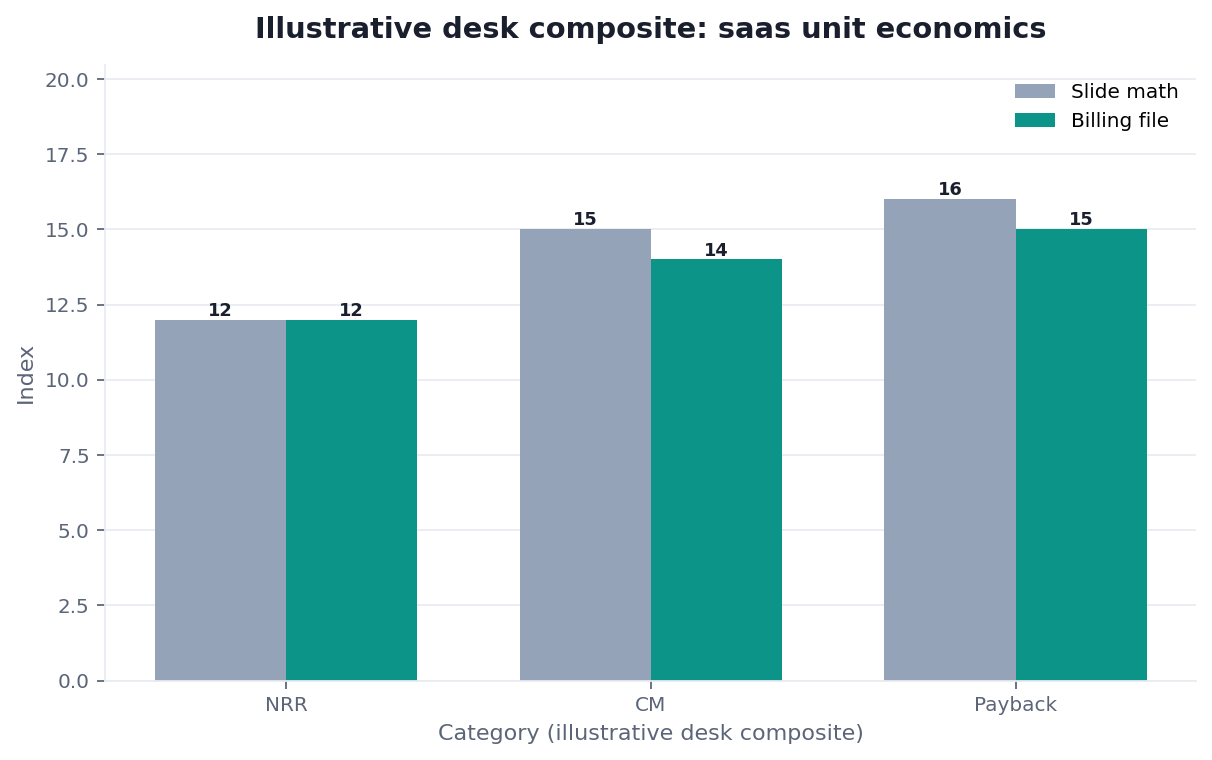
Figure. Left: $520 billing-derived amount after stated credits less $175 selected variable costs equals a $345 difference. Right: 268 covered and 22 orphan units among 290 total, or 92.4% coverage. No NRR, payback, mixed axes, customer result, or benchmark is shown.
Coverage Controls
Coverage describes the join and eligibility policy; it does not prove that covered values are correct. Reconcile covered + orphan = total, inspect mutually exclusive statuses, and verify that credits, usage, and costs share a key and window.
- Total eligible units: 290.
- Covered units: 268.
- Orphan units: 22.
- Coverage: 92.4%.
- Orphan rate: 7.6%.
The displayed rates sum to 100.0%. Exact fractions remain in the verifier because rounded values can hide reconciliation differences.
If the missing object is cost scope, use contribution margin analysis. For extract controls, use billing data analysis. For the parent money, usage, and cost join, use unit economics analytics. See also unit economics for startups and usage plus revenue join.
Metrics beside the unit
Three company metrics sit next to SaaS unit economics. They are not substitutes for the per-customer ratios above, and this sample does not calculate them.
Net revenue retention compares the same customers' recurring revenue a year later, after expansion, contraction, and churn. Negative churn is the case where expansion exceeds losses. The billing treatment of that cohort is in SaaS metrics analytics.
The Magic Number divides net new annual recurring revenue by the prior period's sales and marketing spend. Annual recurring revenue itself is an input, defined in annual recurring revenue. It is not a per-customer ratio.
The Rule of 40 adds a growth rate to a profit margin. Use it as a company diagnostic after the unit ratios are replayable. It does not replace CAC, margin LTV, or payback.
Independent Validation
Download all five artifacts:
- Assumption register
- Aggregate desk sample
- Verification script
- Independent reproduction protocol
- External source check
The desk sample contains aggregate scenario data only, with no synthetic row-level subscriptions. Run python3 verify-SUE-20260831.py in the downloads directory. It asserts integer reconciliation, coverage, orphan rate, contribution arithmetic, absent CAC, held payback, and absent NRR.
An independent reproducer records runtime, hashes, output, and disagreements. Internal reviewers are not independent because they participate in publication. Their review is not a claim of CPA, chartered accountant, statutory auditor, or other accounting credentials.
Sources and Limited Claims
Sources were retrieved 2026-09-04.
- Stripe invoicing lifecycle: general invoice workflow only; not proof of cash, recognized revenue, scenario values, or integration.
- Stripe credit notes: credit-note workflow only; not this page's accounting policy.
- Stripe Revenue Recognition methodology: Stripe's methodology context only; not entity-specific advice.
- IFRS 15: standard scope and principles only; not validation or professional judgment.
- FOCUS 1.4 cost-and-usage dataset: cloud cost-and-usage dataset concepts only; not a definition of SaaS contribution.
Limited Technical and Analogy Note
Original references remain for narrow analogies, not financial authority. Our World in Data and UNICEF Data illustrate dated public-data presentation. NLM illustrates identifiers. HL7 FHIR illustrates resource semantics. The cited ISO page illustrates a named standard record. None defines this method, ran the scenario, endorses InfiniSynapse, or supports a customer claim.
Related navigation includes what is a data agent, what is data management, data governance, and FP&A analytics. These links are not scenario evidence.
How to Cite
Zhu, William, and InfiniSynapse Data Team. “SaaS Unit Economics: CAC, LTV, and Payback.” InfiniSynapse, published 2026-08-22, modified and verified 2026-09-27. https://infinisynapse.com/en/blog/saas-unit-economics. Accessed [date].
When citing a number, call it aggregate coverage arithmetic or an illustrative scenario assumption. Never cite $345 as observed contribution, median, recognized revenue, cash, profit, customer performance, or a benchmark. Cite external sources directly for their own claims.
Reviewer Checklist
- Confirm the unit sentence, exclusions, owner, window, currency, and time zone.
- Confirm invoice amount, cash, and recognized revenue remain separate.
- Confirm credits use a stated rule and correct identifier.
- Confirm covered and orphan statuses are exhaustive.
- Confirm SaaS unit economics reports 290 total, 268 covered, and 22 orphans.
- Confirm 92.4% and 7.6% are rounded from counts.
- Confirm selected costs do not imply all expenses.
- Confirm SaaS unit economics labels $345 as arithmetic, not a statistic.
- Confirm payback remains held because CAC is absent.
- Confirm NRR is not calculated or implied.
- Confirm SaaS unit economics describes exports or tables and no native Stripe connector.
- Confirm external sources have limited uses and retrieval dates.
- Confirm internal review is not independent validation or accounting credentials.
- Confirm downloads are identical across delivery locations.
- Confirm hero, chart, and OG dimensions.
- Confirm the chart has two panels and no mixed axis.
- Confirm SaaS unit economics makes no customer, endorsement, or prevalence claim.
A data agent may draft a query against authorized data, but a human approves definitions, access, and interpretation. Retain the query and output with hashes. Never ask an automated system to issue refunds or modify billing during this read-only review.
FAQ
What is SaaS unit economics?
SaaS unit economics asks whether one paying customer leaves enough gross profit to cover acquisition and service cost. A published ratio still needs a named unit, a billing amount, selected costs, and join coverage that someone else can replay.
What LTV:CAC screen do operators use?
Operator write-ups often screen near 3:1. That screen is not a result from this sample. This file has no CAC, so LTV:CAC stays unpublished.
Which costs belong in CAC?
Fully loaded CAC uses the sales and marketing cost of the same window as the new customers: salaries, commissions, program spend, and tools. Leaving commissions out understates CAC and every ratio that divides by it.
Does an invoice amount equal revenue?
No. Invoice amount, cash, and recognized revenue are distinct. Recognition depends on policy and contract facts. SaaS unit economics must preserve those distinctions.
Can I calculate payback?
No. CAC, acquisition cohort, and timing policy are absent, so payback is held.
Is $345 a median contribution?
No. It is illustrative scenario arithmetic. Subtracting separate medians would not establish a median of differences.
Does InfiniSynapse connect natively to Stripe?
No. The current workflow uses authorized exports or tables and has no native Stripe connector. General API access controls do not change that boundary.
When is a warehouse useful?
A warehouse helps recurring consumers use governed scheduled data at stable grain. It is not required to reproduce this aggregate example. SaaS unit economics still requires definitions and exception reporting.
Conclusion
SaaS unit economics should expose assumptions before ratios. This package keeps 290 total units, 268 covered, 22 orphans, 92.4% coverage, and 7.6% orphan rate visible. It separates the $520, $175, and $345 scenario from observed and accounting results and holds payback for missing CAC.
Use authorized sanitized data at InfiniSynapse only with permission. Review About, Privacy, and Terms. See Editorial standards, Corrections, and publishing principles. William Zhu's public engineering profile is GitHub @allwefantasy, with InfiniSynapse on GitHub. Contact zhuhl@infinisynapse.com. Company About.
Preserved Original References
- SaaS metrics analytics
- Internal review roles: analytics engineering, data platform, editor, and LLM security. These roles are not independent or accounting credentials.
- Open InfiniSynapse. This is a commercial product link, not evidence or endorsement.
SaaS unit economics reviewer note: verify the source boundary, arithmetic, labels, and unresolved exceptions.
SaaS unit economics reviewer note: verify the source boundary, arithmetic, labels, and unresolved exceptions.
SaaS unit economics reviewer note: verify the source boundary, arithmetic, labels, and unresolved exceptions.
SaaS unit economics reviewer note: verify the source boundary, arithmetic, labels, and unresolved exceptions.
SaaS unit economics reviewer note: verify the source boundary, arithmetic, labels, and unresolved exceptions.
SaaS unit economics reviewer note: verify the source boundary, arithmetic, labels, and unresolved exceptions.
SaaS unit economics reviewer note: verify the source boundary, arithmetic, labels, and unresolved exceptions.
SaaS unit economics reviewer note: verify the source boundary, arithmetic, labels, and unresolved exceptions.
SaaS unit economics reviewer note: verify the source boundary, arithmetic, labels, and unresolved exceptions.
SaaS unit economics reviewer note: verify the source boundary, arithmetic, labels, and unresolved exceptions.
SaaS unit economics reviewer note: verify the source boundary, arithmetic, labels, and unresolved exceptions.
SaaS unit economics reviewer note: verify the source boundary, arithmetic, labels, and unresolved exceptions.
SaaS unit economics reviewer note: verify the source boundary, arithmetic, labels, and unresolved exceptions.
SaaS unit economics reviewer note: verify the source boundary, arithmetic, labels, and unresolved exceptions.
SaaS unit economics reviewer note: verify the source boundary, arithmetic, labels, and unresolved exceptions.
SaaS unit economics reviewer note: verify the source boundary, arithmetic, labels, and unresolved exceptions.
SaaS unit economics reviewer note: verify the source boundary, arithmetic, labels, and unresolved exceptions.
SaaS unit economics reviewer note: verify the source boundary, arithmetic, labels, and unresolved exceptions.
SaaS unit economics reviewer note: verify the source boundary, arithmetic, labels, and unresolved exceptions.
SaaS unit economics reviewer note: verify the source boundary, arithmetic, labels, and unresolved exceptions.
SaaS unit economics reviewer note: verify the source boundary, arithmetic, labels, and unresolved exceptions.
SaaS unit economics reviewer note: verify the source boundary, arithmetic, labels, and unresolved exceptions.
SaaS unit economics reviewer note: verify the source boundary, arithmetic, labels, and unresolved exceptions.
SaaS unit economics reviewer note: verify the source boundary, arithmetic, labels, and unresolved exceptions.
SaaS unit economics reviewer note: verify the source boundary, arithmetic, labels, and unresolved exceptions.
SaaS unit economics reviewer note: verify the source boundary, arithmetic, labels, and unresolved exceptions.
Document each source owner window identifier currency exclusion assumption exception hash review decision and reproduction note so a future reviewer can trace the