Unit Economics for Startups: Auditable Board Pack
By William Zhu & the InfiniSynapse Data Team · Published: 2026-08-22 · Last updated: 2026-08-31 · Last verified: 2026-08-31 · Next review: 2026-11-30 · Editorial standards · Corrections
Section: Unit Economics Analytics
Table of Contents
- TL;DR
- Evidence Boundary
- Define the Unit and Accounting Boundaries
- Build the Evidence Pack
- Illustrative Covered-Cohort Scenario
- Coverage and Same-Cohort Payback
- Cost Allocation Controls
- Independent Validation
- Sources and Limited Relevance
- How to Cite
- Reviewer Checklist
- Frequently Asked Questions
- Conclusion
TL;DR
Direct answer: Unit economics for startups becomes board-ready when a named unit, invoice and credit boundary, usage join, selected cost stack, acquisition cohort, and exception rate can be reproduced from dated files. This package demonstrates the controls with one synthetic aggregate scenario, not customer evidence.
The illustrative scenario uses the same 24-account covered acquisition cohort for both CAC and payback. CAC is $680 per covered account, comparable monthly contribution is $41 per covered account, and payback is $680 / $41 = 16.585..., displayed as 16.6 months. The implied covered acquisition spend is 24 × $680 = $16,320. These are assumptions, not observed performance or a benchmark. The ratios a raise will ask to replay are on SaaS unit economics before a raise.
The $41 contribution reconciles as a billing-derived amount after stated credits of $120 - $4 payment fees - $55 metered hosting - $20 selected variable support. It is not cash, recognized revenue, accounting profit, or a distribution statistic. Separately, 900 of 10,000 usage events are unmatched, so the unmatched rate is exactly 9%. Unit economics for startups should display that numerator and denominator rather than hiding exceptions with an inner join.
Evidence Boundary
Unit economics for startups is an educational control pattern. It contains an explicitly synthetic aggregate only: no customer rows, customer result, endorsement, certification, prevalence estimate, uplift, vendor comparison, or benchmark. No named source ran the scenario or validated InfiniSynapse. The values do not establish what is normal for any company.
Unit economics for startups supports arithmetic and process assertions only. It can show that $120 - $4 - $55 - $20 = $41, $680 / $41 rounds to 16.6, 24 × $680 = $16,320, and 900 / 10,000 = 9%. Unit economics for startups cannot turn those assumptions into evidence about market performance.
Unit economics for startups is not accounting, audit, tax, legal, or investment advice. Internal analytics engineering, data platform, LLM security, and editorial reviewers may inspect wording, links, controls, and reproducibility. They are not independent auditors, external accountants, or evidence of CPA, chartered accountant, statutory auditor, or other professional credentials. Independent validation requires a person who did not prepare the package to obtain the artifacts, run the verifier, recompute the results, and record disagreements.
Define the Unit and Accounting Boundaries
For unit economics for startups, a defensible unit sentence might read: “eligible paying account in the stated monthly window, excluding trials, internal seats, investor access, and one-time service-only relationships; joined by stable account identifier.” Unit economics for startups should lock this sentence before calculating contribution or CAC. Changing the unit after seeing the result invalidates the comparison.
Keep invoice, credit, cash, and revenue separate
| Concept | What this package means | What it does not establish |
|---|---|---|
| Invoice-derived amount | Amount selected from invoice records under a dated extraction rule | Cash collected or revenue recognized |
| Credit | Stated credit-note adjustment mapped under the package rule | Refund settlement or an accounting conclusion |
| Cash | Collection and settlement evidence under payment records | Satisfaction of a performance obligation |
| Recognized revenue | Amount determined under the entity's accounting policy and contract facts | Invoice issuance, cash timing, or contribution |
Stripe documents invoice workflow and credit-note workflow; its revenue-recognition methodology describes Stripe's product methodology. IFRS 15 describes principles for revenue from contracts with customers. For unit economics for startups, those references help reviewers identify boundaries, but they do not decide this synthetic scenario's accounting treatment. Unit economics for startups must label $120 as a billing-derived amount after stated credits, never as cash or recognized revenue.
Annual prepayments require particular care. An invoice dated in one month may relate to service across later periods; cash may settle on another date; credits may be issued later; recognized revenue follows the entity's policy and contract facts. A unit economics for startups board pack must state whether it is invoice-dated, cash-based, or aligned to a recognition schedule. It must not slide between those clocks.
Build the Evidence Pack
1. Freeze authorized inputs
For unit economics for startups, export only authorized, sanitized invoice, credit, usage, acquisition-spend, and selected-cost files. Record extraction time, time zone, currency, source owner, file hash, row count, identifiers, exclusions, and credit treatment. Unit economics for startups can begin with controlled files; a warehouse is useful when repeated consumers need governed scheduling, but it does not repair undefined fields.
InfiniSynapse does not claim a native Stripe or Zendesk connector here. General API scopes do not establish a product integration. Never put a live credential in a prompt, spreadsheet, download, or board attachment. Keep the analysis path read-only.
2. Test identity and window alignment
Prove that account_id means the same entity across billing, usage, selected cost, and acquisition records. Print duplicate keys, null keys, unmatched billing rows, and unmatched usage events. Unit economics for startups should retain exceptions in a separate status rather than deleting them through an inner join.
The unit economics for startups time window must also match. If usage is calendar-month activity while invoices represent annual contracts, state the allocation or deferral rule. If acquisition spend covers a campaign quarter, do not divide it by a monthly cohort without a documented mapping. Each numerator and denominator needs the same eligibility rule and period.
3. Write the cost sentence
The unit economics for startups cost sentence is intentionally narrow: subtract payment fees, metered hosting, and selected variable support from the billing-derived amount after stated credits. Unit economics for startups must state what remains outside the stack: fixed payroll, sales and marketing beyond the stated CAC pool, administration, financing, taxes, depreciation, fixed infrastructure, and other costs can all be excluded here. Therefore $41 is a selected contribution difference, not accounting profit.
4. Preserve a replayable trail
For unit economics for startups, retain source hashes, transformation logic, exception output, assumption approval, verifier version, and exported board pack. If a data agent drafts a query, a human still approves definitions and interpretation. A dashboard, self-service analytics, or a semantic layer may distribute governed results, but none substitutes for the evidence trail.
Illustrative Covered-Cohort Scenario
The unit economics for startups table is one synthetic aggregate scenario for the same 24 covered accounts. It is not 24 row-level observations and cannot support a mean, percentile, distribution, or claim of typical performance.
| Scenario item | Value | Boundary |
|---|---|---|
| Covered acquisition cohort | 24 accounts | Same eligibility set for CAC and payback |
| Implied covered acquisition spend | $16,320 | 24 × $680; synthetic assumption |
| CAC per covered account | $680 | $16,320 / 24; no uncovered spend implied |
| Billing-derived amount after stated credits | $120 | Not cash or recognized revenue |
| Payment fees | $4 | Selected variable scenario cost |
| Metered hosting | $55 | Selected allocated variable scenario cost |
| Selected variable support | $20 | Narrow stated support allocation |
| Comparable monthly contribution | $41 | $120 - $4 - $55 - $20; not accounting profit |
| CAC payback | 16.6 months | $680 / $41 = 16.585..., rounded to one decimal |
| Usage events | 10,000 | Aggregate synthetic count |
| Unmatched usage events | 900 | Visible exceptions |
| Unmatched rate | 9% | 900 / 10,000 |
Unit economics for startups should not describe any value in this table as a median. Unit economics for startups has no row-level distribution. The aggregate contribution arithmetic and aggregate coverage counts are separate evidence classes, even though they share the scenario identifier.
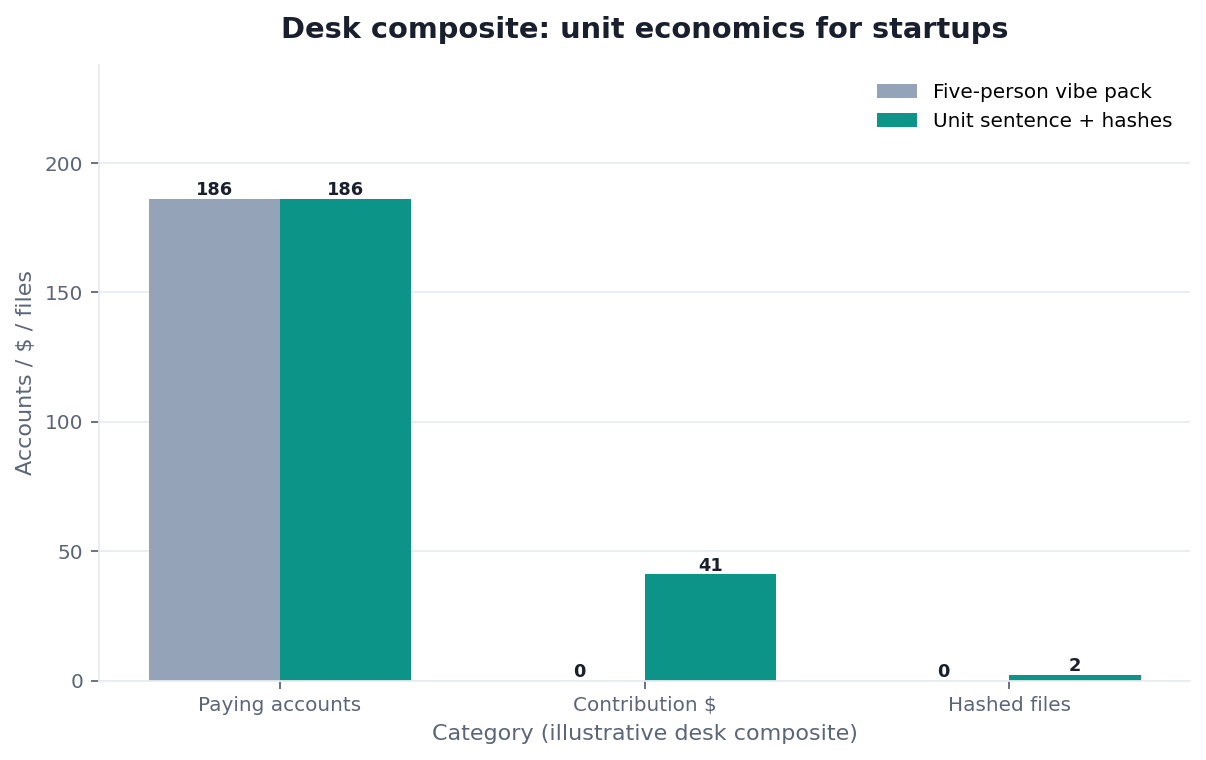
Figure. Left panel uses one dollar scale: $120 billing-derived amount after stated credits is reconciled to $41 after $4 payment fees, $55 metered hosting, and $20 selected variable support. Right panel uses a separate event-count scale: 9,100 matched and 900 unmatched among 10,000 usage events. The panels avoid a mixed-unit axis. Synthetic aggregate only; no customer result or benchmark.
Coverage and Same-Cohort Payback
Unit economics for startups payback is comparable only when CAC and contribution refer to the same eligible cohort, currency, and timing policy. Here both use the stated 24-account covered cohort. The numerator is $680 CAC per covered account and the denominator is $41 comparable monthly contribution per covered account. Unit economics for startups should withhold a broader company claim when spend or contribution coverage differs.
Unit economics for startups makes the scenario's implied spend explicit: $680 × 24 = $16,320. This does not claim that all company acquisition spend is covered. A reviewer should reconcile channel spend to the chosen pool, identify excluded channels, check timing, and report uncovered spend. A blended CAC from one population divided by contribution from another is not a valid payback ratio.
Unit economics for startups treats usage coverage as a separate control. Exactly 900 of 10,000 events lack the billing key, yielding 9%. That rate does not prove the 9,100 matched records are accurate, nor does it quantify financial misstatement. Unit economics for startups should investigate event identity and allocation before treating usage-linked cost as complete.
Cost Allocation Controls
For unit economics for startups, allocated cloud or support costs need a rule, an owner, and a remainder check. The FOCUS 1.4 split-cost-allocation handling page describes attributes for calculated split allocation in cloud cost data. Its relevance is limited to allocation metadata concepts; it does not define contribution, approve this $55 assumption, or validate the scenario.
For each unit economics for startups review, record the allocated source total, eligible target set, allocation driver, zero-driver handling, rounding policy, unallocated remainder, and change approval. Unit economics for startups should reconcile allocated plus unallocated amounts back to the source pool. Avoid allocating fixed costs and then silently calling the result variable.
Unit economics for startups support cost also needs a bounded method. A selected $20 variable support assumption might use eligible ticket handling minutes multiplied by an approved rate, but this package supplies only the aggregate assumption. Zendesk Help is retained as a limited pointer to helpdesk context; it is not evidence for the value, an integration claim, or financial authority.
Independent Validation
Validate unit economics for startups with all five artifacts:
- Assumption register
- Aggregate desk sample
- Verification script
- External source check
- Independent reproduction protocol
Run python3 verify-UES-20260831.py in the downloads directory. It checks contribution, payback and rounding, implied spend, unmatched-event arithmetic, coverage identity, same-cohort controls, evidence labels, and the limits attached to source checks. Unit economics for startups remains independently reproducible only if the reproducer records file hashes, runtime, output, and deviations without silently editing assumptions.
The verifier proves consistency among supplied artifacts; it does not authenticate source-system exports, validate accounting policy, establish allocation accuracy, or provide third-party assurance. A passing script is necessary for this package, not sufficient for a real board decision.
Sources and Limited Relevance
All sources below were retrieved 2026-08-31.
- Stripe invoicing overview (retrieved 2026-09-04): invoice lifecycle context only; not evidence of cash, recognized revenue, integration, or scenario values.
- Stripe credit notes (retrieved 2026-09-04): credit-note workflow context only; not an entity accounting policy.
- Stripe Revenue Recognition methodology (retrieved 2026-09-04): Stripe methodology context only; not professional advice or validation.
- IFRS 15 (retrieved 2026-09-04): standard scope and principles only; not an entity-specific conclusion.
- FOCUS 1.4 calculated split cost allocation handling (retrieved 2026-09-04): allocation-attribute context only; not a contribution definition or endorsement.
Original technical links are preserved with narrow relevance. Apache ORC concerns a file format; Trino concerns distributed SQL; OpenSearch concerns search; Terraform concerns infrastructure configuration; and Zendesk Help concerns helpdesk documentation. None is financial authority, ran this scenario, endorses InfiniSynapse, or establishes customer evidence. Unit economics for startups may use analogous controls from these systems, but the links do not validate the method.
How to Cite
Zhu, William, and InfiniSynapse Data Team. “Unit Economics for Startups: Auditable Board Pack.” InfiniSynapse, published 2026-08-22, modified and verified 2026-08-31. https://infinisynapse.com/en/blog/unit-economics-for-startups. Accessed [date].
When citing numbers, call them synthetic aggregate assumptions or arithmetic from the UES-20260831 package. Do not cite $41 as observed contribution, revenue, cash, accounting profit, or a benchmark. Do not cite 16.6 months as customer performance. This package has not been independently audited or third-party assured; internal review is not a third-party audit. Cite external sources directly for their own bounded claims.
Reviewer Checklist
- Confirm the eligible paying-account sentence and exclusions are signed.
- Confirm invoice, credit, cash, and recognized-revenue clocks remain distinct.
- Confirm the
$120label says billing-derived after stated credits. - Confirm the cost stack lists
$4,$55, and$20and reconciles to$41. - Confirm excluded costs prevent an accounting-profit interpretation.
- Confirm CAC is
$680for the same 24 covered accounts. - Confirm covered spend is
$16,320and no broader spend coverage is implied. - Confirm payback divides
$680by$41and rounds to 16.6 months. - Confirm 900 unmatched events out of 10,000 equals 9%.
- Confirm matched and unmatched events reconcile to total events.
- Confirm the scenario remains aggregate and synthetic, with no row-level records.
- Confirm unit economics for startups makes no customer, endorsement, certification, or benchmark claim.
- Confirm allocation drivers, remainder handling, currency, window, and ownership are recorded.
- Confirm source claims are bounded and retrieval dates are present.
- Confirm internal reviewers are not presented as independent auditors or accountants.
- Confirm downloads are byte-identical across all delivery locations.
- Confirm the hero and OG are 1200 × 630 and chart dimensions match markup and schema.
- Confirm the chart separates dollar and event-count panels without a mixed-unit axis.
- Confirm every original URL remains present and internal slugs resolve to current routes.
- Confirm the verifier passes before the pack is exported.
Related navigation: contribution margin analysis, billing data analysis, payback period analysis, SaaS metrics analytics, unit economics analytics, usage plus revenue join, exploratory data analysis, what is data management, and chat with your data. These links are not scenario evidence.
Frequently Asked Questions
Does an invoice amount equal revenue?
No. Invoice issuance, credits, cash collection, and recognized revenue can occur on different schedules. Unit economics for startups must name the chosen billing basis and avoid presenting it as accounting revenue.
Is the $41 value an average or median?
No. It is synthetic aggregate scenario arithmetic. There are no row-level observations, so no distribution statistic can be calculated.
Why must CAC and contribution use the same cohort?
A ratio is interpretable only when numerator and denominator cover comparable units and timing. This scenario uses the same 24 covered accounts for $680 CAC and $41 monthly contribution.
Does 9% unmatched mean the result is wrong by 9%?
No. It means 900 of 10,000 usage events lack the selected billing key under the stated rule. The financial effect requires investigation; event count is not dollar exposure.
Does a passing verifier constitute an audit?
No. It checks internal consistency in supplied files. It does not authenticate exports, approve accounting policy, or provide independent assurance.
Is a warehouse required?
No. Dated, hashed files can support a replayable aggregate check. A warehouse helps recurring governed use, but unit economics for startups still depends on definitions, access controls, and exception reporting.
Conclusion
Unit economics for startups is strongest when the board can see the unit sentence, evidence clock, cost stack, cohort coverage, and unresolved exceptions before seeing a ratio. The conclusion clearly preserves the arithmetic; same-cohort limit, implied spend, and unmatched numerator and denominator.
Use only authorized, sanitized data at InfiniSynapse. Review About, Privacy, Terms, publishing principles, and corrections. William Zhu's public engineering profile is GitHub @allwefantasy, and InfiniSynapse on GitHub is the organization profile. Contact zhuhl@infinisynapse.com. Company About. Internal roles—analytics engineering, data platform, LLM security, and editor—are not independent assurance.