Usage plus Revenue: Reconcile Meters to Invoices
By William Zhu & the InfiniSynapse Data Team · Published: 2026-08-22 · Last updated: 2026-08-31 · Last verified: 2026-08-31 · Next review: 2026-11-30 · Editorial standards · Corrections
Table of Contents
- TL;DR
- Define the reconciliation
- Separate billing, cash, and revenue
- Control identifiers and cardinality
- Accept and reconcile events
- Synthetic aggregate desk sample
- Build a replayable workflow
- Evidence Boundary
- Independent Validation
- Sources and Limited Claims
- How to Cite
- Frequently Asked Questions
TL;DR
Direct answer: Usage plus revenue is a controlled reconciliation between accepted metered events and finalized invoice lines. It uses stable customer and subscription identifiers, declares event and invoice windows, reports unmatched records, and keeps invoice amounts distinct from credit notes, refunds, customer balances, cash, and recognized revenue.
This usage plus revenue page contains one explicitly synthetic aggregate scenario. From 2026-07-01T00:00:00Z inclusive to 2026-08-01T00:00:00Z exclusive, 12,400,000 events are accepted: 11,904,000 matched and 496,000 unmatched, exactly 96% and 4%. Finalized invoice lines excluding tax total $210,000. Issued line-linked credit notes total $5,600, producing a net finalized invoice amount of $204,400.
That $204,400 is not recognized revenue and is not cash. Cash is held because payment and settlement evidence is not supplied. Recognized revenue is held because service periods, performance-obligation evidence, and the applicable recognition policy are not supplied. Usage per recognized dollar is therefore held. The sample supports arithmetic and reconciliation controls only; it is not a customer result, benchmark, prevalence estimate, or accounting conclusion.
The usage plus revenue downloads provide the assumptions, aggregate data, verifier, source check, and independent reproduction protocol. They let a reviewer reproduce the synthetic arithmetic without implying that InfiniSynapse or its internal reviewers performed an independent audit.
Define the reconciliation
Usage plus revenue begins with a written claim boundary, not a dashboard. State the event population, acceptance rule, stable identifiers, invoice states, credit treatment, cutoff, and allowed outputs before joining tables. A usage plus revenue contract prevents a later query change from silently changing the business meaning.
For usage plus revenue, the left population is accepted metered events. “Accepted” means the event passed the declared schema, timestamp, identity, deduplication, and eligibility checks before the window cutoff. Rejected, quarantined, duplicate, test, and late events are not silently folded into accepted totals. The right population is finalized invoice lines excluding tax, plus separately identified line-linked credit notes.
| Control | Required declaration | Sample setting |
|---|---|---|
| Event window | Inclusive start and exclusive end in UTC | 2026-07-01T00:00:00Z to 2026-08-01T00:00:00Z |
| Event state | Acceptance and deduplication policy | Accepted aggregate only |
| Billing state | Included invoice and line states | Finalized invoice lines, tax excluded |
| Credits | Type, state, and linkage | Issued credit notes linked to invoice lines |
| Key | Stable customer and subscription mapping | billing_customer_id plus controlled map |
| Output | Permitted financial label | Net finalized invoice amount |
A data visualization can display the result, but the usage plus revenue contract remains the authority. Usage plus revenue should never inherit its definition from whatever filters happen to be selected in a chart.
Declare clocks before comparing them
Event time, ingestion time, invoice finalization time, credit issue time, refund time, payment time, and service time are separate clocks. The usage plus revenue sample fixes only the accepted-event window and a billing extract cutoff. It does not assert that invoice lines describe services delivered entirely within July.
Usage plus revenue late arrivals need a policy. A valid event arriving after cutoff can be included in a restated vintage, left in the next operational report, or excluded under a frozen-close rule. Record the choice, source update time, extraction time, and prior total. Usage plus revenue should preserve original and restated outputs instead of overwriting history.
If the missing object is retention, continue in SaaS metrics analytics. If attributable cost is needed, use contribution margin analysis. The broader method remains unit economics analytics.
Separate billing, cash, and revenue
Usage plus revenue is a convenient search phrase, but the supplied money measure is a net finalized invoice amount. Precise labels matter because billing documents, customer balances, cash movements, and accounting recognition can diverge in amount and time.
- Invoice line: a line on a billing document. Draft and finalized states are not interchangeable.
- Credit note: a billing adjustment that may reduce an amount due or affect a customer balance, depending on state and timing.
- Refund: a return of funds through a payment flow; it is not automatically identical to a credit note.
- Customer balance: an amount maintained on the billing account that may be applied to future invoices.
- Cash: payment and settlement evidence, with its own dates and statuses.
- Recognized revenue: an accounting result based on performance obligations, service periods, and policy.
- Service period: the interval over which goods or services are provided; it need not match invoice or cash dates.
The usage plus revenue billing bridge in this sample is deliberately narrow:
$210,000 finalized invoice lines excluding tax - $5,600 issued line-linked credit notes = $204,400 net finalized invoice amount
Usage plus revenue does not convert that arithmetic into recognized revenue. An annual invoice finalized in July could cover future service. A July credit could adjust a prior period. A paid invoice can settle before or after service, and a refund can move cash without matching the credit-note amount or date. Those distinctions must remain visible.
The Stripe invoicing overview (retrieved 2026-09-04) provides product context for invoice workflows. Stripe credit-note documentation (retrieved 2026-09-04) describes credit-note handling. Stripe Revenue Recognition methodology (retrieved 2026-09-04) describes that product’s methodology. IFRS 15 (retrieved 2026-09-04) is a primary standard source. None validates this sample or decides an entity-specific accounting treatment.
Hold unsupported ratios
Cash is held_not_supplied. Recognized revenue is held_inputs_not_supplied. Usage per recognized dollar is held. A ratio would require a supported numerator aligned to the accepted-event population and service period. Dividing 12,400,000 by $204,400 would produce arithmetic, but its financial interpretation would be unsupported.
Usage plus revenue reports what is missing rather than substituting invoice value for cash or recognized revenue. A board pack can still show event reconciliation and the billing bridge, provided its labels and limitations travel with the numbers.
Control identifiers and cardinality
The usage plus revenue identity path carries a stable billing customer identifier into the metering system at event creation. If product and billing identifiers differ, maintain a versioned mapping with effective dates, source ownership, and conflict handling. Email, display name, and device identifiers are attributes, not durable billing keys.
Usage plus revenue requires cardinality tests before aggregation:
- Confirm each accepted
event_idis unique after the declared deduplication rule. - Confirm one event maps to no more than one in-scope billing customer for the effective time.
- Confirm invoice-line identifiers are unique in the billing extract.
- Separate one-to-many subscription or account structures from accidental fan-out.
- Materialize unmatched events and unmatched invoice lines instead of hiding them with an inner join.
The usage plus revenue sample publishes aggregate counts only, so it cannot prove row-level uniqueness or mapping quality. Its 496,000 unmatched events are a synthetic control value, not evidence about an operating system. In live usage plus revenue work, retain reason codes such as missing key, expired map, out-of-scope customer, timestamp outside effective range, and ambiguous mapping.
Document the data contract using stable names. Schema.org documents are retained here as technical context for explicit types and identifiers; Schema.org does not define this finance method. If events reside in Apache Iceberg, snapshot identifiers can support a reproducible source vintage. Apache Impala may query warehouse-resident tables. These links are technical context only, not evidence for the sample amounts.
Avoid fan-out at invoice grain
Joining every event directly to every invoice line for a customer can multiply both populations. Aggregate events to the declared customer-period grain, aggregate eligible billing lines separately, validate each identity, and only then compare. Where line-level attribution is required, use an explicit allocation key and test that allocated amounts sum back to source lines.
Usage plus revenue should publish join diagnostics at each stage: source rows, accepted events, unique events, mapped events, unmatched events, eligible invoice lines, line-linked credits, and post-join rows. A percentage without the identity behind it is difficult to review.
Accept and reconcile events
An event acceptance policy should define schema version, event timestamp field, timezone normalization, event identity, retry behavior, deduplication horizon, customer-key requirement, test-traffic exclusion, and late-arrival treatment. Meter aggregation occurs only after those checks.
The Stripe usage-based billing implementation guide (retrieved 2026-09-04) provides bounded product context for usage-based billing implementation. It does not establish this sample’s event acceptance, completeness, billing correctness, or accounting treatment.
The core usage plus revenue identity is:
11,904,000 matched + 496,000 unmatched = 12,400,000 total accepted events
11,904,000 / 12,400,000 = 96%
496,000 / 12,400,000 = 4%
Usage plus revenue should retain integer counts and exact fractions in machine-readable output. Round only for presentation, and never infer counts by reversing a rounded percentage. Here both percentages are exact because the counts divide evenly.
For live usage plus revenue systems, compare event-time and ingest-time windows. Events may be duplicated by retries, delayed across a cutoff, or corrected after invoice finalization. Define whether a restatement updates only the meter side, reopens billing, or creates a documented variance. The correct usage plus revenue choice depends on policy and system facts not supplied here.
Prometheus is retained as technical context when operational counters are an input, but scrape series are not automatically billable events. Terraform documentation is retained as technical context for environment and ownership metadata, not as financial evidence.
Synthetic aggregate desk sample
The following usage plus revenue example is an explicitly synthetic aggregate only. It contains no customer rows, pseudo-customers, production observations, customer result, benchmark, uplift, prevalence estimate, or distribution.
| Measure | Synthetic aggregate value | Evidence label |
|---|---|---|
| Window start | 2026-07-01T00:00:00Z inclusive | Constructed |
| Window end | 2026-08-01T00:00:00Z exclusive | Constructed |
| Total accepted events | 12,400,000 | Constructed |
| Matched events | 11,904,000 | Constructed |
| Unmatched events | 496,000 | Constructed |
| Match / unmatched rate | 96% / 4% | Derived exactly |
| Finalized invoice lines excluding tax | $210,000 | Constructed |
| Issued line-linked credit notes | $5,600 | Constructed |
| Net finalized invoice amount | $204,400 | Derived |
| Cash | Held—not supplied | No evidence |
| Recognized revenue | Held—service-period, performance-obligation, and policy inputs absent | No evidence |
| Usage per recognized dollar | Held | Unsupported numerator |
Usage plus revenue on this sample supports only the two arithmetic identities, exact event rates, declared window, evidence labels, and held states. The usage plus revenue invoice aggregate is not matched-dollar coverage because no event-level or invoice-line-level distribution is supplied.
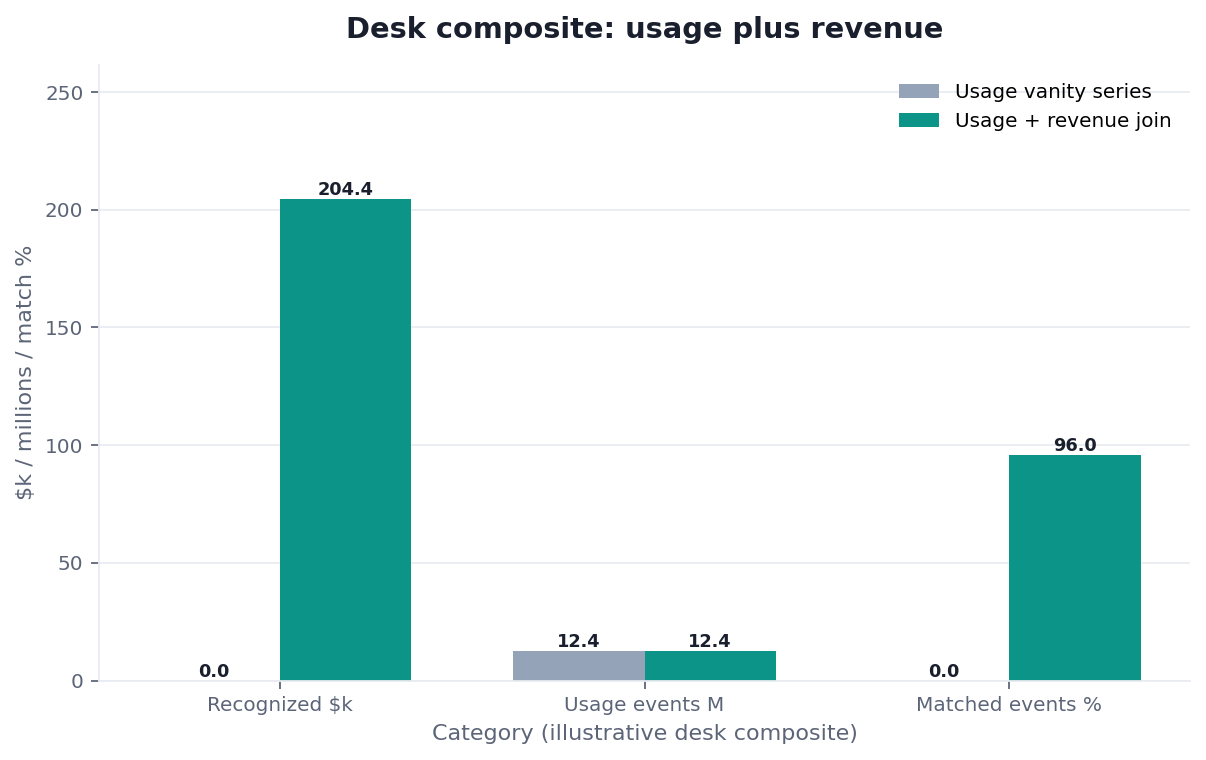
Figure. Synthetic aggregate only. Left: finalized invoice lines excluding tax less issued line-linked credit notes equals net finalized invoice amount. Right: accepted events split into matched and unmatched counts. Separate axes and scales are used. Invoice amounts are not recognized revenue or cash.
Download the evidence pack
- Assumption register
- Synthetic aggregate desk sample
- Standard-library verifier
- External source check
- Independent reproduction protocol
Run python3 verify-UPRJ-20260831.py from the downloads directory. The verifier asserts invoice-credit net arithmetic, event identity and exact rates, window identity, held cash and recognition states, held ratio, evidence class, and source-limit markers.
Build a replayable workflow
1. Freeze authorized inputs
Record source file names or table snapshots, extraction timestamps, timezones, hashes, row counts, and access boundaries. Read-only access means the analysis path cannot issue invoices, create credit notes, change meter values, refund payments, or alter recognition schedules.
InfiniSynapse does not provide a native Stripe connector. Use dated exports or warehouse tables already authorized by the organization. A data agent can assist with repeatable queries, but transport and automation do not prove source completeness or accounting correctness.
2. Lock event acceptance
Save schema versions, deduplication logic, eligibility rules, timestamp choice, late-arrival horizon, and rejected-event counts. Usage plus revenue becomes non-reproducible when the accepted population changes without a version note.
3. Reconcile each side before joining
Reconcile invoice lines to the selected finalized-invoice extract and credit notes to issued, line-linked records. Reconcile accepted, matched, and unmatched event counts. A dashboard may present these controls, while the downloadable query and evidence remain reviewable.
4. Test the join
Inspect null keys, key collisions, effective-date gaps, duplicate event identities, duplicate invoice-line identities, and post-join fan-out. Natural language to SQL can draft a query, but a reviewer should inspect its grain and cardinality.
5. Align clocks and release bounded claims
Compare event, invoice, credit, service, recognition, payment, and refund clocks. Release only the measures supported by aligned inputs. In this sample, usage plus revenue releases event reconciliation and net finalized invoice arithmetic; cash, recognized revenue, and usage per recognized dollar remain held.
6. Preserve revisions
Store run identifiers, query or code version, source hashes, parameters, exact outputs, and reviewer notes. Label each rerun as correction, late-arrival refresh, source replacement, or policy restatement. Do not overwrite the prior result without a bridge.
Evidence Boundary
This usage plus revenue page uses public documentation and a constructed aggregate. It does not access a customer billing account, meter stream, contract, general ledger, bank statement, payment processor settlement, service schedule, or accounting policy. It cannot establish any organization’s revenue, cash, billing completeness, or event coverage.
The usage plus revenue downloads intentionally contain aggregate fields only. No row-level records or personal identifiers are present. Reproducing the arithmetic does not validate source systems, configurations, joins, controls, or financial statements.
Internal InfiniSynapse reviewers are not independent auditors or accountants. Their editorial, engineering, platform, and security review is not an audit opinion, assurance engagement, endorsement, certification, or professional credential.
Independent Validation
An independent usage plus revenue reviewer can hash the five downloads, inspect the evidence labels, run the verifier in a clean standard-library Python environment, and recompute both identities from the CSV. The reviewer should record software version, UTC timestamp, hashes, output, and any disagreement.
Independent reproduction of this synthetic usage plus revenue sample means reaching the same aggregate arithmetic. It does not mean validating operational meter events, finalized invoices, credits, refunds, customer balances, cash, service periods, performance obligations, recognized revenue, or accounting policy.
For a live usage plus revenue engagement, independence requires evidence and authority outside the model author’s control. A suitably qualified reviewer would need controlled source exports and relevant policy evidence. This page does not appoint such a reviewer and does not provide third-party assurance.
Sources and Limited Claims
The following usage plus revenue sources are used only for the linked, bounded context:
- Stripe: Invoicing overview (retrieved 2026-09-04) — invoice workflow context; not evidence of this sample, cash, revenue, or integration.
- Stripe: Credit notes (retrieved 2026-09-04) — credit-note workflow context; not an entity-specific accounting policy.
- Stripe: Revenue Recognition methodology (retrieved 2026-09-04) — product methodology context; not accounting advice or an audit conclusion.
- Stripe: Usage-based billing implementation guide (retrieved 2026-09-04) — product implementation context; not proof of meter acceptance or completeness.
- IFRS 15 (retrieved 2026-09-04) — standard scope and principles; not an entity-specific conclusion.
The optional FinOps FOCUS specification (retrieved 2026-09-04) can provide normalized billing-data context where cloud costs are later joined. It does not define the event or invoice measures on this page.
Schema.org, Apache Iceberg, Apache Impala, Prometheus, and Terraform remain technical context only. They did not run, validate, endorse, or certify the sample. No cited source endorses InfiniSynapse.
How to Cite
Cite the page as a method note and synthetic aggregate example:
Zhu, William, and InfiniSynapse Data Team. “Usage plus Revenue: Reconcile Meters to Invoices.” InfiniSynapse, published 22 August 2026, updated and verified 31 August 2026, https://infinisynapse.com/en/blog/usage-plus-revenue-join. Accessed [date].
When citing a usage plus revenue download, name the file, version date 20260831, and evidence class “synthetic aggregate only.” Cite the relevant primary source separately for invoice, credit-note, usage-billing, or revenue-recognition context.
Do not describe this page or pack as a third-party audit, independent assurance report, accounting opinion, certification, customer case study, or production validation. Usage plus revenue reproduction is limited to the supplied aggregate arithmetic.
Practical review checklist
| Review question | Release evidence | Hold condition |
|---|---|---|
| Event population | Acceptance and deduplication policy | Undefined accepted event |
| Window | UTC inclusive start and exclusive end | Mixed or implicit clocks |
| Identity | Stable keys and effective-dated map | Email or ambiguous fan-out |
| Billing | Finalized lines and stated tax scope | Draft and final mixed |
| Credits | Issued state and line linkage | Credits silently omitted |
| Cash | Payment and settlement evidence | Not supplied |
| Recognition | Service periods, obligations, policy | Inputs incomplete |
| Revisions | Vintage, cutoff, and restatement bridge | Prior output overwritten |
Usage plus revenue is ready for board reporting only for the rows that pass their release evidence. A held usage plus revenue measure is a control outcome, not a gap to fill with an estimate.
Route related questions to billing data analysis, chat with your data, or exploratory data analysis. For assumption-led recovery analysis, see Payback Period Analysis and Unit Economics for Startups.
Reconcile meters to finalized invoice lines
Use authorized, sanitized exports; lock identifiers and windows; inspect unmatched records before reporting. The educational method on this page does not require the workspace.
Commercial association: InfiniSynapse sells an AI-native Data Agent.
Open InfiniSynapseEditorial accountability. William Zhu is cofounder of InfiniSynapse (GitHub @allwefantasy). Internal review roles: analytics engineering, data platform, LLM security, and editor. These reviewers are not independent auditors or accountants. See publishing principles, corrections, Company Vision, or contact zhuhl@infinisynapse.com. Usage plus revenue is not tax, legal, investment, or accounting advice.
Frequently Asked Questions
Does the $204,400 equal recognized revenue?
No. It is the synthetic net finalized invoice amount after issued line-linked credits and excluding tax. Recognized revenue is held because service periods, performance-obligation evidence, and policy are not supplied.
Does the sample say how much cash was collected?
No. Usage plus revenue keeps cash held because payment and settlement records are absent. Invoice finalization, a customer balance, a refund, and cash settlement are distinct events.
Why are 496,000 events unmatched?
The usage plus revenue count is constructed to test reconciliation; it is not an observed failure rate. A live analysis would materialize reason codes and inspect missing keys, effective-date gaps, eligibility, and timestamp boundaries.
Can the event count be divided by the invoice amount?
The arithmetic is possible, but the resulting interpretation is unsupported. The invoice amount is not established as recognized revenue aligned to the event service period, so usage per recognized dollar remains held.
Is a warehouse required?
No specific usage plus revenue platform is required. Usage plus revenue needs authorized source vintages, controlled acceptance, stable identifiers, tested cardinality, and preserved outputs. A warehouse can operationalize those controls but does not create them.
Conclusion
Usage plus revenue is strongest when it refuses category errors. Reconcile accepted events, finalized invoice lines, and line-linked credits on stable identities; print unmatched records; preserve late-arrival and restatement vintages; and label every released amount by its actual evidence class.
For this synthetic usage plus revenue aggregate, 11,904,000 matched plus 496,000 unmatched equals 12,400,000 accepted events, exactly 96% and 4%. Finalized invoice lines of $210,000 less $5,600 in issued line-linked credit notes equal a $204,400 net finalized invoice amount. Cash, recognized revenue, and usage per recognized dollar remain held. These limits keep the packet precise, reviewable, and suitable for restatement.