Annual Recurring Revenue from the Billing File
By William Zhu & the InfiniSynapse Data Team · Published: 2026-08-22 · Last updated: 2026-08-31 · Last verified: 2026-08-31 · Next review: 2026-11-30 · About · Privacy policy · Terms · Editorial standards · Corrections
Table of Contents
- TL;DR
- What Annual Recurring Revenue Means in 2026
- A Billing-Extract Framework
- How Teams Compare ARR Clocks
- Tool Landscape for ARR Packs
- Implementation Steps You Can Audit
- Accuracy and Experience Record: Illustrative ARR Pack
- Evidence Boundaries and Independent Validation
- How to Cite This Page
- Selection Scorecard for ARR Packs
- Failure Modes That Invent ARR
- Frequently Asked Questions
- Conclusion
TL;DR
We evaluate these patterns at the InfiniSynapse desk on sanitized composites; sample figures on this page are illustrative, not customer uplifts.
Direct answer: Annual recurring revenue is a billing extract you can reconcile: prepaid invoices, credits, and a locked paying cohort dated to the same file, so the board number walks back to lines you already export—without copying every invoice into a new finance warehouse first.
What you'll learn: an extract-first definition; a prepaid-and-credit framework; cash ARR versus recognized ARR; a four-step implementation path; an illustrative ARR desk; a scorecard; and the failure modes that invent a year of revenue in one month.
Download evidence: desk log · ARR CSV · verification script · source check · reproduction protocol. First-party illustrative evidence only; not audited finance or customer evidence.
Annual recurring revenue fails when the slide is a run-rate, the billing file is a different grain, and “recurring” includes one-time setup. The fix is a signed recognition rule, a hashed export, and a question you can replay. It is not a prettier ARR tile.
What Annual Recurring Revenue Means in 2026
Key Definition: Annual recurring revenue is the audit of recognized subscription dollars against an authorized billing extract so prepaid cash, credits, and the paying cohort stay inspectable. The unit of work is a board pack that points at the file, not a run-rate nobody can restate.
Annual recurring revenue starts when someone writes “paying accounts with a dated subscription invoice, annual prepay spread across the covered months, credits joined on customer_id, trials excluded” and the next run uses the same words.
If the missing object is NRR against those same invoices, continue in SaaS metrics analytics. If the missing object is price minus the cost lines you have, use contribution margin analysis. The parent join of money, usage, and cost remains unit economics analytics. ARR is an input to SaaS unit economics and ARR, not the per-customer ratio itself.
ARR is a billing extract you can reconcile. Bind the recognition sentence to the billing source in a short knowledge-base note before you ask for a company-wide figure.
Treat the extract like a public series: dated, owned, and free of live keys, with the same seriousness a World Bank data (retrieved 2026-09-04) release would demand for a named vintage. Annual recurring revenue that leaves Stripe secret keys in a CSV is not a metric pack. It is an access incident.
ARR is a billing extract you can reconcile
Slide ARR often starts from “MRR times twelve” and then edits the exceptions in the speaker notes. Annual recurring revenue refuses that path. Prepaid cash in January is not twelve months of new ARR unless the recognition rule says so. Credits that land late must restate the original month or hit the credit month—write which.
A semantic layer can freeze those names. A Markdown note bound to the billing extract is enough for the first pack.
Why prepaid and credits must share one rule
“Recurring” is an expensive adjective. Is it a paid invoice this month, a subscription that did not cancel, or a usage floor? Write it. Bind it. If two analysts disagree, stop.
One-time setup, professional services, and refunds need their own rules. A services invoice booked as subscription ARR will look heroic and be wrong in month two.
A Billing-Extract Framework
Use one table as the contract. Annual recurring revenue questions should name the cohort, the recognition rule, and the credit rule.
| Layer | What you lock | Typical source | Failure if skipped |
|---|---|---|---|
| File | dated export, owner, hash | Stripe or ledger CSV | Silent re-exports |
| Cohort | paying accounts in the window | Same extract | Mixed trials and logos |
| Money | invoices, credits, refunds | Line items | ARR without cash |
| Prepaid rule | spread vs cash-in-month | Knowledge-base sentence | January heroics |
| Eligibility | paying vs trial vs internal | Same note | Cheap-looking ARR |
| Window | invoice date vs period | File dates | Snapshot vs cohort mix |
Annual recurring revenue can start when the first honest pack joins a billing export to a subscription extract in place. A warehouse helps later, when many consumers need the same grain on a schedule.
When operators need a recurring view, generate a dashboard from the same query that produced the table.
Date the file the way a FRED (retrieved 2026-09-04) series names a vintage: one extract, one as-of, one owner. Annual recurring revenue on an undated CSV will argue with last month’s CSV.
How Teams Compare ARR Clocks
Teams argue tools. They should argue clocks. Annual recurring revenue methods differ in the cash they hold still.
| Method | Works when | Breaks when |
|---|---|---|
| Cash ARR | The question is collected dollars | Prepaid years hide as one month |
| Recognized ARR | The question is earned months | Credits restated silently |
| Logo ARR | The question is account count | Seats and add-ons drive the P&L |
| Run-rate ARR | You need a fast tile | New logos and one-time fees mix in |
Cash ARR versus recognized ARR
Cash annual recurring revenue books the invoice when collected. Recognized annual recurring revenue spreads a prepaid year across the covered months. Do not average them. A January cash spike that you call ARR is not a recurring run-rate. It is a prepaid pile wearing a subscription name.
AI for data analysis can draft the join. A human still owns the recognition rule.
Credits, refunds, and the prepaid story
Credits are the usual lie. Annual recurring revenue should subtract credit notes on the same customer key and window. If a refund arrives a month late, write whether it restates the original month or hits the credit month. Silent restatement is how boards get two ARR numbers.
Illustrative desk rule: if more than a small share of ARR dollars (you set the threshold) cannot be walked to an invoice line, do not publish company-wide ARR. Report the covered cohort only.
If the extract itself is the money source, use billing data analysis. If meters sit next to those invoices, continue in usage plus revenue join.
Tool Landscape for ARR Packs
A data agent is a fit when the question is a goal (“ARR for paying accounts after credits, prepaid spread”) and you need the SQL trail. It is a poor fit when someone wants the tool to issue invoices.
Warehouse-resident billing facts
Read-only roles only. Annual recurring revenue should never write to the billing provider. InfiniSynapse does not ship a native Stripe connector; use a dated export or a warehouse table you already operate. If you connect Postgres or a warehouse table, record the role and the window. Natural language to SQL is an execution path, not a replacement for the recognition sentence.
Treat the billing table like a Federal Reserve data (retrieved 2026-09-04) release: published, dated, and not rewritten in place. Annual recurring revenue that lets a nightly job silently replace last month’s extract will invent a restatement nobody signed.
File-first packs for early-stage teams
Five-person companies often have a Stripe CSV and a subscription dump. Annual recurring revenue can start there on those files. Freeze the file dates. Bind “paying account.” Ask ARR under the written prepaid and credit rules. Do not paste live API keys into a prompt.
If finance already compares ARR to a broader money series, a BIS statistics table is a useful reminder that a named series has a vintage and a method note. Your ARR pack needs the same two fields.
Implementation Steps You Can Audit
Annual recurring revenue starts with the recognition sentence. A pack that starts from “what is our ARR” will invent a denominator.
Lock the paying cohort and the prepaid rule
Write paying versus trial versus internal. Write how a twelve-month invoice hits the year. Get a finance partner to initial the note. This is a signed paragraph, not a product metric warehouse.
Pick customer_id or subscription_id and prove it exists on invoices, credits, and the subscription extract. A fuzzy email join will double-count logos. List unmatched credits and unmatched invoices. If match rate is weak, do not publish ARR.
Data governance is the longer question of who owns that sentence. The shorter question: can this file restate last month’s ARR with the same words.
Ask ARR, then inspect SQL
Ask one goal: recognized ARR for the last complete paying cohort after credits, or prepaid dollars booked as month-one ARR. Annual recurring revenue quality is the inspectable join. Open the query. Check that a credit did not land on a different customer key.
If an agent drafted SQL, read it. Attach it. Replay next month with the same cohort rule. Download Markdown or PDF from the task workspace so the chat is not the only artifact.
Name fields the way a CDC NCHS table names a measure: one definition, one vintage, one suppression rule. Annual recurring revenue that hides small cohorts inside a company-wide tile will invent precision.
Accuracy and Experience Record: Illustrative ARR Pack
The following numbers are an illustrative desk composite, not a customer result, audited financial statement, or benchmark. Run ID: ARR-PREPAY-20260823. Operator: InfiniSynapse Data Team. Six outputs and three held items were inspected.
| Item | Desk composite (illustrative) |
|---|---|
| File | Stripe invoice export, hashed 2026-07-31 |
| Paying cohort | 380 accounts, trials and internal seats excluded |
| Cash collected in July | $96,000 including one annual prepay of $48,000 |
| Recognized ARR (spread) | $612,000 annualized under the signed rule |
| Cash-times-twelve ARR | $1,152,000 if the prepay is treated as July run-rate |
| Unmatched credits | 5% of credit dollars with no customer key |
| Action | Publish recognized ARR only; do not headline the run-rate |
Annual recurring revenue on this pack is useful because the prepaid gap is visible. A rank that hid the $48,000 year as July MRR would have looked cleaner and been wrong.
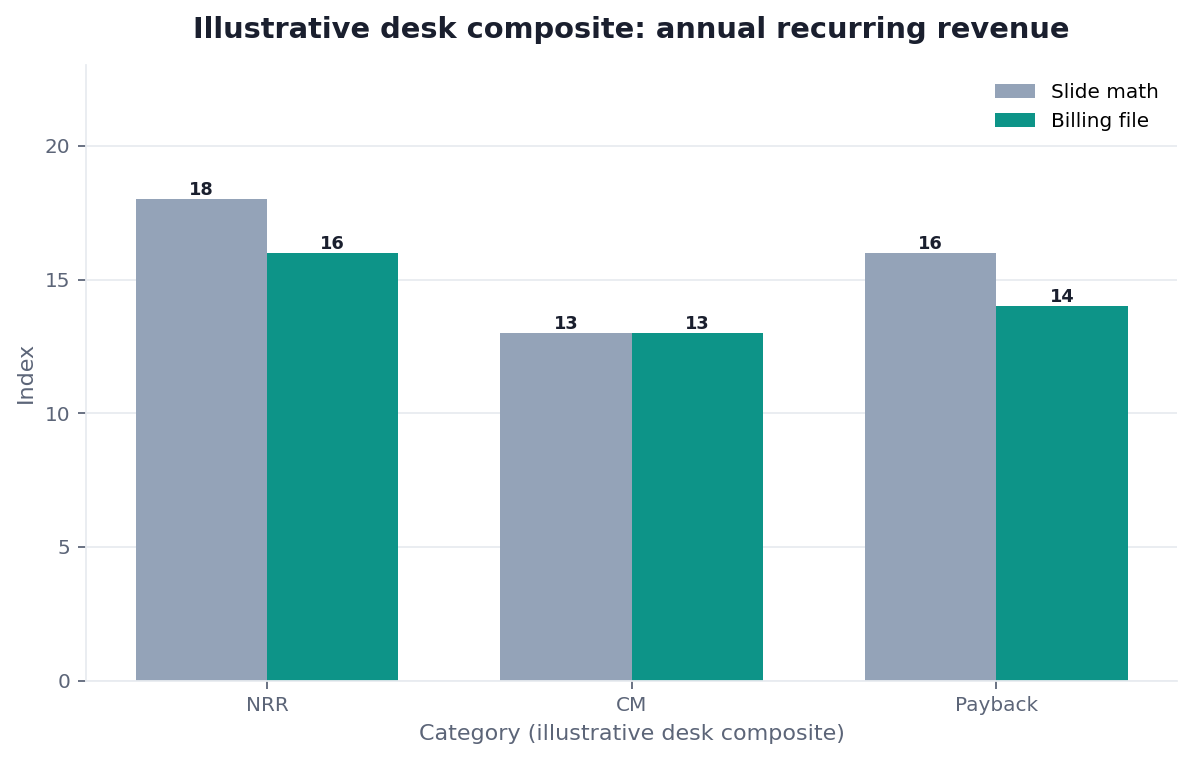
Figure. Illustrative desk composite (recognition method × prepaid share). Not a customer experiment, SLA, or official benchmark.
| Evidence class | What you can cite | What you cannot claim |
|---|---|---|
| Desk composite on this page | Grain, prepaid gap, inspectable artifacts | Customer uplift %, vendor bake-off win |
| Published authority (named above) | Dated-series discipline from the cited sources | That those sources ran this desk sample |
Desk composite: $612k recognized ARR versus $1.15M cash-times-twelve, 5% unmatched credits. Published context: World Bank, FRED, Federal Reserve, BIS, CDC NCHS.
The operator held recognition evidence, the reproduction query, and company-wide ARR. The desk log records limitations; the CSV exposes six outputs and three held items.
Evidence Boundaries and Independent Validation
Invoice rows, service periods, contracts, credit mapping, recognition policy, SQL, currency treatment, reconciliations, finance approval, and customer outcomes are unavailable. The displayed figures are illustrative and cannot establish actual recurring revenue.
The source check limits each authority to publication-method analogies. The open protocol defines external testing. No qualifying independent report, audited customer case, or media investigation exists as of 2026-08-31.
The checker validates displayed values only; it does not prove recognition treatment, cohort completeness, credit matching, reconciliation, or product performance.
This metric needs invoice rows. Annual recurring revenue evidence needs recognition policies. Annual recurring revenue evidence needs credit maps. Annual recurring revenue evidence needs reconciliations. Annual recurring revenue evidence needs independent replication.
How to Cite This Page
Zhu, W., & InfiniSynapse Data Team. (2026). Annual recurring revenue from the billing file. InfiniSynapse. https://infinisynapse.com/en/blog/annual-recurring-revenue
Run: InfiniSynapse Data Team. (2026). Desk log ARR-PREPAY-20260823. https://infinisynapse.com/blog-media/annual-recurring-revenue/downloads/desk-log-ARR-PREPAY-20260823.md
Neither is an independent audit, customer case, tax opinion, benchmark, or proof of ARR.
Selection Scorecard for ARR Packs
Score from 1 to 5. A pack that cannot inspect SQL should not win on a prettier run-rate chart.
| Criterion | What “5” looks like | Disqualifier |
|---|---|---|
| Recognition rule | Prepaid spread written | Cash-times-twelve as ARR |
| Join honesty | Unmatched credit rates printed | Silent inner joins |
| Eligibility | Paying vs trial labeled | Internal seats in ARR |
| Grain | Invoice vs subscription mapped | Mixed one-time and recurring |
| Audit | Pack + SQL downloadable | Chat-only ARR |
| Write path | Read-only billing | Agent can issue invoices |
Annual recurring revenue scores well when a skeptical CFO can replay the extract. It scores poorly when the stack implies a finance warehouse you do not operate.
Failure Modes That Invent ARR
Name the break on the pack. Annual recurring revenue reviews go faster when the known distortions are written down.
Booking a prepaid year as month-one ARR
A prepaid year is not twelve months of new ARR in January. Annual recurring revenue should spread or label the cash. Silent cash-in-month “ARR” is how boards get surprised in month two.
Mixing one-time fees into recurring
Setup, professional services, and hardware are not subscription dollars. Annual recurring revenue that folds them into the recurring tile will look smoother than cash. Keep a second row for one-time revenue if the board wants both stories.
Credits booked as new sales
Refunds that land as positive invoice lines will inflate ARR. Annual recurring revenue must join credit notes on the same customer key. If the export drops the credit type, stop. Do not guess.
A fourth pattern is trials that convert mid-window and get counted as both new and recurring. Write the conversion rule once.
Before you open a workspace, check the recognition sentence, the billing-to-credit key, the prepaid rule, and whether unmatched credits are small enough to publish.
Route the same diagnosis to the live guide that owns the next object. Each row is a single hop, not a reading dump.
| Live guide | Open it when |
|---|---|
| unit economics analytics | the question is contribution and payback |
| FP&A analytics | the question is variance, budget, or close |
| billing data analysis | the extract itself is the source of truth |
| data governance | the missing object is an owned definition |
Reconcile ARR to the billing file, not a slide
Upload a sanitized billing extract, bind the prepaid and credit rules, and ask recognized ARR for the paying cohort. This check uses only sources you authorize.
Commercial association: You do not need the workspace to complete the educational diagnosis on this page.
Open InfiniSynapseHow this page is sourced. William Zhu is cofounder of InfiniSynapse (GitHub @allwefantasy); no personal LinkedIn, accounting credential, customer affiliation, or independent reviewer role is claimed. Run record. Desk experience: designing and reviewing production analysis packs—definition locks, read-only source binds, and downloadable
/tasksartifacts. Reviewed by analytics engineering · data platform · LLM security · editor. Editorial standards · corrections · publishing principles · Contact zhuhl@infinisynapse.com. Company About. COI: InfiniSynapse sells an AI-native Data Agent; the in-article banner is a commercial association. World Bank, FRED, Federal Reserve, BIS, and CDC did not validate this run. Fact-check: data.worldbank.org · fred.stlouisfed.org · federalreserve.gov · bis.org · CDC. This page can affect money or identifiable people; it is a method note, not tax, employment, or legal advice.
Frequently Asked Questions
Do I need a finance warehouse before annual recurring revenue is real?
Bottom line: No. Annual recurring revenue is real when a locked paying cohort, a prepaid rule, and a signed credit sentence can be joined to a dated extract and replayed. A warehouse is optional for the first board pack on dated exports.
Should annual recurring revenue use cash or recognition?
Bottom line: Print both if the board needs cash collected, but headline recognized annual recurring revenue when invoices are prepaid. If you need logo count and dollar ARR, publish two packs. Do not average them.
How should credits be treated in annual recurring revenue?
Bottom line: Print the credit rule, the unmatched share, and whether restatements hit the original month. Do not headline ARR when credit dollars cannot be walked to a customer key. Never treat a model-drafted percentage as a board fact without the query.
Can annual recurring revenue replace the billing system?
Bottom line: No. Annual recurring revenue explains recognized subscription dollars on authorized reads. It does not issue invoices, write credits, or replace the close. Keep the path read-only. InfiniSynapse does not provide a native Stripe connector; analyze a dated export. If a teammate wants automated dunning, that is a different control path.
Can readers reproduce the displayed ARR?
Bottom line: No. Invoice rows, recognition policy, credit map, SQL, and reconciliation are unavailable. The CSV is aggregate evidence only.
Has an independent finance analyst reproduced this run?
Bottom line: No qualifying external report is published as of 2026-08-31. See the open protocol for requirements.
Conclusion
Annual recurring revenue is a join you can defend: a billing extract, a locked paying cohort, and a prepaid rule someone signed. Print unmatched credits, and refuse company-wide ARR when the map is thin.
When the recognition sentence and the extract are ready, ask recognized ARR on an authorized source at https://app.infinisynapse.com/. Download the pack and keep the SQL.