Fix Website Indexation Before You Rewrite Page Copy
Fix website indexation by checking status, noindex, canonicals, redirects, and raw-versus-rendered HTML on a bounded sitemap sample before editing copy.
Author credentials: William Zhu is cofounder of InfiniSynapse (GitHub @allwefantasy · auto-coder). Desk: shipping SEO Health and the /en/tool/ visibility pages. No personal LinkedIn published. About: team / editorial standards.
Publisher credentials: InfiniSynapse has public profiles on GitHub, YouTube, and X. A 2026 WAIC Future Tech OPC excellence award covers the Agentic Data Infra entry (WAIC; third-party recap: Xinhua / Caohejing). That award does not review this page or SEO Health. Method CLI: infinitegrowth on npm. Archive: recognition and scope notes.
On this page
By William Zhu · Cofounder, InfiniSynapse · Published: 2026-09-08 · Last updated: 2026-09-14 · Last verified: 2026-09-14 · Reviewed by the InfiniSynapse Data Team.
Reviewed by: InfiniSynapse Data Team · method review 2026-09-14. First-party curl review of InfiniSynapse public URLs.
Trust / COI: About · Corrections. SEO Health and InfiniSynapse are commercial products from this team. The table below is a desk fetch of our own public URLs, not a customer sitemap and not proof that Google stored any URL.
TL;DR
Website indexation is eligibility: can a crawler fetch a URL, keep it, and treat it as the chosen document. Fix noindex leftovers, dishonest status, broken canonicals, extra hops, and empty HTML shells before you rewrite titles.
Direct answer: Treat website indexation as a fetch problem. Status, robots, canonical, hops, and the first HTML bytes are the evidence. A title rewrite does not remove a leftover noindex or a 308 that still points at the wrong host path.
On 2026-09-14 we used curl against InfiniSynapse public URLs with user-agent InfiniSynapse-P4-desk/2026-09-14. The sample is this host, not a customer crawl. Reproduce the hops with curl -sSI and curl -L. Those codes do not prove Google stored the URL.
What you will learn
- Which first-party paths 308 into
/or/en/tool/ - Why an invented
/en/...path 301s into a blog 404 - What the live tool page declares for canonical and hreflang
- When a sitemap loc count is still not a pagination series
- Where this website indexation hub stops and a cluster page begins
What eligibility means here
Key definition: Website indexation is the set of conditions that let a search engine fetch a URL, accept it as a document, and keep that URL as the chosen one. It is not a rewrite of your H1. It is not an official Google health score.
The Google indexing systems guide is the official reminder that crawl, store, and retrieve are separate jobs. This hub copies that order. It does not claim Google indexed any row below.
Bing Webmaster guidelines are a second independent crawl-control reference. They do not grade this host.
Paste a public URL at SEO Health for eight lights if you want a punch list. Those lights are not a Google 100. Website indexation work starts in status and in the HTML head, not in a slogan. Tech amber is a clue. It is not a substitute for curl -sSI.
SEO Health remains the deterministic evidence foundation for status, robots, canonical, and raw-versus-rendered comparisons. Once defects are classified, teams may send those rows to an InfiniSynapse Server API long-task workspace to sequence engineering queues; the API does not refetch pages or override any observation.
Status is not a keep decision
A 200 can still be a leftover noindex. A 404 can still wear a homepage title. A 308 can still be the correct keep path. Read the code, then read the body.
Canonical is a keep vote, not a fetch
https://infinisynapse.com/en/tool/website-indexation?utm_source=p4-desk answered 200 and declared the clean tool URL as canonical. That is a keep vote. It is not proof the query string will disappear from every log.
Observed sample: first-party fetches on 2026-09-14
| Requested URL | First status | Hops | Final URL | Final status | Declared canonical |
|---|---|---|---|---|---|
/ | 200 | 0 | / | 200 | https://infinisynapse.com |
/en | 308 | 1 | / | 200 | https://infinisynapse.com |
/zh | 308 | 1 | / | 200 | https://infinisynapse.com |
/en/tool/website-indexation | 200 | 0 | same | 200 | self |
/en/blog/website-indexation | 308 | 1 | /en/tool/website-indexation | 200 | tool URL |
/zh/tool/website-indexation | 308 | 1 | /en/tool/website-indexation | 200 | tool URL |
/en/this-path-should-not-exist-p4-20260914 | 301 | 1 | /en/blog/this-path-… | 404 | none |
http://infinisynapse.com/ | 302 | 1 | https://infinisynapse.com/ | 200 | apex |
https://www.infinisynapse.com/ | 301 | 1 | https://infinisynapse.com/ | 200 | apex |
tool URL + utm_source | 200 | 0 | same request | 200 | clean tool URL |
robots.txt answered 200 (938 bytes) and allowed / while disallowing /auth/, /api/, and related internals. sitemap.xml answered 200 (192,851 bytes) with 1,568 <loc> values: 392 /en/tool/ and 1,131 /en/blog/. No loc used page= or /page/.
The invented /en/ path did not 404 in place. It 301’d into /en/blog/… and that blog URL 404’d. The 404 HTML title was the homepage title. That is a classification finding for website indexation, not a customer outage.
This host’s next.config.ts already documents why those hops exist: /en and /zh are permanent locale-root redirects; /en/blog/{tool-slug} and /zh/tool/{slug} are permanent consolidations onto /en/tool/{slug}. The 2026-09-14 curl merely confirmed the live hop. A later deploy can change Location. A website indexation file that quotes only the config and skips the live status is incomplete.
We did not sample 50–500 sitemap URLs in this desk. The 1,568-loc map is an inventory. Template prevalence still needs a stratified fetch. Homepage-only confidence is how twins hide. Keep that limit next to the hop table so a later briefing cannot promote seven first-party paths into a site audit.
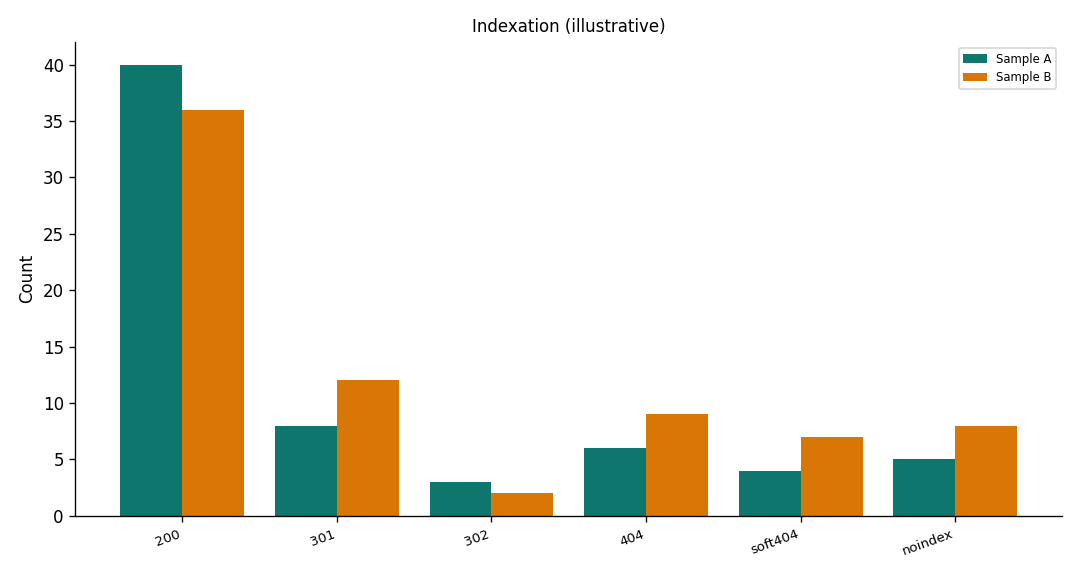
Figure: Two series from the same curl desk. First status is not hop count. Neither series is an indexed-page count.
How we fetched
curl -sSI -A 'InfiniSynapse-P4-desk/2026-09-14' \
  https://infinisynapse.com/en/blog/website-indexation
A website indexation record should keep the user-agent, the first status, the Location, and the followed final URL. RFC 9111 is the caching standard we used when deciding not to treat a cached 200 as a new fetch. It does not decide index membership.
The Google URL Inspection documentation remains the official property-level inspection surface. This desk fetch is not that tool.
What the tool HTML declared
The live tool document declared a self canonical, robots = index, follow, max-image-preview:large, max-snippet:-1, and two hreflang entries: en and x-default, both pointing at the English tool URL. Raw HTML already contained a title and 43 script tags in 96,998 bytes. That is not an empty mount-node shell.
Google’s Indexing API quickstart is a separate official surface for notifying Google about specific URL changes. It does not replace the hop table above.
A five-signal framework
Honest status
200 for a live document. 404 for a gone document. The invented path on this host failed that test on the first hop: it became a blog URL before it became a 404. That hop still belongs in a website indexation register even though the final code was honest. The 404 errors seo page owns that chain.
Robots match intent
The tool page asked to be indexed. robots.txt did not block it. Leftover noindex is a different ticket. A website indexation pass that never opens the robots meta will miss a 200 that asked not to be kept. Open noindex tag when the live directive disagrees with intent.
One keep URL
Apex, www, http, /en, and /zh already collapse toward https://infinisynapse.com/ or the English tool URL. A website indexation keep list that still contains both /en and / as live documents is already stale. The canonical tag checker and duplicate URL indexation pages own twins that still answer 200. The element job is a canonical checker.
One hop when you redirect
Locale roots, blog-to-tool, www, and http were one hop. The invented /en/ path was one hop into a 404. A website indexation register should store hop count beside Location, not as a slogan. Longer chains belong on redirect chain.
HTML that already has a body
curl already saw a title on / and on the tool URL. That is enough to reject an empty-shell story for those two URLs. If noindex or the canonical goes red, confirm the other modules on the SEO health checker. A later client-only route can still fail website indexation if the first bytes are a mount node. rendering checker, javascript crawling, and prerender SEO own those cases.
How eligibility compares to a rewrite
A title change helps after the URL returns the status you meant, is indexable, has an honest canonical, and has a body. Website indexation fails before that queue. Credits do not flip a 308. A website indexation owner who starts InfiniSynapse before the hop table exists is buying a story about missing evidence.
The a hreflang audit page owns the locale pair. This host’s tool HTML names en and x-default only. /zh/tool/website-indexation 308s to English. That is a declared-pair finding, not a translation proof.
HTTPS security headers SEO owns the host header layer. This curl -I on / and the tool URL showed x-powered-by: Next.js and did not show HSTS, X-Content-Type-Options, X-Frame-Options, or CSP. Absence is an observation, not a ranking score.
pagination indexation owns series URLs. This sitemap snapshot had no pagination query. 1,568 locs still do not invent a page-2 template.
Failure modes that hide eligibility
Copy first. Rewriting a URL that still emits noindex does not remove the directive. Verify the live HTML after deploy. Website indexation tickets stay in engineering until that re-fetch.
Soft 404 politeness. A 404 that reprints the homepage title still needs classification. Status was honest on the final hop here. The title was not. File that mismatch on the website indexation row, not as a copy win.
Canonical theater. Two URLs each point at themselves. Pick one winner, then 301 the loser. The UTM twin on this host already voted for the clean tool URL.
Shell confidence. A browser may hydrate a full interface even when curl retrieves only a mount node. Compare the first HTML with a rendered DOM before you file SSR.
Update fan fiction. A core update week is not an eligibility diagnosis. If you need history, use a GSC export in its own window. Do not invent a recovery percentage.
A website indexation briefing that skips the first status and jumps to copy is already late.
Record the user-agent. A later bot with a different UA can see a different HTML. This desk used one string. It cannot stand in for Googlebot. If you need property-level membership, open URL Inspection on the keep URL and keep that screenshot beside the curl. Do not paste the Inspection GIF into this hub as if it were the hop table.
When two people repeat the same seven requests, they should see the same first codes unless a deploy landed between them. That repeatability is the point of a website indexation desk. Narrative priority lists are a different job.
Cluster guides for this pillar
This hub keeps the eligibility map. Narrower jobs live on sibling pages.
| Job you actually have | Guide to open next |
|---|---|
| Hop count and final status | redirect chain |
| One chosen URL per twin | canonical tag checker |
| Empty JS body | rendering checker |
| Locale pairs on this host | hreflang audit |
| Missing host headers | HTTPS security headers SEO |
| A miss that should 404 in place | 404 errors seo |
| Leftover meta or header refusals | noindex tag |
| What a crawler sees without a browser | javascript crawl |
| Snapshot versus SSR | prerender SEO |
| Parameter and slash twins | duplicate URL indexation |
| What to sample in a series | pagination indexation |
Adjacent hubs stay in their rooms: SEO health checker, SEO website audit, analyze Search Console with AI, SEO CI/CD. Use those pages when website indexation is already honest.
Inspect the live URL before you rewrite it
Read status, Location, robots, and canonical on the public host. Then open a sample only if templates disagree.
Run SEO Health CheckerFrequently Asked Questions
What does eligibility mean here?
Website indexation is eligibility: fetch, accept, and keep a URL as the chosen document. It is not a title rewrite and not an official Google score. Prove it on status, noindex, canonical, redirects, and the HTML body.
Can a title rewrite fix eligibility?
No. A title change helps after the URL returns the status you meant, is indexable, has an honest canonical, and has a body. Website indexation has to clear first. Rewrite later.
Do status codes need InfiniSynapse?
No. HTTP status, redirect hops, robots directives, and declared canonicals come from deterministic fetches. InfiniSynapse is optional only after the measured table exists and a team wants a credited prioritization narrative.
How does a sitemap sample prove eligibility?
A 50–500 URL sample shows which templates fail. This host’s 1,568-loc map is a loc inventory, not a rendered-pagination proof. Stratify, fetch, classify, then write. Homepage-only checks hide twins. That sample rule is part of website indexation, not a later audit luxury.
Does a 308 mean the old path is indexed?
No. A 308 records a hop we observed. Website indexation still requires a property-level inspection if you need to know what Google kept. The hop table answers fetch. It does not answer membership.
Conclusion
Use website indexation when the job is to verify fetch, keep, and chosen URL before anyone opens a copy doc. The 2026-09-14 desk shows locale roots collapsing to /, blog tool slugs collapsing to /en/tool/, and an invented /en/ path walking into a blog 404. Close the file when the first status, the Location, the canonical, and the unresolved alternatives are still visible. A bounded hop table is more useful than an unsupported index claim.
William Zhu · Cofounder, InfiniSynapse · GitHub @allwefantasy
Desk-validated SEO Health methods. Corrections: zhuhl@infinisynapse.com · corrections policy.