Find and Remove Every Leftover Noindex Tag in HTML
Find each noindex tag in HTML and response headers, compare it with release intent, and remove production leftovers before rewriting eligible keep-pages.
Author credentials: William Zhu is cofounder of InfiniSynapse (GitHub @allwefantasy · auto-coder). Desk: shipping SEO Health and the /en/tool/ visibility pages. No personal LinkedIn published. About: team / editorial standards.
Publisher credentials: InfiniSynapse has public profiles on GitHub, YouTube, and X. A 2026 WAIC Future Tech OPC excellence award covers the Agentic Data Infra entry (WAIC; third-party recap: Xinhua / Caohejing). That award does not review this page or SEO Health. Method CLI: infinitegrowth on npm. Archive: recognition and scope notes.
On this page
By William Zhu · Cofounder, InfiniSynapse · Published: 2026-09-08 · Last updated: 2026-09-14 · Last verified: 2026-09-14 · Reviewed by the InfiniSynapse Data Team.
Reviewed by: InfiniSynapse Data Team · method review 2026-09-14. First-party curl of the live website-indexation tool HTML and
robots.txt.
Trust / COI: About · Corrections. SEO Health and InfiniSynapse are commercial products from this team. The robots rows below are a desk fetch of our own public keep-page. They are not a customer CMS export and not proof that Google stored the URL.
TL;DR
A noindex tag leftover in meta robots or X-Robots-Tag hides eligibility on URLs you meant to keep. Staging leftovers are the usual source. Catch both channels. Remove the leftover. Re-sample. Then write.
Direct answer: A leftover noindex tag is a present-or-absent fact. On 2026-09-14 the live tool page at
/en/tool/website-indexationdeclaredrobotsasindex, follow, max-image-preview:large, max-snippet:-1. That URL had no leftover refusal in meta orX-Robots-Tag.robots.txtanswered 200, allowed/, and commented that attachments stay out of the index viaX-Robots-Tag. Read both channels. Do not infer a leftover from the page topic.
We used user-agent InfiniSynapse-P4-desk/2026-09-14. Reproduce the read with curl -sSI and a raw HTML dump. Those directives do not prove Google stored the URL.
What you will learn
- What the live tool page actually declared
- Why
robots.txtallow is not the same as a keep vote - Where attachment comments mention
X-Robots-Tag - When a noindex tag hunt stops and a miss-class sibling begins
What leftovers a refusal finds
Key definition: A noindex tag leftover is a meta robots or X-Robots-Tag refusal that still sits on a keep-page after launch. The job records both channels, then labels each row leftover or intentional. A leftover hides eligibility. An intentional refusal is a clean “do not keep.”
People search this phrase when a launch page never appears and the title looks fine. A noindex tag leftover answers “did we leave a refusal on production.” Copy cannot override that bit.
The Google robots meta specification is the official rule we used for meta and header names. It is not a product endorsement.
The Google valid page metadata guide is the reminder that robots values must be inspectable, not inferred from copy. A noindex tag leftover hunt follows that habit.
Paste a public URL at SEO Health to see eight lights. The traffic-light board is not a Google 100. A noindex tag leftover hunt starts in tech, not in a slogan.
SEO Health remains the deterministic layer for status, meta robots, X-Robots-Tag, canonical, and raw-versus-rendered evidence. Classified production leftovers may enter an InfiniSynapse Server API long-task workspace to sequence CMS and edge queues; the API does not refetch keep-pages, remove directives, or override the captured refusal.
Leftover is not the same as intentional
The leftover pass asks whether the refusal matches intent. Staging should refuse. Production keep-pages should not. Mixing those rooms wastes a sprint. If tech is red on a leftover noindex tag, stop the outline. If the refusal is intentional, leave it and move on.
What this page will not retarget
This page’s target is a noindex tag leftover. It stays off miss classes, hop counts, and empty shells. Stay here when the ticket is “meta or header still says noindex.”
Allow rules still belong on the robots txt check. A robots-allow check is required and still incomplete. Leftover refusals can still appear after allow: the path is fetchable and the document refuses to be kept.
First-party robots read on 2026-09-14
We fetched https://infinisynapse.com/en/tool/website-indexation without following hops. The answer was HTTP/2 200, a self canonical, and this robots meta: index, follow, max-image-preview:large, max-snippet:-1. has_noindex was false. No X-Robots-Tag sat on that HTML response.
https://infinisynapse.com/robots.txt answered 200 (938 bytes), allowed /, and disallowed /auth/, /api/, /v1/, /webhooks/, /dashboard, /analyze, and related internals. Comments in that file say attachments stay out of the index via next.config X-Robots-Tag, and that blocking those files in robots.txt would hide the header from Search Console.
| Requested URL | Status | Robots / header | Leftover noindex? |
|---|---|---|---|
/en/tool/website-indexation | 200 | index, follow, max-image-preview:large, max-snippet:-1 | no |
tool URL + utm_source=p4-desk | 200 | same robots; canonical is the clean tool URL | no |
/robots.txt | 200 | Allow /; comments name X-Robots-Tag on attachments | file itself sent X-Robots-Tag: noindex, nofollow |
curl -sS -A 'InfiniSynapse-P4-desk/2026-09-14' \
  https://infinisynapse.com/en/tool/website-indexation \
  | grep -i 'name="robots"'
A noindex tag leftover hunt records that the keep-page asked to be indexed. It does not invent a staging leftover on that URL. The attachment comment is a different channel: files that should stay out of the index use a header, not a Disallow that would hide the header.
The Google block indexing guide is the official “how to refuse” page. This desk did not treat that guide’s topic as proof that our tool URL refused. Inspect directives. Do not infer them from a title.
Cloudflare response header modification shows how an edge can inject X-Robots-Tag. Applied here: a leftover at the gateway is still a leftover. The public fetch is the truth.
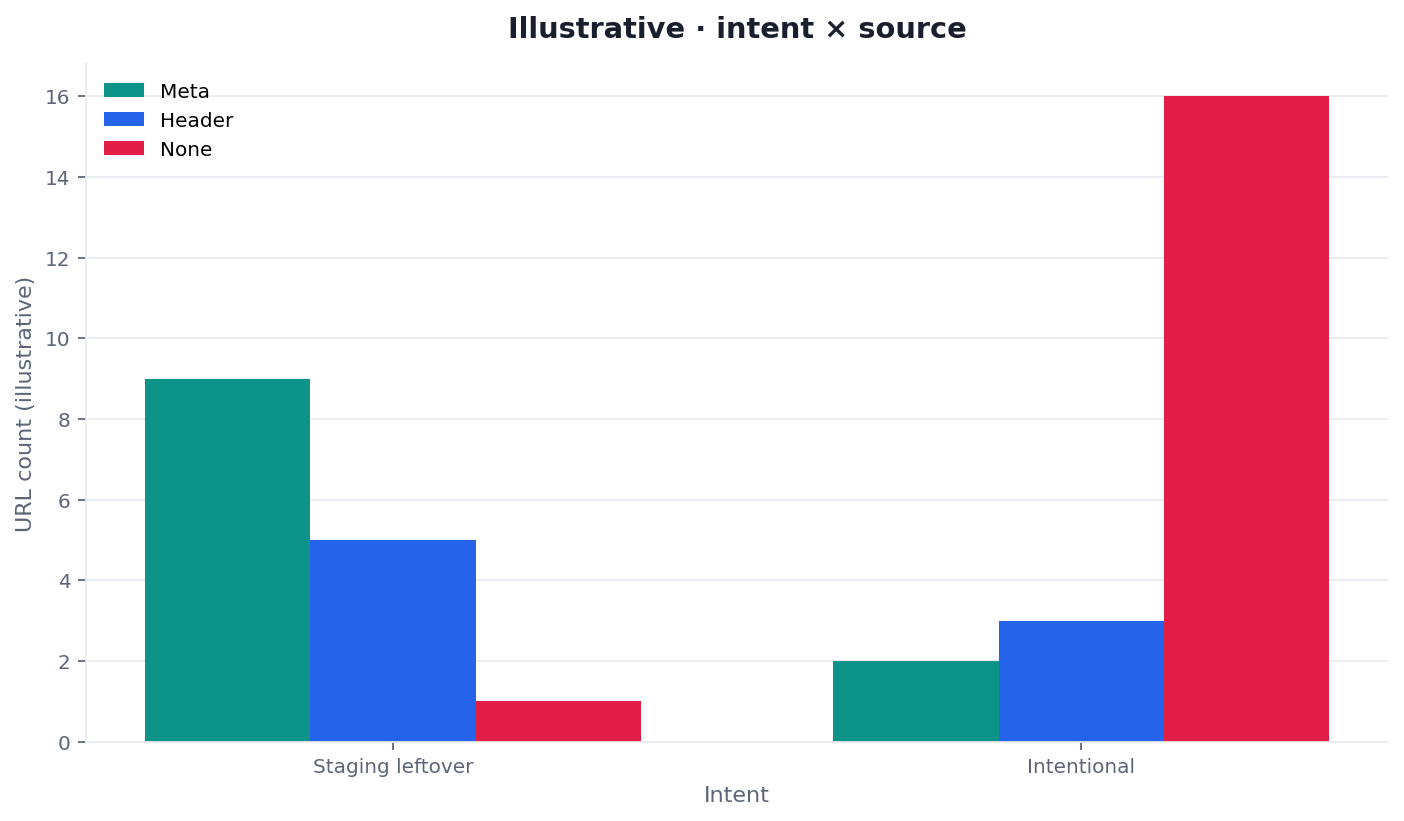
Figure: Two series from the same curl desk. Meta robots is not X-Robots-Tag. Neither series is an indexed-page count.
What the tool HTML declared
The live tool document also declared two hreflang entries: en and x-default, both pointing at the English tool URL. Raw HTML already contained a title. Those facts are keep-votes. They are not a leftover noindex tag. Do not file a staging ticket against a page that asked to be indexed.
The UTM twin answered 200 on the same request and still declared the clean tool URL as canonical, with the same robots string. A leftover hunt that only reads the query string and skips the robots meta will invent a problem that this fetch did not show.
What robots.txt allowed and commented
Allow / means the path is fetchable. It does not mint a keep vote. The comments warn operators not to Disallow attachment paths if they want Search Console to see the X-Robots-Tag. That is operator guidance for files. It is not a leftover noindex tag on the tool HTML.
sitemap.xml also answered 200 and sent X-Robots-Tag: noindex, nofollow on the map file itself. That header is expected on a machine list. Do not treat the sitemap header as a leftover noindex tag on a keep-page.
A three-source framework
Use this map before you open a copy doc. A noindex tag leftover is a source table, not a vibe.
| Source | Where you read it | This 2026-09-14 desk |
|---|---|---|
| Meta | robots meta in the document | tool URL: index, follow, … |
| Header | X-Robots-Tag on the response | absent on the tool HTML; present on robots.txt and sitemap |
| None | No refusal | keep-page channel |
A noindex tag leftover hunt holds when those three agree with the keep-list. A keep-page with meta noindex is a leftover. A thank-you page with meta noindex is intent. Do not average them into a 100.
The Apache mod_headers reference is the origin-side reminder that headers are operator-owned. Applied here: X-Robots-Tag is a header you can leave on by accident. The leftover pass names the leftover. It does not treat the header as a ranking score.
Both channels can refuse
Meta and header both count. A noindex tag leftover pass that reads only the head will miss a CDN leftover. A pass that reads only the header will miss a CMS default. Fetch both. Quote both.
Fetch utilities sit on the technical SEO tools page for other fetch jobs. This cluster stays on the leftover.
How a leftover compares to intent
Intentional noindex is a product decision. Leftover noindex is a deploy bug. A noindex tag leftover exists to separate those two. If you only need a title, wait until the keep-page is indexable.
Use the website indexation hub when eligibility still spans more than a leftover robots bit. This page owns the noindex tag leftover-refusal slice.
A 404 errors seo miss can sit next to a leftover tag: a polite 200 that also refuses. Classify both. Removing noindex on a gone document does not make the 200 honest.
A canonical tag checker pass can show twins that also carry leftover noindex. Pick the winner after the leftover is gone. A leftover hunt does not merge the keep-list.
This host’s tool HTML already voted for itself and asked to be indexed. The noindex tag leftover pass on that URL is closed until a later deploy changes the bit.
Who owns the robots bit
Engineering owns meta defaults, header maps, and the edge. Editorial owns titles after the URL is eligible. Noindex tag leftover meetings fail when writers own the first hour. Start with the sample. Then assign copy.
When one URL is enough
One URL is enough when a launch page is new and you need a leftover check on that address only. Paste it. Read tech. Confirm 200, no leftover refusal, self-canonical, and a body. Then write.
One URL is not enough when a CMS default stamps every template. A noindex tag leftover at template scale needs a wider sample. This desk proved one keep-page and the robots file on our host. It did not sample 50–500 sitemap URLs. Leftovers still cluster on CMS defaults. Homepage-only checks hide them.
Credits are optional. You can list every leftover without a model. Buy a write-up only when a wide sample needs a ranked punch list. Do not buy narrative to delete a noindex tag.
How to run the leftover pass
Use the four steps before anyone drafts a new H1. A noindex tag leftover hunt is a fetch, a classify, and only then a sentence.
Step 1 — Sample the keep-list
Take production URLs you meant to keep. Stratify launch pages, account flows, and thank-you templates. Leftovers cluster on CMS defaults and edge maps. A homepage-only paste hides them.
If the sitemap lists staging hosts, that is already a finding. Remove those rows from the public sitemap, then resume the leftover pass on production.
Step 2 — Read meta and header
Fetch each sampled URL. Record status, meta robots, X-Robots-Tag, and canonical. This table is the job. The eight-module lights still run; tech is the column you sort first for a noindex tag leftover.
Status codes stay free. The robots table does not need credits to name a leftover.
Step 3 — Label leftover versus intent
Mark meta, header, or none. Then mark leftover versus intentional. A noindex tag leftover fails when a keep-page still refuses. Remove the tag on keep-pages. Leave the tag on pages you truly do not want kept. Re-sample. Then write.
Hold the H1 rewrite until the refusal is gone. Eligibility before copy still wins.
Step 4 — Optional priority narrative
If the sample is large, ask for a ranked list: which template still stamps noindex. The narrative must still quote the source table. The model may not invent a meta tag. After the list, remove leftovers, then retitle.
When an update week coincides with a drop, keep the evidence on the fetch. The leftover tag is the live refusal. A Performance CSV is history. Do not invent a GSC index count for the tool URL.
Scorecard for leftover refusals
Score a noindex tag leftover, not a vanity 100, before you call production done.
| Check | Pass | Fail |
|---|---|---|
| Keep-pages have no refusal | Meta and header clear | Staging leftover on production |
| Intentional refusals are named | Thank-you and attachments listed | Tribal “we think it is fine” |
| Both channels read | Head and X-Robots-Tag | Head-only pass |
robots.txt allow not treated as keep | Allow recorded, then meta read | Allow used as a keep vote |
| Eligibility before copy | Remove leftover, then write | Rewrite under noindex |
A pass means a leftover hunt is clear enough to write. A fail keeps the leftover ticket open. Credits do not delete a meta tag.
Failure modes that leave the bit
Copy first. The common miss is rewriting a keep-page while it still emits noindex. If a search engine crawls the URL and processes that directive, it is being asked not to index the page; verify removal in both meta and response headers before evaluating copy.
Head-only theater. Reading meta and skipping X-Robots-Tag hides the CDN leftover.
Topic inference. Treating a page about blocking as if it refused. This desk’s tool URL asked to be indexed. A noindex tag hunt still inspects the string.
Intent confusion. Treating every noindex as a bug will index thank-you pages and attachments you meant to hide. Label first.
Sitemap leftovers. Advertising staging URLs in the public sitemap keeps the mess visible. Remove those rows.
Credit superstition. Buying EEAT or visibility does not remove noindex. Status codes and robots bits stay in SEO Health.
Adjacent jobs in this pillar
This page is the noindex tag leftover-refusal cluster. Nearby guides pick up miss classes and chosen-URL fights after the leftover is gone.
When the gone URL should 404 in place, open 404 errors seo. When twins still answer 200, open the canonical tag checker. Twins that still answer 200 need a canonical checker. When the stored 200 is missing HSTS, open HTTPS security headers SEO. When the first HTML bytes are the defect, open javascript crawl.
Read both HTML and response directives through SEO Health tools, because checking only the visible source can miss an X-Robots-Tag refusal.
Read both robots channels before you rewrite
Store meta robots and X-Robots-Tag on the keep-page. Then decide leftover versus intent.
Run SEO Health CheckerFrequently Asked Questions
Can a leftover refusal hide a keep-page?
Yes. A noindex tag leftover exists to find that leftover. Staging meta or X-Robots-Tag on production hides eligibility. Remove the tag, re-sample, then write.
Does a title change override the bit?
No. A noindex tag leftover fails on the robots bit. A title change helps after the keep-page returns 200 and no longer refuses.
Do I need credits to see the leftover?
No. Status codes and tech lights stay free. The leftover pass does not require a login. An account and credits start only if you begin EEAT, visibility, GSC narrative, or a deep report.
Will one launch URL catch a CMS default?
Only for that launch URL. A noindex tag leftover at template scale needs a wider sample. Leftovers cluster. This desk proved the tool URL asked to be indexed. Homepage-only checks hide the rest.
Does robots.txt allow replace a keep vote?
No. Allow means the path is fetchable. A noindex tag leftover hunt still reads meta and X-Robots-Tag on the document. This host allowed / and the tool page still had to declare index, follow.
Conclusion
A noindex tag leftover in meta or header hides eligibility. Staging leftovers are the usual source. The 2026-09-14 desk showed the live tool page asking to be indexed, no leftover refusal on that URL, and a robots.txt that allows / while commenting X-Robots-Tag on attachments. Remove leftovers where they exist, re-sample, then write. Status codes stay free. Eligibility still comes before copy.
William Zhu · Cofounder, InfiniSynapse · GitHub @allwefantasy
Desk-validated SEO Health methods. Corrections: zhuhl@infinisynapse.com · corrections policy.