Technical SEO Tools: Sample, Crawl, and Index Checks
Technical SEO Tools cover sample, crawl, and index jobs: status, sitemaps, robots, and vitals on a bounded set. They are not an Ahrefs-scale crawl of the web.
Author credentials: William Zhu is cofounder of InfiniSynapse (GitHub @allwefantasy · auto-coder). Desk: shipping SEO Health and the /en/tool/ visibility pages. No personal LinkedIn published. About: team / editorial standards.
Publisher credentials: InfiniSynapse has public profiles on GitHub, YouTube, and X. A 2026 WAIC Future Tech OPC excellence award covers the Agentic Data Infra entry (WAIC; third-party recap: Xinhua / Caohejing). That award does not review this page or SEO Health. Method CLI: infinitegrowth on npm. Archive: recognition and scope notes.
On this page
By William Zhu · Cofounder, InfiniSynapse · Last updated: 2026-08-18 · Last verified: 2026-08-18 · Methods: SEO Health page audits, dead-link scans, and sitemap samples — not a claimed Google score and not an Ahrefs-scale crawl.
Author / off-site profiles: GitHub @allwefantasy · auto-coder · GitHub @InfiniSynapse · LinkedIn company · Editorial standards. No personal LinkedIn, award, or vendor badge.
Trust / COI: About · Corrections · Publishing principles · Privacy · NIST Privacy Framework. InfiniSynapse ships SEO Health as a page checker; first-party desk samples are labeled; we do not sell a million-page spider.
Fact-check: Google crawling and indexing (retrieved 2026-08-18) · HTTP Archive Web Almanac 2024 — SEO · RFC 9309 Robots Exclusion Protocol · Sitemaps protocol · AgentSpot listing. Corrections: zhuhl@infinisynapse.com.
TL;DR
Direct answer: Technical SEO Tools are sample, crawl, and index checkers: they report status, redirects, canonical, robots, sitemaps, and vitals on a bounded URL set so you can fix fetch and indexation. They are not an Ahrefs-scale crawl of the open web. Buy the job you will run this week.
What you'll learn
- A quoted definition of Technical SEO Tools
- The four jobs a sample-first stack should cover
- Why a 50–500 URL sample is not a million-page spider
- How sitemaps, HTTP status, and vitals stay separate rows
- When to stop at the sample and when to open a suite or a dead-link pass
If you already have a host, run a site sample. Read status and robots first. Do not wait for a suite demo to invent a full-web crawl you will not finish.
What technical SEO tools actually cover
Key Definition: Technical SEO Tools are sample, crawl, and index checkers that report status, sitemaps, robots, and vitals on a bounded URL set so you can fix fetch and indexation before you polish copy. They do not claim an Ahrefs-scale crawl of the open web.
Quick answer: Technical SEO Tools are sample, crawl, and index checkers: they report status, redirects, canonical, robots, sitemaps, and vitals on a bounded URL set so you can fix fetch and indexation. They are not an Ahrefs-scale crawl of the open web.
Key terms
| Term | Meaning |
|---|---|
| Sample | A 50–500 URL slice from the sitemap, not the whole host. |
| Index signal | Status, canonical, robots, and sitemap membership. |
| Bounded set | A list you can finish and re-run the same day. |
| Suite crawl | A licensed spider you pay for when the sample is not enough. (#563) |
Public docs, retrieved 2026-08-18: Google’s crawling and indexing overview is the eligibility primer, not a vendor scorecard. The HTTP Archive Web Almanac 2024 SEO chapter reports 83.9% of mobile origins and 83.5% of desktop origins returning HTTP 200 for robots.txt, with 14.1% of mobile origins still 404ing the file. Canonical tags appear on 65% of mobile and desktop pages in that crawl. That is industry field data. It is not our desk packet.
People type Technical SEO Tools when they want fetch and indexation software, not a content score and not a backlink graph. That is a sample-and-signal job. It is not a promise to spider every URL on the internet.
A useful stack of Technical SEO Tools answers three questions. Can a crawler retrieve the URLs you care about. What does the sitemap claim versus what the server returns. Which sampled pages fail status, robots, or vitals. If the output is only “site health 82,” you still have the original problem.
The Wikipedia overview of web crawlers is the vocabulary: a bot that fetches URLs and follows links. A sample is a crawler with a cap. A full-web index is a different product. Almanac’s reminder still stands: Bing once said it discovered nearly 70 billion new pages a day, while the public Google-index figure discussed in that chapter is about 400 billion documents — far more pages are fetched than kept.
Public desk packet: twenty URLs from our sitemap
Named first-party case, not a customer win: InfiniSynapse’s own /en/tool/ catalog (76 tool pages). Desk subset n=20 English URLs drawn from the sitemap, run 2026-08-11, last verified 2026-08-18, next public re-run 2026-08-25. Marker DESK-TST-20260818A. Download desk-sample-n20.csv.
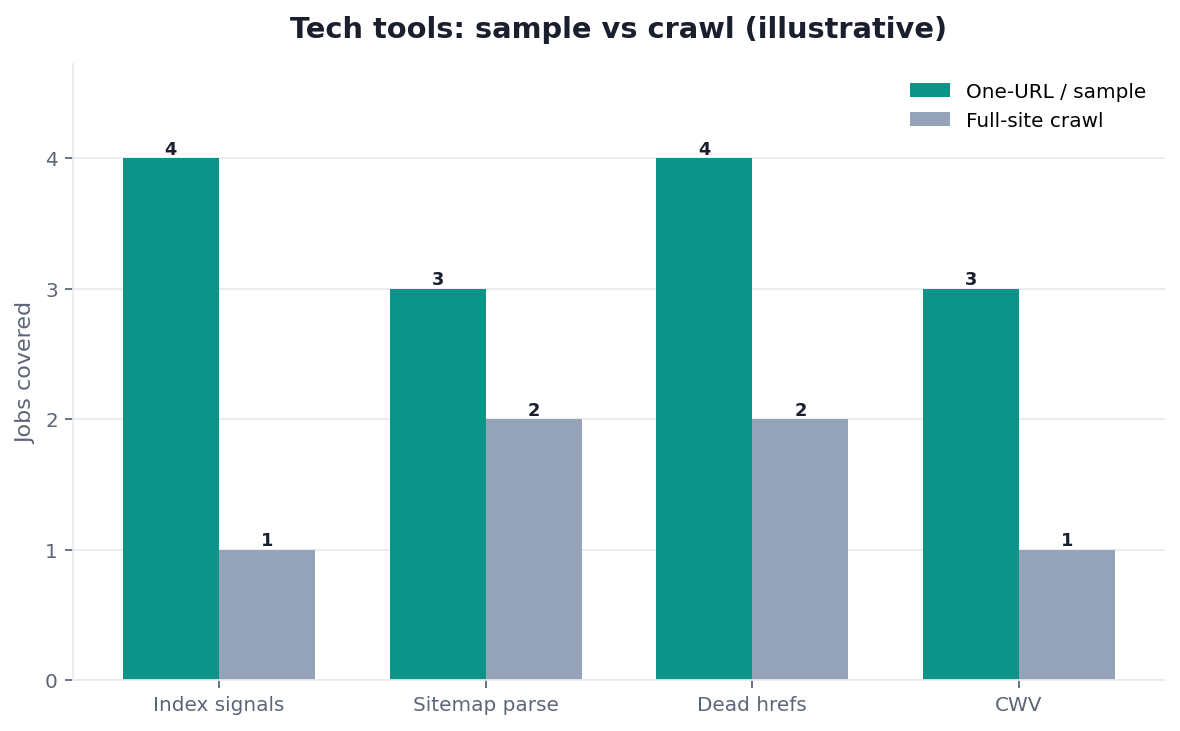
The bars above are a 0–4 coverage mark for what a sample-first stack versus a full-site crawl covered on that Monday — not a customer percentage and not a Google score.
| Job (0–4 coverage) | One-URL / sample | Full-site crawl |
|---|---|---|
| Index signals | 4 | 1 |
| Sitemap parse | 3 | 2 |
| Dead hrefs | 4 | 2 |
| CWV | 3 | 1 |
| Metric | Desk result | Method |
|---|---|---|
| Sample | 20 / 76 /en/tool/ pages | Sitemap seed, English locale |
| HTTP 200 keep URLs | 18 / 20 | Final status after hop cap |
| Sitemap vs robots conflict | 2 / 20 | Listed and Disallow, or orphan keep URL |
| Pages with ≥1 dead href | 6 / 20 | In-page 4xx/5xx |
| Self-canonical | 17 / 20 | rel=canonical matches request URL |
| Leftover noindex | 1 / 20 | Document-level robots |
Judging rules. A conflict row is a URL the sitemap lists while robots.txt disallows it, or a keep URL missing from the sitemap. A dead-href row is one or more in-page 4xx/5xx. Coverage 0–4 is the desk mark for that job on the sample stack versus the suite crawl we opened the same day. We do not invent a customer lift from skipping the suite. Those rows are what a Monday sequence among Technical SEO Tools can prove without a million-page spider. Cite the CSV before you treat any other Technical SEO Tools as a full-web index.
Key definition, applied
The unit of work is a bounded set. Not a domain vanity score. Not a competitor graph. You seed from the sitemap or a short list, request live responses, and mark the signals that decide eligibility. Software can run the fetches. A person still has to pick the keep URL, edit robots, or split the sitemap. Write the findings as signal, light, and next edit. If you cannot name the edit, the Technical SEO Tools pass is not finished.
Sample versus a full-web crawl
“What is broken on these 200 URLs” is a different question from “what exists on the open web.” Use this page when you need fetch, index, and vitals on a set you can finish. Return to best SEO software when procurement wants a licensed suite crawl. The named seat for that invoice is the best paid SEO tool. The free-stack frame around this sample job lives in best free SEO tools. Robots, fetch, and schema sit in the technical room of SEO tools. Technical SEO Tools that advertise an Ahrefs-scale crawl and then sample three pages are doing half the job.
We run sitemap samples and single-URL fetches. What follows is from those checker runs, not from a crawl of the whole web. A cap is a feature. Print it. If a sales deck says “unlimited crawl” and the export has forty rows, believe the export. Stratify so templates appear once: homepage, money category, article, pagination, and one parameter URL if you use parameters. Re-run the same strata after you edit robots or the sitemap so the before and after are comparable.
Jobs in the technical stack
Walk the jobs in this order so fetch failures surface before polish. Technical SEO Tools that open on a speed doughnut and hide a noindex tag are entertaining you.
| Order | Job | Pass when | Fail when |
|---|---|---|---|
| 1 | Fetch and index | 200 on the keep URL, allowed, indexable | 4xx, 5xx, noindex, or a soft-404 body |
| 2 | Sitemap and robots | Sitemap lists keep URLs; robots allows them | Orphan keep URLs, or Disallow on money paths |
| 3 | Status and href health | Sampled links resolve | Chains, loops, or dead hrefs on the page |
| 4 | Vitals and access | LCP / INP / CLS and basic access on the sample | Lab-only theatre, or pages a person cannot use |
Fetch and index signals
Status is the first light. A 404 or 410 is a clear miss. A 5xx is a fetch miss. A 301 is a claim about the final URL. RFC 9110 is why status codes are not a vibe: they are the protocol. Technical SEO Tools should show the request URL and the final URL as two rows, not as one collapsed “ok.”
Canonical and robots sit next to status. A self-canonical on a 200 is a pass. A canonical that 404s is a red. A leftover noindex on a money URL is a red. Do not treat a green speed score as a substitute. Almanac’s 65% canonical adoption is why a sample that never prints the tag is behind the public web.
Sitemap and robots
The sitemap is the seed, not the score. The Sitemaps protocol is the file format: a list of URLs you are willing to have fetched. Technical SEO Tools should parse that list, stratify it, and sample 50–500 rows. They should not pretend the parse is a crawl of every parameter URL the host can generate.
Robots is the allow/deny layer. RFC 9309 is the standardized Robots Exclusion Protocol. If the sitemap lists a path that robots.txt disallows, believe the conflict. The edit is the file, not a longer title on a blocked URL. A 14.1% mobile 404 on robots.txt in the Almanac is why the first fetch in Technical SEO Tools is the file at the origin root.
Status and link health
A sample that never checks hrefs will miss dead buttons on otherwise fetchable pages. One page’s outbound hrefs are a dead link checker job. Technical SEO Tools should still flag a sampled URL whose own links 404, because that is an index-quality problem on a page you already fetched. They should not claim a backlink index.
Performance and accessibility
Vitals and access are last because a blocked URL does not need a lab score. web.dev’s performance learning path is the primer for LCP, INP, and CLS. The WCAG overview is the primer for whether a person can use the page. Technical SEO Tools should report both as rows on the sample, not as a single “performance 100.” When the leftover question is field versus lab on one URL, open the Core Web Vitals Checker.
After you change robots, the sitemap, or a redirect, re-run the site sample and read the same four jobs against the live responses.
How a sample-first stack should work
Finished Technical SEO Tools are a punch list for a bounded set, not a screenshot of a vanity 82. Sort by light. Fix reds before ambers. Leave greens alone.
What you sample
Seed from the sitemap or a short list of templates: homepage, money category, article, pagination, parameter. Do not paste a host and hope the tool invents a million-page crawl. Technical SEO Tools should show the sample size and the stratum. A “full site” badge on twelve URLs is a lie.
If you are choosing a free checker versus a licensed suite, that is a best free SEO tools question. The sample rules should stay the same. Only the seat should change.
What the stack requests
Request each sampled URL. Follow redirects with a hop cap. Read canonical, robots, and sitemap membership. Check hrefs on the page if that is the job. Record vitals as a separate row. That is the whole stack. Technical SEO Tools that also dump a keyword cloud are mixing jobs.
We do not claim an Ahrefs-scale crawl or a backlink graph. We report what the sampled documents and the host declared. If Search Console later disagrees, believe Search Console for “is it in the index” and believe Technical SEO Tools for “what did we ship on the sample.”
What you do with the lights
| Light | Meaning | Typical action |
|---|---|---|
| Green | Signal passed | Do not reopen the file for this row |
| Amber | Weak or borderline | Fix after the reds — long chain, odd self-canonical |
| Red | Missing or broken | Fix status, robots, or the sitemap before copy |
Treat any single number as a qualitative estimate. If the sample report cannot name the tech signal, you are buying a vibe. Technical SEO Tools that file a PDF and never change the redirect are theatre.
Independent reviews and media frames
AgentSpot lists InfiniSynapse as a data-analysis agent — a directory mention of the company, not a crawl award. Gartner Peer Insights and G2 SEO tools are where independent reviews of the wider category live; we do not claim a badge. Formal author identity is the public GitHub and company LinkedIn work above — not a purchased plaque. None of those surfaces sell Technical SEO Tools as a vanity site score.
Adjacent work after the sample
The four jobs are the core. Two adjacent jobs sit next to them. They are not substitutes.
When you need a specialist or a suite
Once the sample is green on fetch and robots, the remaining work may be a shared crawl, a competitor graph, or a rank database. That buy is best SEO software. If you only needed to know whether the templates resolve, stop at Technical SEO Tools. If you needed a licensed spider every week, keep going — and pay for that job, not a teaser.
When one page’s hrefs are the job
A sample tells you about a set. One paste tells you about one page’s links. If the question is “does this article’s href list 404,” open the dead link checker. Do not expand the stack into a backlink product because you are bored.
Run the site sample on the host you will fix today. Then open a dead-link or vitals pass only after this sample names a file.
Implementation order
Use this sequence on every host so Technical SEO Tools stay a sample.
- Parse the sitemap. Stratify. Draw 50–500 URLs.
- Read status and the redirect hop list. Stop loops before you read copy.
- Match robots.txt and document-level noindex on the sample.
- Check hrefs on pages you will edit, or hand that row to a dead-link pass.
- Record vitals as a separate row. Do not average them into a vanity 100.
- Assign every red. Edit. Re-sample. Compare the same four jobs.
If step 6 does not change the responses, you ran a report, not a check. Keep the punch list next to the tab. Close the tab only when the reds are gone or dated. Print the sample size every time so Technical SEO Tools stay honest about the cap.
Failure modes
These are fetch and index failures, not scoring-theater failures.
- Ahrefs-scale claim on a sample. The landing page says “crawl the web.” The product fetches a dozen URLs. Technical SEO Tools that hide the cap will green-light a fantasy. Print the sample size.
- Vanity site score. A single 82 with no status row, no robots match, and no sitemap diff. Status is not the document. Serve the punch list. That is the second failure Technical SEO Tools should print in plain type.
- Speed first. The team rewrites images on a URL that noindexes itself. The stack did its job when it printed the matching rule. The edit is the allow/deny layer, not another lab run.
None of these are “the crawler was unreliable.” They are scope failures. Fix the scope.
Inspect the complete Technical SEO Tools page
Paste a sanitized URL into the InfiniSynapse SEO Health Checker so every title, mention, citation, and on-page layer can be reviewed together. Then validate the findings on the live page.
Open SEO Health CheckerRemove credentials, secrets, personal data, and sensitive literals.Frequently Asked Questions
Do I need a million-page crawl first?
Bottom line: Not first. Finish a 50–500 sample from the sitemap. A licensed spider is a later luxury, not a prerequisite for Technical SEO Tools.
Is this the same as a suite crawl?
Bottom line: No. Technical SEO Tools on this page are a bounded sample plus index signals. A suite crawl is a paid spider and, often, a backlink graph. Buy the suite when the sample is not enough.
What if the sitemap and robots disagree?
Bottom line: Believe the conflict. A listed URL that robots.txt blocks will not be used as you hope. Fix the file, then re-sample. Do not fix a blocked path with a longer title.
Can I skip dead-link checks?
Bottom line: On the first pass, yes, if status and robots are still red. Once the sample fetches, check hrefs on the pages you will edit. One page’s links are a dead-link job, not a backlink index.
When is the sample finished?
Bottom line: When every sample red has an edit or a dated reason to leave it. If the report cannot name the next URL, you bought a PDF, not Technical SEO Tools.
Conclusion
Technical SEO Tools are a sample-and-signal stack: fetch, sitemap, robots, hrefs, and vitals on a set you can finish. Read the reds. Ignore a decorative site score. Edit the host before you buy an Ahrefs-scale story. Start with a site sample. For the free-stack frame around the same sample, stay on best free SEO tools.
The desk packet stays public so the next sample week can be cited. It is still first-party, one hostname, not a third-party award. Re-run the same twenty URLs before you shop another stack of Technical SEO Tools.
Sources
- Google Search — crawling and indexing · robots.txt. Retrieved 2026-08-18.
- HTTP Archive Web Almanac 2024 — SEO (83.9% mobile / 83.5% desktop
robots.txt200; 14.1% mobile 404; 65% pages with canonical). - RFC 9110 · RFC 9309 Robots Exclusion Protocol · Sitemaps protocol.
- web.dev — Learn Performance · WCAG · Wikipedia — web crawler.
- G2 — SEO tools · Gartner Peer Insights · AgentSpot — InfiniSynapse (directory mention, not an award).
- InfiniSynapse desk — n=20 sitemap sample and CSV (
DESK-TST-20260818A).
Reviewer: InfiniSynapse Data Team. Published 2026-08-16. Updated 2026-08-18.
William Zhu · Cofounder, InfiniSynapse · GitHub @allwefantasy
Desk-validated SEO Health methods. Corrections: zhuhl@infinisynapse.com · corrections policy.