SEO Software: Compare Suites, Specialists & AI Tools
Compare SEO software for audits, rankings, links, content, and AI visibility. Match suites and specialists to your workflow, budget, and ROI.
Author credentials: William Zhu is cofounder of InfiniSynapse (GitHub @allwefantasy · auto-coder). Desk: shipping SEO Health and the /en/tool/ visibility pages. No personal LinkedIn published. About: team / editorial standards.
Publisher credentials: InfiniSynapse has public profiles on GitHub, YouTube, and X. A 2026 WAIC Future Tech OPC excellence award covers the Agentic Data Infra entry (WAIC; third-party recap: Xinhua / Caohejing). That award does not review this page or SEO Health. Method CLI: infinitegrowth on npm. Archive: recognition and scope notes.
On this page
60-second answer. SEO software includes suites, specialists, and automation platforms for technical audits, keywords, rankings, links, content, reporting, and AI visibility. Compare the weekly job first: if you need competitor data and shared rank history, test a suite; if you need a punch list on URLs you own, start with a specialist and first-party data. Evaluate automation only when every proposed action can be reviewed, reversed, and measured.
By William Zhu · Cofounder, InfiniSynapse · Reviewed by the InfiniSynapse Data Team · Last updated: 2026-09-24 · Last verified: 2026-09-24 · Methods: SEO Health page audits, sitemap samples, and GSC export math — not a claimed Google score.
Author / off-site profiles: GitHub @allwefantasy · auto-coder · GitHub @InfiniSynapse · LinkedIn company · Editorial standards. No personal LinkedIn, award, or vendor badge.
Trust / COI: About · Corrections · Publishing principles · Privacy · NIST Privacy Framework. InfiniSynapse ships SEO Health as a specialist checker; first-party desk counts are labeled; product CTAs are commercial.
Fact-check: Google Search Console (retrieved 2026-08-18) · PageSpeed Insights · Screaming Frog SEO Spider · G2 SEO tools · AgentSpot listing. Corrections: zhuhl@infinisynapse.com.
TL;DR
Direct answer: Compare SEO software as a suite, specialist, or automation platform. A small team rarely needs every module: begin with first-party data and a specialist, then add a suite for competitor graphs, shared rank history, or repeatable multi-site reporting. Add AI visibility or automated fixes only when the system shows evidence, approvals, rollback, and measurable results.
If you already have a URL, run a free page check. Do not start a software RFP to learn the title is truncated.
What Is SEO Software? Suites, Specialists, and Automation
SEO software is licensed or hosted software that helps teams research search demand, audit websites, monitor rankings and links, improve content, report outcomes, or measure visibility in conventional and AI-generated search. Wikipedia’s Software as a service overview is the right commercial shape: you usually rent access, data, and workflow rather than own the vendor’s crawl or index.
Key definition: SEO software falls into three useful buying categories. A suite bundles crawl, keyword, rank, link, content, and reporting rooms. A specialist performs one bounded job well. An automation platform can propose or execute changes, but it also requires approval, rollback, and outcome controls.
Public product limits, retrieved 2026-08-18: Screaming Frog documents a 500-URL free crawl. Search Console and PageSpeed Insights stay first-party and free on a property you own. G2’s SEO tools category and Gartner Peer Insights — Analytics & BI are independent review markets; we do not claim a badge. An advertised entry suite seat near $99 / month is a common SKU on vendor pricing pages that same week — not our invoice and not a utilization study. It does not, by itself, make that SKU the best SEO software.
ISO’s catalog entry 63534 (retrieved 2026-08-18) is the posture we want: published requirements you can audit. If the deck cannot map to a job this month, it is a brochure, not best SEO software.
How We Tested Eight Options
We evaluated jobs rather than vendor module counts, recording the URL set, date, route, retained output, wall time, unresolved work, and whether the next action could be assigned. The packet covers only InfiniSynapse-owned pages; it does not rank vendor databases, backlink indexes, or customer outcomes.
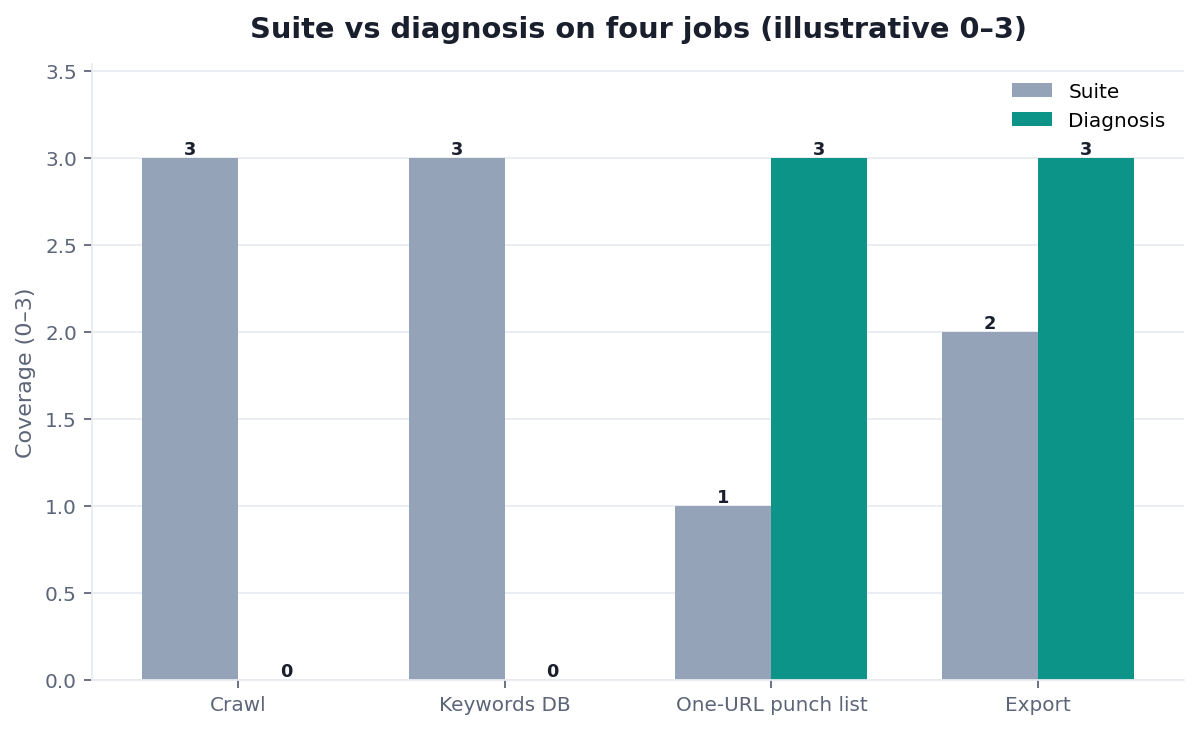
Public desk packet: suite rooms vs punch list, n=8
Named first-party case, not a customer win: InfiniSynapse’s own /en/tool/ catalog (76 tool pages). Desk subset n=8 English URLs, run 2026-08-11, last verified 2026-08-18, next public re-run 2026-08-25. Marker DESK-BSS-20260818A. Download desk-suite-vs-specialist-n8.csv.
The grouped bars above are that series on a 0–3 coverage scale — not a customer percentage and not a Google score.
| Job (0–3 coverage) | Suite | Diagnosis (SEO Health) |
|---|---|---|
| Crawl | 3 | 0 |
| Keyword database | 3 | 0 |
| One-URL punch list | 1 | 3 |
| Export a human can assign | 2 | 3 |
| Metric | Desk result | Method |
|---|---|---|
| Sample | 8 / 76 /en/tool/ pages | Same hostname, English locale |
| Median page-check wall time | 19 s | Paste URL → punch list on screen |
| Punch-list items after one pass | median 6 | Title, heading, alt, or dead link |
| Pages with ≥1 dead href | 3 / 8 | HTTP 4xx/5xx on in-page links |
| Leftover jobs that needed a competitor graph | 0 / 8 | Own property only |
Judging rules. A leftover suite job is a graph of sites you do not own, a live link index, or shared rank history. A dead href is a 4xx/5xx at fetch time. Wall time starts at paste and ends when the punch list is visible. Coverage 0–3 is the desk mark for that job, not a sitewide “health 82.” That is the only best SEO software benchmark we will defend here: same eight URLs, a punch list, and a leftover-job column. Not a utilization study.
For provenance, William Zhu’s public work is available through GitHub @allwefantasy, the auto-coder repository, GitHub @InfiniSynapse, and the InfiniSynapse LinkedIn company profile. AgentSpot’s InfiniSynapse listing is a directory mention, not a product award.
What a suite actually bundles
A suite usually means site crawl, rank tracking, a keyword database, a content editor, and some form of link index. You pay for the bundle even when you only open two of those rooms. That can be rational for an agency that lives in one project every day. It is a bad default for a two-person site that needed a dead-link list on Monday.
Write the rooms on a whiteboard before a demo. “Fix five titles and the 404s” calls for a checker; “report twenty client domains against a shared crawl” can justify a suite.
The U.S. CIO Council says name the job, then pick the system. Steal that order.
What a specialist is for
A specialist is one job: a page auditor, a speed lab, a GSC export reader, an E-E-A-T pass, or a link prospector. SEO Health is a specialist on diagnosis — free page, dead links, sampled site; depth AI on credits. We are not a suite and we are not Ahrefs.
When the job is one URL, stay on on page SEO tool. When the job is the suite-versus-specialist split, stay on best SEO software.
Required Features
Do not compare every SEO software product on the same oversized checklist. Start with the capabilities required by recurring jobs, then mark whether each capability is native, integrated, usage-capped, or absent.
| Capability | Question to verify | Evidence to request |
|---|---|---|
| Technical audit | Does it crawl the required URL count and render JavaScript when needed? | Crawl limit, render mode, issue export |
| Keyword research | Which countries, devices, and update dates does the database cover? | Database scope and refresh policy |
| Rank tracking | Can teams retain daily or weekly history by location and device? | Retention window and export |
| Backlink analysis | Is there a proprietary index, a partner source, or no link graph? | Index date, discovered/lost links |
| Content workflow | Does it diagnose existing pages or mainly generate drafts? | Recommendation method and editable brief |
| AI visibility | Which answer engines, prompts, locales, and citations are measured? | Prompt set, observation date, source URLs |
| Reporting | Can users export raw rows as well as dashboards? | CSV/API access and scheduled reports |
| Integrations | Does it connect to GSC, GA4, CMS, task, and warehouse systems? | Permission scope and data direction |
| Automation | Can every change be approved, logged, reversed, and attributed? | Audit log, rollback, control settings |
Traditional rankings and AI mentions answer different questions. An SEO software product should not collapse them into one unexplained visibility score. Keep the engine, query or prompt set, locale, observation date, and source evidence visible.
Why small teams skip the full suite
When choosing SEO software, small teams need a Monday stack and one paid job they will repeat. See best free SEO tools for the free stack and best SEO tools for small business for budget and contract constraints. Before you compare suites, read the free SEO tools scorecard. Add a suite only when the leftover job needs shared history or data about competitors.
Seat math versus credit math
A $99 / month advertised entry seat that three people forget is more expensive than four E-E-A-T credits you used. That dollar figure is the common public SKU noted above, retrieved 2026-08-18, not a negotiated invoice. Credits should buy a reproducible diagnosis. Seats should buy a workspace you open weekly. If you cannot name the weekly job, you are not ready to buy best SEO software as a suite.
NIST’s Cybersecurity Framework and NIST Privacy Framework (retrieved 2026-08-18) provide the right risk posture: know what leaves the building and how personal data is handled. A local page check plus a browser-side export is a smaller surface than “upload the company.”
Pricing, Free Trials, and Hidden Limits
Compare SEO software pricing by the limits that change the weekly job: projects, users, tracked keywords, crawl credits, report exports, API access, history, AI prompts, and cancellation terms. Judge a free layer by what you can retain without a calendar link. If the useful row arrives only after a demo, it was never a free layer; it was a lead form with a gauge on top.
First-party reports you already have
Search Console (retrieved 2026-08-18) is free, first-party, and not a page auditor. PageSpeed Insights is free speed. Neither replaces a title-and-links pass. Pair them with a checker that reads HTML. Do not replace the checker with a GSC screenshot in Slack and call that best SEO software.
W3C’s standards index (retrieved 2026-08-18) is a reminder that titles, HTML, and sitemaps are public contracts. A vendor who invents a second language for “healthy” should show the mapping.
Honest checkers versus demo forms
| Layer | What you keep | Fail if |
|---|---|---|
| SEO Health free | Page, dead links, 50–500 sample | You needed a link index |
| Search Console | Queries, coverage, experience | You needed on-page HTML |
| PageSpeed Insights | Lab + field speed | You needed headings |
| Suite free tier | A tease of the UI | You planned a quarter on ten lookups |
| Open-source crawler | A local crawl you run | You needed AI diagnosis |
The Open Source Definition is the test for a crawler you can run yourself: can you inspect it, or did you rent a black box? Local crawls are specialists. They are not AI diagnosis. Depth AI on SEO Health uses credits; it does not pretend the free sample is a million-page crawl.
Run a site sample when one URL is not the problem and you are not ready to buy a suite.
Match the Tool to the Team and Use Case
| Team or job | Start with | Add when needed |
|---|---|---|
| One site, one operator | GSC, PSI, page checker | Local crawler or one specialist |
| Small content team | Page and content diagnosis | Rank history and shared briefs |
| Technical SEO team | Full crawler and log-capable workflow | Warehouse/API and monitoring |
| Agency or portfolio | Shared suite with projects and roles | Client reporting and competitor graphs |
| Enterprise program | Governed platform and integrations | Approval, audit, procurement, and data controls |
| AI visibility program | Prompt and citation monitoring | Controlled recommendations; automation only with rollback |
This SEO software use-case split is more defensible than a universal winner. A tool can be strong for an agency and wasteful for one site; a specialist can be ideal for one task and incomplete for portfolio reporting.
When a suite still wins
An SEO software suite still wins when several people live in one project, when you need a graph of domains you do not own, or when rank history is the QBR. That is not a failure of the free checker.
Before you sign, ask who will live in the project on a Tuesday. If the answer is “whoever has time,” you will pay for empty rooms. Named ownership is the difference between best SEO software and a logo on an expense report.
If you need accounts, roles, and a scheduler rather than a license logo, read seoplatform. Platform is control. Software is the job you licensed.
We still will not put SEO Health on a backlink leaderboard to “complete” a suite comparison. If prospecting is the job, buy link software. If the page is untrustworthy, run the E-E-A-T pass first. Trust work is E-E-A-T SEO, not another seat.
Suite and Specialist Comparison Scorecard
Score SEO software as a stack, not a trophy. Marks are High / Partial / None. Verify vendor-specific limits during a trial because plans, data coverage, and AI features change.
| Job | Full suite | Specialist checker (SEO Health) | First-party (GSC / PSI) |
|---|---|---|---|
| Page HTML punch list | Partial | High | None |
| Dead links | Partial | High | None |
| Site coverage | Crawl | Sample 50–500 | Your property |
| Rank history | High | None | Your verified property |
| Keyword / competitor graph | High | None | Your queries only |
| Link index | High | None | None |
| E-E-A-T diagnosis | Partial | Credits | None |
| AI visibility tracking | Plan-dependent | Diagnosis only | None |
| Raw export / API | Plan-dependent | Export | GSC export / API |
| Roles and approvals | Plan-dependent | None | Property permissions |
| Cost shape | Annual seat | Free + credits | Free |
How to read the marks
“None” on a link index for SEO Health is correct; a suite’s graph is why teams still pay for one. “Partial” means a crawl may see titles and status codes while hiding the assignable punch list behind a site-health score.
A 30-day buy sequence
Run thirty days on work you already own before buying SEO software from a comparison grid.
Week one: run what you own
- Pick five URLs you own. Run the free page check on each.
- Export Search Console. Fix titles, dead links, and one decaying query. If the list is empty, stop shopping for thirty days.
Weeks two to four: add one paid job
3. Add one paid job you will repeat: an E-E-A-T credit, a 500-URL local crawl (Screaming Frog documents that free ceiling), or a suite trial you will actually log into. 4. Cancel a tease. If the trial is ten lookups you will not repeat, it is not a candidate for best SEO software.
Diagnosis that uses models — E-E-A-T, GEO — stays on credits here. Writing assistants stay off this buyer page; they are a different cluster.
Failure Modes
Avoid four common SEO software mistakes: paying for unused modules, planning a quarter around a trial cap, expecting a page checker to supply a backlink graph, and treating AI drafting as diagnosis. Judge each product on the job it claims; reject missing evidence, not an honest boundary.
Inspect the complete SEO Software page
Paste a sanitized URL into the InfiniSynapse SEO Health Checker so every title, mention, citation, and on-page layer can be reviewed together. Then validate the findings on the live page.
Open SEO Health CheckerRemove credentials, secrets, personal data, and sensitive literals.Frequently Asked Questions
What is SEO software?
Bottom line: SEO software helps teams research search demand, audit websites, monitor rankings and links, improve content, report outcomes, or measure visibility in AI answers. Suites bundle several jobs, specialists focus on one, and automation platforms can recommend or execute changes under controls.
What is an all-in-one suite?
Bottom line: An all-in-one suite bundles crawling, rank tracking, keyword data, and often content or link analysis. A specialist does one bounded job.
How do I compare tools?
Bottom line: Compare the weekly job, not module count. Use a checker plus Search Console for URLs you own; compare paid suites for competitor graphs, shared rank history, and multi-site reporting.
Which suite is best for a small team?
Bottom line: Start with a specialist plus GSC. Add a suite when several people share a weekly project or need competitor data.
When should I pay for a suite?
Bottom line: Pay when several people share a weekly project or you need data about competitors. Keep a checker for individual URLs.
Is a free tier real software?
Bottom line: A free SEO software tier is useful only if you keep the output. Ten lookups and a demo form are a trial, not a durable stack.
Which tools track AI visibility?
Bottom line: Use software that discloses the answer engines, prompts, locales, observation dates, and cited sources it monitors. Do not merge AI mentions and Google rankings into one unexplained score. Confirm whether AI visibility is native, an add-on, or a separate product before buying.
Where does SEO Health sit?
Bottom line: On the specialist row of best SEO software: free page, dead links, sampled site; credits for depth AI. We are not a suite and we are not a link index.
Conclusion
The SEO software decision is suite, specialist, or governed automation—not one universal winner. Small teams often skip the full suite, while agencies and enterprise teams may need shared projects, competitor data, integrations, and reporting. Start with one URL and run the free check. Open best AI SEO tools if AI visibility or diagnosis is the unresolved job.
The desk packet for the best SEO software stays public: first-party, one hostname, not a third-party award.
Sources
- Google Search Console · PageSpeed Insights. Retrieved 2026-08-18.
- Screaming Frog SEO Spider — free crawl ceiling 500 URLs.
- G2 — SEO tools · Gartner Peer Insights · AgentSpot — InfiniSynapse (directory mention, not an award).
- ISO 63534 · NIST Cybersecurity Framework · W3C standards · Open Source Definition · U.S. CIO Council · Wikipedia — SaaS.
- InfiniSynapse desk — n=8 suite-versus-specialist packet and CSV (
DESK-BSS-20260818A).
Reviewer: InfiniSynapse Data Team. Published 2026-08-16. Updated 2026-09-24. SEO software intent refresh: DESK-BSS-20260924A.
William Zhu · Cofounder, InfiniSynapse · GitHub @allwefantasy
Desk-validated SEO Health methods. Corrections: zhuhl@infinisynapse.com · corrections policy.