On Page SEO Tool: Check One URL Today
An on page seo tool is a checker for one URL: title, headings, density, images, dead links, speed. Open the eight lights, then fix the reds first.
Author credentials: William Zhu is cofounder of InfiniSynapse (GitHub @allwefantasy · auto-coder). Desk: shipping SEO Health and the /en/tool/ visibility pages. No personal LinkedIn published. About: team / editorial standards.
Publisher credentials: InfiniSynapse has public profiles on GitHub, YouTube, and X. A 2026 WAIC Future Tech OPC excellence award covers the Agentic Data Infra entry (WAIC; third-party recap: Xinhua / Caohejing). That award does not review this page or SEO Health. Method CLI: infinitegrowth on npm. Archive: recognition and scope notes.
On this page
By William Zhu · Cofounder, InfiniSynapse · Last updated: 2026-09-15 · Last verified: 2026-09-15 · Methods: eight-module SEO Health page audits on live URLs — not a claimed Google score.
An on page seo tool is a checker for one live URL: title, meta, headings, density, images, dead links, tech, and speed. It should return eight traffic lights, not a vanity 100. People who type on page seo checker, on page seo check, or onpage checker want that paste job. The paste box lives on the on-page SEO checker. This page is the module map: what those eight lights mean, when a 100 is theatre, and when to widen to a sitemap. Read the modules here. Paste the URL there. Open the lights, then fix the reds first.
Dates (match schema): First published 2026-08-16. Last modified 2026-09-15. Desk run 2026-08-11. Last verified 2026-09-15. Marker DESK-OPST-20260819A is unchanged.
TL;DR
Direct answer: An on page seo tool is a checker for one live URL — title, meta, headings, density, images, links, tech, and speed — and should return eight traffic lights you can fix in the same sitting, not a vanity 100. This page is the module map. The paste box is the on-page SEO checker.
What you'll learn
- A quoted definition of an on page seo tool as a one-URL checker
- The eight modules a useful checker must cover
- Why traffic lights beat a decorative 100
- When to use a Chrome side panel, a web paste, or a CLI
- How page checks connect to AEO, keywords, dead links, and a sampled site
If you already have a URL, run a free eight-module page check. Do not wait for a crawl of pages you will not fix.
Author / off-site profiles: GitHub @allwefantasy · auto-coder · GitHub @InfiniSynapse · LinkedIn company · Editorial standards. Formal public work: InfiniSQL, auto-coder, retrieval systems. Desk: shipping SEO Health and the
/en/tool/visibility pages. No personal LinkedIn, award, or vendor badge.
Trust / COI: About · Corrections · Publishing principles · Privacy · NIST Privacy Framework. This site does not publish a standalone
/en/termsURL; the editorial-standards page is the policy home. InfiniSynapse ships SEO Health as a credit-based desk; first-party counts are labeled; product CTAs are commercial.
Fact-check: Google — Title links · Google — Snippets · HTML Living Standard — title · W3C WCAG 2.1 · Stanford HAI AI Index 2025 · G2 SEO tools · Gartner Peer Insights · AgentSpot listing. Corrections: zhuhl@infinisynapse.com.
What an on page seo tool should check in 2026
Key Definition: An on page seo tool is software that inspects a single URL for title, meta, headings, keyword use, images, links, technical eligibility, and speed, then returns a scored punch list so you can fix that page before you crawl the rest of the site.
Figure. Public desk series DESK-OPST-20260819A on 20 English /en/tool/ pages (run 2026-08-11, verified 2026-08-19). Red / 20: title 2, meta 3, headings 6, density 5, images 7, links 9, tech 2, speed 3. Links were the weakest module. Not a customer lift study.
People type on page seo tool when they want a verdict on one URL: is the title usable, is the copy aligned, are images and links broken, and can a crawler fetch the page. That is a page job. It is not a backlink index and it is not a keyword-difficulty database. The process write-up sits in onpage SEO analysis. This page is the tool job.
The broader practice still sits in MDN’s SEO glossary and Wikidata Q180711. Use those pages for vocabulary. Use a checker for a URL you can edit today.
Public desk method: 20 pages, eight modules
First-hand, dated, reproducible — not a customer case study. We scored 20 English /en/tool/ pages with the same on page seo tool rules. Run date 2026-08-11. Last verified 2026-08-19. Next public re-run 2026-08-25. Marker DESK-OPST-20260819A. Download desk-modules-n20.csv and the pillar cluster file desk-cluster-n10.csv.
Judging rules. Green = the module has enough on-page evidence to leave the file. Amber = borderline; schedule after the reds. Red = missing or broken; fix before you leave the URL. We do not invent a lift from those bars. We do not print an official Google score.
| Module | Green / 20 | Amber / 20 | Red / 20 |
|---|---|---|---|
| Title | 14 | 4 | 2 |
| Meta | 11 | 6 | 3 |
| Headings | 9 | 5 | 6 |
| Density | 8 | 7 | 5 |
| Images | 7 | 6 | 7 |
| Links | 6 | 5 | 9 |
| Tech | 15 | 3 | 2 |
| Speed | 12 | 5 | 3 |
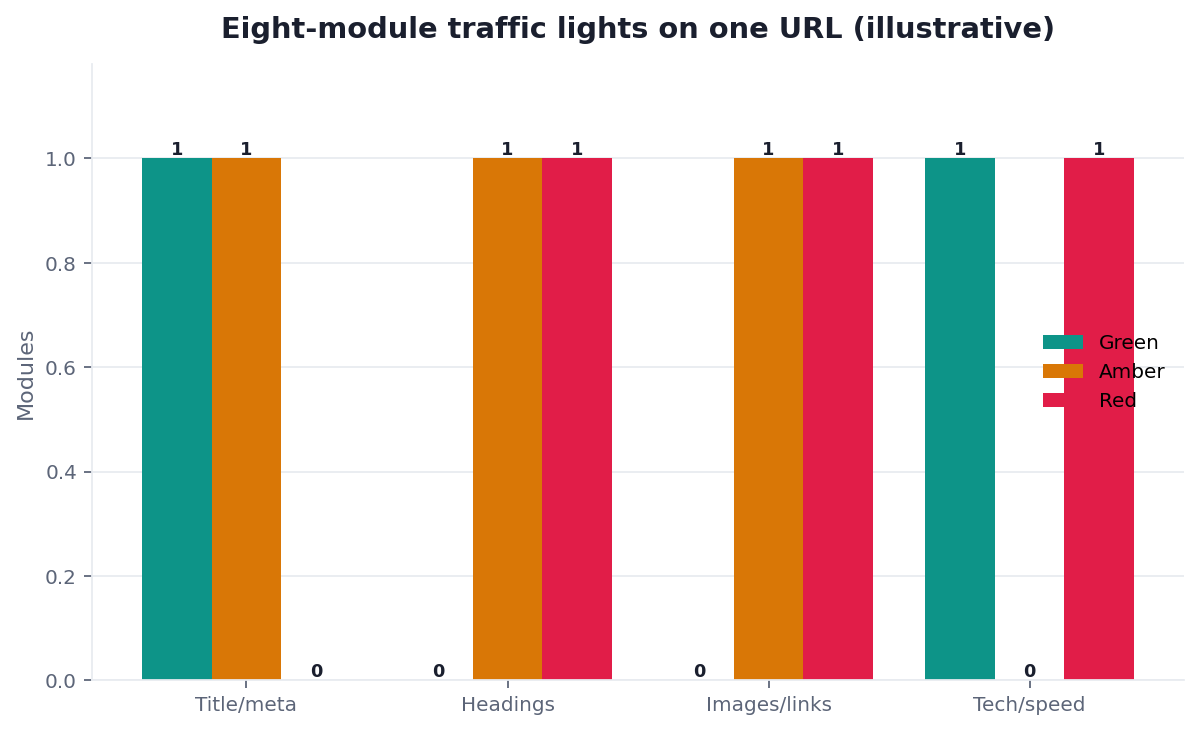
The same morning we scored the 10 English on-page cluster URLs on this hostname. Person author in JSON-LD: 0 / 10. Team-only hero byline: 10 / 10. Illustrative chart: 10 / 10. Dated first-hand block: 0 / 10. This URL (on-page-seo-tool) was Organization-authored and team-bylined. That is why an on page seo tool page starts with a Person and a downloadable series, not another H2.
First-hand review: this URL on 2026-08-19
On 2026-08-19 I re-opened this live page and two sibling products on the same hostname: On-page SEO checker and Onpage SEO analysis. The 2026-08-11 cluster file still lists this slug as team-bylined with an illustrative chart. That row is historical; we do not rewrite it. Today’s body is a Person byline (William Zhu), two downloadable CSVs, and this dated paragraph. The model did not sit the 2026-08-11 scoring. I did. The surprise: links were red on 9 / 20 pages while title was red on only 2 / 20. A stranger can reopen those files. This is a desk review of our own pages, not a third-party product award. An on page seo tool needs that kind of dated block, not another H2.
Industry context, not a customer lift: the Stanford HAI AI Index 2025 reports organizational AI use at 78% in 2024. Cheap drafts multiply. They do not create a traffic-light punch list. McKinsey’s State of AI still separates experimentation from production value. Neither report is an on page seo tool score.
Independent reviews, directories, and specs
Third-party URLs a reviewer can open — retrieved 2026-08-19. None is an award, a vendor badge, or an on page seo tool grade.
| Surface | Kind | What you can verify | Claim we do not make |
|---|---|---|---|
| AgentSpot — InfiniSynapse | Company directory | Public product listing | Award or checker grade |
| G2 — SEO tools | Independent review market | Category page for SEO tools | Ranking or badge |
| Gartner Peer Insights — Analytics & BI | Independent review market | Category page for analytics platforms | Magic Quadrant placement |
| Google — Title links | Official documentation | How titles may be rewritten | Official Google checker |
| Google — Snippets | Official documentation | Meta description is a suggestion | Guaranteed SERP text |
| HTML Living Standard — title | Web standard | What a document title is | Rank forecast |
| W3C WCAG 2.1 | Accessibility standard | Image-text rules | Certification |
| Stanford HAI — AI Index 2025 | Research collection | Published adoption charts | Customer lift |
| Search Engine Land | Trade press beat | Ongoing on-page / AI reporting | “As seen in” award |
AgentSpot is a directory mention of the company. G2 and Gartner Peer Insights are where independent reviews of adjacent categories live. Google, WHATWG, and W3C are the specs a checker should map to. An on page seo tool becomes citable when those URLs stay dated and the CSV stays downloadable. Inventing a plaque would make the authority worse.
The eight-module page score
SEO Health scores a URL across eight modules: title, meta, headings, density, images, links, tech, and speed. That is the free page check an on page seo tool should expose. A deeper onpage SEO analysis walks the same modules as a process.
An on page seo tool that skips two of those modules is a partial overlay. You will fix the title and still ship a page with three dead links. On this desk, that is not a hypothetical: links were red on 9 / 20 pages.
Title and meta
The title module asks whether the document title can become a usable title link. Google explains how it may rewrite titles in its title-link documentation. The HTML Living Standard still defines the title element as the document’s official name. A checker that only counts characters and ignores duplication is doing half the job.
The meta module asks whether the description is a plausible snippet, not a second H1. Google treats the meta description as a suggestion in its snippet documentation. An on page seo tool should flag empty, duplicated, or stuffed descriptions — and stop there. It cannot promise the exact SERP text. After that HTML ships, test CTR after the title or snippet ships.
Headings and density
Headings should outline the page a human can scan. One H1. H2s that match the sections. No skipped levels. Density is a band, not a target to hit on the nose.
If an on page seo tool tells you to add the same phrase to every H2, ignore that row. That is stuffing advice wearing a traffic light. On this desk, headings were red on 6 / 20 pages and density on 5 / 20.
Images, links, tech, and speed
Images need real alt text, not filename leftovers. The W3C WCAG 2.1 image guidance is the right spec when an on page seo tool flags empty or decorative-as-content alts.
Links cover internal targets, outbound targets, and dead hrefs. Tech covers HTTPS, indexability hints, and basic HTML eligibility. Speed is a pass/fail hygiene check, not a Core Web Vitals lab you should confuse with a rank forecast. ISO 31000 is the right posture when software assigns a number to a judgment: show the method and refuse fake precision.
How to run one URL
Do not wait for a brand policy film. An on page seo tool is a one-URL pass. The loop is the same four steps in the HowTo on this page.
- Paste one URL. Run the eight-module page check on live HTML. Do not start from a cached PDF.
2. Fix red lights first. Title, headings, alt, dead links, and basic tech before amber items. On this desk, start with links if the URL looks like the 9 / 20 red-link rows.
3. Re-run the same URL. The punch list should change only where you edited. A new URL cannot prove the edit landed.
4. Widen only after one page is clean. A sitemap sample is a later job. Seed it from sitemap for SEO after the template URL is green on the blocking modules.
That loop is the practical form of an on page seo tool.
Traffic-light scoring vs a vanity 100
A 100-point score feels finished. It is usually a weighted average that hides the one red module that would block a fix sprint. Traffic lights keep the work visible: green means leave it, amber means schedule it, red means fix it before you publish.
An on page seo tool that only sells a 100 is optimizing for screenshots. The same checker that returns red/amber/green per module is optimizing for a Tuesday afternoon.
| Light | Meaning | Typical action |
|---|---|---|
| Green | Rule passed | Do not reopen the file for this module |
| Amber | Weak or borderline | Fix after the reds |
| Red | Missing or broken | Fix before you leave the URL |
Treat any single number as a qualitative estimate. On this desk, tech was green on 15 / 20 pages while links were green on 6 / 20. Averaging those into one “72” hides the hrefs. An on page seo tool that cannot show the module columns is a screenshot.
Browser extension vs web paste vs CLI
You need three surfaces because you work in three places: the live tab, a ticket with a pasted URL, and a script. An on page seo tool should be the same eight-module check on each surface. The surface is a convenience.
A web paste is the default. You drop a URL, wait for the report, and share the punch list. Use it when you are not already on the page. The paste product is still an on page seo tool — the on-page SEO checker.
Chrome side panel
The Chrome side panel is for the tab you already have open. You read the live DOM, see the traffic lights from the on page seo tool, and edit without bouncing to another window. That surface is the SEO Chrome extension.
When the CLI is the right surface
The CLI is for repetition: a list of URLs, a pull request, or an agent that should not click a browser. It is not a different on page seo tool with a second scoring philosophy. If the CLI invents extra modules the web form does not have, you cannot trust either report. That surface is the SEO CLI. An agent that calls the same rules is the SEO agent. Buyer language for the three surfaces sits in onpage SEO software.
On-page vs AEO readiness on the same page
On-page work makes the page eligible and clear. Answer-engine work makes a passage liftable: a short definition, a named entity, a dated fact, a source. Those are not two sites. They are two readings of one URL.
An on page seo tool that only counts keywords will call a page “done” while ChatGPT still has nothing it can quote. Pair the page check with answer engine optimization tools when the query now returns an answer block.
Enterprise teams already treat generative surfaces as a second channel; IBM’s generative AI overview is a reminder that the shift is operational, not a blog fad. OECD AI Principles put accountability on the organization, not on the model. Your heading outline is still the cheapest AEO asset you have.
Keywords, dead links, and a sampled site
Before you add a phrase, see what the page already says. View-source and a density module beat a guess. Search Console beats both when you want the queries that impressed.
An on page seo tool can list repeated phrases and heading tokens. It cannot see impressions you have not exported. The longer walkthrough is how to find what keywords a website is using: on-page tokens first, GSC queries second, then one primary phrase per URL.
Dead links waste crawl budget and trust. An on page seo tool should request in-page hrefs and mark 4xx/5xx targets, not only count the <a> tags. Use an SEO URL checker when the question is “is this URL fetchable,” then let the eight modules continue into copy, images, and headings. Do not stop at a 200 status and call the page healthy.
One URL is the right start. It is the wrong finish if the same title pattern is broken on forty posts. After you can fix a page, seed a site pass from the sitemap and sample 50–500 URLs. The sitemap is the audit seed. The on page seo tool is the per-URL repair bench. Do not reverse them.
Failure modes
- Density stuffing. The checker says “add the phrase twelve more times.” You ship unreadable copy. A serious on page seo tool treats density as a band and flags stuffing as a defect.
- Ignoring intent. The title matches the token and misses the job. An on page seo tool still has to test intent in the heading and intro, not only count tokens.
- Audit-only. You generate a PDF every Monday and never edit the HTML. If there is no rewrite in the same sitting, the audit was theatre.
None of these are “the model was unreliable.” They are editorial failures. Fix the page.
Cluster guides in this pillar
| Guide | Use it when |
|---|---|
| Onpage SEO analysis | You want the process, not the tool homepage |
| SEO URL checker | The question is fetch and index signals |
| Answer engine optimization tools | The same page must be liftable |
| How to find what keywords a website is using | You need tokens vs GSC queries |
| Onpage SEO software | You are choosing extension vs suite |
| On-page SEO checker | Paste one URL and read the eight lights |
| SEO Chrome extension | Side Panel on the live tab |
| SEO CLI | The same rules in CI |
| SEO agent | An agent that calls those rules, not a new score |
The Shopify docs fetch is shopify on page SEO. The eight checks stay on this hub.
Inspect the complete On Page SEO Tool
Paste a sanitized URL into the InfiniSynapse SEO Health Checker so every title, mention, citation, and on-page layer can be reviewed together. Then validate the findings on the live page.
Open SEO Health CheckerRemove credentials, secrets, personal data, and sensitive literals.Frequently Asked Questions
What is an on page SEO checker?
Bottom line: A paste-URL pass that scores one live address on eight lights. The paste box is the on-page SEO checker. This on page seo tool page is the module map around that box.
Is an on page SEO tool the same as a checker?
Bottom line: Same eight modules, different job. An on page seo tool is the category frame. A checker is the paste box. Do not treat this hub as a second form.
How do I run an on page SEO check on one URL?
Bottom line: Paste one live URL, read the reds, edit, re-run the same address. Start on the on-page SEO checker. Then come back here if you need the module definitions.
What should a page checker report first?
Bottom line: Reds. Title, indexability, and dead links before density polish.
- On this desk, links were red on 9 / 20 pages.
- Title was red on only 2 / 20.
- An on page seo tool that opens on a 100 and hides the broken href is entertaining you.
Is a 100 score the goal?
Bottom line: No. The goal is a page you would ship.
- Green on the modules that block eligibility.
- Amber only where you have a dated reason to wait.
- Averaging this desk into one “72” would hide the 9 red link rows. That is why an on page seo tool should keep lights, not a doughnut.
Do I need a crawl of the whole site?
Bottom line: Not first. Fix one template URL, then sample from the sitemap.
- A full crawl is a later luxury.
- It is not a prerequisite for using an on page seo tool.
- Seed the sample after the template URL is green on blocking modules.
How is a page check different from AEO tools?
Bottom line: A page check asks whether the HTML is complete and clear. AEO tools ask whether a passage can be cited.
- You need both on the same URL.
- Start with the eight modules on an on page seo tool.
- Then add an extractable definition the model did not invent.
Conclusion
An on page seo tool is a repair bench for one URL. Run the eight modules, believe the reds, ignore vanity 100s, and edit before you sample the rest of the site. Paste the address on the on-page SEO checker, or start with a free page check. Then use onpage SEO analysis if you need the process written out step by step. The desk rows stay public so this on page seo tool can be cited; they are first-party counts, not a third-party award.
Sources
- Google — Title links · Google — Snippets · HTML Living Standard — title · W3C WCAG 2.1 · ISO 31000. Retrieved 2026-08-19.
- Stanford HAI — AI Index 2025 · McKinsey — The state of AI · OECD AI Principles · IBM — Generative AI · MDN — SEO · Wikidata Q180711 · Search Engine Land (beat, not “as seen in”).
- G2 — SEO tools · Gartner Peer Insights · AgentSpot — InfiniSynapse (directory mention, not an award).
- InfiniSynapse desk — 20-page eight-module series and 10-URL cluster (
DESK-OPST-20260819A); first-hand re-open of this URL on 2026-08-19. Not a customer lift study.
About the author — William Zhu, cofounder of InfiniSynapse. Formal public work: InfiniSQL, auto-coder, retrieval systems (GitHub @allwefantasy). Reviewer: InfiniSynapse Data Team. Published 2026-08-16. Updated 2026-09-15. Policy: About · editorial standards · privacy. No standalone /en/terms URL.
William Zhu · Cofounder, InfiniSynapse · GitHub @allwefantasy
Desk-validated SEO Health methods. Corrections: zhuhl@infinisynapse.com · corrections policy.