Sitemap for SEO: Best Practices and Faster Audits
Use a sitemap for SEO to show crawlers which URLs matter, then sample 50–500 pages for tech, on-page, compliance, and topic-cluster audit reports in 2026.
Author credentials: William Zhu is cofounder of InfiniSynapse (GitHub @allwefantasy · auto-coder). Desk: shipping SEO Health and the /en/tool/ visibility pages. No personal LinkedIn published. About: team / editorial standards.
Publisher credentials: InfiniSynapse has public profiles on GitHub, YouTube, and X. A 2026 WAIC Future Tech OPC excellence award covers the Agentic Data Infra entry (WAIC; third-party recap: Xinhua / Caohejing). That award does not review this page or SEO Health. Method CLI: infinitegrowth on npm. Archive: recognition and scope notes.
On this page
By William Zhu · Cofounder, InfiniSynapse · Last updated: 2026-08-19 · Last verified: 2026-08-19 · Methods: first-party sitemap inventory plus robots.txt lines on this hostname — not a claimed Google ranking score.
Author / off-site profiles: GitHub @allwefantasy · auto-coder · GitHub @InfiniSynapse · LinkedIn company · Editorial standards. Formal public work: InfiniSQL, auto-coder, retrieval systems. Desk: shipping SEO Health and the
/en/tool/visibility pages. No personal LinkedIn, award, or vendor badge.
Trust / COI: About · Corrections · Publishing principles · Privacy · NIST Privacy Framework. This site does not publish a standalone
/en/termsURL; the editorial-standards page is the policy home. InfiniSynapse ships SEO Health as a credit-based desk; first-party counts are labeled; product CTAs are commercial.
Fact-check: Google — Sitemaps overview · Google — Crawlers · W3C XML · Stanford HAI AI Index 2025 · G2 SEO tools · Gartner Peer Insights · AgentSpot listing. Corrections: zhuhl@infinisynapse.com.
Dates (match schema): First published 2026-08-16. Last modified 2026-08-19. Desk run 2026-08-11. Last verified 2026-08-19.
TL;DR
Direct answer: A sitemap for seo is a published list of canonical URLs that tells search and AI crawlers which pages exist and are eligible to fetch. It is a discovery file, not a ranking lever. The useful 2026 move is to keep that list clean, then parse it and audit a stratified sample of 50–500 pages instead of pretending a million-URL crawl is the first job.
What you'll learn
- A 48-word definition of a sitemap for seo you can quote
- XML vs HTML vs sitemap index, and which file crawlers actually parse
- Size, lastmod, hreflang, and junk-URL rules that still hold
- Why a language subdirectory is not a content column
- How a 50–500 page sample becomes four reports: tech, on-page, compliance, topic cluster
If you already have a live domain and a sitemap for seo file, run a sampled site check. Paste the host, let the checker read the map, and start from the pages that represent each bucket — not from a random homepage click.
What a Sitemap Is For in 2026
Key Definition: A sitemap for seo is a published list of canonical URLs, usually XML, that tells search and AI crawlers which pages exist and are eligible to fetch. Treat it as discovery inventory, not a ranking switch. Teams also use it as the seed for a stratified site audit.
Figure. Public desk series DESK-SITEMAP-20260819A on this hostname’s sitemap.xml (925 <loc> rows; verified 2026-08-19). lastmod present: /en/blog 3 / 708, /en/tool 76 / 183, other 1 / 34. First 50 rows were 50 / 50 /en/blog. Not a customer crawl-budget study.
People type sitemap for seo when they want a definition, a generator, or a way to make Google “see” a new site. This hub covers the definition and the audit method. The beginner walkthrough lives in What Is a Sitemap?. Path and robots problems live in Sitemap URL.
Public desk method: 925 URLs plus a 10-page cluster
First-hand, dated, reproducible — not a customer case study. We counted every <loc> in the first-party files this host declares. Run date 2026-08-11 for the cluster snapshot. Last verified 2026-08-19. Next public re-run 2026-08-25. Marker DESK-SITEMAP-20260819A. Download desk-inventory-n925.csv, desk-first50.csv, and the pillar cluster file desk-cluster-n10.csv.
Judging rules. Green = the field is present and honest. Amber = present but weak. Red = missing, stamped on unchanged rows, or first-N bias. We do not invent a “500-site industry study.” We do not print an official Google sitemap score.
| Inventory check | Count | Note |
|---|---|---|
<loc> rows in sitemap.xml | 925 | One file, not an index |
Rows with <lastmod> | 80 / 925 | 845 rows have no date |
/en/blog with lastmod | 3 / 708 | Almost no change log |
/en/tool with lastmod | 76 / 183 | Dates exist; 76 / 76 in the sibling file share 2026-08-16 |
First 50 <loc> rows | 50 / 50 /en/blog | First-N is not a sample |
robots.txt Sitemap lines | 2 | sitemap.xml and sitemap-seo-health.xml |
| Overlap of the two files | 76 / 76 | The second file adds no new URL |
The same morning we scored the 10 English sitemap-pillar URLs. Person author in JSON-LD: 0 / 10. Team-only hero byline: 10 / 10. Illustrative chart: 10 / 10. Dated first-hand block: 0 / 10. This URL (sitemap-for-seo) was Organization-authored and team-bylined. That is why a sitemap for seo hub starts with a Person and a downloadable series.
First-hand review: this URL on 2026-08-19
On 2026-08-19 I re-opened this live page and requested three addresses on the same hostname: https://infinisynapse.com/robots.txt, https://infinisynapse.com/sitemap.xml, and https://infinisynapse.com/en/tool/sitemap-url. robots.txt still declares both sitemap files. The live sitemap.xml request returned HTTP 500. The checked-in file still has 925 rows. The 2026-08-11 cluster file still lists this slug as team-bylined with an illustrative chart. That row is historical; we do not rewrite it. Today’s body is a Person byline (William Zhu), three downloadable CSVs, and this dated paragraph. The model did not count those 925 rows. I did. The surprise: 845 / 925 rows have no lastmod, and the first 50 lines are all /en/blog/ — 0 tool URLs. A stranger can reopen those files. This is a desk review of our own map, not a third-party award. We do not publish a fake “indexation rose 40% after we added XML” from this desk. A sitemap for seo hub needs that dated inventory, not another H2.
Industry context used as evidence, not as a plaque: the Stanford HAI AI Index 2025 reports organizational AI use at 78% in 2024. Cheap drafts multiply. They do not create an honest <lastmod>. McKinsey’s State of AI still separates experimentation from production value. A file that 500s while robots still points at it is still in the experiment column. That is not a sitemap for seo score.
Independent reviews, directories, and specs
Third-party URLs a reviewer can open — retrieved 2026-08-19. None is an award, a vendor badge, or a sitemap for seo grade.
| Surface | Kind | What you can verify | Claim we do not make |
|---|---|---|---|
| AgentSpot — InfiniSynapse | Company directory | Public product listing | Award or sitemap grade |
| G2 — SEO tools | Independent review market | Category page for SEO tools | Ranking or badge |
| Gartner Peer Insights — Analytics & BI | Independent review market | Category page for analytics platforms | Magic Quadrant placement |
| Google — Sitemaps overview | Official documentation | Discovery, not guaranteed indexation | Official ranking lever |
| Google — Crawlers | Official documentation | Fetchable URLs first | Rank forecast |
| W3C XML | Web standard | Well-formed markup | Certification |
| Sitemaps protocol | Protocol spec | <urlset>, size caps, lastmod | Google score |
| Search Engine Land | Trade press beat | Ongoing crawl / index reporting | “As seen in” award |
AgentSpot is a directory mention of the company. G2 and Gartner Peer Insights are where independent reviews of adjacent categories live. Google and sitemaps.org are the specs a file should map to. A sitemap for seo page becomes citable when those URLs stay dated and the CSV stays downloadable. Inventing a plaque would make the authority worse.
Google’s public sitemaps overview is still the right first document: a sitemap helps Google find URLs, especially on large or isolated sites, and it does not guarantee indexation. Sitemap for seo work starts there. You publish a list. Crawlers may fetch it. Eligibility and quality still decide what ranks.
Google’s crawler overview puts fetchable URLs and a clear site structure before any ranking trick. A map that lists every parameter, thank-you page, and expired promo spends crawl budget on URLs you do not want in the index.
A sitemap for seo is not a ranking bonus you can buy by adding <priority>1.0</priority> to every row. Priority and changefreq are hints most engines ignore. lastmod is useful only when it is true. Treat the file as inventory.
Googlebot and AI crawlers share the map
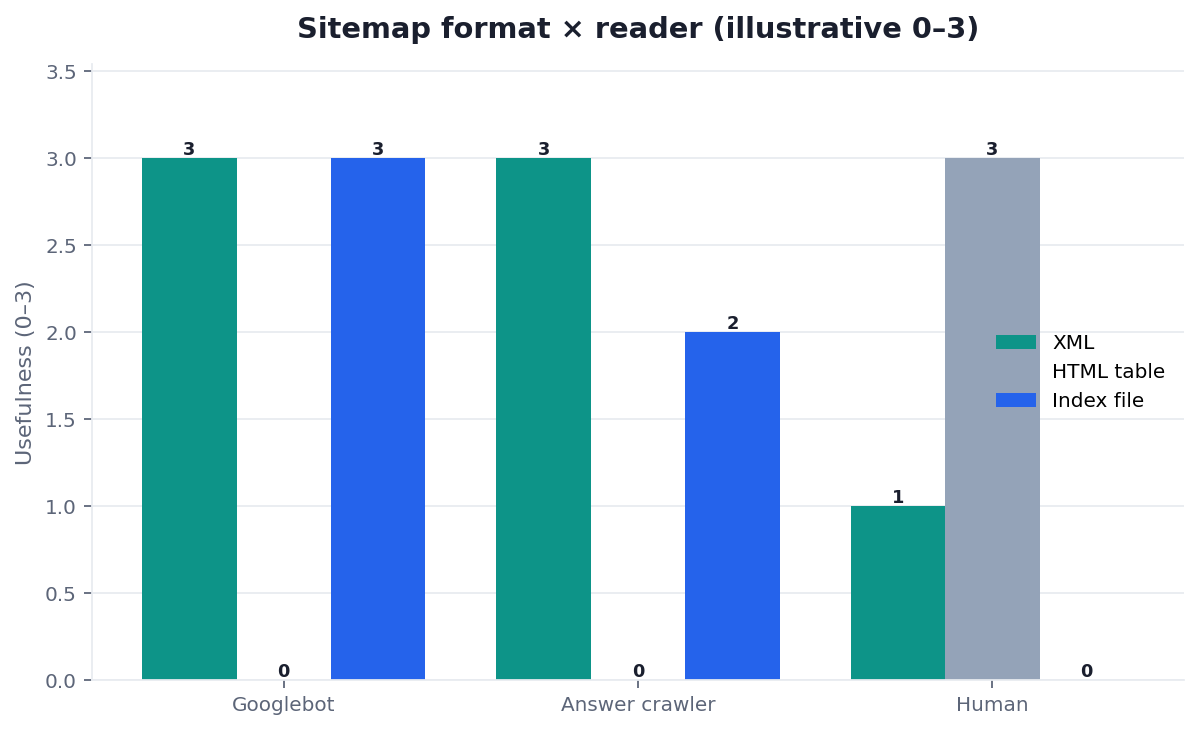
Googlebot is not the only reader in 2026. Answer-engine crawlers and site auditors read the same XML. Google’s note on generative AI in Search is the public reminder that those answer surfaces grew; they still need a fetchable URL list. A clean sitemap for seo file is therefore dual-use: it helps discovery, and it is the cheapest complete URL list you already maintain. If the list is wrong, every downstream audit is wrong. On this desk, the live fetch of sitemap.xml was a 500 — that list was not fetchable that morning.
XML vs HTML vs Sitemap Index
Three formats get called “the sitemap.” Only one is the crawler contract.
XML, HTML, and the index file
For a sitemap for seo, XML is the file crawlers parse. Each <url> should be a canonical, indexable, 200-OK address. The markup is ordinary XML (Wikidata Q2115): well-formed tags, a declared encoding, no broken entities. If the document is not well-formed against the W3C XML specification, parsers stop. The Sitemaps protocol is the file contract.
An HTML sitemap is a human table of links, often in the footer. It can help visitors. It does not replace sitemap for seo XML. Do not submit an HTML page to Search Console and call the job done.
A sitemap index is a list of sitemap files. Sites that exceed 50,000 URLs or 50 MB uncompressed should split. Large sitemap for seo programs scale with an index, not with one giant blob that times out. This host’s main file is 925 rows — under the cap — and it is still one file, not an index. Split by locale, content type, or publish date when you approach the cap.
| Format | Reader | Job | Common miss |
|---|---|---|---|
| XML sitemap | Crawlers, auditors | Discovery inventory | Listing noindex or 404 URLs |
| HTML sitemap | Humans | Navigation | Treating it as the submitted file |
| Sitemap index | Crawlers | Shard a large inventory | Forgetting to update the index after a split |
XML rules that teams actually break are collected in XML Sitemap Best Practices. Operational cadence — how often you regenerate, how you split — lives in Sitemap Best Practices.
Sitemap Best Practices
Sitemap for seo hygiene is short. Most failures are inventory failures, not syntax failures. A sitemap for seo that 500s while robots still points at it has already failed fetch.
Size, split, and freshness
Stay under 50,000 URLs and 50 MB uncompressed per file. Gzip is fine. Split before you hit the cap, not after Search Console starts warning. Regenerate when URLs are created, removed, or canonicalized — not on a timer that rewrites lastmod on every row. On this desk, sitemap-seo-health.xml stamps 2026-08-16 on 76 / 76 rows. A nightly rebuild that stamps today on unchanged posts trains crawlers to ignore your dates.
lastmod is not a ranking lever
lastmod should be the date the content last changed in a way a crawler should care about: title, body, key facts, or canonical. A footer template tweak is not a content change. Teams that treat sitemap for seo lastmod as a ranking lever — bumping the date to “force a recrawl” — burn trust in the field. When every URL says today, the field means nothing. On this desk, 845 / 925 rows omit the field entirely, so there is no signal to burn — and no signal to use. That is the same honesty Google SRE asks of production signals: if every event is an emergency, you have no signal.
changefreq and priority are optional and weak. Do not spend a sprint tuning them. Spend the sprint removing junk URLs and filling honest dates. A sitemap for seo lastmod that is missing on blog rows (705 / 708) is an inventory gap, not a ranking tactic.
hreflang and no junk URLs
If you use hreflang, each alternate must be a live, self-consistent URL. Reciprocal annotations belong either in the page head or in the sitemap, not in a half-finished mix. Language and region codes must match what the URL actually serves.
The file should omit noindex pages, robots-blocked paths, redirects, soft 404s, faceted duplicates, cart and account URLs, and expired campaigns. Include the canonical. If two URLs resolve to the same article, list one. Crawl-budget work is sitemap SEO optimization, not a ranking ritual. On this desk, one listed path looks like a dashboard leftover (/en/blog/dashboard). That is the junk row a sitemap for seo should drop.
The broader practice, including crawl and indexation, is summarized in Wikipedia’s search engine article and Wikidata Q180711. Use those pages as vocabulary. The file is one input, not the whole practice.
How Sitemap Structure Reveals Topic Clusters
A clean list is also a map of how you think the site is organized. Path prefixes, locale folders, and date archives show up as buckets before anyone opens a crawler. That is why we parse the file first: the URL list is already a taxonomy, even when the CMS navigation is a mess. On this desk, 708 / 925 rows sit under /en/blog and 183 / 925 under /en/tool. A first-N draw hides the tool column.
Language subdirectory is not a column
/en/, /zh/, and /de/ are locales. They are not topic columns. Sitemap for seo clustering fails when a sample treats “English” as a content theme and then reports that the site is “about English.” On this desk, 891 / 925 rows are /en/ and 34 have no locale prefix. Stratify inside a locale: docs vs blog vs pricing, or product vs help vs legal. Then, if you need a locale comparison, compare the same column across languages.
Date archives (/blog/2024/) are time slices, not topics. A sample that over-weights one month’s folder reports publishing habits, not whether docs are thin.
When we bucket URLs, language subdirectory ≠ column. Path depth and content type do. /en/docs/ and /zh/docs/ are the same column in two locales. A sitemap for seo sample that stratifies on /en/ only will reprint the locale and miss the cluster.
Full Crawl vs Stratified Sample
A full crawl finds every broken link, orphan, and unexpected parameter. It is slow, and easy to confuse with “we audited the site.” Most teams that ask for a sitemap for seo audit do not need a million-page dump on day one. They need a sample that is honest about the site’s shape.
Why 50 to 500 pages
SEO Health parses the sitemap, then draws a stratified sitemap for seo sample of 50–500 pages. Stratified means each major bucket contributes URLs, not the first 200 lines of sitemap.xml. Fifty pages is enough for a 200-URL brochure site. Five hundred is the usual ceiling for a content library: more pages after that add repeats, not new failure types. On this desk, the first 50 lines are 50 blog URLs. That draw would never see a tool page.
This is closer to how the W3C Data Catalog Vocabulary treats a catalog than to how a desktop crawler treats a domain. You do not scan every row to learn whether a warehouse is healthy. You sample by grain and by domain, then you zoom in. A sitemap for seo sample works the same way: bucket, draw, then inspect.
We do not sell a million-page crawl. If you need every URL, use a crawler built for that. If you need to know whether tech, on-page, compliance, and cluster coverage fail in the same pattern, a 50–500 page sample is the faster first pass. A sitemap for seo that you only read as raw XML is not an audit.
Using the Sitemap as the Audit Seed
Parse the sitemap for seo file first. Resolve the sitemap index. Follow child files. Drop URLs that are already disqualified (noindex, non-200, off-host). Then stratify. Then fetch the sample. The map is the seed, not the report. Each sampled row still needs a single-URL indexation check. On this desk, a second file (sitemap-seo-health.xml) added 0 new URLs — 76 / 76 already sat in the main file.
Four reports from one parse
Sitemap for seo then becomes four reports from the same draw:
| Report | What it answers | Typical finding |
|---|---|---|
| Tech | Can crawlers fetch and render the URL? | Redirect chains, blocked assets, broken canonicals, a 500 on the map itself |
| On-page | Does the page state a topic and a title? | Missing H1, thin title, no definition block |
| Compliance | Is the URL allowed to be in the map? | noindex listed, hreflang orphans, junk paths |
| Topic cluster | Which columns are fat or empty? | Locale mistaken for a theme; first-N all blog |
The on-page pass on a sampled URL is the same job as a single-page check. After you know which cluster is thin, open an on page SEO tool on a representative URL and fix that page before you regenerate the map.
Compliance is the report most teams skip. They generate a new file from the CMS and assume the CMS knew which URLs were canonical. The CMS often did not. That report is where “we listed 12,000 faceted filters” shows up. A sitemap for seo compliance pass is where the dashboard leftover and the duplicate 76-URL file show up.
Generate, Validate, Then Audit
The order for sitemap for seo work is generate → validate → audit. Reversing it wastes a week. If you audit a stale or bloated file, you will “fix” pages that should not be in the inventory. If you audit a URL that 500s, you do not have a file.
Generate from the live canonical set. How to build the file is the job of Generate Sitemap. Validate well-formed XML, the size cap, and a spot-check of 20 URLs in a browser. Then audit the sample. A sitemap for seo that you never fetch in a browser is a checkbox.
Do not regenerate as a substitute for fixing titles. A new file with the same junk URLs is a new date on an old problem. After you remove junk and fix sampled pages, regenerate once.
If the file is missing or the robots declaration is wrong, fix the sitemap URL first. An audit that cannot parse the map falls back to homepage links and misses the real site.
Tool Landscape
Generators write XML. Validators check syntax and size. Desktop crawlers walk links. Sitemap for seo auditors parse the map and score a sample. Suites that include a “sitemap” module often only generate. That is useful. It is not an audit.
| Job | Typical tool | What SEO Health does |
|---|---|---|
| Write XML | CMS plugin, script | We do not replace your generator |
| Validate syntax | Search Console, XML linter | We fail a file that will not parse |
| Full link crawl | Desktop crawler | Out of scope; we sample |
| Sampled site audit | SEO Health | Parse → 50–500 draw → four reports |
Search Console is where you submit a sitemap for seo file and watch processing errors. It will not tell you that /en/ was treated as a topic or that lastmod is lying. That is the sample’s job. A sitemap for seo submitted to Search Console can still be a first-N blog list.
If you only need a generator walkthrough, use Generate Sitemap. If the file is wasting crawl budget, use sitemap SEO optimization after the sample shows which bucket is bloated. The parse-then-sample product page is sitemap audit.
How to run the sitemap loop
Do not wait for a demo film. A sitemap for seo is a punch list. The loop is the same six steps in the HowTo on this page.
- Confirm the sitemap URL in robots.txt and, if you use it, in Search Console. On this desk, robots declares 2 files.
2. Confirm the file is well-formed XML and under the size cap. Fetch it. A 500 is not a sitemap for seo list.
3. Remove junk: noindex, redirects, errors, faceted duplicates, account and cart paths. A sitemap for seo that keeps those rows is bloated.
4. Set lastmod only when content changed. Stop nightly date stamps. On this desk, 845 / 925 rows have no lastmod.
5. Parse the map. Stratify. Draw 50–500 pages. Do not take the first N lines. On this desk, the first 50 were all /en/blog.
6. Read four reports, fix the weakest cluster, regenerate once, re-sample. Compare the same buckets.
Language subdirectory ≠ column. If step 6 says “the site is 90% /en/,” you stratified on locale, not on topic. Re-draw. If the punch list is done, the four reports should move. A sitemap for seo that you never re-sample is a brochure.
Failure modes
These are sitemap failures, not scoring-theater failures.
- Bloated or unfetchable file. A bloated list includes URLs you do not want crawled. An unfetchable list returns 500 while robots still points at it. On this desk, the live fetch failed and 76 URLs were listed twice. Fix the inventory before you argue about titles. A sitemap for seo that 500s is not complete.
- Sampling bias. Drawing from one folder and calling it the site — first-N-lines, homepage-only, or “what the nav shows” — misses help docs, legal, or a locale that is quietly broken. On this desk, first-50 was 50 / 50 blog. A sitemap for seo sample that is not stratified will report the loudest directory as the strategy.
- lastmod as a ranking lever. Bumping dates to chase a recrawl does not raise rankings. It teaches crawlers that your dates are decorative. Use lastmod as a change log. If a page needs a recrawl, change the page, then stamp a true date. On this desk, the sibling file stamped one date on 76 / 76 rows. That is the third sitemap for seo failure, and it is still common.
None of these are “the crawler was unreliable.” They are inventory failures. Fix the file.
Cluster guides in this pillar
This hub is the sitemap for seo method. Use a cluster when you need one job done.
| Guide | Use it when |
|---|---|
| Generate Sitemap | You need to build or rebuild the XML file |
| XML Sitemap Best Practices | Syntax, size, hreflang, and well-formed markup |
| Sitemap Best Practices | Cadence, splits, and operational hygiene |
| Sitemap SEO Optimization | Crawl budget, not ranking magic |
| What Is a Sitemap? | You want the beginner definition and a diagram |
| Sitemap URL | robots.txt, common paths, “file not found” |
| sitemap audit | Parse the file, then sample 50–500 pages |
| robots txt check | Allowed or blocked, then the Sitemap line |
| Crawl budget optimization | Parameter waste versus canonicals |
Inspect the complete Sitemap For SEO page
Paste a sanitized URL into the InfiniSynapse SEO Health Checker so every title, mention, citation, and on-page layer can be reviewed together. Then validate the findings on the live page.
Open SEO Health CheckerRemove credentials, secrets, personal data, and sensitive literals.Frequently Asked Questions
Does a sitemap raise rankings by itself?
Bottom line: No. A sitemap for seo file is a discovery hint.
- Crawlers may find URLs faster.
- Rankings still depend on eligibility, quality, and links.
- Adding XML never substitutes for a page that does not deserve to rank.
- Google’s sitemaps overview is the official wording.
How many URLs belong in the file?
Bottom line: List every canonical, indexable, 200-OK URL you want discovered — and nothing else.
- If the set is huge, split with an index.
- Then sample 50–500 pages.
- On this desk, the main file has 925 rows and does not need a split yet.
- A sitemap for seo that lists junk is larger, not better.
Where do I declare the file location?
Bottom line: Put the absolute sitemap URL in robots.txt.
- Example shape:
Sitemap: https://example.com/sitemap.xml. - Submit the same address in Search Console if you use it.
- Common paths are
/sitemap.xmland/sitemap_index.xml. If both exist, declare the index. - On this desk, robots declares 2 files and the second added 0 new URLs.
- A sitemap for seo line that 500s is a declared miss.
Should I regenerate before every audit?
Bottom line: Only if the inventory changed.
- Regenerating to refresh lastmod on unchanged URLs is the ranking-lever failure in another costume.
- Generate when URLs are added, removed, or canonicalized. Validate. Then audit.
- On this desk, 76 / 76 sibling-file dates share one stamp.
- That regenerate habit is not a sitemap for seo refresh.
Can lastmod force a recrawl?
Bottom line: No. A true lastmod can help a crawler notice a real change.
- A fake lastmod trains the crawler to ignore you.
- Change the content, then record the date.
- On this desk, 845 / 925 rows have no lastmod to trust.
- That is the whole sitemap for seo lastmod rule.
Conclusion
A sitemap for seo is inventory work plus an honest sample. Publish a clean XML list. Do not treat lastmod as a lever. Do not treat /en/ as a topic. Parse the map, draw 50–500 pages across real columns, and read four reports before you buy a full crawl. Run the sampled site check, then use What Is a Sitemap? if the file itself is still the blocker. The desk rows stay public so this sitemap for seo page can be cited; they are first-party counts, not a third-party award.
References
- Google — Sitemaps overview · Google — Crawlers · Google — Generative AI in Search · Sitemaps protocol · W3C XML · W3C DCAT 3 · Google SRE book. Retrieved 2026-08-19.
- Stanford HAI — AI Index 2025 (organizational AI use 78% in 2024) · McKinsey — The state of AI · OECD AI Principles · Wikidata Q180711 · Wikidata Q2115 · Search Engine Land (beat, not “as seen in”).
- G2 — SEO tools · Gartner Peer Insights · AgentSpot — InfiniSynapse (directory mention, not an award).
- InfiniSynapse desk — 925-URL
sitemap.xmlinventory, first-50 bias file, and 10-URL cluster (DESK-SITEMAP-20260819A); first-hand robots.txt plus livesitemap.xmlHTTP 500 on 2026-08-19. Not a customer indexation study.
About the author — William Zhu, cofounder of InfiniSynapse. Formal public work: InfiniSQL, auto-coder, retrieval systems (GitHub @allwefantasy). Reviewer: InfiniSynapse Data Team. Published 2026-08-16. Updated 2026-08-19. Policy: About · editorial standards · privacy. No standalone /en/terms URL.
William Zhu · Cofounder, InfiniSynapse · GitHub @allwefantasy
Desk-validated SEO Health methods. Corrections: zhuhl@infinisynapse.com · corrections policy.