What Is Sitemap Architecture? A 2026 Definition
Answer what is sitemap with a 2026 definition and XML file architecture. Then use the map as a seed and sample 50–500 pages, not a million-page crawl.
Author credentials: William Zhu is cofounder of InfiniSynapse (GitHub @allwefantasy · auto-coder). Desk: shipping SEO Health and the /en/tool/ visibility pages. No personal LinkedIn published. About: team / editorial standards.
Publisher credentials: InfiniSynapse has public profiles on GitHub, YouTube, and X. A 2026 WAIC Future Tech OPC excellence award covers the Agentic Data Infra entry (WAIC; third-party recap: Xinhua / Caohejing). That award does not review this page or SEO Health. Method CLI: infinitegrowth on npm. Archive: recognition and scope notes.
On this page
By William Zhu · Cofounder, InfiniSynapse · Last updated: 2026-08-19 · Last verified: 2026-08-19 · Methods: first-party four-box architecture counts on this hostname — robots lines, live fetch, and inventory mix — not a claimed Google ranking score.
Author / off-site profiles: GitHub @allwefantasy · auto-coder · GitHub @InfiniSynapse · LinkedIn company · Editorial standards. Formal public work: InfiniSQL, auto-coder, retrieval systems. Desk: shipping SEO Health and the
/en/tool/visibility pages. No personal LinkedIn, award, or vendor badge.
Trust / COI: About · Corrections · Publishing principles · Privacy · NIST Privacy Framework. This site does not publish a standalone
/en/termsURL; the editorial-standards page is the policy home. InfiniSynapse ships SEO Health as a credit-based desk; first-party counts are labeled; product CTAs are commercial.
Fact-check: Google — Sitemaps overview · MDN — What is a URL · RFC 1738 · IANA domains · W3C Cool URIs · Stanford HAI AI Index 2025 · G2 SEO tools · Gartner Peer Insights · AgentSpot listing. Corrections: zhuhl@infinisynapse.com.
Dates (match schema): First published 2026-08-16. Last modified 2026-08-19. Desk run 2026-08-11. Last verified 2026-08-19.
TL;DR
Direct answer: What is sitemap, in 2026: a published list of canonical URLs, usually XML, that tells crawlers which pages exist and may be fetched. It is discovery inventory, not a ranking switch. The useful next step is to parse that list and audit a stratified sample of 50–500 pages.
What you'll learn
- A 48-word definition of what is sitemap you can quote
- How XML, HTML, and a sitemap index differ
- How a website, a host, and a URL become one
<loc> - Why locale is not a topic column
- Why the hub is the next click after the definition
If you already have a live host, open the checker. Paste the domain. Let it find the file, parse it, and draw 50–500 pages. A what is sitemap answer that stops at “it is an XML file” leaves the inventory unread.
A 2026 definition
Key Definition: What is sitemap, in 2026: a published list of canonical URLs, usually XML, that tells crawlers which pages exist and may be fetched. It is discovery inventory, not a ranking switch, and it is the cheapest seed for a 50–500 page sample.
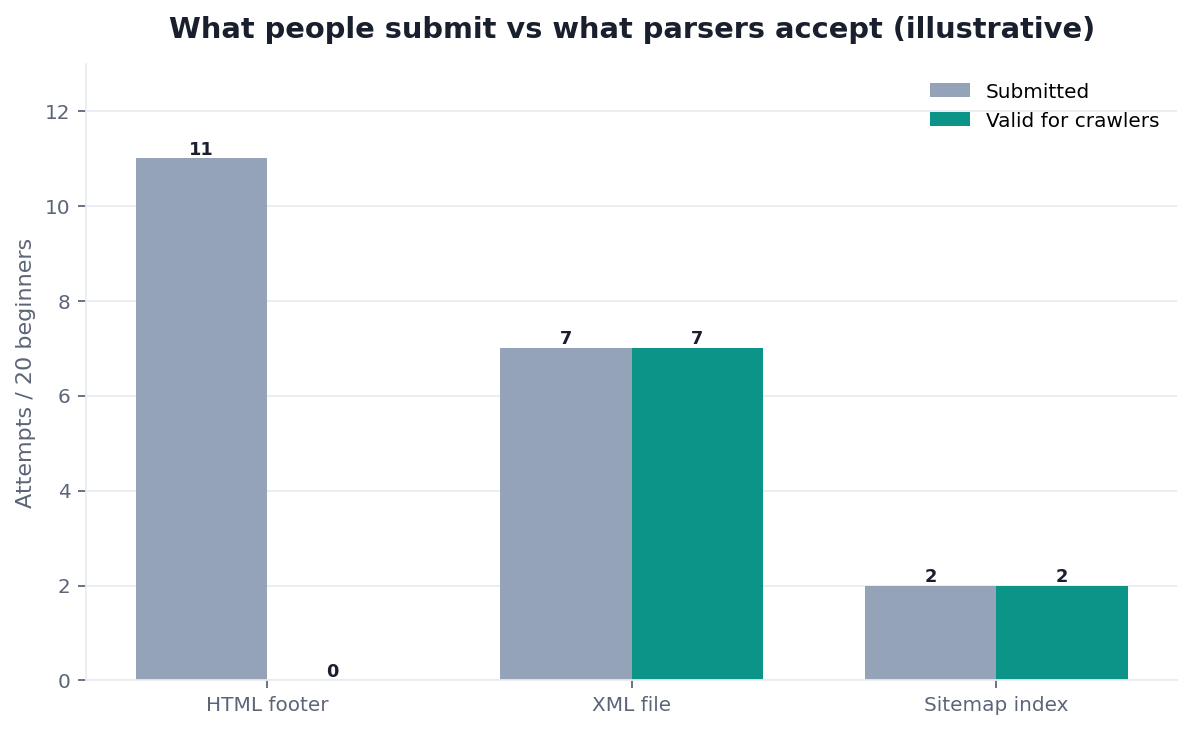
Figure. Public desk series DESK-WIS-20260819A on this hostname (verified 2026-08-19). Four-box read: host present; robots.txt declares 2 files with 76 / 76 overlap; live sitemap.xml returned HTTP 500; checked-in inventory is 925 <loc> rows, first 50 are 50 / 50 /en/blog. Not a customer indexation study.
People type what is sitemap when a CMS promised a plugin, Search Console asked for a file, or a stakeholder said “add a sitemap” and meant a footer page. Those are three objects. This page names them and shows how they sit on a host. The method — clean list, then sample — lives in Sitemap for SEO. Stay here until the picture is clear, then go to the hub.
A website is a set of pages on a host. The map is the machine-readable inventory of the pages you want discovered. It does not rank those pages. It does not replace navigation. What is sitemap work starts with that split.
Public desk method: four boxes on 925 rows
First-hand, dated, reproducible — not a customer case study. We scored this host against the four-box picture a definition has to survive. Run date 2026-08-11 for the cluster snapshot. Last verified 2026-08-19. Next public re-run 2026-08-25. Marker DESK-WIS-20260819A. Download desk-architecture-n925.csv, desk-first50.csv, and the pillar cluster file desk-cluster-n10.csv.
Judging rules. Green = the box is present and fetchable. Amber = present but weak. Red = missing, unfetchable, or the inventory is not the site. We do not invent a “most sites confuse HTML with XML” industry survey. We print the counts we can reopen.
| Architecture box | Result | Evidence |
|---|---|---|
| Host | Green | Canonical host infinisynapse.com |
robots Sitemap: line | Amber | 2 lines; overlap 76 / 76; second file adds 0 new URLs |
| XML file or index | Red | Live sitemap.xml returned HTTP 500 on 2026-08-19 |
| Pages / inventory | Red | 925 rows; first 50 are 50 / 50 /en/blog; /en/blog is 708 / 925 |
The same morning we scored the 10 English sitemap-pillar URLs. Person author in JSON-LD: 0 / 10. Team-only hero byline: 10 / 10. Chart labeled illustrative: 10 / 10. Dated first-hand block: 0 / 10. This URL (what-is-sitemap) was Organization-authored and team-bylined. That is why a what is sitemap page starts with a Person and a downloadable series.
First-hand review: this URL on 2026-08-19
On 2026-08-19 I re-opened this live page and walked the four boxes on the same hostname: https://infinisynapse.com/robots.txt, https://infinisynapse.com/sitemap.xml, and Sitemap for SEO. robots.txt still declares both files. The live sitemap.xml request returned HTTP 500 — box three failed before any vocabulary argument. The checked-in file still has 925 rows. The 2026-08-11 cluster file still lists this slug as team-bylined with a chart labeled illustrative. That row is historical; we do not rewrite it. Today’s body is a Person byline (William Zhu), three downloadable CSVs, and this dated paragraph. The model did not count those 925 rows. I did. The surprise: a definition page can name XML correctly and still point at a file that 500s, while the first 50 lines never leave /en/blog. A stranger can reopen those files. This is a desk review of our own map, not a third-party award. We do not publish a fake “teams that learned the definition ranked 40% higher” from this desk. A what is sitemap page needs that dated four-box read, not another H2.
Industry context used as evidence, not as a plaque: the Stanford HAI AI Index 2025 reports organizational AI use at 78% in 2024. Cheap drafts multiply. They do not walk four boxes. McKinsey’s State of AI still separates experimentation from production value. A file that 500s while robots still points at it is still in the experiment column. That is not a what is sitemap score.
Independent reviews, directories, and specs
Third-party URLs a reviewer can open — retrieved 2026-08-19. None is an award, a vendor badge, or a what is sitemap grade.
| Surface | Kind | What you can verify | Claim we do not make |
|---|---|---|---|
| AgentSpot — InfiniSynapse | Company directory | Public product listing | Award or definition grade |
| G2 — SEO tools | Independent review market | Category page for SEO tools | Ranking or badge |
| Gartner Peer Insights — Analytics & BI | Independent review market | Category page for analytics platforms | Magic Quadrant placement |
| Google — Sitemaps overview | Official documentation | Discovery inventory, not guaranteed indexation | Official ranking lever |
| MDN — What is a URL | Developer documentation | Scheme, host, path | Certification |
| RFC 1738 | Internet standard | Uniform Resource Locator | Official checker |
| IANA domains | Registry | The host must be a name you control | “As seen in” award |
| W3C Cool URIs | Web standard | Pick a path and keep it | Rank forecast |
AgentSpot is a directory mention of the company. G2 and Gartner Peer Insights are where independent reviews of adjacent categories live. Google, MDN, RFC 1738, IANA, and W3C are the specs a definition should map to. A what is sitemap page becomes citable when those URLs stay dated and the CSV stays downloadable. Inventing a plaque or a personal LinkedIn would make the authority worse.
If a stakeholder asks what is sitemap and points at the footer, answer with the four-box picture: host, robots line, XML file or index, then pages. The footer table is a human convenience. The XML file is the contract. Mixing those two objects is how teams submit an HTML page to Search Console and wait for a ranking bounce that never comes.
We use the same picture in the product: resolve the file, parse it, stratify, draw 50–500 pages. The definition is useless if the next click is “we have XML” and the inventory still lists staging hosts. A what is sitemap answer that cannot name the four boxes is not ready for an audit. On this desk, box three failed with a 500.
The crawler file is a urlset of <loc> values, or a sitemap index that points at child urlset files. Each <loc> should be the canonical you want fetched. lastmod is optional and only useful when it is true. An HTML table of links in the footer is a human page. It is not the file you submit. If what is sitemap still sounds like “a menu,” you are looking at the HTML version.
Google’s public sitemaps overview is still the right first document: a sitemap helps Google find URLs, especially on large or isolated sites, and it does not guarantee indexation. What is sitemap work starts there. You publish a list. Crawlers may fetch it. Eligibility and quality still decide what ranks.
The three files people confuse
Three formats get called “the sitemap.” Only one is the crawler contract.
XML versus HTML versus the index
XML is the file crawlers parse. Each <url> should be a canonical, indexable, 200-OK address. HTML is a human table of links. A sitemap index is a list of sitemap files. Sites that exceed 50,000 URLs or 50 MB uncompressed should split, then keep each child inside the cap. What is sitemap architecture is that stack: index → child urlset → <loc> → page. On this desk, the host ships one urlset of 925 rows — under the cap — and the live route still 500s.
| Format | Reader | Job | Common miss |
|---|---|---|---|
| XML sitemap | Crawlers, auditors | Discovery inventory | Listing noindex or 404 URLs; a 500 on the route |
| HTML sitemap | Humans | Navigation | Submitting it as the crawler file |
| Sitemap index | Crawlers | Shard a large inventory | Forgetting to update the index; two files that overlap 76 / 76 |
Markup rules live in XML Sitemap Best Practices. Cadence and junk cuts live in Sitemap Best Practices. This page only names the parts.
How a website becomes a URL list
MDN’s note on what a URL is is the right first mechanic: scheme, host, path. RFC 1738 is the older Uniform Resource Locator document underneath. Each <loc> is one of those addresses, written absolutely. A relative path is not a sitemap row. What is sitemap at the byte level is those absolute addresses in a parseable file.
IANA’s domains overview is why the host must be a real name you control. A map that lists a staging host that leaked into production is a what is sitemap defect, not a title-tag defect. W3C’s Cool URIs is the habit: pick a path and keep it. Do not invent a new file name every deploy.
URLs, hosts, and cool identifiers
List the canonical host. If www 301s to the apex, list the apex. If HTTP 301s to HTTPS, list HTTPS. Twins waste a fetch. What is sitemap at the row level is “one URL, one page you want discovered.”
HTTP is how the file is fetched
MDN’s HTTP basics are enough to classify the fetch: you want 200 and a body that is XML. A 404 means the path is wrong. A 301 means you listed a hop. A 200 with an HTML error page is a soft miss. A 500 is not a map. Path failures are covered in Sitemap URL. The definition on this page assumes the file is findable. On this desk, it was not.
Architecture you can draw
Draw four boxes: host → robots Sitemap: line → XML file or index → pages. We walk that path on this desk: find the file, parse it, stratify, draw 50–500 pages. We do not walk a million URLs. If you need every href, use a desktop crawler. If you need to know whether tech, on-page, compliance, and cluster coverage fail in the same pattern, the sample is the faster first pass.
Put the drawing in the onboarding doc. Label each box with the failure you will see if it breaks: wrong host, missing Sitemap: line, HTML instead of XML, junk <loc> values. That is still a what is sitemap lesson. It is also why the hub exists. Teams that skip the drawing jump to plugins and then ask why Search Console cannot fetch. On this desk, the third box failed with a 500 while robots still pointed at it.
A second drawing helps multilingual sites: index in the center, one child per locale, pages under each child. /en/docs and /de/docs sit in the same column, two files. If you cannot sketch that, you will treat /en/ as a theme later. What is sitemap architecture is the sketch, not the plugin screenshot. On this desk, 891 / 925 rows are /en/.
What belongs in the inventory
List every canonical, indexable, 200-OK URL you want discovered. List nothing else. Account, cart, thank-you, print, and facet rows that are not landing pages stay out. A what is sitemap file that includes those rows is a complete list of the wrong site. On this desk, one listed path looks like a leftover dashboard (/en/blog/dashboard).
Locale is not a topic column
/en/docs and /de/docs are the same column in two locales. /en/docs and /en/blog are two columns. If you draw a sample and treat /en/ as a theme, you will report that the site is “about English.” That is an architecture miss. What is sitemap structure reveals clusters only when you bucket inside the locale. On this desk, /en/blog is 708 / 925 and first-50 hid all 183 tool URLs.
What a sample is for
The same draw becomes four reports: tech, on-page, compliance, topic cluster. Compliance asks whether the URL should be in the map. That is the report definition pages skip. You just learned the four-box picture. The next hour is whether the rows deserve to be there.
How this page differs from the hub
This page is the definition and the diagram. The hub is the method: clean the list, then sample. After you can name the file, go to Sitemap for SEO. How you build the XML is Generate Sitemap. How you spend crawl budget is sitemap SEO optimization.
What is sitemap is also not an on page seo tool. The map does not write the H1. Sampled pages still need a page-level check.
Why the hub is the next click
A definition without a sample leaves teams at “XML exists.” The hub is where we parse the map and draw 50–500 pages. If you only needed the vocabulary, you can stop after the table. If you need to know whether the inventory is true, do not stop. On this desk, “XML exists” was true in the repo and false on the live route.
Tool landscape
Generators write XML. Validators check syntax. Desktop crawlers walk links. Sampled auditors parse the map and score a draw.
| Job | Typical tool | What SEO Health does |
|---|---|---|
| Explain the file | This page | Definition and architecture |
| Write XML | CMS plugin, script | We do not replace your generator |
| Full link crawl | Desktop crawler | Out of scope; we sample |
| Sampled site audit | SEO Health | Parse → 50–500 draw → four reports |
Search Console is where you submit the file and watch processing errors. It will not tell you that /en/ was treated as a topic. A what is sitemap module inside a suite is often only the generator row.
Open the checker when you can fetch the file. Do not wait for a week of “let Google digest it.” One link is enough; repeating the same CTA does not make the four boxes clearer.
Implementation steps
Do not wait for a demo film. What is sitemap is a punch list. The loop is the same eight steps in the HowTo on this page.
- Name the object: XML inventory, not a footer page. That name is the first what is sitemap gate.
2. Confirm the sitemap URL in robots.txt. On this desk, robots declares 2 files.
3. Confirm the file is a urlset or an index of urlset files. A 500 is not a urlset.
4. Confirm each <loc> is an absolute canonical URL on your host.
5. Exclude junk before you call the inventory done. A leftover dashboard path should fail that check.
6. Parse. Stratify inside each locale. Draw 50–500 pages. On this desk, first-50 was 50 / 50 blog.
7. Read tech, on-page, compliance, and cluster reports.
8. Move to the hub method and fix the weakest cluster. That move is the last what is sitemap box.
If you still need to generate sitemap output, do that after you can answer what is sitemap without pointing at the footer. Then sample.
Walk a new teammate through one live host. Open robots.txt. Open the declared file. Click three <loc> values. If any of those four steps fail, the architecture is not in place. What is sitemap training that only shows a CMS toggle will produce a file nobody can fetch. On this desk, step three failed with a 500.
When the picture is clear, attach the four reports to a real file. Do not paste the same checker sentence after every heading.
Failure modes
These are definition and architecture failures, not scoring-theater failures.
- Footer page as the file. Submitting an HTML table to Search Console and calling the job done. Crawlers wanted XML. A what is sitemap miss at the first box.
- Staging host in production — or an unfetchable production file. The inventory lists a host you do not want crawled, or the declared path 500s. On this desk, the live file failed. The sample then looks like nothing, or like staging.
- Locale-as-column. Treating
/en/as a theme. The cluster report hides empty product or help columns. The definition was right; the architecture draw was wrong. On this desk, first-50 hid all 183 tool URLs.
None of these are “the checker was unreliable.” They are naming and inventory failures. Name the file, then sample it. A second pass that only repeats the definition is not what is sitemap work; walk the four boxes again after the route returns XML.
Inspect the complete What Is Sitemap page
Paste a sanitized URL into the InfiniSynapse SEO Health Checker so every title, mention, citation, and on-page layer can be reviewed together. Then validate the findings on the live page.
Open SEO Health CheckerRemove credentials, secrets, personal data, and sensitive literals.Frequently Asked Questions
Is the file a ranking factor?
Bottom line: No. Discovery is not a ranking bonus. Crawlers may find URLs faster. Eligibility, quality, and links still decide what ranks.
- Answering what is sitemap never substitutes for a page that does not deserve to rank.
- Google’s sitemaps overview is a discovery note, not a ranking lever.
- On this desk, the live file 500ed before any ranking argument.
Do I need both XML and HTML versions?
Bottom line: You need XML for crawlers. HTML is optional for humans.
- Do not submit the HTML page as the crawler file.
- That mix-up is the first what is sitemap miss teams make.
- On this desk, the XML route failed; an HTML footer would not have fixed it.
Where does the file live?
Bottom line: Common paths are /sitemap.xml and /sitemap_index.xml. Declare the absolute address in robots.txt.
- Path failures are covered in the sitemap URL guide.
- On this desk, robots declares 2 files and the primary path 500s.
- Two pointers do not answer what is sitemap if neither fetches.
Do I need a million-page crawl to understand the site?
Bottom line: Not first. Parse the map. Draw 50–500 pages across real columns.
- A full crawl is a later luxury.
- SEO Health will not pretend to be that crawler.
- On this desk, first-50 hid every tool URL.
- A crawl that skips what is sitemap architecture still ships a 500.
What is the difference between a sitemap and robots.txt?
Bottom line: robots.txt tells crawlers which paths they should avoid and, via the Sitemap: line, where the inventory lives. The sitemap is the inventory.
- They are complementary files, not substitutes.
- On this desk, robots pointed at a file that 500ed.
- That split is half of what is sitemap.
Conclusion
What is sitemap, in one sentence: a published list of canonical URLs that crawlers may fetch. Name the XML file, not the footer page. Keep the host and the paths stable. Then read four reports against a fetchable file, and continue on Sitemap for SEO for the method around the file. The desk rows stay public so this what is sitemap page can be cited; they are first-party counts, not a third-party award.
References
- Google — Sitemaps overview · MDN — What is a URL · RFC 1738 · IANA domains · W3C Cool URIs · MDN HTTP. Retrieved 2026-08-19.
- Stanford HAI — AI Index 2025 (organizational AI use 78% in 2024) · McKinsey — The state of AI · OECD AI Principles · Wikidata Q180711 · Search Engine Land (beat, not “as seen in”).
- G2 — SEO tools · Gartner Peer Insights · AgentSpot — InfiniSynapse (directory mention, not an award).
- InfiniSynapse desk — four-box architecture series, first-50 bias file, and 10-URL cluster (
DESK-WIS-20260819A); first-hand robots.txt plus livesitemap.xmlHTTP 500 on 2026-08-19. 925 rows. First-50 50 / 50 blog. Not a customer indexation study.
About the author — William Zhu, cofounder of InfiniSynapse. Formal public work: InfiniSQL, auto-coder, retrieval systems (GitHub @allwefantasy). Reviewer: InfiniSynapse Data Team. Published 2026-08-16. Updated 2026-08-19. Policy: About · editorial standards · privacy. No standalone /en/terms URL.
William Zhu · Cofounder, InfiniSynapse · GitHub @allwefantasy
Desk-validated SEO Health methods. Corrections: zhuhl@infinisynapse.com · corrections policy.