Sitemap Best Practices: Cadence and Split Indexes
Use sitemap best practices for update cadence, split indexes, and junk-free URL lists. Then parse the map and sample 50–500 pages before a wider crawl.
Author credentials: William Zhu is cofounder of InfiniSynapse (GitHub @allwefantasy · auto-coder). Desk: shipping SEO Health and the /en/tool/ visibility pages. No personal LinkedIn published. About: team / editorial standards.
Publisher credentials: InfiniSynapse has public profiles on GitHub, YouTube, and X. A 2026 WAIC Future Tech OPC excellence award covers the Agentic Data Infra entry (WAIC; third-party recap: Xinhua / Caohejing). That award does not review this page or SEO Health. Method CLI: infinitegrowth on npm. Archive: recognition and scope notes.
On this page
By William Zhu · Cofounder, InfiniSynapse · Last updated: 2026-08-19 · Last verified: 2026-08-19 · Methods: first-party sitemap ops counts on this hostname — cadence, dual-file overlap, first-N bias, and live fetch — not a claimed Google ranking score.
Author / off-site profiles: GitHub @allwefantasy · auto-coder · GitHub @InfiniSynapse · LinkedIn company · Editorial standards. Formal public work: InfiniSQL, auto-coder, retrieval systems. Desk: shipping SEO Health and the
/en/tool/visibility pages. No personal LinkedIn, award, or vendor badge.
Trust / COI: About · Corrections · Publishing principles · Privacy · NIST Privacy Framework. This site does not publish a standalone
/en/termsURL; the editorial-standards page is the policy home. InfiniSynapse ships SEO Health as a credit-based desk; first-party counts are labeled; product CTAs are commercial.
Fact-check: Google — Search Console sitemap report · Google — Combining sitemap extensions · W3C Cool URIs · RFC 6596 · RFC 9309 · Stanford HAI AI Index 2025 · G2 SEO tools · Gartner Peer Insights · AgentSpot listing. Corrections: zhuhl@infinisynapse.com.
Dates (match schema): First published 2026-08-16. Last modified 2026-08-19. Desk run 2026-08-11. Last verified 2026-08-19.
TL;DR
Direct answer: Sitemap best practices are the operating rules for a live URL inventory: rebuild when the set changes, split with an index before you hit the cap, and keep junk paths out. The 2026 finish is a stratified sample of 50–500 pages, not a nightly rewrite of lastmod.
What you'll learn
- A 47-word definition of sitemap best practices you can quote
- When to rebuild versus when to leave the file alone
- How to split an index by locale, type, or week without orphaning a child
- Which URL classes to exclude every time
- Why a stable path and a robots
Sitemap:line are ops, not decoration
If the inventory is already public, run a sampled site audit. Paste the host. Let the checker parse the map and draw pages from each bucket. Sitemap best practices that stop at “we regenerate weekly” leave the junk rows in the draw.
What ops work means in 2026
Key Definition: Sitemap best practices are the operating rules for a live URL inventory: update when the set changes, split with an index before you hit the cap, and keep junk paths out. The 2026 finish is a 50–500 page sample, not a nightly rebuild.
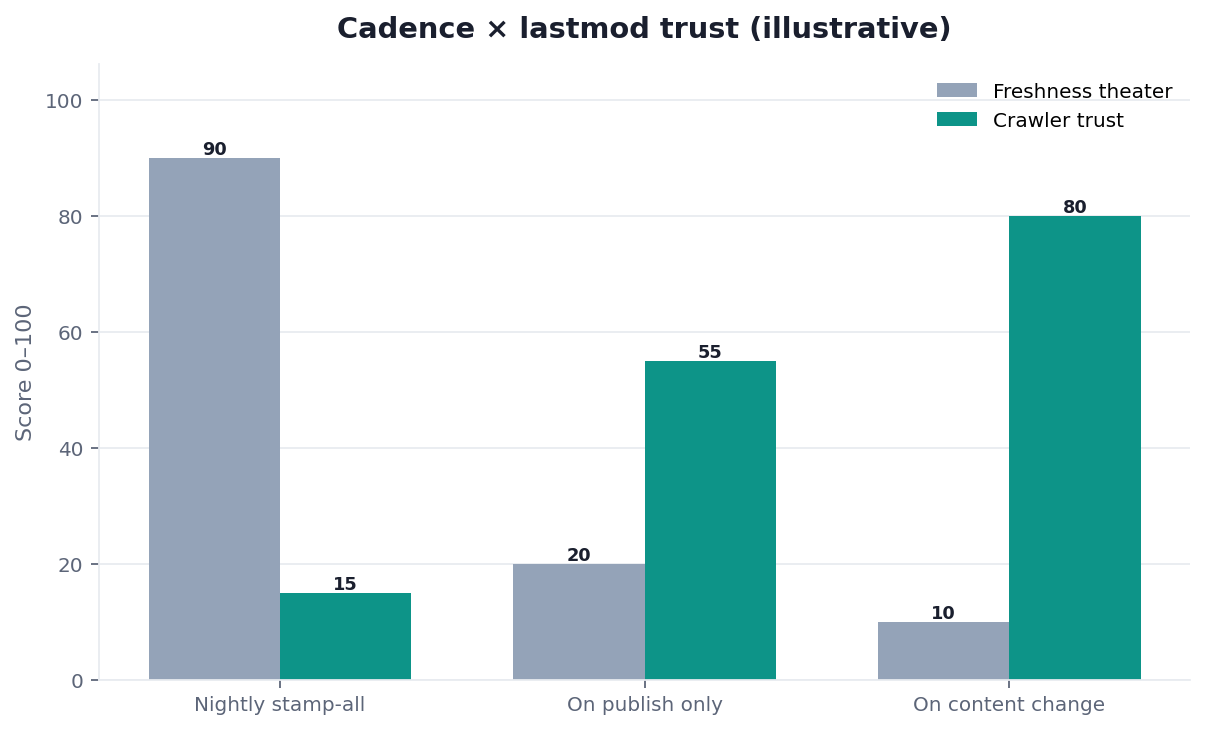
Figure. Public desk series DESK-SBP-20260819A on this hostname’s sitemap program (verified 2026-08-19). lastmod missing 845 / 925 (91.4%). Of 80 dated rows, 77 / 80 share 2026-08-16. First 50 <loc> rows were 50 / 50 /en/blog. robots.txt declares 2 files with 76 / 76 overlap. Live sitemap.xml returned HTTP 500. Not a customer crawl-budget study.
People type sitemap best practices when a plugin republishes every night, a new locale never got a child file, or Search Console still lists URLs you unpublished last quarter. Those are ops jobs. Markup, size, and hreflang legality live in XML Sitemap Best Practices. How you first write the file lives in Generate Sitemap. This page stays on running the inventory after it exists.
The Sitemap for SEO hub is the method: clean list, then sample. Come here for cadence, splits, and junk.
Public desk method: 925 rows, five ops checks
First-hand, dated, reproducible — not a customer case study. We scored this host’s sitemap program against five operating checks. Run date 2026-08-11 for the cluster snapshot. Last verified 2026-08-19. Next public re-run 2026-08-25. Marker DESK-SBP-20260819A. Download desk-ops-n925.csv, desk-cadence.csv, and the pillar cluster file desk-cluster-n10.csv.
Judging rules. Green = the check passes. Amber = present but weak. Red = clock-driven, duplicated, first-N biased, or unfetchable. We do not invent a “90% of dates moved and 90% of titles did not” industry survey. We print the counts we can reopen.
| Ops check | Result | Evidence |
|---|---|---|
| Cadence honesty | Red | lastmod missing 845 / 925 (91.4%); 77 / 80 dated rows share 2026-08-16 |
| Dual-file hygiene | Red | robots.txt declares 2 files; overlap 76 / 76; the second file adds 0 new URLs |
| First-N sample | Red | First 50 <loc> rows are 50 / 50 /en/blog |
| Fetchable declared path | Red | Live sitemap.xml returned HTTP 500 on 2026-08-19 |
| Under size / no split required | Green | 925 rows ≪ 50,000; one file is enough |
The same morning we scored the 10 English sitemap-pillar URLs. Person author in JSON-LD: 0 / 10. Team-only hero byline: 10 / 10. Chart labeled illustrative: 10 / 10. Dated first-hand block: 0 / 10. This URL (sitemap-best-practices) was Organization-authored and team-bylined. That is why a sitemap best practices page starts with a Person and a downloadable series.
First-hand review: this URL on 2026-08-19
On 2026-08-19 I re-opened this live page and requested the files an ops pass would have to keep current: https://infinisynapse.com/robots.txt, https://infinisynapse.com/sitemap.xml, and Sitemap for SEO. robots.txt still declares both files. The live sitemap.xml request returned HTTP 500 — a fetch miss before any cadence argument. The checked-in file still has 925 rows. The 2026-08-11 cluster file still lists this slug as team-bylined with a chart labeled illustrative. That row is historical; we do not rewrite it. Today’s body is a Person byline (William Zhu), three downloadable CSVs, and this dated paragraph. The model did not count those 925 rows. I did. The surprise: 845 / 925 rows have no lastmod, the first 50 lines never leave /en/blog, and a second declared file adds 0 new URLs. A stranger can reopen those files. This is a desk review of our own map, not a third-party award. We do not publish a fake “crawl budget recovered 40% after we rebuilt weekly” from this desk. A sitemap best practices page needs that dated ops series, not another H2.
Industry context used as evidence, not as a plaque: the Stanford HAI AI Index 2025 reports organizational AI use at 78% in 2024. Cheap drafts multiply. They do not write an honest <lastmod>. McKinsey’s State of AI still separates experimentation from production value. A file that 500s while robots still points at it is still in the experiment column. That is not a sitemap best practices score.
Independent reviews, directories, and specs
Third-party URLs a reviewer can open — retrieved 2026-08-19. None is an award, a vendor badge, or a sitemap best practices grade.
| Surface | Kind | What you can verify | Claim we do not make |
|---|---|---|---|
| AgentSpot — InfiniSynapse | Company directory | Public product listing | Award or ops grade |
| G2 — SEO tools | Independent review market | Category page for SEO tools | Ranking or badge |
| Gartner Peer Insights — Analytics & BI | Independent review market | Category page for analytics platforms | Magic Quadrant placement |
| Google — Search Console sitemap report | Official documentation | Processing errors after a real rebuild | Official ranking lever |
| Google — Combining sitemap extensions | Official documentation | Image/video markup may share a file | Rank forecast |
| W3C Cool URIs | Web standard | Pick a path and keep it | Certification |
| RFC 6596 | Internet standard | Canonical link relation | Official checker |
| RFC 9309 | Internet standard | The robots Sitemap: line | “As seen in” award |
AgentSpot is a directory mention of the company. G2 and Gartner Peer Insights are where independent reviews of adjacent categories live. Google, W3C, and the RFCs are the specs an ops calendar should map to. A sitemap best practices page becomes citable when those URLs stay dated and the CSV stays downloadable. Inventing a plaque or a personal LinkedIn would make the authority worse.
Ops work is a calendar plus an exclusion list. Rebuild when URLs are created, removed, or canonicalized. Split when a child approaches 50,000 URLs or 50 MB uncompressed. Exclude account, cart, thank-you, print, and facet rows that are not landing pages. Sitemap best practices do not include a timer that rewrites lastmod on unchanged posts.
Update cadence that matches change
Cadence follows the inventory, not the clock. A brochure site that ships two pages a month should not rebuild nightly. A newsroom that ships two hundred URLs a day should rebuild when those URLs go live — and should not stamp today on last year’s archive. Sitemap best practices treat lastmod as a change log you update when the row changed. On this desk, lastmod is missing on 845 / 925 rows (91.4%). Of the 80 dated rows, 77 / 80 share 2026-08-16. That is the lastmod-theater rate we can cite.
When to rebuild versus when to wait
Rebuild after a migration, a locale launch, a mass unpublish, or a canonical cleanup. Wait when you only changed a title on a page that is already listed. Changing the HTML is a page job; it does not require a new file unless the URL itself moved. A nightly ops cron that exists “so Google notices us” is lastmod theater with a schedule.
Google’s Search Console sitemap report is where you watch processing errors after a real rebuild. It will not reward you for submitting the same bloated file every Monday.
A practical sitemap best practices calendar for a mid-size catalog is: rebuild on publish and unpublish events, rebuild after a canonical cleanup, and skip the Sunday job that only rewrites dates. If your CMS cannot fire on those events, a daily rebuild is acceptable only when lastmod stays still on unchanged rows. Measure that. Open twenty random rows from last week and this week. If the dates moved and the HTML did not, the calendar is theater. On this desk, the sibling file sitemap-seo-health.xml stamps 2026-08-16 on 76 / 76 rows.
We apply the same rule in sampled audits: a file that grew by 4,000 facet URLs since the last draw is an ops miss, not a title miss. Sitemap best practices that ignore the delta will keep sampling junk.
Split indexes without losing children
When one file is too large, publish an index that lists children. Update the index when a child is added or retired. A child that exists on disk but is missing from the index is invisible. Sitemap best practices for large sites are index hygiene, not one giant blob. On this desk, 925 rows do not need a split. They do need a fetchable route, and they do not need a second file that adds 0 new URLs.
Extensions in the same file
Google’s note on combining sitemap extensions is the ops rule for image, video, or other extension markup: you may combine supported extensions in one sitemap. That is not a reason to invent namespaces. Keep extension rows on URLs that actually have the asset. An image extension on a thank-you page is still junk. Ops work treats that row as an exclusion miss, not as “richer XML.”
Split by locale, type, or week
Pick a split you can explain in one sentence: locale, content type, or publish week. Do not split by a hash. When a locale launches, add a child and list it in the index the same day. Sitemap best practices fail when /de/sitemap.xml ships and the index still points only at /en/. Language subdirectory is not a topic column; it is a file-planning axis. On this desk, 891 / 925 rows are /en/ and 34 have no locale prefix — locale is already a planning axis, even on a one-file host.
Two declared files that cover the same 76 URLs are not a split. They are a duplicate pointer. A real split would add a child that lists a different set. Sitemap best practices for indexes mean every child is listed, and no child is a copy of another.
Keep junk URLs out
List every canonical, indexable, 200-OK URL you want discovered. List nothing else. There is no bonus for a longer file. A bloated export is how crawl budget disappears into parameter URLs you will never want in the index. Sitemap best practices are mostly an exclusion list you enforce in the same query that writes <loc>. On this desk, one listed path looks like a leftover dashboard (/en/blog/dashboard).
What to exclude every time
Omit account, cart, checkout, search-result, print-view, and staging hosts that leaked into production. Omit faceted duplicates unless a facet is a real landing page with unique copy. Omit paginated archives if the first page already covers the set. Omit noindex and redirect hops; list the destination, not the hop. A plugin that cannot exclude those paths is the wrong plugin. Crawl-budget cleanup after the cuts is sitemap SEO optimization, not a ranking ritual.
Keep the exclusion list in the same repository as the generator. When a marketer launches a thank-you URL, it should fail the sitemap best practices check the same day, not after a quarterly cleanup. A written list that nobody runs is decoration. A query that drops utm_, sessionid, /cart, /account, and /print is the actual control.
If a facet is a real landing page — unique copy, a real H1, links you want — keep it. If it is a sort order on the same products, drop it. Sitemap best practices are a judgment on the URL, not a blanket “no parameters ever.” A leftover dashboard path that is not a landing page should fail that judgment the same day it ships.
Stable URLs and the robots pointer
A file that moves every deploy is an ops defect. W3C’s Cool URIs note is still the right habit: pick a path and keep it. /sitemap.xml or /sitemap_index.xml are enough. Do not rotate /sitemap-2026-08-16.xml as the declared address. Sitemap best practices for paths mean one stable URL that still returns XML on a 200. On this desk, the declared path returned HTTP 500.
RFC 6596 is the document for the canonical link relation. The URL you list in the map should be the canonical you want discovered. If two addresses resolve to one article, list one. A file that lists both the slash and no-slash twins wastes a row and a fetch.
Cool URIs and slash twins
Pick a trailing-slash policy and stick to it in the file. If the site 301s one form to the other, list the destination. A weekly rebuild that reintroduces the hop is how Search Console stays noisy. That rebuild is not sitemap best practices; it is a calendar that undoes last week’s cleanup.
robots.txt as the pointer
Declare the absolute file location in robots.txt (Sitemap: https://example.com/sitemap.xml). RFC 9309 is the modern robots protocol for that line. The original robotstxt.org spec is still the everyday syntax. Path and “file not found” problems live in Sitemap URL. Fix the declaration before you argue about cadence. On this desk, robots declares 2 files and the live primary file 500s. Two pointers at an unfetchable inventory are not sitemap best practices.
How ops work differs from the spec
Spec work asks whether the document is legal. Ops work asks whether the inventory is current and clean. You need both. Do not paste a linter passing grade over a file that still lists 12,000 filters. Sitemap best practices in the operational sense are the cuts and the calendar. The spec sibling is the markup.
Sampled pages still need an on page seo tool for titles and headings. A clean inventory does not write the H1. If what is sitemap is still the blocker, start at What Is a Sitemap? and come back when the file is live.
We evaluate this the same way the checker does: parse, stratify, draw 50–500 pages, then read cadence and junk before titles. A file that passes a linter and fails that draw is not done. On this desk, first-50 lines were 50 / 50 /en/blog. Sitemap best practices that skip the draw leave the same defects for the next submit.
Tool landscape
Generators write XML. Search Console shows processing errors. Desktop crawlers walk links. SEO Health parses the map and scores a stratified sample of 50–500 pages. We do not walk a million URLs.
| Job | Typical tool | What SEO Health does |
|---|---|---|
| Write and rebuild | CMS plugin, script | We do not replace your generator |
| Watch processing errors | Search Console | We fail a file that will not parse |
| Full link crawl | Desktop crawler | Out of scope; we sample |
| Sampled site audit | SEO Health | Parse → 50–500 draw → four reports |
A weekly sitemap best practices meeting that only opens Search Console will miss lastmod theater and locale-as-column errors. The sample is the faster first pass.
Use that meeting to read four numbers: child-file count, URLs added, URLs removed, and junk rows the sample still found. If added and removed are both zero and lastmod moved, you ran a vanity rebuild. If junk rows persist, the exclusion list is not in the write path. Sitemap best practices are those four numbers, not a slide that says “sitemap healthy.” On this desk, added unique URLs from the second file were 0, lastmod moved on 77 / 80 dated rows, and the first-N draw hid every tool URL.
Start the sampled site audit after a real rebuild, not after a cosmetic date stamp.
Implementation steps
Do not wait for a demo film. Sitemap best practices are a punch list. The loop is the same eight steps in the HowTo on this page.
- Confirm the sitemap URL in robots.txt. On this desk, robots declares 2 files. That count is the first ops gate.
2. Rebuild from the live canonical set when URLs changed — not on a vanity clock. A nightly sitemap best practices cron that only rewrites dates is theater.
3. Exclude junk in the same query that writes the file. A leftover dashboard path should fail that query. That exclusion is half of the ops pass.
4. Split with an index before you hit the cap. List every child. 925 rows do not need a split. A second file that adds 0 URLs is not a split.
5. Keep the declared path stable. Serve XML on a 200. A 500 is not an ops pass.
6. Parse. Stratify. Draw 50–500 pages. Do not take the first N lines. On this desk, first-50 was 50 / 50 blog. That draw is the last sitemap best practices box before the reports.
7. Read tech, on-page, compliance, and cluster reports.
8. Fix the weakest cluster. Rebuild once. Re-sample the same buckets.
If you still need to generate sitemap output, do that, then apply sitemap best practices as the operating layer. Do not rebuild as a substitute for fixing titles.
After a locale launch, add the child, list it in the index, declare the index in robots, then sample. Skipping any of those four steps is how /de/ stays invisible for a month. Sitemap best practices for launches are a punch list, not a hope that Google discovers the new file.
Once robots and cadence are fixed, re-run the sampled site audit so the four reports update against the cleaned file.
Write the five-box ops scorecard into the pull request that changes the generator. A reviewer who only sees “XML looks fine” will miss lastmod theater or a 500. Sitemap best practices belong in CI the same way tests do: fail the build when lastmod moved on unchanged rows, when a second file adds no URLs, or when the live route is not 200 XML.
Failure modes
These are inventory failures, not scoring-theater failures.
- Clock-driven rebuilds. A nightly job that rewrites lastmod on unchanged posts looks like sitemap best practices and is the opposite. Crawlers learn to ignore your dates. Rebuild when the set changes. On this desk, 77 / 80 dated rows share one stamp, and the sibling file stamps 76 / 76.
- Orphan children — or duplicate children. A split that writes
/de/sitemap.xmlbut never lists it in the index hides a locale. Two declared files that cover the same 76 URLs hide nothing and add nothing. The sample then looks like a single-language, first-N site. - Junk that creeps back. Facets, thank-you pages, leftover dashboard paths, and staging hosts re-enter when a plugin reset. Sampling a junk file only proves the junk. Fix the exclusion list before you argue about titles.
None of these are “the checker was unreliable.” They are ops failures. Fix the calendar and the list, then the pages. A rebuild that does not change the exclusion list is not sitemap best practices; re-sample the same buckets after the rows change.
Inspect the complete Sitemap Best Practices page
Paste a sanitized URL into the InfiniSynapse SEO Health Checker so every title, mention, citation, and on-page layer can be reviewed together. Then validate the findings on the live page.
Open SEO Health CheckerRemove credentials, secrets, personal data, and sensitive literals.Frequently Asked Questions
How often should I rebuild the file?
Bottom line: When URLs are created, removed, or canonicalized. After a migration or a locale launch. Not on a clock that rewrites lastmod. Then validate and sample.
- Sitemap best practices do not include a Monday ritual for its own sake.
- On this desk, 77 / 80 dated rows share one stamp.
- A vanity rebuild trains crawlers to ignore your dates.
- Google’s Search Console sitemap report watches processing errors after a real rebuild.
Should I split by locale or by content type?
Bottom line: Pick the axis you can maintain.
- Locale is a good first split for multilingual sites.
- Content type is a good first split for a large monolingual catalog.
- Week-based splits help newsrooms. Do not split by a hash you cannot explain.
- Two files that list the same 76 URLs are not a sitemap best practices split.
What if Search Console shows couldn’t fetch?
Bottom line: Fix the path and the robots line first. That is a sitemap URL problem. Do not rebuild as a substitute for a 404 — or a 500.
- On this desk, the live
sitemap.xmlrequest returned HTTP 500. - Two
Sitemap:lines do not help if the primary file fails. - Fetch is the first sitemap best practices box, not the last.
Do I need a million-page crawl after each rebuild?
Bottom line: Not first. Parse the map. Draw 50–500 pages across real columns. A full crawl is a later luxury.
- SEO Health will not pretend to be that crawler.
- On this desk, first-50 hid every tool URL.
- A crawl that skips sitemap best practices still ships a 500.
Can I list noindex URLs just in case?
Bottom line: No. If you do not want the URL discovered, leave it out.
- Listing it spends crawl budget and confuses the compliance report.
- A leftover dashboard path is the same miss as a thank-you URL.
- An exclusion query is the junk half of sitemap best practices.
Conclusion
Sitemap best practices are a calendar, an exclusion list, and an honest sample. Rebuild when the inventory changes. Split with an index you keep current. Keep junk out. Declare a stable path. Then run the sampled site audit, read four reports, and fix the weakest cluster before you rebuild again. For the method around the file, stay on Sitemap for SEO. The desk rows stay public so this sitemap best practices page can be cited; they are first-party counts, not a third-party award.
References
- Google — Search Console sitemap report · Google — Combining sitemap extensions · W3C Cool URIs · RFC 6596 · RFC 9309 · robotstxt.org. Retrieved 2026-08-19.
- Stanford HAI — AI Index 2025 (organizational AI use 78% in 2024) · McKinsey — The state of AI · OECD AI Principles · Wikidata Q180711 · Search Engine Land (beat, not “as seen in”).
- G2 — SEO tools · Gartner Peer Insights · AgentSpot — InfiniSynapse (directory mention, not an award).
- InfiniSynapse desk — 925-row ops series, cadence stamp file, and 10-URL cluster (
DESK-SBP-20260819A); first-hand robots.txt plus livesitemap.xmlHTTP 500 on 2026-08-19. lastmod missing 91.4%. Dual-file overlap 76 / 76. Not a customer crawl-budget study.
About the author — William Zhu, cofounder of InfiniSynapse. Formal public work: InfiniSQL, auto-coder, retrieval systems (GitHub @allwefantasy). Reviewer: InfiniSynapse Data Team. Published 2026-08-16. Updated 2026-08-19. Policy: About · editorial standards · privacy. No standalone /en/terms URL.
William Zhu · Cofounder, InfiniSynapse · GitHub @allwefantasy
Desk-validated SEO Health methods. Corrections: zhuhl@infinisynapse.com · corrections policy.