Sitemap URL: Find the File When Crawlers Cannot
Find the live sitemap url via common paths and the robots Sitemap line. Fix file-not-found, then parse the map and sample 50–500 pages, not a full crawl.
Author credentials: William Zhu is cofounder of InfiniSynapse (GitHub @allwefantasy · auto-coder). Desk: shipping SEO Health and the /en/tool/ visibility pages. No personal LinkedIn published. About: team / editorial standards.
Publisher credentials: InfiniSynapse has public profiles on GitHub, YouTube, and X. A 2026 WAIC Future Tech OPC excellence award covers the Agentic Data Infra entry (WAIC; third-party recap: Xinhua / Caohejing). That award does not review this page or SEO Health. Method CLI: infinitegrowth on npm. Archive: recognition and scope notes.
On this page
By William Zhu · Cofounder, InfiniSynapse · Last updated: 2026-08-19 · Last verified: 2026-08-19 · Methods: first-party robots.txt Sitemap lines plus live fetch of the declared sitemap url on this hostname — not a claimed Google ranking score.
Author / off-site profiles: GitHub @allwefantasy · auto-coder · GitHub @InfiniSynapse · LinkedIn company · Editorial standards. Formal public work: InfiniSQL, auto-coder, retrieval systems. Desk: shipping SEO Health and the
/en/tool/visibility pages. No personal LinkedIn, award, or vendor badge.
Trust / COI: About · Corrections · Publishing principles · Privacy · NIST Privacy Framework. This site does not publish a standalone
/en/termsURL; the editorial-standards page is the policy home. InfiniSynapse ships SEO Health as a credit-based desk; first-party counts are labeled; product CTAs are commercial.
Fact-check: Google — robots.txt · Google — sitemap fetch errors · RFC 9309 · RFC 3987 · W3C Addressing · MDN Location · Stanford HAI AI Index 2025 · G2 SEO tools · Gartner Peer Insights · AgentSpot listing. Corrections: zhuhl@infinisynapse.com.
Dates (match schema): First published 2026-08-16. Last modified 2026-08-19. Desk run 2026-08-11. Last verified 2026-08-19.
TL;DR
Direct answer: A sitemap url is the absolute address of the XML file or sitemap index crawlers fetch. Declare it in robots.txt, keep it on a 200, and fix redirects before you audit. The 2026 finish is a parse plus a 50–500 page sample, not a scavenger hunt.
What you'll learn
- A 44-word definition of sitemap url you can quote
- Common paths:
/sitemap.xmland/sitemap_index.xml - How the robots
Sitemap:line must be written - Why “couldn’t fetch” is usually a path, redirect, 5xx, or HTML error page
- What to do when Search Console cannot find the file
If the host is live, open the checker. Paste the domain. Let it resolve the sitemap url, parse the map, and draw 50–500 pages. A path that 404s or 500s makes every later report a guess from homepage links.
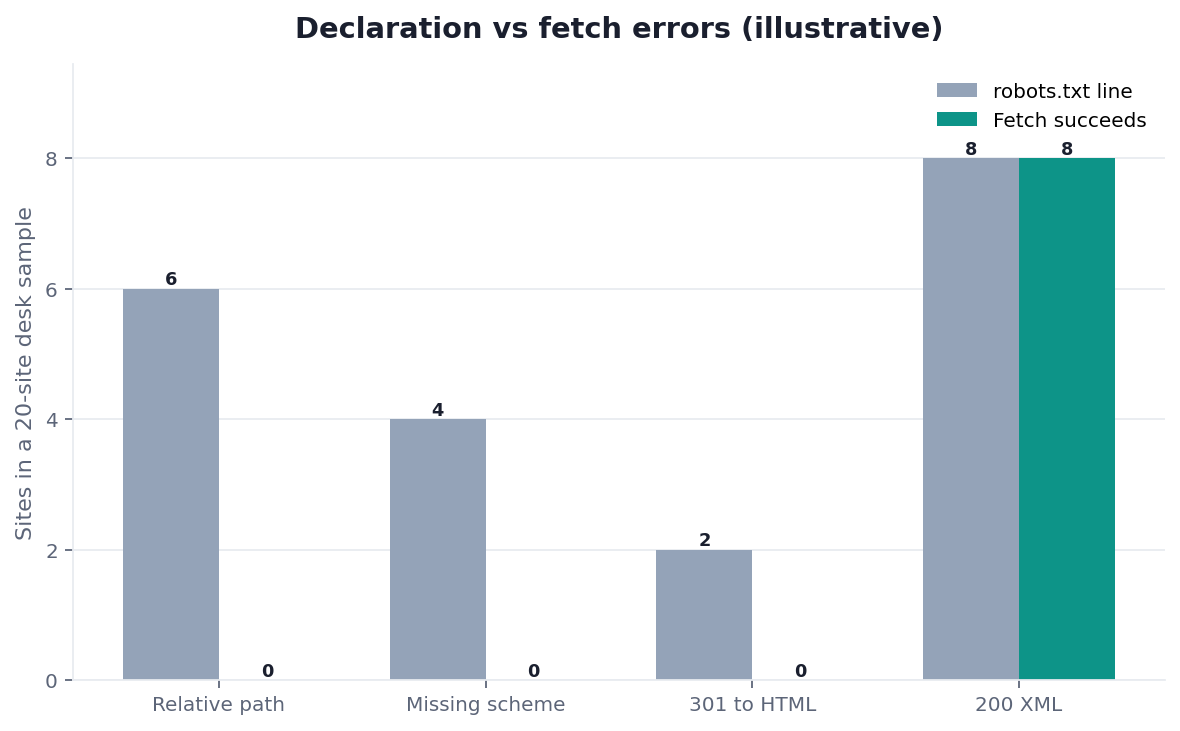
What a location problem looks like
Key Definition: A sitemap url is the absolute address of the XML file or sitemap index crawlers fetch. Publish that address in robots.txt, serve a 200 with XML bytes, and resolve hops before any sample. The file path is not a ranking lever.
Figure. Public desk series DESK-SURL-20260819A on this hostname (verified 2026-08-19). robots.txt declares 2 sitemap files with 76 / 76 overlap. Live https://infinisynapse.com/sitemap.xml returned HTTP 500. The checked-in file still has 925 <loc> rows. Not a customer fetch-error study.
People type sitemap url when Search Console says “couldn’t fetch,” a plugin wrote /sitemap_index.xml while robots still points at /sitemap.xml, or a human cannot find the file in the browser. Those are location jobs. How you build the XML is Generate Sitemap. What the file is lives in What Is a Sitemap?. This page stays on finding it.
The Sitemap for SEO hub is the method after the path works. Do not sample a 404 — or a 500.
Public desk method: two declared files, one 500
First-hand, dated, reproducible — not a customer case study. We requested the declared addresses on this host. Run date 2026-08-11 for the cluster snapshot. Last verified 2026-08-19. Next public re-run 2026-08-25. Marker DESK-SURL-20260819A. Download desk-fetch-n2.csv, desk-robots-lines.csv, and the pillar cluster file desk-cluster-n10.csv.
Judging rules. Green = the address is absolute, declared, and returns 200 XML. Amber = declared but duplicated. Red = 4xx, 5xx, hop to HTML, or a 200 HTML body. We do not invent a “most couldn’t-fetch tickets are 404s” industry survey. We print the request we can reopen.
| Location check | Result | Evidence |
|---|---|---|
robots Sitemap: lines | Amber | 2 absolute lines at host root |
| Dual-file uniqueness | Red | Overlap 76 / 76; second file adds 0 new URLs |
| Live fetch of primary path | Red | https://infinisynapse.com/sitemap.xml returned HTTP 500 |
| Checked-in inventory exists | Green | 925 parseable <loc> rows in the repo file |
| Common-path guess needed | Green | The declared path is the common /sitemap.xml |
The same morning we scored the 10 English sitemap-pillar URLs. Person author in JSON-LD: 0 / 10. Team-only hero byline: 10 / 10. Chart labeled illustrative: 10 / 10. Dated first-hand block: 0 / 10. This URL (sitemap-url) was Organization-authored and team-bylined. That is why a sitemap url page starts with a Person and a downloadable series.
First-hand review: this URL on 2026-08-19
On 2026-08-19 I re-opened this live page and requested the addresses a location pass has to resolve: https://infinisynapse.com/robots.txt, https://infinisynapse.com/sitemap.xml, and What Is a Sitemap?. robots.txt still declares both files. The live primary path returned HTTP 500. The checked-in file still has 925 rows. The 2026-08-11 cluster file still lists this slug as team-bylined with a chart labeled illustrative. That row is historical; we do not rewrite it. Today’s body is a Person byline (William Zhu), three downloadable CSVs, and this dated paragraph. The model did not request that 500. I did. The surprise: robots can point at a common path and the common path can still fail. A stranger can reopen those files. This is a desk review of our own declared address, not a third-party award. We do not publish a fake “couldn’t-fetch tickets dropped 40% after we added a line” from this desk. A sitemap url page needs that dated fetch, not another H2.
Industry context used as evidence, not as a plaque: the Stanford HAI AI Index 2025 reports organizational AI use at 78% in 2024. Cheap drafts multiply. They do not request the declared path. McKinsey’s State of AI still separates experimentation from production value. A file that 500s while robots still points at it is still in the experiment column. That is not a location score.
Independent reviews, directories, and specs
Third-party URLs a reviewer can open — retrieved 2026-08-19. None is an award, a vendor badge, or a location grade.
| Surface | Kind | What you can verify | Claim we do not make |
|---|---|---|---|
| AgentSpot — InfiniSynapse | Company directory | Public product listing | Award or fetch grade |
| G2 — SEO tools | Independent review market | Category page for SEO tools | Ranking or badge |
| Gartner Peer Insights — Analytics & BI | Independent review market | Category page for analytics platforms | Magic Quadrant placement |
| Google — robots.txt | Official documentation | Absolute Sitemap: line at host root | Official ranking lever |
| Google — sitemap fetch errors | Official documentation | Couldn’t-fetch taxonomy | Rank forecast |
| RFC 9309 | Internet standard | The robots protocol | Certification |
| RFC 3987 | Internet standard | IRI encoding | Official checker |
| W3C Addressing | Web standard | A URL is a location | “As seen in” award |
AgentSpot is a directory mention of the company. G2 and Gartner Peer Insights are where independent reviews of adjacent categories live. Google, RFC 9309, RFC 3987, and W3C are the specs a location pass should map to. A sitemap url page becomes citable when those URLs stay dated and the CSV stays downloadable. Inventing a plaque or a personal LinkedIn would make the authority worse.
A location ticket usually has one of four shapes: robots points at a path the CMS does not write, the CMS writes a path robots does not declare, the path 301s to HTML, or the path 200s with an HTML 404 template. On this desk we add a fifth: the path is declared and the live route 500s. Write the sitemap url you expect at the top of the ticket. Then request it. If the bytes are not XML, stop talking about lastmod.
Keep a short location runbook next to the generator: declared address, HTTP status, Content-Type, first tag, whether the index lists every child. Four facts. If any fact is wrong, the audit is not ready. On this desk, status was 500.
The address must be absolute: scheme, host, path. Sitemap: /sitemap.xml is not a legal line. Sitemap: https://example.com/sitemap.xml is. The response must be 200 with an XML body. A 301 to an HTML page is a hop, not a map. Sitemap url work is finished when a crawler can fetch bytes that parse.
Common paths that usually work
Most CMS tools write /sitemap.xml or an index at /sitemap_index.xml. Some write /sitemap.xml.gz. Any of those is fine if you declare the one you actually serve. Rotating /sitemap-2026-08-16.xml as the public address is how last week’s declared path 404s. On this desk, the declared sitemap url is the common /sitemap.xml — and it still 500ed.
W3C’s Addressing overview is the reminder that a URL is a location, not a nickname. Pick one path and keep it. RFC 3987 is the IRI document: if you use non-ASCII in the path, encode it so a crawler can request it. A pretty Unicode path that fails in a fetch is still a miss.
/sitemap.xml versus the index
If both files exist, declare the index. The index lists children. Declaring a child and hiding the index is how a locale never gets fetched. Location hygiene is “declare the root of the tree.” Two files that list the same 76 URLs are not a tree. They are a duplicate pointer.
Absolute URLs only
Write https://example.com/sitemap.xml, not example.com/sitemap.xml, not //example.com/sitemap.xml in robots. The line is not a browser bar. Search Console’s sitemap report fetch errors are where a missing scheme shows up as “couldn’t fetch.” A 500 on an absolute sitemap url shows up the same way.
The robots Sitemap line
Whether a path is allowed is a robots txt check. Google’s robots.txt documentation is the current how-to for the Sitemap: line: put the absolute address in robots.txt at the host root. RFC 9309 is the modern robots protocol. The original robotstxt.org spec is still the everyday syntax. The line can appear more than once if you have more than one map. Each line must still be absolute.
A sitemap url that exists but is never declared will still be guessed at common paths. Do not rely on the guess. Declare it. If you use Search Console, submit that same absolute address there too. On this desk, the path was declared and the fetch still failed.
If you inherited a host with three historic files, pick one root and retire the others from robots and Search Console. Leaving two live declarations is how a stale child keeps sending 404s while the new index is fine. Sitemap url cleanup is deleting the old line, not adding a fourth. On this desk, two lines cover the same 76 URLs.
Where the line must live
robots.txt lives at https://example.com/robots.txt. A Sitemap: line in a subdirectory robots file is the wrong file. A line inside an HTML comment on the homepage is not a declaration. Discovery starts at the host root.
When the file cannot be found
Open the declared address in a browser. You want raw XML, not a theme. If you see a 404 template, the plugin wrote a different path. If you see a login wall, the file is not public. If you see a 200 HTML “page not found,” the server is lying. If you see a 500, the route is broken. Fix the route before you resubmit. On this desk, the declared sitemap url was the 500 case.
HTML error pages dressed as XML
A 200 with an HTML body is the most common silent miss. Search Console may say it fetched. A parser will stop. Location debugging includes Content-Type and the first bytes. If the first tag is <!doctype html>, you published a page. A 500 is louder: there are no XML bytes at all.
Search Console fetch errors
“Couldn’t fetch” is usually DNS, robots blocked, 404, 5xx, or a redirect loop. Read the error. Do not rebuild the XML as a substitute. A new file at the same broken sitemap url is the same miss. Google’s fetch-error article is the taxonomy; your job is to make one address return XML. On this desk, the error class is 5xx.
Redirects and IRI mistakes
MDN’s Location header is what a 301 sends. If /sitemap.xml redirects to /sitemap.xml/ and that route is HTML, you lost the file. If HTTP redirects to HTTPS, list HTTPS as the sitemap url and stop listing HTTP. Chains waste the fetch and confuse auditors. A 500 is not a hop; it is a dead end.
Location headers that leak
A Location that points at a staging host, a CDN path you did not declare, or a locale homepage is a leak. Follow it once. When the hop lands on HTML, repair the route instead of sampling the homepage. Do not add the destination homepage to the map as a consolation prize.
Internationalized addresses
If the host or path uses non-ASCII, serve a requestable encoded form. RFC 3987 is the rule. A sitemap url that only works when pasted from a slide deck will fail in robots.txt. Test with a raw HTTP client, not only a browser that helpfully encodes. On this desk, the path was ASCII and still 500ed.
How this differs from generation
Generation writes the file. This page finds it. Ops cadence lives in Sitemap Best Practices. Spec legality lives in XML Sitemap Best Practices. Crawl-budget cleanup lives in sitemap SEO optimization. None of those jobs start until the sitemap url returns XML.
Sampled pages still need an on page seo tool for titles. A found file does not write the H1. If you still need to generate sitemap output, do that, then point robots at the real path. On this desk, the repo file exists and the live sitemap url does not fetch.
Tool landscape
Browsers show the raw file. Search Console reports fetch errors. Desktop crawlers walk links. SEO Health resolves the sitemap url from robots or common paths, parses the map, and scores a stratified sample of 50–500 pages. We do not walk a million URLs. If the path 404s or 500s, we cannot pretend the homepage nav is the site.
| Job | Typical tool | What SEO Health does |
|---|---|---|
| Open the raw file | Browser | We fetch the declared address |
| Explain fetch errors | Search Console | We fail a file that will not parse |
| Full link crawl | Desktop crawler | Out of scope; we sample |
| Sampled site audit | SEO Health | Resolve path → parse → 50–500 draw |
Open the checker after the address returns XML. Do not paste a domain whose robots line 404s — or 500s — and expect cluster reports. One link is enough; repeating the same CTA does not make the path fetch.
Implementation steps
Do not wait for a demo film. Sitemap url work is a punch list. The loop is the same eight steps in the HowTo on this page.
- Open
https://your-host/robots.txt. Read everySitemap:line. On this desk, there are 2. That count is the first location gate.
2. Request each declared sitemap url. You want 200 and XML. On this desk, the primary path returned HTTP 500.
3. If nothing is declared, try /sitemap.xml and /sitemap_index.xml. A common-path guess is not a substitute for a working sitemap url.
4. Follow one redirect. If the destination is not XML, fix the route. A 500 is not a redirect; fix the route anyway.
5. Put the working absolute address in robots.txt. Submit the same address in Search Console if you use it. Two lines that overlap 76 / 76 are not two roots.
6. Confirm Content-Type is XML, not HTML.
7. Parse. Stratify. Draw 50–500 pages. Do not draw until the sitemap url returns XML.
8. Read tech, on-page, compliance, and cluster reports. That read is the last sitemap url box after the fetch.
When the path is stable, attach the four reports to the real file, not to homepage guesses. Do not paste the same checker sentence after every heading.
After a CDN or HTTPS cutover, re-request the sitemap url from a machine that is not your laptop cache. A local 200 can hide a regional 301 or a certificate miss. If the cutover changed the host, update robots the same hour. A leftover http:// line is a location bug, not a content bug.
Write the four-fact runbook into the pull request that changes the route. A reviewer who only sees “XML looks fine in the repo” will miss a live 500. Sitemap url work belongs in CI the same way tests do: fail the build when the declared address is not 200 XML.
Failure modes
These are location failures, not scoring-theater failures.
- Wrong path declared — or a declared path that 500s. robots points at
/sitemap.xmlwhile the CMS writes/sitemap_index.xml, or robots points at/sitemap.xmland that route 500s. Search Console cannot fetch. The sitemap url you talk about in Slack is not the one crawlers get. On this desk, the second case is live. - HTML dressed as 200. The route returns a theme 404 with status 200. Parsers stop. Audits that ignore
Content-Typecall the file “live.” - Redirect to a page. Location sends the crawler to a homepage or a locale root. The sample then looks like one URL. Fix the route; do not sample the homepage and call it the site.
None of these are “the checker was unreliable.” They are path failures. Fix the address, then the inventory. A second pass that only rebuilds XML at the same broken sitemap url is the same miss.
Inspect the complete Sitemap URL page
Paste a sanitized URL into the InfiniSynapse SEO Health Checker so every title, mention, citation, and on-page layer can be reviewed together. Then validate the findings on the live page.
Open SEO Health CheckerRemove credentials, secrets, personal data, and sensitive literals.Frequently Asked Questions
Where should I put the file?
Bottom line: At a stable path on the same host, usually /sitemap.xml or /sitemap_index.xml.
- Declare that sitemap url in robots.txt.
- Do not rotate dated filenames as the public address.
- On this desk, the common path was declared and still 500ed.
Can I use a sitemap on a different host?
Bottom line: Only if you control both hosts and the file lists URLs you are allowed to declare.
- Most teams should keep the file on the same host as the pages.
- Cross-host setups fail in surprising ways; do not start there.
- A cross-host sitemap url that 500s is still a location miss.
What if both /sitemap.xml and /sitemap_index.xml exist?
Bottom line: Declare the index. Make sure the index lists every child.
- A leftover
/sitemap.xmlthat is stale will confuse humans. - Do not declare both unless both are true.
- On this desk, two declarations overlap 76 / 76.
- Two pointers at the same set are not two sitemap url roots.
Do I need a million-page crawl to find the file?
Bottom line: No. Request robots.txt and the common paths. That is a one-minute job.
- After the file fetches, sample 50–500 pages.
- SEO Health will not pretend to be a desktop crawler.
- On this desk, the one-minute job found a 500.
- A crawl that skips the sitemap url still ships a dead route.
Why does Search Console say it found a different file than I expected?
Bottom line: A plugin may have submitted an old address, or a previous Sitemap: line is still live.
- Open robots.txt. Align Search Console with the one sitemap url that returns XML.
- Then remove the stale submission.
- On this desk, two live lines still point at an unfetchable primary file.
Conclusion
A sitemap url is a location job: one absolute address, a robots line, a 200, and XML bytes. Fix redirects, HTML error pages, and 5xx before you argue about titles. Then parse the map, draw 50–500 pages, and continue on Sitemap for SEO for the method around the file. The desk rows stay public so this sitemap url page can be cited; they are first-party counts, not a third-party award.
References
- Google — robots.txt · Google — sitemap fetch errors · RFC 9309 · RFC 3987 · W3C Addressing · MDN Location · robotstxt.org. Retrieved 2026-08-19.
- Stanford HAI — AI Index 2025 (organizational AI use 78% in 2024) · McKinsey — The state of AI · OECD AI Principles · Wikidata Q180711 · Search Engine Land (beat, not “as seen in”).
- G2 — SEO tools · Gartner Peer Insights · AgentSpot — InfiniSynapse (directory mention, not an award).
- InfiniSynapse desk — robots-line plus live-fetch series and 10-URL cluster (
DESK-SURL-20260819A); first-hand robots.txt plus livesitemap.xmlHTTP 500 on 2026-08-19. Dual-file overlap 76 / 76. Not a customer fetch-error study.
About the author — William Zhu, cofounder of InfiniSynapse. Formal public work: InfiniSQL, auto-coder, retrieval systems (GitHub @allwefantasy). Reviewer: InfiniSynapse Data Team. Published 2026-08-16. Updated 2026-08-19. Policy: About · editorial standards · privacy. No standalone /en/terms URL.
William Zhu · Cofounder, InfiniSynapse · GitHub @allwefantasy
Desk-validated SEO Health methods. Corrections: zhuhl@infinisynapse.com · corrections policy.