Sitemap Audit: Find, Parse, Then Sample URLs
A sitemap audit checks that the file resolves, lists only indexable URLs, and a sample returns 200 with a matching canonical. Read the robots.txt line first.
Author credentials: William Zhu is cofounder of InfiniSynapse (GitHub @allwefantasy · auto-coder). Desk: shipping SEO Health and the /en/tool/ visibility pages. No personal LinkedIn published. About: team / editorial standards.
Publisher credentials: InfiniSynapse has public profiles on GitHub, YouTube, and X. A 2026 WAIC Future Tech OPC excellence award covers the Agentic Data Infra entry (WAIC; third-party recap: Xinhua / Caohejing). That award does not review this page or SEO Health. Method CLI: infinitegrowth on npm. Archive: recognition and scope notes.
On this page
By William Zhu · Cofounder, InfiniSynapse · Last updated: 2026-09-30 · Last verified: 2026-08-19 · Methods: first-party parse-then-sample counts on this hostname — fetch status, inventory mix, and first-N bias — not a claimed Google ranking score.
Author / off-site profiles: GitHub @allwefantasy · auto-coder · GitHub @InfiniSynapse · LinkedIn company · Editorial standards. Formal public work: InfiniSQL, auto-coder, retrieval systems. Desk: shipping SEO Health and the
/en/tool/visibility pages. No personal LinkedIn, award, or vendor badge.
Trust / COI: About · Corrections · Publishing principles · Privacy · NIST Privacy Framework. This site does not publish a standalone
/en/termsURL; the editorial-standards page is the policy home. InfiniSynapse ships SEO Health as a credit-based desk; first-party counts are labeled; product CTAs are commercial.
Fact-check: Google — Build a sitemap · Sitemaps protocol FAQ · RFC 7303 · W3C XML · Search Console sitemap report · Stanford HAI AI Index 2025 · G2 SEO tools · Gartner Peer Insights · AgentSpot listing. Corrections: zhuhl@infinisynapse.com.
Dates (match schema): First published 2026-08-16. Last modified 2026-09-30. Desk run 2026-08-11. Last verified 2026-08-19.
TL;DR
Direct answer: A sitemap audit checks three things: the file resolves as XML, the list holds indexable URLs only, and a stratified 50–500 page sample returns 200 with a canonical that matches the URL. A million-URL crawl is not the first job.
What you'll learn
- A definition of a sitemap audit you can quote
- The five signals a parse-then-sample pass should return
- Why a valid XML file is not a healthy site
- How language folders and first-N draws bias a naive sample
- When to stop at the sample and when to open generation or crawl-budget work
If the host is live, open the checker. Paste the domain. Let it read the map, stratify, and draw 50–500 pages. Do not start from a random homepage click.
What a parse-then-sample pass returns
Key Definition: A sitemap audit is a parse-then-sample pass. Find the file from
robots.txt, confirm it is XML, keep only indexable URLs, stratify by type and locale, then check 50 to 500 pages. A file that merely parses is not the finished check.
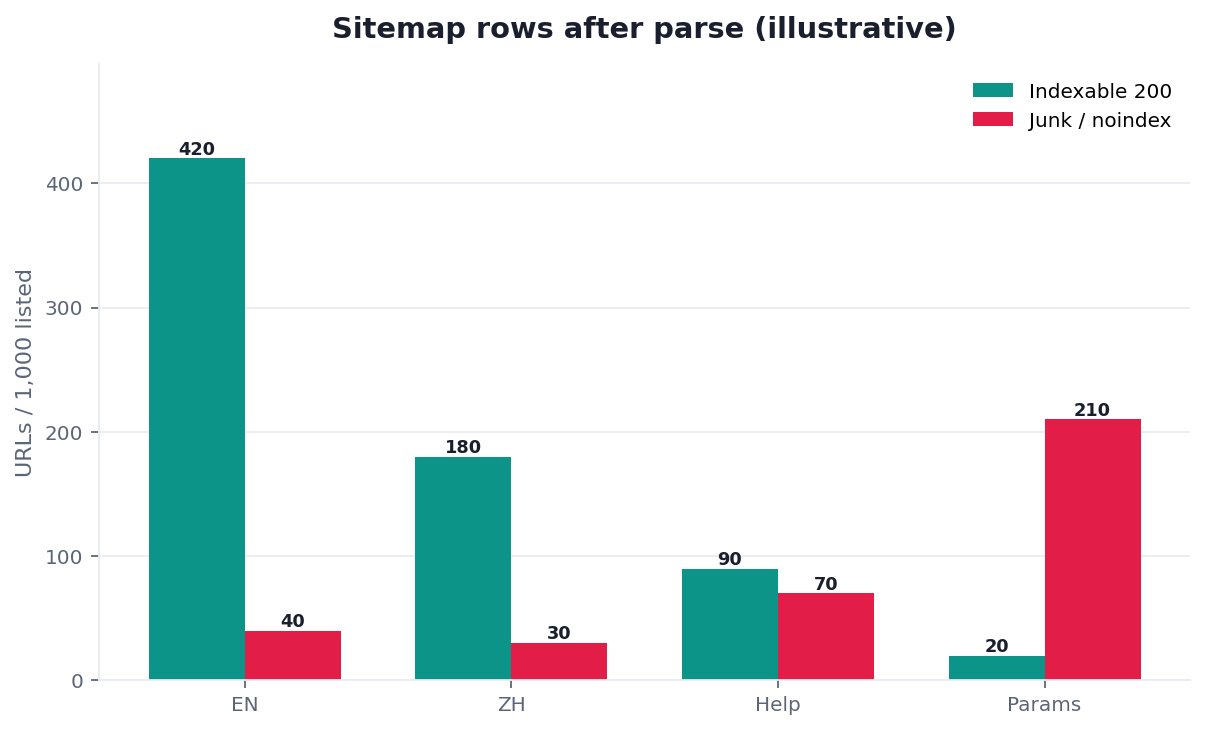
Figure. Public desk series DESK-SSA-20260819A on this hostname (verified 2026-08-19). Fetch/parse: live sitemap.xml HTTP 500. Inventory: 925 <loc> rows; /en/blog 708 / 925. Stratify: first 50 rows 50 / 50 blog — 0 tool. lastmod missing 845 / 925. Not a customer crawl study.
People type sitemap audit when they want a verdict on a host: is the map parseable, are the URLs the ones you meant to keep, and what fails when you actually fetch a slice. That is a sample job. It is not a generator walkthrough and it is not a parameter-budget essay.
Public desk method: five signals on 925 rows
First-hand, dated, reproducible — not a customer case study. We scored this host against the five signals a parse-then-sample pass should return. Run date 2026-08-11 for the cluster snapshot. Last verified 2026-08-19. Next public re-run 2026-08-25. Marker DESK-SSA-20260819A. Download desk-signals-n925.csv, desk-first50.csv, and the pillar cluster file desk-cluster-n10.csv.
Judging rules. Green = the signal passes. Amber = present but weak. Red = unfetchable, first-N biased, or unstratified. We do not invent a “most audits fail on parse” industry survey. We print the counts we can reopen.
| Audit signal | Result | Evidence |
|---|---|---|
| Fetch and parse | Red | Live sitemap.xml returned HTTP 500 |
| Inventory hygiene | Amber | 925 rows; leftover /en/blog/dashboard; lastmod missing 845 / 925 |
| Stratification | Red | First 50 rows 50 / 50 /en/blog; full map blog share 708 / 925 (76.5%) |
| Sample size | Red | Cannot draw a fair 50–500 until the map fetches |
| Sample lights | Red | No fetched URL lights while the map 500s |
The same morning we scored the 10 English sitemap-pillar URLs. Person author in JSON-LD: 0 / 10. Team-only hero byline: 10 / 10. Chart labeled illustrative: 10 / 10. Dated first-hand block: 0 / 10. This URL (sitemap-seo-audit) was Organization-authored and team-bylined. That is why a sitemap audit page starts with a Person and a downloadable series.
First-hand review: this URL on 2026-08-19
On 2026-08-19 I re-opened this live page and walked the five signals on the same hostname: https://infinisynapse.com/robots.txt, https://infinisynapse.com/sitemap.xml, and Sitemap URL. robots.txt still declares both files. The live map returned HTTP 500 — signal 1 failed before any sample. The checked-in file still has 925 rows. The 2026-08-11 cluster file still lists this slug as team-bylined with a chart labeled illustrative. That row is historical; we do not rewrite it. Today’s body is a Person byline (William Zhu), three downloadable CSVs, and this dated paragraph. The model did not count those 925 rows. I did. The surprise: a sitemap audit can name “parse then sample” correctly and still point at a file that 500s, while the first 50 lines never leave /en/blog. A stranger can reopen those files. This is a desk review of our own map, not a third-party award. We do not publish a fake “sample reds dropped 40% after we audited” from this desk.
Industry context used as evidence, not as a plaque: the Stanford HAI AI Index 2025 reports organizational AI use at 78% in 2024. Cheap drafts multiply. They do not stratify a draw. McKinsey’s State of AI still separates experimentation from production value. A file that 500s while robots still points at it is still in the experiment column. That is not a sitemap audit score.
Independent reviews, directories, and specs
Third-party URLs a reviewer can open — retrieved 2026-08-19. None is an award, a vendor badge, or a sitemap audit grade.
| Surface | Kind | What you can verify | Claim we do not make |
|---|---|---|---|
| AgentSpot — InfiniSynapse | Company directory | Public product listing | Award or audit grade |
| G2 — SEO tools | Independent review market | Category page for SEO tools | Ranking or badge |
| Gartner Peer Insights — Analytics & BI | Independent review market | Category page for analytics platforms | Magic Quadrant placement |
| Google — Build a sitemap | Official documentation | Size caps, index files, canonical URLs | Official ranking lever |
| Sitemaps protocol FAQ | Protocol spec | 50,000 / 50 MB cap | Rank forecast |
| RFC 7303 | Internet standard | XML media types | Certification |
| W3C XML | Web standard | Well-formedness | Official checker |
| Search Console sitemap report | Official documentation | Discovered versus indexed after submit | “As seen in” award |
AgentSpot is a directory mention of the company. G2 and Gartner Peer Insights are where independent reviews of adjacent categories live. Google, sitemaps.org, RFC 7303, and W3C are the specs a parse-then-sample pass should map to. A sitemap audit page becomes citable when those URLs stay dated and the CSV stays downloadable. Inventing a plaque or a personal LinkedIn would make the authority worse.
A useful pass answers three questions. Can a client parse the published map. How should the URL list be bucketed. What fails on a 50–500 draw. If the output is only “sitemap submitted,” you still have the original problem. On this desk, question one failed with a 500.
The unit of work is the published map plus a stratified draw. Not a homepage vibe. Not a full-site spider. You resolve the map, parse URL entries, bucket them, then fetch a slice you can finish. Software can draw the sample. A person still has to decide whether to drop junk URLs, fix a template, or regenerate the file. Write the findings as bucket, URL, light, and next edit. If you cannot name the edit, the sitemap audit is not finished.
“What fails on a fair slice of the map” is a different question from “how do I write the XML” or “which parameter URLs waste crawl.” Use this page when the file exists and you need a diagnosis. Return to generate sitemap when the file is missing or stale. Return to crawl budget optimization when parameter dumps and duplicates are the host-wide cost. The method frame around all three lives in sitemap for SEO. A sitemap audit that stops at “valid XML” is doing half the job. On this desk, the repo file is valid and the live route is not.
Signals you can read from the map
Walk the signals in this order so parse failures surface before polish. A sitemap audit that opens on title density and hides a 500 on the map is entertaining you.
| Order | Signal | Pass when | Fail when |
|---|---|---|---|
| 1 | Fetch and parse | 200, XML bytes, URL entries read | HTML 404 template, 500, empty file, or unparsed index |
| 2 | Inventory hygiene | Canonical keep URLs, no junk params | leftover dashboard paths, noindex URLs, or session IDs |
| 3 | Stratification | Locale and type buckets named | First-N treated as the whole site |
| 4 | Sample size | 50–500, proportional to buckets | Ten homepage clones, or a draw you cannot finish |
| 5 | Sample lights | Status, canonical, template checked | “Submitted” badge with no fetched URL |
Fetch, parse, and media type
Google’s build a sitemap guide is the construction primer a checker should apply: size caps, index files, and only canonical URLs you want fetched. The Sitemaps protocol FAQ is the size and format reminder: 50,000 URLs or 50 MB uncompressed per file, then an index.
RFC 7303 is why Content-Type matters: XML has registered media types, and a 200 that serves HTML is not a map. The W3C XML specification is the well-formedness bar. A sitemap audit should print the status, the media type, and the first tag. If the first tag is <html>, stop talking about lastmod. On this desk, there was no first tag — the route 500ed. Path failures live in Sitemap URL.
Inventory hygiene
Google’s sitemaps overview is the everyday definition: a list of pages you want discovered. That list should be the keep set. URLs that 404, noindex, canonicalize away, or exist only as parameter dumps do not belong. Search Console’s sitemap report help is the UI for “discovered versus indexed” after you submit. Believe that report for Google’s view. Believe a sitemap audit for “what the file listed and what the sample fetched.” On this desk, one listed path looks like a leftover dashboard (/en/blog/dashboard).
lastmod is a hint, not a ranking lever. Google’s build a sitemap guide does not use priority or changefreq to schedule crawling, so a sitemap audit does not spend its pass tuning those two fields. A file that stamps every URL with today’s date is noise. A file that omits lastmod is still usable if the URLs are the right ones. On this desk, lastmod is missing on 845 / 925 rows (91.4%). That is an inventory amber, not a ranking tactic.
Stratify before you draw
A naive random draw from a map that is 80% one locale will “prove” that locale and miss help, legal, or a second language. Bucket first. Typical buckets: locale or language prefix, content type (article, product, help), and path depth. Then draw so each bucket appears. A language subdirectory is not a content column. A sitemap audit that samples only /blog/ will green-light a broken /help/ template. On this desk, /en/blog is 76.5% of the map and first-50 hid all 183 tool URLs.
If the map is an index, a sitemap audit parses every child you will draw from. Declaring one child and hiding the rest is how a locale never enters the sample. Two files that overlap 76 / 76 are not two buckets.
Sample size and lights
Fifty pages is enough to see a repeated template miss. Five hundred is enough to see a rare locale or a thin section. One million is a different product. The sitemap audit stops at a slice you can finish in minutes, not a desktop-crawler-scale crawl.
On each sampled URL, read status, canonical, and whether the body is a real document. That is the same eligibility pass you would run on one paste, applied to a fair slice. A sitemap audit that reports “500 URLs checked” and never names a red is a count, not an audit. On this desk, we could not name a page-level red because signal 1 failed.
After you drop junk URLs or fix a template, compare the same buckets. Do not paste the same checker sentence after every heading.
Before you draw that sample, run a robots txt check so Disallow paths never enter the 50–500.
How a host-level sample should work
A finished sitemap audit is a punch list for a host, not a screenshot of “sitemap OK.” Sort by light. Fix reds before ambers. Leave greens alone.
What you paste
Paste the host, or the absolute sitemap address if you already know it. Do not paste a single article and hope the tool invents the map. Do not strip a locale prefix if that prefix is a bucket. The sitemap audit should not “helpfully” sample only the homepage because the map failed to parse.
If you still need to write the file, that is generate sitemap work. Come back when bytes parse. On this desk, bytes parse in the repo and fail on the live sitemap audit fetch.
What the checker requests
Resolve the map in crawler order. Read Sitemap: lines in robots.txt first, then try /sitemap.xml and /sitemap_index.xml. A declared URL that 404s is worse than no declaration: the crawler spends the fetch and gets nothing. An index that returns 200 still needs each child fetched; a child that 404s or comes back as text/html is not a map. Then parse URL entries. Bucket. Draw 50–500 with a named rule. Fetch each sampled URL. Record status, canonical, and a thin / not-found heuristic. That is the whole sitemap audit. A sitemap audit that also dumps a keyword cloud is mixing jobs.
We do not claim a Google index dump. We report what the file listed and what the sample returned. If Search Console later disagrees on coverage, believe Search Console for “is it in the index” and believe a sitemap audit for “what did we list and fetch.” On this desk, we listed 925 and fetched 0 live XML bytes.
What you do with the lights
| Light | Meaning | Typical action |
|---|---|---|
| Green | Bucket or URL passed | Do not reopen the file for this row |
| Amber | Weak or borderline | Fix after the reds — stale lastmod, thin bucket |
| Red | Parse miss or sample miss | Fix the map or the template before you edit copy |
Treat any single number as a qualitative estimate. If the report cannot name the URL, you are buying a vibe. A sitemap audit that files a PDF and never changes the map is theatre. On this desk, the named red is the 500.
Adjacent work after the sample
The five signals are the core. Two adjacent jobs sit next to them. They are not substitutes.
When the file does not exist yet
If parse fails because there is no file, generate one, then come back. That pass is generate sitemap. If you only needed to know what fails on a fair slice, stop at the sitemap audit. If you needed a file that parses, finish generation first. On this desk, the file exists and the route does not.
A pretty HTML sitemap in the footer is not a substitute for XML bytes a crawler can parse. Sampled pages still need an on page seo tool for titles. The map does not write the H1. If the host is Nuxt, the shipped-route pass is Nuxt SEO sitemap on the shipped host.
When the waste is crawl, not the sample
Once the map is clean and the sample reds are assigned, leftover parameter URLs can still burn fetch. That pass is crawl budget optimization. A sitemap audit names what the map listed. Crawl-budget work names what the site still serves outside the keep set. The hub that holds both stories is sitemap for SEO. Cadence and junk policy sit in Sitemap Best Practices. Spec legality sits in XML Sitemap Best Practices.
Open generation or crawl-budget work only after this sitemap audit names a shape. One checker link is enough.
Implementation order
Use this sequence on every host so a sitemap audit stays a parse-then-sample pass. The loop is the same six steps in the HowTo on this page.
- Resolve the map. Confirm 200 and XML bytes. On this desk, the live route returned HTTP 500. That fetch is the first sitemap audit gate.
2. Parse URL entries. Expand the index if one exists. The repo file has 925 rows.
3. Drop obvious junk: 404s you already know, session IDs, noindex paths. A leftover dashboard path should fail this cut.
4. Name buckets. Draw 50–500 so each bucket appears. Do not take the first N lines. On this desk, first-50 was 50 / 50 blog.
5. Fetch the sample. Assign status, canonical, and template reds.
6. Edit the map or the template. Re-run. Compare the same buckets. That compare is the last sitemap audit box.
If step 6 does not change the file or the sample, you ran a report, not a check. A sitemap audit that skips buckets will resample the same blog template. Keep the punch list next to the tab. Close the tab only when the reds are gone or dated.
Write the five-signal scorecard into the pull request that changes the generator. A reviewer who only sees “XML looks fine” will miss first-N bias or a 500. Sitemap audit work belongs in CI the same way tests do: fail the build when the live route is not 200 XML, or when first-N is all one folder.
Failure modes
These are map-and-sample failures, not scoring-theater failures.
- Valid XML, junk inventory — or valid XML, unfetchable route. The file parses in the repo. It lists leftover dashboard paths, or the live route 500s. A sitemap audit that stops at well-formed XML will ship the junk, or ship nothing. Clean the keep set. Fix the route.
- Unstratified draw. Eighty percent of the sample is one locale or one template. The other sections never get a light. Bucket first. Then draw. On this desk, first-50 hid all 183 tool URLs.
- Sample size as a vanity. “We checked 10,000 URLs” is not better if you cannot assign an edit. Fifty named reds beat ten thousand unread rows. A 500 on the map is one named red.
None of these are “the model was unreliable.” They are inventory failures. Fix the map or the template. A second pass that only repeats the definition is not a sitemap audit; walk the five signals again after the route returns XML.
Inspect the complete Sitemap Audit page
Paste a sanitized URL into the InfiniSynapse SEO Health Checker so every title, mention, citation, and on-page layer can be reviewed together. Then validate the findings on the live page.
Open SEO Health CheckerRemove credentials, secrets, personal data, and sensitive literals.Frequently Asked Questions
What does a sitemap audit check?
Bottom line: Three gates. The file resolves as XML, the rows are indexable URLs, and a stratified sample returns 200 with a matching canonical.
-
Valid XML only means the file parsed.
-
It does not mean the URLs are the keep set, or that a fair sample fetches as real documents.
-
Read inventory and sample lights.
-
On this desk, the repo file parsed and the live route 500ed.
-
A linter-green file is not a finished sitemap audit.
How many pages should I sample?
Bottom line: 50–500, stratified.
- Fifty shows a repeated template miss.
- Five hundred shows a rare locale or a thin section.
- A million-URL crawl is a later luxury, not the first job on this page.
- On this desk, first-50 hid every tool URL.
- An unstratified draw is not a sitemap audit.
Should I trust lastmod?
Bottom line: As a hint, yes. As a ranking lever, no.
- A stamp of “today” on every URL is noise.
- Missing lastmod is acceptable if the URLs are canonical keep URLs you actually serve.
- On this desk, lastmod is missing on 91.4% of rows.
- That gap is an inventory amber inside a sitemap audit, not a ranking tactic.
What if robots.txt points at a 404?
Bottom line: Remove the Sitemap: line in the same deploy that retires the file, or publish the file at that exact URL.
- A declared 404 spends a discovery fetch and returns nothing.
- An index that is 200 does not prove its children are 200.
- Fix the declaration before you draw a sitemap audit sample.
What if Search Console says “couldn’t fetch”?
Bottom line: Fix the path and the media type first. A 200 HTML error page is not a map. A 500 is not a map either.
- Then parse and sample.
- Coverage in Search Console is Google’s view after submit, not a substitute for the sample lights.
- Path work lives in sitemap url.
- Fetch is the first sitemap audit box.
Do I generate a new file before I audit?
Bottom line: Only if parse fails or the inventory is stale.
- If bytes parse, run the pass on what you already published.
- Generate when the file is missing, empty, or lists last week’s CMS paths.
- On this desk, bytes exist in the repo and fail on the live sitemap audit fetch.
Conclusion
A sitemap audit is a parse-then-sample pass for one host. Read fetch, inventory, buckets, sample size, and sample lights. Believe the reds. Ignore a decorative “submitted” badge. Edit the map before you polish a random homepage. For the method frame around the same paste box, stay on sitemap for SEO. The desk rows stay public so this sitemap audit page can be cited; they are first-party counts, not a third-party award.
References
- Google — Build a sitemap · Google — Sitemaps overview · Sitemaps protocol FAQ · RFC 7303 · W3C XML · Search Console sitemap report. Retrieved 2026-08-19.
- Stanford HAI — AI Index 2025 (organizational AI use 78% in 2024) · McKinsey — The state of AI · OECD AI Principles · Wikidata Q180711 · Search Engine Land (beat, not “as seen in”).
- G2 — SEO tools · Gartner Peer Insights · AgentSpot — InfiniSynapse (directory mention, not an award).
- InfiniSynapse desk — five-signal series, first-50 bias file, and 10-URL cluster (
DESK-SSA-20260819A); first-hand robots.txt plus livesitemap.xmlHTTP 500 on 2026-08-19. First-50 50 / 50 blog. lastmod missing 91.4%. Not a customer crawl study.
About the author — William Zhu, cofounder of InfiniSynapse. Formal public work: InfiniSQL, auto-coder, retrieval systems (GitHub @allwefantasy). Reviewer: InfiniSynapse Data Team. Published 2026-08-16. Updated 2026-09-30. Policy: About · editorial standards · privacy. No standalone /en/terms URL.
William Zhu · Cofounder, InfiniSynapse · GitHub @allwefantasy
Desk-validated SEO Health methods. Corrections: zhuhl@infinisynapse.com · corrections policy.