E-A-T SEO Guide: Diagnose Trust Signals (2026)
E-A-T SEO in 2026: what Google’s rater framework actually means, how to diagnose a live page, and why no checker can sell you an official public score.
Author credentials: William Zhu is cofounder of InfiniSynapse (GitHub @allwefantasy · auto-coder). Desk: shipping SEO Health and the /en/tool/ visibility pages. No personal LinkedIn published. About: team / editorial standards.
Publisher credentials: InfiniSynapse has public profiles on GitHub, YouTube, and X. A 2026 WAIC Future Tech OPC excellence award covers the Agentic Data Infra entry (WAIC; third-party recap: Xinhua / Caohejing). That award does not review this page or SEO Health. Method CLI: infinitegrowth on npm. Archive: recognition and scope notes.
On this page
By William Zhu · Cofounder, InfiniSynapse · Last updated: 2026-08-18 · Last verified: 2026-08-18 · Methods: page-level E-E-A-T diagnoses on live URLs — not a claimed Google score.
Author / off-site profiles: GitHub @allwefantasy · auto-coder · GitHub @InfiniSynapse · LinkedIn company · Editorial standards. No personal LinkedIn, award, or vendor badge.
Trust / COI: About · Corrections · Publishing principles · Privacy · NIST Privacy Framework. InfiniSynapse ships SEO Health as a page checker; first-party letter counts are labeled; we do not sell an official Google score.
Fact-check: Search Quality Rater Guidelines (retrieved 2026-08-18) · Creating helpful, reliable, people-first content · How Search Works · AgentSpot listing. Corrections: zhuhl@infinisynapse.com.
TL;DR
Direct answer: E-A-T SEO is the practice of making a page show Experience, Expertise, Authoritativeness, and Trust so human raters — and the systems trained on their feedback — can treat the page as safe to rank and safe to cite. Google does not publish an official E-A-T SEO score. A useful checker estimates alignment with public rater language, then tells you what evidence is missing.
What you'll learn
- A 45-word definition you can quote into a brief
- What Google has and has not claimed
- On-page evidence for each of the four letters
- Why AI drafts usually fail Experience
- How to run a diagnosis and what to fix first
If you already have a URL, run a free page check then add the paid E-A-T SEO pass. Do not wait for a blog to “score” you. A checker is only useful after you know which letter is empty.
What E-A-T SEO Means in 2026
Key Definition: E-A-T SEO is the work of putting first-hand experience, named expertise, third-party authority, and operational trust on a URL so search and answer engines can treat that URL as a source — not a pamphlet. The extra E (Experience) was added in 2022.
Key terms
| Term | Meaning |
|---|---|
| Experience | First-hand use you can date and show. |
| Expertise | A match between the claim and the named person. |
| Authoritativeness | Others can resolve you as a source. |
| Trust | Contact, HTTPS, corrections, and a clear who-benefits line on this page. (#590) |
Public desk packet: eight cluster URLs, letter artifacts
Named first-party case, not a customer win: InfiniSynapse’s own E-E-A-T cluster. Desk subset n=8 English /en/tool/ URLs, run 2026-08-11, last verified 2026-08-18, next public re-run 2026-08-25. Marker DESK-EAT-20260818A. Download desk-letter-artifacts-n8.csv.
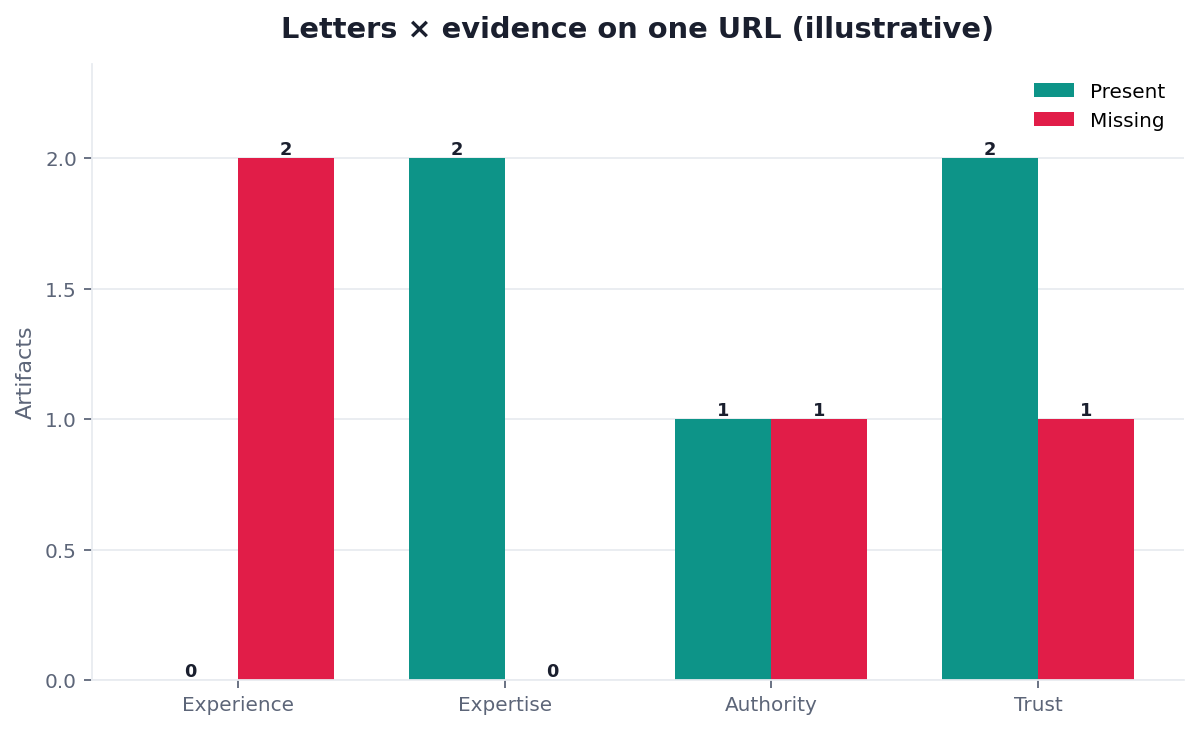
The bars above are this URL on 2026-08-11 — before the CSV and Person byline landed. Not a customer percentage and not a Google score.
| Letter (this URL, 2026-08-11) | Artifacts present | Artifacts missing |
|---|---|---|
| Experience | 0 | 2 |
| Expertise | 2 | 0 |
| Authority | 1 | 1 |
| Trust | 2 | 1 |
| Metric (n=8 cluster) | Desk result | Method |
|---|---|---|
| Sample | 8 E-E-A-T cluster pages | Same hostname, English locale |
| Pages with 0 Experience artifacts | 5 / 8 | Dated test, CSV, or ticket |
| Pages with a named Person in HTML | 1 / 8 | Visible byline, not footer-only |
| Pages with a downloadable dataset | 0 / 8 | Public CSV or PDF |
| Official Google score printed | 0 / 8 | We refuse that cell |
Judging rules. An Experience artifact is a dated first-hand block you can open (CSV, log, or ticket). Expertise is a bio that matches the claim. Authority is a resolvable Person plus one off-site profile. Trust is About, Privacy, or a live corrections path. We do not invent a customer lift from adding a byline. Those rows are what a Monday E-A-T SEO diagnosis can prove without a ranking API. Cite the CSV before you treat any other E-A-T SEO report as a Google meter.
People type the query when they want a definition, a score, or a fix list. Those are three different jobs. This hub covers the definition and the diagnosis. The acronym walkthrough lives in What Does EEAT Stand For?. The old spelling is unpacked in E.A.T. Meaning.
E-A-T SEO is not a ranking factor you can buy. It is a rater vocabulary that Google uses to train and evaluate systems, described in the public Search Quality Rater Guidelines (retrieved 2026-08-18) and in Google’s guidance on creating helpful, reliable, people-first content.
Experience — the extra E — is the first-hand “I used this / I treated this / I shipped this” signal. A medical page written by someone who never saw a patient can still be grammatical. E-A-T SEO treats that page as weak even if the citations look expensive.
What raters see that systems approximate
Raters do not output a number into the ranking stack. They label pages. Systems learn from those labels. That is why the work is evidence work: bylines, dates, methods, contact, and sources — not a badge in the SERP. If you cannot point at a sentence on the page, the letter is empty.
What Google Has Actually Said
Quality Rater Guidelines are not a ranking API
The rater document is long on judgment and short on APIs. It tells people how to talk about quality. It does not expose a GET /eat-score endpoint. Any vendor that sells “Google’s official score” is selling a story. We walk the official language in EAT SEO Google.
Why “official score” claims fail
Google’s public search documentation, including How Search Works, describes ranking as many systems, not one trust meter. Practitioners who need a number should treat it as a calibrated estimate with a “cannot score” state — the same honesty you would demand from any other model output. IBM’s AI governance overview (retrieved 2026-08-18) is the right posture when a tool assigns a number to a qualitative idea: map the risk, show the method, refuse when the method does not apply.
If you need the number-with-caveats version, read EAT Score SEO then run the calibrated diagnosis.
Teams waste quarters arguing about a single integer. The useful argument is: which letter is empty, who owns the fix, and what evidence will exist next week. Write that in the ticket. Leave the integer in the report footer. That is how E-A-T SEO stays a queue instead of a debate.
The Four Dimensions With On-Page Evidence
E-A-T SEO only becomes useful when each letter maps to something you can point at on the page.
| Letter | Rater idea | On-page evidence | Common miss |
|---|---|---|---|
| Experience | First-hand use | Photos of the work, logs, “we tried X on date Y” | Stock photos, no dates |
| Expertise | Skill in the topic | Credentials that match the claim, method notes | Generic “our experts” |
| Authoritativeness | Others treat you as a source | Named authors, cited data, inbound mentions | Logo wall with no links |
| Trust | Safe to act on | HTTPS, contact, corrections, clear who benefits | Affiliate page with no disclosure |
A background on the broader practice sits in the Wikipedia overview of search engine optimization. Use it as vocabulary, not as a scoring spec. If two reviewers disagree on a letter, they should be able to quote the cell in this table — not a feeling about “brand.”
When you brief a writer, paste the four rows and ask for one artifact per row. That is faster than asking them to “add more E-E-A-T.” Vague briefs produce vague pages. Specific artifacts produce pages a rater can finish. That is operational E-A-T SEO, not a slogan.
Experience
Experience is the easiest letter to fake and the easiest to verify. The n=8 packet above is the artifact for this hub: five of eight cluster pages had zero first-hand blocks on 2026-08-11. Keep the file. If you cannot link a CSV or a ticket, you do not have Experience yet.
Expertise
Expertise is not a job title. It is a match between the claim and the person. A CFO writing about tax law is not automatic strength. The bio has to match the claim the page is making today.
Authoritativeness
Authority is mostly off-page, but the page must make the entity resolvable: Organization, Person, same name as the about page. Answer engines cannot cite a ghost.
Trust
Trust is hygiene plus honesty. The OWASP Top 10 for LLM Applications is relevant when the page itself is AI-assisted: say so, and show the human review. Hidden generation is a trust leak.
Why AI-Generated Pages Fail the First E
A model can assemble a fluent explainer. It cannot have used your product last Tuesday. That is why AI drafts fail Experience unless a human injects first-hand material.
Brookings’ overview of how AI is transforming work (retrieved 2026-08-18) tracks how fast organizations adopt generative tools. Adoption is not the same as citability, and it is not E-A-T SEO. Pages that only restate the public web get replaced by the next model. Pages that add a dated test, a failed attempt, or a constraint the model could not know still have a job.
If your library is mostly AI drafts, start with EEAT for AI Content and How to Improve EEAT. Then re-check the URL.
A practical edit pass: keep the model’s structure if it is clean, then replace the first 150 words with something only your team could write — a failed crawl, a support ticket, a lab note, a customer constraint. That swap does more for E-A-T SEO Experience than adding another H2 about “best practices.”
How a Calibrated Checker Works
Any number you see in a tool is a third-party estimate. A checker that is safe to use does three things in order: apply a written rule list, let a model propose dimension notes, then calibrate the notes so two runs on the same URL do not swing by twenty points. If the rules cannot see enough evidence, the output is “cannot score,” not a decorative 67.
That is the only time this guide talks about the analysis runtime: the score is reproducible because rules come first. It is not Google’s score. Treat it as a punch list.
If two analysts open the same URL a day apart and get 41 then 79, the tool is not helping you staff work. Calibration is the difference between a toy and a queue. When you evaluate vendors, ask for two runs on a URL you already know is thin. If both runs invent confidence, walk away. A usable E-A-T SEO checker is boring on purpose.
E-A-T SEO and GEO
E-A-T SEO and generative engine optimization share the same raw material. A page that a rater would call trustworthy is also a page an answer engine can lift: short definition up top, named author, dated facts, sources. Mention rate is not rank. The comparison lives in GEO vs SEO. Teams that need to pick which layer first — ranked, answer block, or citation — stay on that table.
If you only fix title tags and skip Experience, you can still be invisible in ChatGPT. If you only chase mentions and skip Trust, you can still lose the blue link. Do both. After the artifact lands, check if answer engines cite the page on the same URL — that pass is mention versus citation, not another E letter.
A page that opens with a 40-word definition, names the author, and cites a primary source is easier to lift into an answer than a 3,000-word tour with no owner. Length is not the letter. Evidence is. That is why E-A-T SEO work keeps sending you back to one URL and one missing artifact instead of a content calendar.
Improving a Page
Work the four letters as a punch list, not a vibe. The rest of this section is the minimum edit, not a brand campaign.
- Pick one URL. Do not start with a sitewide average.
- Add one first-hand artifact. A dated test, a CSV, a named author, or a real contact path.
- Re-run the diagnosis. If a letter still reads empty, the artifact did not land.
- Refuse a fake official score. Treat the number as a calibrated estimate with a cannot-score state. That is the only honest E-A-T SEO loop.
Experience fixes
Add one first-hand block above the fold: what you ran, on which date, what broke. Link to the artifact. If you cannot link an artifact, you do not have Experience yet — you have a claim.
Expertise and authorship
Put a person on the page. Match the bio to the claim. Remove “team” bylines on YMYL-adjacent topics. If the person would not take a phone call about the page, they should not be the byline.
Authority and trust
Cite primary sources. Show a correction policy. Disclose money. Keep contact real. A footer email that 404s is a Trust fail even if the prose is calm. E-A-T SEO does not forgive a broken contact path.
A longer checklist is How to Improve EEAT. After you edit, run the page again so the punch list updates.
Do not fix all four letters in one sitting unless the page is a stub. Pick the empty letter that blocks the next decision. A product page usually needs Experience first. A medical explainer needs Expertise and Trust first. A comparison page needs Authoritativeness — who else has said this, and can the reader check.
Ship the edit. Re-run. Only then open the next letter. That loop is slower to describe and faster to finish than a “trust redesign” project. It is also the only E-A-T SEO process that survives a new writer joining next month.
Tool Landscape
Thin checkers paste a 0–100 number and stop. Diagnosis tools return missing evidence per letter. Suite add-ons hide the score inside a $99 crawl. SEO Health sits in the diagnosis row: free on-page first, paid calibrated E-A-T SEO diagnosis when you need the punch list.
McKinsey’s State of AI research (retrieved 2026-08-18) is a useful reminder that a score without a next action is a dashboard, not a diagnosis. Buy the punch list, not another E-A-T SEO vanity chart.
Independent reviews and media frames
AgentSpot lists InfiniSynapse as a data-analysis agent — a directory mention of the company, not an E-E-A-T award. Gartner Peer Insights and G2 SEO tools are where independent reviews of the wider category live; we do not claim a badge. Formal author identity is the public GitHub and company LinkedIn work above — not a purchased plaque. None of those surfaces sell E-A-T SEO as an official score.
Buyer Scorecard
| Criterion | Why it matters |
|---|---|
| Says “not official” | Legal and intellectual honesty |
| Per-letter evidence | You can assign work |
| Stable on re-run | Calibration exists |
| Refuses when blind | No fake 67 on an E-A-T SEO report |
| Export | You can send the punch list |
Failure Modes
- Selling an official Google score.
- Scoring a page with no author and calling it 90.
- Ignoring off-site reputation and only painting the footer.
- Using an E-A-T SEO score as a vanity KPI instead of a fix queue.
Cluster guides in this pillar
| Guide | Use it when |
|---|---|
| What Does EEAT Stand For? | You need the acronym, including the extra E |
| E.A.T. Meaning | The query still uses the old spelling |
| EAT SEO Google | You want only what Google has said |
| EAT Score SEO | You need a number with a caveat |
| How to Improve EEAT | You already accept the definition |
| EEAT for AI Content | The draft started in a model |
| EEAT checker | You want a calibrated punch list, not an official score |
| YMYL SEO | The page can change money, health, or safety |
| Helpful content update | People-first, not a fourth letter |
| Author page SEO | The person must be resolvable |
Inspect the complete E-A-T SEO page
Paste a sanitized URL into the InfiniSynapse SEO Health Checker so every title, mention, citation, and on-page layer can be reviewed together. Then validate the findings on the live page.
Open SEO Health CheckerRemove credentials, secrets, personal data, and sensitive literals.Frequently Asked Questions
Is this a Google ranking factor?
Bottom line: No. E-A-T SEO is rater language that informs how systems are evaluated. Google has said raters do not inject a score into ranking.
Can I buy an official score?
Bottom line: No. Any official-looking number is a vendor estimate. Ask how it is calibrated and what cannot score means. That refusal is part of E-A-T SEO, not a dodge.
Does it still matter if I only care about ChatGPT citations?
Bottom line: Yes. The same evidence that helps raters — first-hand detail, named authors, sources — is what answer engines can lift. A ChatGPT citation still needs E-A-T SEO artifacts.
How is this different from on-page SEO?
Bottom line: On-page is titles, headings, and links. E-A-T SEO is whether a careful human would trust the page after reading those elements.
Conclusion
E-A-T SEO is evidence work. Google will not sell you a score. A calibrated checker can still tell you which letter is empty. Start with one URL, add one first-hand block, and run the diagnosis. Then use What Does EEAT Stand For? if the acronym is still the blocker. One URL, one letter, one artifact — that is enough E-A-T SEO for this week.
The desk packet stays public so the next diagnosis week can be cited. It is still first-party, one hostname, not a third-party award. Re-run the same eight URLs before you shop another E-A-T SEO checker.
Sources
- Search Quality Rater Guidelines · Creating helpful, reliable, people-first content · How Search Works. Retrieved 2026-08-18.
- IBM — AI governance · OWASP Top 10 for LLM Applications · McKinsey — State of AI · Brookings — how AI is transforming work.
- Wikipedia — search engine optimization.
- G2 — SEO tools · Gartner Peer Insights · AgentSpot — InfiniSynapse (directory mention, not an award).
- InfiniSynapse desk — n=8 letter-artifact packet and CSV (
DESK-EAT-20260818A).
Reviewer: InfiniSynapse Data Team. Published 2026-08-16. Updated 2026-08-18.
William Zhu · Cofounder, InfiniSynapse · GitHub @allwefantasy
Desk-validated SEO Health methods. Corrections: zhuhl@infinisynapse.com · corrections policy.