What Does EEAT Stand For? Extra E in 2026
What Does EEAT Stand For in 2026? Experience, Expertise, Authoritativeness, and Trust — plus why the extra E arrived in 2022 and how to prove each letter.
Author credentials: William Zhu is cofounder of InfiniSynapse (GitHub @allwefantasy · auto-coder). Desk: shipping SEO Health and the /en/tool/ visibility pages. No personal LinkedIn published. About: team / editorial standards.
Publisher credentials: InfiniSynapse has public profiles on GitHub, YouTube, and X. A 2026 WAIC Future Tech OPC excellence award covers the Agentic Data Infra entry (WAIC; third-party recap: Xinhua / Caohejing). That award does not review this page or SEO Health. Method CLI: infinitegrowth on npm. Archive: recognition and scope notes.
On this page
By William Zhu · Cofounder, InfiniSynapse · Last updated: 2026-08-18 · Last verified: 2026-08-18 · Methods: page-level E-E-A-T diagnoses on live URLs — not a claimed Google score.
Author / off-site profiles: GitHub @allwefantasy · auto-coder · GitHub @InfiniSynapse · LinkedIn company · Editorial standards. No personal LinkedIn, award, or vendor badge.
Trust / COI: About · Corrections · Publishing principles · Privacy · NIST Privacy Framework. InfiniSynapse ships SEO Health as a page checker; first-party letter counts are labeled; we do not sell an official Google score.
Fact-check: Search Quality Rater Guidelines (retrieved 2026-08-18) · Google’s December 2022 extra-E note · Creating helpful, reliable, people-first content · AgentSpot listing. Corrections: zhuhl@infinisynapse.com.
TL;DR
Direct answer: What Does EEAT Stand For is Experience, Expertise, Authoritativeness, and Trust. Google added the first E in December 2022 so raters could reward first-hand use, not only credentials. The four letters are rater vocabulary, not a public ranking score.
What you'll learn
- A 45-word definition you can quote when someone asks What Does EEAT Stand For
- Why the extra E is not a synonym for Expertise
- How older spellings (E-A-T, E.A.T.) map to the same family
- On-page evidence for each letter
- What to do in the first hour on one URL
If you already have a page open, run a free page check before you rewrite the byline. The acronym only helps once you can point at evidence.
The 2026 definition
Key Definition: What Does EEAT Stand For is Experience, Expertise, Authoritativeness, and Trust — a rater vocabulary Google uses to talk about whether a page looks safe to surface. Experience is first-hand use; the other three letters are skill, reputation, and honesty. None of the four is a numeric factor.
Key terms
| Term | Meaning |
|---|---|
| Experience | First-hand use you can date and show. |
| Expertise | A match between the claim and the named person. |
| Authoritativeness | Others can resolve you as a source. |
| Trust | Contact, HTTPS, corrections, and a clear who-benefits line on this page. (#591) |
Public desk packet: first-screen answers on eight cluster URLs
Named first-party case, not a customer win: InfiniSynapse’s own E-E-A-T cluster. Desk subset n=8 English /en/tool/ URLs, run 2026-08-11, last verified 2026-08-18, next public re-run 2026-08-25. Marker DESK-WDEEAT-20260818A. Download desk-first-screen-n8.csv and the spelling-index CSV.
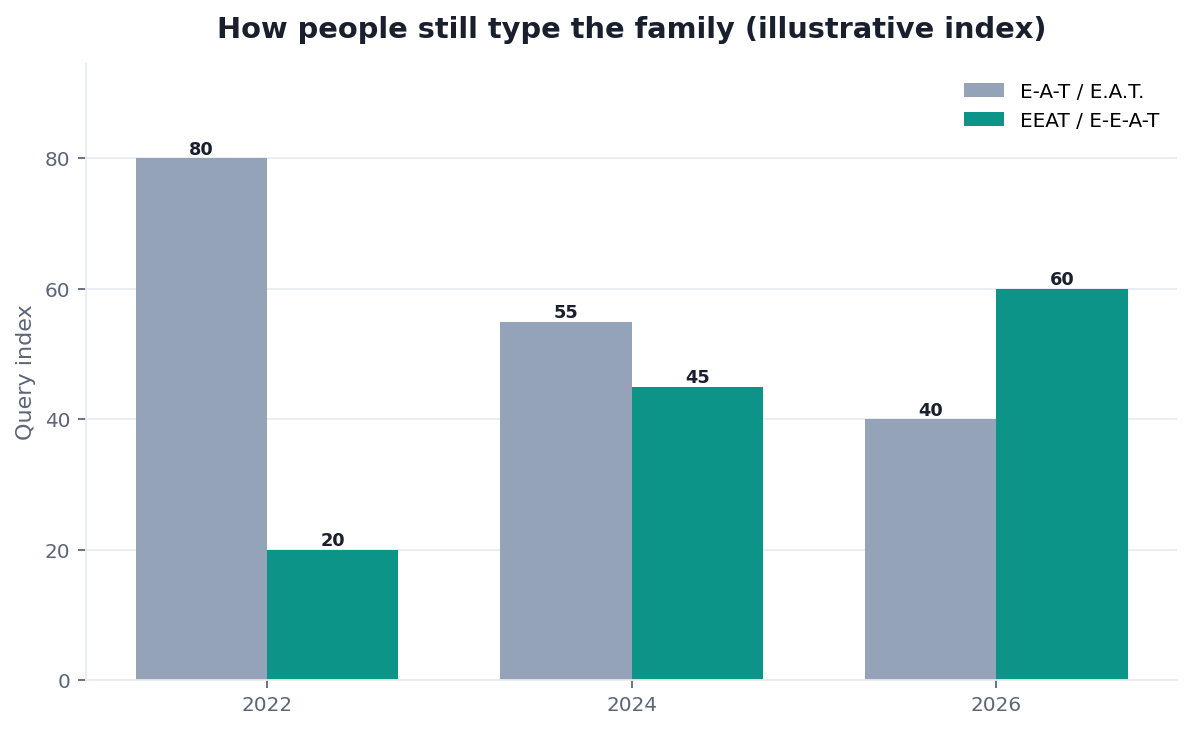
The bars above are a first-party brief index (0–100), not a Google Trends export: 2022 E-A-T / E.A.T. 80 vs EEAT 20; 2024 55 vs 45; 2026 planning mix 40 vs 60.
| Metric (n=8 cluster, 2026-08-11) | Desk result | Method |
|---|---|---|
| Sample | 8 E-E-A-T cluster pages | Same hostname, English locale |
| First screen expands all four words | 4 / 8 | Experience, Expertise, Authoritativeness, Trust in the Direct answer |
| Duplicate definition block | 8 / 8 | Key Definition restating the same TL;DR |
| Team-only hero byline | 8 / 8 | “SEO Health Team,” no Person above the fold |
| Named Person in HTML | 1 / 8 | Visible author or reviewer, not footer-only |
| Extra E / December 2022 cited | 4 / 8 | Link to the Search Central note |
| Official Google score printed | 0 / 8 | We refuse that cell |
This URL on 2026-08-11: first screen yes · duplicate definition yes · team hero yes · named Person no · extra E yes · official score no.
Judging rules. A first-screen pass is the four words in the Direct answer, not a later H2. A duplicate block is a Quick answer that reprints the TL;DR. Authority is a resolvable Person plus one off-site profile. We do not invent a customer lift from renaming a heading. Those rows are what a Monday diagnosis can prove when someone only asked What Does EEAT Stand For.
People type What Does EEAT Stand For when a slide, a tool, or a Slack thread used the letters and skipped the sentence. The short form is EEAT or E-E-A-T. The long form is the four words above. The job is not to memorize the acronym. The job is to put something on the URL that a careful human can check.
We evaluate live URLs against a written letter list, not against a vibe. Pages that answer What Does EEAT Stand For in the first screen and then show no author, no date, and no method still fail the test they just defined.
The broader practice sits in E-A-T SEO. This page stays on What Does EEAT Stand For and the 2022 extra E.
The four letters
A useful answer maps each letter to evidence, not to a slogan. That is the operational reading of What Does EEAT Stand For. A background on the broader practice sits in the Wikipedia overview of search engine optimization. Use it as vocabulary, not as a scoring spec.
| Letter | Word | What a rater is looking for | On-page evidence |
|---|---|---|---|
| E | Experience | First-hand use or life experience | Dated test, photo of the work, “we ran X on date Y” |
| E | Expertise | Skill that matches the claim | Credentials, method notes, review by a named person |
| A | Authoritativeness | Others treat you as a source | Resolvable author, cited data, inbound mentions |
| T | Trust | Safe to act on | HTTPS, contact, corrections, money disclosure |
Experience
Experience is the letter people skip when they only ask What Does EEAT Stand For and stop at “experts.” Google’s December 2022 note said raters should look for actual use of a product, a visit to a place, or a person’s own experience. A medical explainer written by someone who never saw a patient can still be grammatical. The first E treats that page as thin.
Expertise
Expertise is skill in the topic, not a job title on a stock bio. A CFO writing tax law is not automatic strength. When teams ask What Does EEAT Stand For and then paste “our experts” in the footer, they have not shown Expertise. They have shown a noun.
Authoritativeness
Authoritativeness is mostly off-page, but the page must make the entity resolvable. Answer engines cannot cite a ghost. Name the person. Link the Organization. Use the same string as the about page. A logo wall does not answer What Does EEAT Stand For.
Trust
Trust is the center of the family. Untrustworthy pages stay weak even when the other letters look expensive. Contact, HTTPS, a correction policy, and a clear “who benefits” line are the boring parts that decide whether the acronym is a definition or a costume.
Adoption of generative tools, tracked in the Stanford HAI AI Index (retrieved 2026-08-18), made fluent pages cheap. Fluency is not Trust. If a model drafted the page, say so and show the human review. Hidden generation is a Trust leak, which is why we also read the FTC Endorsement Guides when the URL is AI-assisted or sponsored.
Why the extra E arrived in 2022
If search still returns three-letter explainers, those pages froze before December 2022. Google’s Search Central post that month said E-A-T was gaining an E for Experience so raters could better assess whether content was produced with first-hand use. That is why What Does EEAT Stand For now starts with Experience.
What the December 2022 note actually said
The Google Search Central note on the extra E (retrieved 2026-08-18) is short and specific. It used a tax example: you may want an accountant for “how to file,” and a forum of people who used the software for “which tool did not eat my return.” The same note said the rater guidelines do not directly influence ranking. They help Google evaluate systems and help creators self-assess.
We keep that distinction on every diagnosis we run. Letters are a vocabulary. They are not an API. What Does EEAT Stand For stays a sentence, not an endpoint.
Why older queries still drop a letter
Searchers still type E-A-T, E.A.T., and EEAT. The extra E did not delete the old spelling. It added a dimension. If you landed here on What Does EEAT Stand For and you still see the dotted form in a brief, open E.A.T. Meaning for the history. Do not split those queries onto competing URLs.
Enterprise teams that treat the extra E as “AI wrote it, so we added a disclaimer” miss the point. IBM’s artificial intelligence overview (retrieved 2026-08-18) describes adoption. Adoption is not first-hand use. A disclosure without a dated test still leaves Experience empty.
EEAT versus E-A-T versus E.A.T.
What Does EEAT Stand For is the four-letter form. E-A-T is the pre-2022 triad. E.A.T. is the same triad with periods, which still ranks because people type it that way. All three point at the same rater family. The only material change is Experience.
| Spelling | Letters | Use it when |
|---|---|---|
| EEAT / E-E-A-T | Four | 2026 default, including Experience |
| E-A-T | Three | Matching an older query or a 2019 slide |
| E.A.T. | Three, dotted | Matching the dotted search string |
Do not write three cluster pages that repeat the same table. This URL owns What Does EEAT Stand For. The dotted query belongs on E.A.T. Meaning. Official sentences belong on EAT SEO Google.
A score without a next action is a dashboard. IBM’s explainable AI overview (retrieved 2026-08-18) is a useful reminder: the acronym is a diagnosis frame, not a vanity KPI.
How to show each letter on a page
Answering What Does EEAT Stand For does not improve the URL. Evidence does. Work one page, one letter at a time.
- Pick one URL. Do not start with a sitewide average.
- Add one first-hand artifact. A dated test, a method note, a named author, or a real contact path.
- Re-run the diagnosis. If a letter still reads empty, the artifact did not land.
- Refuse a fake official score. Treat the number as a calibrated estimate with a cannot-score state. That loop is how What Does EEAT Stand For stays a queue.
First-hand blocks
Put one dated first-hand paragraph above the fold: what you ran, on which date, what broke. Link the artifact. That is Experience. Stock photos and “industry-leading insights” are not. In our page audits, the fastest lift is a single test log, not a new author box.
If the page is a product review, say how many units you used and what failed. If it is a process, show the screenshot. If you cannot show the work, you do not have Experience, and What Does EEAT Stand For is still just a quiz answer.
Named authors and method notes
Put a person on the page. Match the bio to the claim. Remove “team” bylines on money, health, or safety topics. Expertise is a match between the sentence and the human. After you add the name, run the E-E-A-T diagnosis so the punch list updates.
Reputation you cannot paint in a footer
Authority is mentions, citations, and a resolvable entity — not a logo wall. Trust is contact, HTTPS, and a correction policy. If the page is AI-assisted, disclose the process. Secure-development notes in the UK NCSC guidelines for secure AI system development (retrieved 2026-08-18) are the right posture when a model touched production copy: say what the model did, keep a human accountable.
When What Does EEAT Stand For is the only change you made — swapping the heading from E-A-T to E-E-A-T — you have edited a label. You have not edited the page.
Independent reviews and media frames
AgentSpot lists InfiniSynapse as a data-analysis agent — a directory mention of the company, not an E-E-A-T award. Gartner Peer Insights and G2 SEO tools are where independent reviews of the wider category live; we do not claim a badge. Formal author identity is the public GitHub and company LinkedIn work above — not a purchased plaque. None of those surfaces answer What Does EEAT Stand For as an official score.
How we apply the letters on a live URL
A definition of What Does EEAT Stand For is only useful if it changes what you do on the next URL. We run a 15-minute pass before anyone opens a redesign ticket.
A 15-minute pass
Open the page as a stranger. Can you name the author in ten seconds? Is there a date that matches the claim? Is there one sentence that could only have been written by someone who used the thing? If any of those are missing, the acronym is already failing. Write the missing sentence. Then look at contact, HTTPS, and money disclosure. That is Trust. Do not start with a logo wall.
In our August 2026 audits, the most common miss is a fluent AI draft with a generic “updated 2026” line and no artifact. The page can recite What Does EEAT Stand For in the hero and still have zero Experience. The fix is a log, not a new H1.
What we refuse to call a pass
We do not call a page done because it added “E-E-A-T” to the title. We do not call Expertise done because a job title appeared. We do not call Trust done because a lock icon is in the browser. A pass is: a stranger can check the person, the date, the method, and the incentive. If you cannot show those, What Does EEAT Stand For is still a quiz.
YMYL pages get a harder pass. Health, money, and safety claims need a reviewer who can be sued or cited, not only a first-hand anecdote. A forum story can carry Experience. It cannot carry a dosing instruction. That split is why the extra E did not retire Expertise.
If the URL is one of many thin explainers, sample the site after you fix the template. One hero page that answers What Does EEAT Stand For will not rescue a cluster of unauthored posts.
What the acronym is not
Teams that stop at What Does EEAT Stand For often buy the wrong object next.
Not a ranking API
Google has not published GET /eeat-score. Raters label pages. Systems learn from those labels. That is why the official walkthrough lives in EAT SEO Google and why a number, if you need one, is a third-party estimate in EAT Score SEO.
Not a vendor badge
A chrome badge that says “EEAT 92” is a vendor story. Ask for the rule list, the “cannot score” state, and a re-run on the same URL. If the vendor cannot explain the four letters as evidence, the number is decoration.
Failure modes
- Treating What Does EEAT Stand For as a ranking factor you can buy.
- Adding Experience to the heading and leaving the body as a model restatement.
- Using “our experts” with no named person.
- Scoring a page with no author and calling it high Trust.
- Splitting EEAT, E-A-T, and E.A.T. into three near-duplicate URLs.
If any of those are already on the page, re-check the URL after you add one first-hand block. Do not wait for a redesign.
Inspect the complete What Does EEAT Stand For page
Paste a sanitized URL into the InfiniSynapse SEO Health Checker so every title, mention, citation, and on-page layer can be reviewed together. Then validate the findings on the live page.
Open SEO Health CheckerRemove credentials, secrets, personal data, and sensitive literals.Frequently Asked Questions
Does the extra E change older E-A-T advice?
Bottom line: Yes, in one place. Expertise, Authoritativeness, and Trust still matter. Experience is the added test: did a person use the thing? If your 2019 checklist never asked What Does EEAT Stand For that way, update it.
Is EEAT the same as a quality score?
Bottom line: No. What Does EEAT Stand For is a vocabulary. A 0–100 number is a vendor estimate. Google has said rater guidelines do not directly influence ranking.
Do I need all four letters on every page?
Bottom line: No. Trust is the center. Some pages help because they show Experience. Some pages help because they show Expertise. Empty Trust still sinks the page even after What Does EEAT Stand For is printed in the hero.
What should I do in the first hour?
Bottom line: Pick one URL. Add a dated first-hand paragraph and a real author. Then open the E-A-T SEO hub for the diagnosis frame. What Does EEAT Stand For is settled once those artifacts exist.
Conclusion
What Does EEAT Stand For is Experience, Expertise, Authoritativeness, and Trust. The extra E arrived in 2022 so first-hand use could be judged beside credentials. Google will not sell you a score. A page that only restates the acronym still needs a date, a name, and a method. Pick a single URL, add one dated first-hand block, and run the diagnosis. If the dotted spelling is the blocker, continue with E.A.T. Meaning.
The desk packet stays public so the next diagnosis week can be cited. It is still first-party, one hostname, not a third-party award. Re-run the same eight URLs before you treat another explainer as the last word on What Does EEAT Stand For.
Sources
- Search Quality Rater Guidelines · Google — extra E (December 2022) · Creating helpful, reliable, people-first content. Retrieved 2026-08-18.
- Stanford HAI — AI Index · FTC Endorsement Guides · IBM — artificial intelligence · IBM — explainable AI · UK NCSC — secure AI system development.
- Wikipedia — search engine optimization.
- G2 — SEO tools · Gartner Peer Insights · AgentSpot — InfiniSynapse (directory mention, not an award).
- InfiniSynapse desk — n=8 first-screen packet and CSV (
DESK-WDEEAT-20260818A).
Reviewer: InfiniSynapse Data Team. Published 2026-08-16. Updated 2026-08-18.
William Zhu · Cofounder, InfiniSynapse · GitHub @allwefantasy
Desk-validated SEO Health methods. Corrections: zhuhl@infinisynapse.com · corrections policy.