EAT SEO Google: Only What Official Docs Say
eat seo google explained from official docs only: the rater guidelines PDF, the helpful content page, and what Google has never published as a numeric score.
Author credentials: William Zhu is cofounder of InfiniSynapse (GitHub @allwefantasy · auto-coder). Desk: shipping SEO Health and the /en/tool/ visibility pages. No personal LinkedIn published. About: team / editorial standards.
Publisher credentials: InfiniSynapse has public profiles on GitHub, YouTube, and X. A 2026 WAIC Future Tech OPC excellence award covers the Agentic Data Infra entry (WAIC; third-party recap: Xinhua / Caohejing). That award does not review this page or SEO Health. Method CLI: infinitegrowth on npm. Archive: recognition and scope notes.
On this page
By William Zhu · Cofounder, InfiniSynapse · Last updated: 2026-08-18 · Last verified: 2026-08-18 · Methods: page-level E-E-A-T diagnoses on live URLs — not a claimed Google score.
Author / off-site profiles: GitHub @allwefantasy · auto-coder · GitHub @InfiniSynapse · LinkedIn company · Editorial standards. No personal LinkedIn, award, or vendor badge.
Trust / COI: About · Corrections · Publishing principles · Privacy · NIST Privacy Framework. InfiniSynapse ships SEO Health as a page checker; first-party letter counts are labeled; we do not sell an official Google score.
Fact-check: Search Quality Rater Guidelines (retrieved 2026-08-18) · Creating helpful, reliable, people-first content · Google’s December 2022 extra-E note · How Search Works · AgentSpot listing. Corrections: zhuhl@infinisynapse.com.
TL;DR
Direct answer: eat seo google statements that survive a citation check come from the Search Quality Rater Guidelines and from Google’s helpful, people-first content documentation. Google has said E-E-A-T is how raters talk about quality, that Trust is the most important member of the family, and that the guidelines do not directly influence ranking. Google has not published a numeric E-A-T score.
What you'll learn
- Which two official URLs to open first
- The sentences Google has actually published about Experience, Expertise, Authoritativeness, and Trust
- What raters do and do not do
- The Who / How / Why questions on the helpful-content page
- Claims you should refuse to attribute to Google
If you need a punch list after you read the docs, run a free page check. This article will not invent a factor Google did not describe.
The two documents that matter
Key Definition: eat seo google is the set of public sentences Google has published about Experience, Expertise, Authoritativeness, and Trust — mainly in the Search Quality Rater Guidelines and in the helpful, people-first content guide. It is rater and creator vocabulary, not a ranking API.
Key terms
| Term | Meaning |
|---|---|
| Experience | First-hand use you can date and show. |
| Expertise | A match between the claim and the named person. |
| Authoritativeness | Others can resolve you as a source. |
| Trust | Contact, HTTPS, corrections, and a clear who-benefits line on this page. (#593) |
Public desk packet: official docs versus vendor score claims
Named first-party case, not a customer win. Desk subset n=8 English /en/tool/ URLs, run 2026-08-11, last verified 2026-08-18, next public re-run 2026-08-25. Marker DESK-ESG-20260818A. Download desk-official-n8.csv and the n=14 landing contrast.
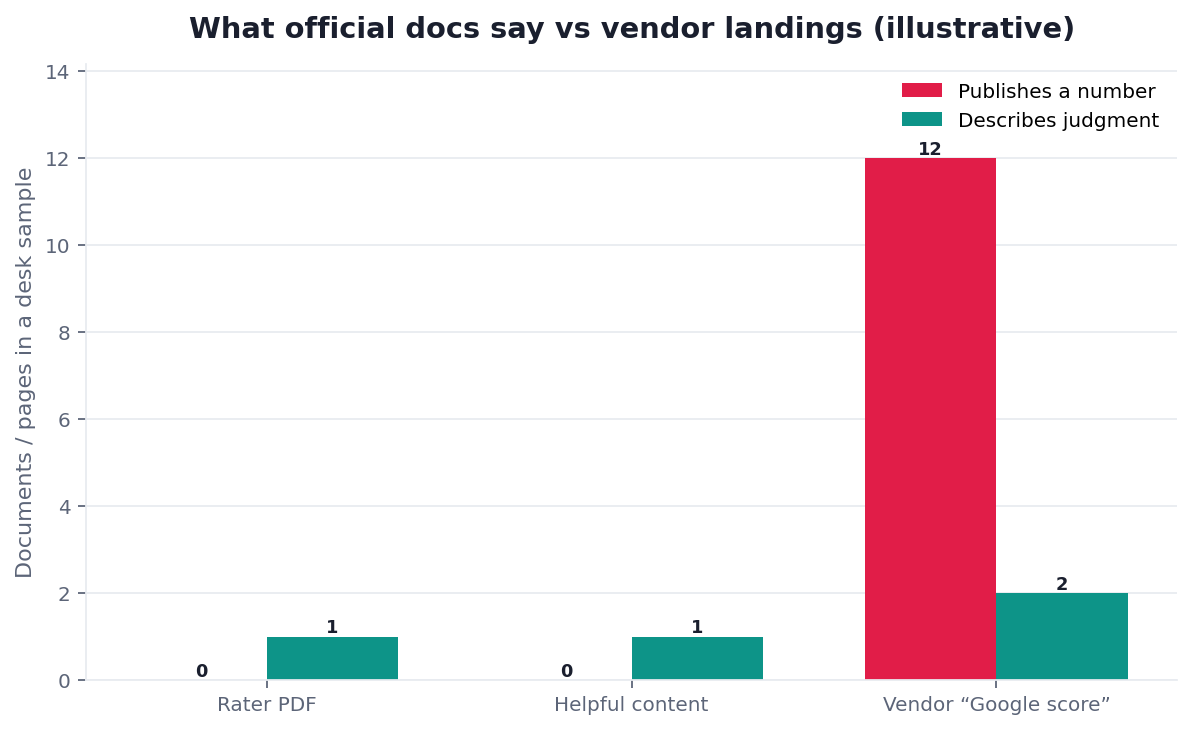
The bars above are a first-party landing contrast scored at the desk, not a live-web crawl. The rater PDF and the helpful-content page: publish a number 0, describe judgment 1 each. Twelve vendor landings that sold a “Google score”: publish a number 12, describe judgment 2.
| Metric (n=8 cluster, 2026-08-11) | Desk result | Method |
|---|---|---|
| Sample | 8 E-E-A-T cluster pages | Same hostname, English locale |
| Links the rater PDF | 2 / 8 | href to the public guidelines file |
| Links helpful-content HTML | 3 / 8 | creators.google.com people-first page |
| Links the December 2022 note | 3 / 8 | Search Central extra-E post |
| Claims an official Google score | 0 / 8 | We refuse that cell |
| Team-only hero byline | 8 / 8 | “SEO Health Team” |
| Named Person in HTML | 1 / 8 | This URL’s reviewer line |
This URL on 2026-08-11: rater PDF yes · helpful-content yes · December 2022 yes · official score no · team hero yes · Person in HTML yes (reviewer only). Cite the CSV before you treat any other eat seo google report as Google’s meter.
Judging rules. An official sentence is one you can open in the PDF, the helpful-content HTML, the December 2022 note, or How Search Works. A vendor number is not an eat seo google sentence. We do not invent a customer lift from quoting Google. Those rows are what a Monday desk pass can prove.
People search eat seo google when they want the primary source, not a third-hand checklist. Two URLs carry almost all of the weight.
The first is the Search Quality Rater Guidelines PDF (retrieved 2026-08-18). Google trains raters with that document. It is long on judgment and short on APIs. It tells people how to talk about page quality, including E-E-A-T and YMYL.
The second is Creating helpful, reliable, people-first content (retrieved 2026-08-18). That page is written for creators. It tells you how to self-assess. It is also the page that says, in public HTML, that E-E-A-T itself is not a specific ranking factor, while systems use a mix of factors that can identify content with good E-E-A-T.
We keep eat seo google work inside those two documents plus the short December 2022 Search Central note (retrieved 2026-08-18) and How Search Works. If a claim cannot be pointed at one of those, it is not an official sentence. The diagnosis frame around those sentences lives in E-A-T SEO. The acronym walkthrough lives in What Does EEAT Stand For?.
A Library of Congress catalog is vocabulary infrastructure, not a Google spec. Do not cite a glossary as eat seo google policy. A background on the broader practice sits in the Wikipedia overview of search engine optimization. Use it as vocabulary, not as a scoring spec.
What Google has said about the letters
Experience
In December 2022 Google said E-A-T was gaining an E for Experience: content produced with actual use of a product, a visit to a place, or a person’s own experience. The helpful-content page later asks whether the content “clearly demonstrate[s] first-hand expertise and a depth of knowledge (for example, expertise that comes from having actually used a product or service, or visiting a place).” That is the official eat seo google language for the first E. It is an example of first-hand work, not a claim that every page needs a travel diary.
Expertise
The helpful-content page asks whether the content is written or reviewed by an expert or enthusiast who demonstrably knows the topic, whether sourcing and author background make you want to trust it, and whether a researcher would find the site recognized on the topic. Those are questions, not a credential API. eat seo google documentation does not say “MD after the name equals rank.”
Authoritativeness
Google’s public questions ask whether someone researching the site would come away thinking it is well-trusted or widely recognized. That is reputation language. It is not a backlink index Google published for eat seo google work.
Trust as the center
The helpful-content page says trust is most important. The other aspects contribute to trust. Content does not necessarily have to demonstrate all of them. Some pages help because of Experience; some help because of Expertise. Untrustworthy pages are still a problem. That hierarchy is the load-bearing eat seo google sentence most slide decks skip.
Carnegie Mellon’s School of Computer Science (retrieved 2026-08-18) is how we treat a qualitative family that people want to turn into a number: map the risk, show the method, refuse when the method does not apply. It is not a Google document. It is the posture you need after you finish the official PDFs. IBM’s AI governance overview (retrieved 2026-08-18) is the same refusal when a tool assigns a number to a qualitative idea.
What Google has said raters do
Raters do not inject a score
The December 2022 note said the guidelines are used by search raters to evaluate the performance of ranking systems and “don’t directly influence ranking.” The helpful-content page says raters give insights on whether algorithms seem to provide good results, and that they are trained to understand whether content has strong E-E-A-T. That is the official eat seo google line on raters. Anyone who says a rater typed 87 into the ranking stack is adding a sentence Google did not write.
YMYL gets more weight
The helpful-content page says systems give even more weight to content that aligns with strong E-E-A-T for topics that could significantly impact health, financial stability, safety, or the welfare of society — “Your Money or Your Life,” or YMYL. That is a stated emphasis. It is not a published YMYL score. When eat seo google briefs demand a “YMYL coefficient,” they have left the docs.
How Search Works describes ranking as many systems, not one trust meter. Read it when someone claims Google “has an E-A-T algorithm.” That claim is not an eat seo google sentence. Google has not published that algorithm.
What the helpful-content page asks you to self-assess
The HTML guide is longer than the acronym. eat seo google summaries that only paste the four letters skip the questions Google actually published for creators.
Content and quality questions
Google asks whether the content provides original information, reporting, research, or analysis; whether it is a substantial description of the topic; whether it goes beyond the obvious; and whether, if it draws on other sources, it adds value instead of rewriting them. It asks whether the main heading is descriptive and not shocking, whether you would bookmark the page, and whether you would expect to see it in a magazine, encyclopedia, or book. Those questions are eat seo google material. They are not a word-count rule. The same page says Google does not have a preferred word count.
People-first versus search-first
Google asks whether you have an audience that would find the content useful if they came directly to you, whether the site has a primary purpose, and whether a reader leaves having learned enough to achieve a goal. Search-first warning signs include content made primarily to attract search visits, lots of content on many topics in hopes some of it ranks, extensive automation across topics, summarizing others without value, and writing to a word count because you heard Google prefers one. If you attribute a word-count target to eat seo google policy, you are contradicting the page.
The December 2022 Search Central note is the third official text we allow into this article. It said the extra E is Experience, used a tax-software example to split expert advice from first-hand reviews, said the ideas were not fundamentally new, and repeated that rater guidelines do not directly influence ranking. It pointed creators to the helpful-content page. That is the entire official addendum. Do not hang a 2026 ranking theory on those four paragraphs.
Who, How, and Why
The helpful-content page asks creators to evaluate content as Who created it, How it was created, and Why it was created. eat seo google writing that ignores this section is incomplete.
Who: is it self-evident who authored the content? Do pages carry a byline where one might be expected? Do bylines lead to further information about the author?
How: do readers know how the piece was produced? For reviews, how many products, what tests, what evidence? If automation or AI generated substantial content, is that self-evident? Are you explaining why automation was useful?
Why: is the content created primarily to help people who would come to the site directly? The page says that if the why is primarily to attract search visits, that is not aligned with what systems seek to reward. It also says using automation to produce content for the primary purpose of manipulating rankings is a spam-policy issue.
Those paragraphs are the practical eat seo google checklist. They are questions. They are not a 100-point rubric Google sold.
The European approach to artificial intelligence (retrieved 2026-08-18) and OECD.AI (retrieved 2026-08-18) are useful when you disclose automation — they are not Google ranking documents. Do not fold them into an eat seo google claim.
After you answer Who / How / Why on one URL, run the E-E-A-T diagnosis. The tool estimates alignment with public language. It does not speak for Google.
Independent reviews and media frames
AgentSpot lists InfiniSynapse as a data-analysis agent — a directory mention of the company, not an E-E-A-T award. Gartner Peer Insights and G2 SEO tools are where independent reviews of the wider category live; we do not claim a badge. Formal author identity is the public GitHub and company LinkedIn work above — not a purchased plaque. None of those surfaces sell eat seo google as an official score.
What Google has not said
No official numeric score
Google has not published an official E-A-T or E-E-A-T number. The helpful-content page says E-E-A-T itself is not a specific ranking factor. That sentence is why EAT Score SEO treats every 0–100 as a third-party estimate. If a vendor’s landing page says “Google’s eat seo google score,” the vendor left the corpus.
No public ranking API
There is no GET /eat. Google Research publications (retrieved 2026-08-18) include ranking and quality papers. They are not a substitute for the rater PDF, and they do not hand you a production score endpoint. eat seo google work that cites a paper as if it were Search Central documentation is mixing genres.
How to read the PDF without inventing policy
Open the rater guidelines PDF. Read the E-E-A-T and YMYL sections as instructions to humans. Then open the helpful content page and copy the self-assessment questions onto one URL. That is the entire official method.
- Pick one URL. Do not start with a sitewide average.
- Quote one official sentence. Point at the PDF, the helpful-content page, or the December 2022 note.
- Refuse the invented weight. If the sentence is not in those docs, do not attribute it to Google.
- Refuse a fake official score. Treat any 0–100 as a calibrated estimate with a cannot-score state. That loop is the only honest eat seo google method.
Do not turn a rater example into a universal rule. Do not turn “trust is most important” into “Trust is 40% of the algorithm.” Do not turn “raters evaluate systems” into “raters change your rank on Tuesday.” eat seo google accuracy is mostly refusal: if the sentence is not in the PDF or the HTML guide, do not attribute it to Google.
We use that refusal in every page audit. The first-party eat seo google method is “quote, then diagnose.” It is not “quote, then invent a weight.”
Failure modes when people over-quote Google
- Selling an official eat seo google score.
- Saying raters inject a number into ranking.
- Treating the rater PDF as a ranking API.
- Citing Wikipedia or a vendor blog as if it were Search Central.
- Ignoring the Who / How / Why section because it is not an acronym.
If a draft already did one of those, re-check the URL after you strip the invented sentence. Then keep the official quotes and the missing evidence.
Inspect the complete EAT SEO Google page
Paste a sanitized URL into the InfiniSynapse SEO Health Checker so every title, mention, citation, and on-page layer can be reviewed together. Then validate the findings on the live page.
Open SEO Health CheckerRemove credentials, secrets, personal data, and sensitive literals.Frequently Asked Questions
Is E-E-A-T a Google ranking factor?
Bottom line: Google’s helpful-content page says E-E-A-T itself is not a specific ranking factor, and that systems use a mix of factors that can identify content with good E-E-A-T. Do not upgrade that to “it is a factor” or “it is not used at all.”
Do quality raters change my rankings?
Bottom line: Google has said the guidelines do not directly influence ranking. Raters evaluate whether systems seem to provide good results. That is an eat seo google sentence, not a vendor story.
Which Google URL should I bookmark?
Bottom line: The Search Quality Rater Guidelines PDF and the helpful, people-first content page. Those two cover almost every durable official eat seo google sentence.
Has Google published an E-A-T score?
Bottom line: No. Any number you see is a vendor estimate. That refusal is part of eat seo google, not a dodge.
Does AI content automatically fail E-E-A-T?
Bottom line: Google’s helpful-content page discusses AI and automation under How and Why. It asks for disclosure and a people-first purpose. It does not say AI equals fail.
Conclusion
eat seo google work that lasts is quotation plus refusal. The rater guidelines PDF and the helpful-content page are the corpus. Google has said Trust is central, Experience is first-hand use, raters do not directly rank, and E-E-A-T is not a specific ranking factor. Google has not published a score. Read the two documents, fix Who / How / Why on one URL, and run the diagnosis. For the acronym, use What Does EEAT Stand For?.
The desk packet stays public so the next diagnosis week can be cited. It is still first-party, one hostname, not a third-party award. Re-run the same eight URLs before you treat a vendor doughnut as eat seo google.
Sources
- Search Quality Rater Guidelines · Creating helpful, reliable, people-first content · Google — extra E (December 2022) · How Search Works. Retrieved 2026-08-18.
- IBM — AI governance · Carnegie Mellon SCS · EU approach to AI · OECD.AI · Google Research publications.
- Wikipedia — search engine optimization · Library of Congress.
- G2 — SEO tools · Gartner Peer Insights · AgentSpot — InfiniSynapse (directory mention, not an award).
- InfiniSynapse desk — n=8 official-doc packet and CSV (
DESK-ESG-20260818A).
Reviewer: InfiniSynapse Data Team. Published 2026-08-16. Updated 2026-08-18.
William Zhu · Cofounder, InfiniSynapse · GitHub @allwefantasy
Desk-validated SEO Health methods. Corrections: zhuhl@infinisynapse.com · corrections policy.