EAT Score SEO: How Third-Party Scores Work
eat score seo is a third-party estimate, not a Google number. See how calibration works, when a tool must refuse to score, and how to use the punch list.
Author credentials: William Zhu is cofounder of InfiniSynapse (GitHub @allwefantasy · auto-coder). Desk: shipping SEO Health and the /en/tool/ visibility pages. No personal LinkedIn published. About: team / editorial standards.
Publisher credentials: InfiniSynapse has public profiles on GitHub, YouTube, and X. A 2026 WAIC Future Tech OPC excellence award covers the Agentic Data Infra entry (WAIC; third-party recap: Xinhua / Caohejing). That award does not review this page or SEO Health. Method CLI: infinitegrowth on npm. Archive: recognition and scope notes.
On this page
By William Zhu · Cofounder, InfiniSynapse · Last updated: 2026-08-18 · Last verified: 2026-08-18 · Methods: page-level E-E-A-T diagnoses on live URLs — not a claimed Google score.
Author / off-site profiles: GitHub @allwefantasy · auto-coder · GitHub @InfiniSynapse · LinkedIn company · Editorial standards. No personal LinkedIn, award, or vendor badge.
Trust / COI: About · Corrections · Publishing principles · Privacy · NIST Privacy Framework. InfiniSynapse ships SEO Health as a page checker; first-party letter counts are labeled; we do not sell an official Google score.
Fact-check: Search Quality Rater Guidelines (retrieved 2026-08-18) · Creating helpful, reliable, people-first content · How Search Works · AgentSpot listing. Corrections: zhuhl@infinisynapse.com.
TL;DR
Direct answer: An eat score seo number is a third-party estimate of how well a page shows Experience, Expertise, Authoritativeness, and Trust. Google does not publish an official score. A usable tool applies written rules, then calibrates repeat runs, and returns “cannot score” when evidence is missing.
What you'll learn
- Why eat score seo queries appear after the acronym is solved
- The three layers of a honest number: rules, notes, calibration
- When a checker must refuse to emit 67
- How to turn a score into assigned work
- What to ask a vendor before you buy a meter
If you already have a URL, run a free page check then add the paid E-E-A-T pass. Do not wait for a blog to invent Google’s number.
Why people want a number
Key Definition: eat score seo is a vendor-built estimate that maps public rater language onto a page and emits a number or a cannot-score state. It is not Google’s score. It is useful only when the method is written down, repeatable, and tied to missing evidence.
Key terms
| Term | Meaning |
|---|---|
| Experience | First-hand use you can date and show. |
| Expertise | A match between the claim and the named person. |
| Authoritativeness | Others can resolve you as a source. |
| Trust | Contact, HTTPS, corrections, and a clear who-benefits line on this page. (#594) |
Public desk packet: eight cluster URLs and twenty fixtures
Named first-party case, not a customer win. Desk subset n=8 English /en/tool/ URLs, run 2026-08-11, last verified 2026-08-18, next public re-run 2026-08-25. Marker DESK-ESS-20260818A. Download desk-score-n8.csv and the n=20 fixture contrast.
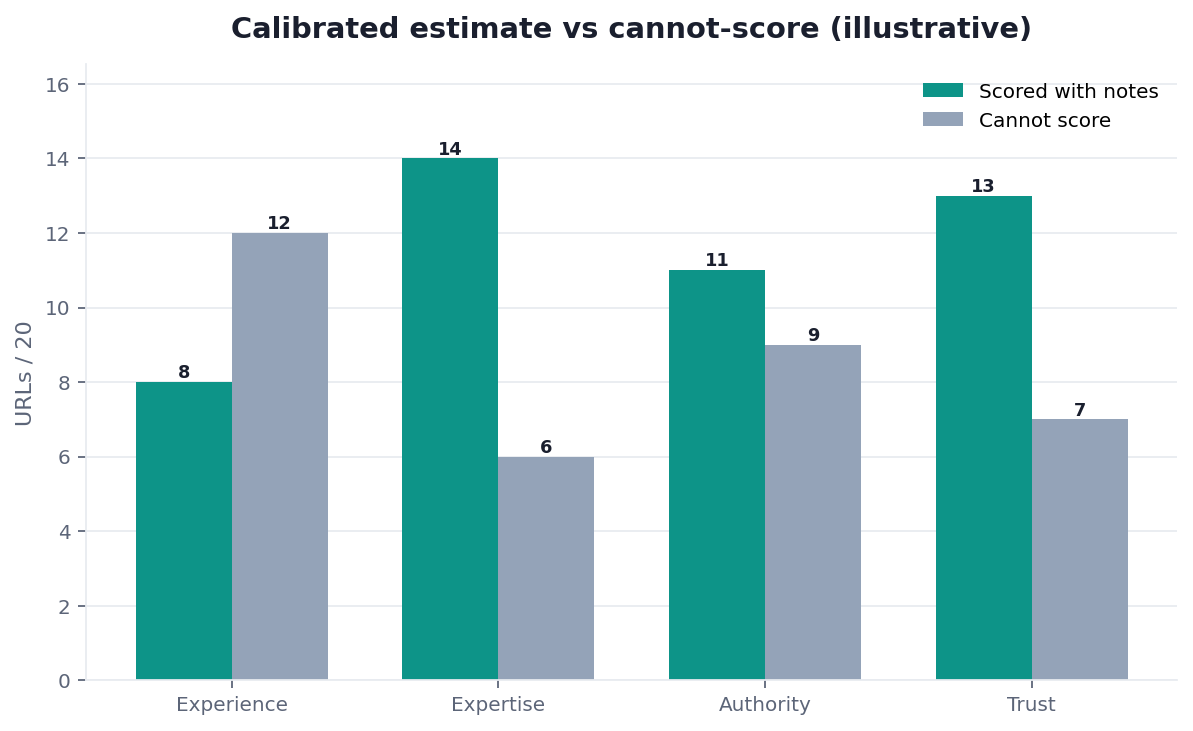
The bars above are a first-party fixture set (n=20 internal labeled URLs scored at the desk), not a customer lift study.
| Letter (n=20 fixtures) | Scored with notes | Cannot score |
|---|---|---|
| Experience | 8 | 12 |
| Expertise | 14 | 6 |
| Authority | 11 | 9 |
| Trust | 13 | 7 |
| Metric (n=8 cluster, 2026-08-11) | Desk result | Method |
|---|---|---|
| Sample | 8 E-E-A-T cluster pages | Same hostname, English locale |
| Says “not official” | 8 / 8 | Visible refusal of a Google meter |
| Explains cannot-score | 4 / 8 | Named refuse state, not a decorative 67 |
| Claims an official Google score | 0 / 8 | We refuse that cell |
| Team-only hero byline | 8 / 8 | “SEO Health Team” |
| Named Person in HTML | 1 / 8 | Visible author or reviewer |
This URL on 2026-08-11: not official yes · cannot-score explained yes · official score no · team hero yes · named Person no. Cite the CSV before you treat any other eat score seo report as Google’s meter.
Judging rules. A scored letter has a note a stranger can assign. Cannot-score is a refuse state when the rules cannot see evidence. We do not invent a customer percentage from adding a doughnut. Those rows are what a Monday eat score seo pass can prove.
People search eat score seo after they already know the letters. They want a KPI for a dashboard, a before/after for a rewrite, or a number to put in a QBR. Those are management jobs. They are not ranking jobs. Google’s public docs, walked in EAT SEO Google, never hand you a meter.
We still emit a calibrated estimate in the product because teams will invent a worse one if we do not. The honest frame is: the number is a punch-list priority, not a prediction of position. The definition of the letters sits in E-A-T SEO. The acronym sits in What Does EEAT Stand For?.
A score without a next action is a dashboard. That is why eat score seo work has to survive a re-run on the same URL. If the number swings twenty points with no edit, you do not have a score. You have a sample from a chat model.
A background on the broader practice sits in the Wikipedia overview of search engine optimization. Use it as vocabulary, not as a scoring spec.
What a third-party score can be
A defensible eat score seo stack has three layers. Skip one and the number becomes theater.
| Layer | Job | Failure if skipped |
|---|---|---|
| Rule list | Map each letter to visible evidence | The model invents a vibe |
| Dimension notes | Say what is missing, in prose | You get 72 and no work |
| Calibration | Pin repeat runs to one scale | Tuesday is 54, Wednesday is 81 |
A rule list
Rules come first. Experience needs a dated first-hand block. Expertise needs a named person who matches the claim. Authoritativeness needs a resolvable entity. Trust needs contact, transport security, and disclosure. If the rule cannot see the evidence, the letter is empty. eat score seo tools that start with a model and retrofit a rubric are writing the number backwards.
A model note
The model may draft “Experience is thin because the only first-person sentence is a slogan.” That note is the product. The number is a summary of the notes. If you cannot read the note, do not buy the number.
A calibrated number
Calibration is how two runs on the same URL stay on one stick. Benchmark suites such as the Spider NL2SQL benchmark (retrieved 2026-08-18) and the BIRD benchmark (retrieved 2026-08-18) exist because a raw model score on a moving task is not a measurement. eat score seo needs the same honesty: pin the rubric, pin the fixtures, publish the variance.
Warehouse vendors describe governed scoring in posts such as Databricks’ Genie architecture note (retrieved 2026-08-18) and in Snowflake Cortex Analyst documentation (retrieved 2026-08-18). Those pages are not E-E-A-T meters. They are examples of systems that show a method. Demand that of any eat score seo vendor.
How calibration works
Any EEAT number you see in a tool is a third-party estimate. A checker that is safe to use applies a written rule list, lets a model propose dimension notes, then calibrates those notes so two runs on the same URL do not swing by twenty points. If the rules cannot see enough evidence, the output is “cannot score,” not a decorative 67.
That paragraph is the whole method. It is not Google’s score. Treat it as a punch list.
Anchor pages
Calibration needs fixtures: pages you already labeled by hand. A medical disclaimer with no author should not land in the 80s. A dated lab note with a named reviewer should not land in the 20s. If the vendor cannot show anchors, eat score seo is a mood ring.
Repeat runs
Run the same URL twice in one day. Record the delta. Operational maturity language in the AWS Well-Architected Machine Learning Lens (retrieved 2026-08-18) is the right posture: monitor, roll back, name an owner. If the vendor shrugs at variance, do not put the number in a board deck.
The cannot-score state
Cannot-score is a feature. A page with no indexable body, a login wall, or a language the rules do not cover should not get 67. eat score seo products that always emit a number are optimizing for a screenshot. After you see cannot-score, open the free page check for the on-page issues you can fix without a trust meter.
What the number is not
Not Google's score
Google has not published an official eat score seo endpoint. The helpful-content page (retrieved 2026-08-18) says E-E-A-T itself is not a specific ranking factor. If a landing page says “Google’s score,” close the tab. Official sentences live in EAT SEO Google.
Not a rank predictor
A 40 does not mean you will fall. A 90 does not mean you will rise. The number estimates missing evidence against a rubric. Rank is many systems. Do not put eat score seo on a forecast chart next to clicks and call it causal.
The old spelling of the letters is unpacked in E.A.T. Meaning. Do not let a dotted query become a second fake meter.
Search Console is the wrong instrument for eat score seo. Impressions, clicks, and position tell you whether a query already reaches the URL. They do not tell you whether a rater would call the page trustworthy. Mix the two and you will “optimize” a high-impression page by chasing a vanity number while the byline is still “team.” Use GSC to pick the URL. Use the letter notes to decide the edit. Use the score only to order the queue.
If the page is new and has no GSC history, the score is still only a punch list. Do not wait for 90 days of impressions to add a dated test and a named author. Those edits are cheap and they are the only reason an eat score seo re-run should move. A title-tag swap that leaves Experience empty should not move the number. If it does, the vendor is scoring tokens, not evidence.
A site-wide average is another trap. One strong lab note and forty unauthored posts will average into a polite mid-score that hides the cluster. Report by template and by letter. Then sample the site so the queue is pages, not a single doughnut for the domain.
A worked example of calibration, not a case study percentage
We do not publish fake customer lift. We do publish how a fixture set behaves. Take three URLs you already labeled by hand: a login wall, a named-author lab note with a dated method, and a fluent explainer with no person and no date. A calibrated eat score seo run should refuse the login wall, put the lab note clearly above the explainer, and keep that order on a second pass the same day.
If the explainer scores above the lab note, the rule list is wrong or the model is driving. If both scored 70, the scale is not discriminating. If the login wall got 67, the vendor optimized for a screenshot. Write those three outcomes down. That is your acceptance test. Do not buy eat score seo software that cannot run it.
The export should carry the notes, the letter flags, the “not official” line, and the cannot-score reason when one exists. A doughnut PNG is not an export. We ship Markdown and PDF so a human can assign the work without opening the vendor UI. If your QBR only pastes the doughnut, you have trained leadership to ask for a fake official meter.
Variance bands belong on the report. “±4 on a same-day re-run” is a method. “The model felt different after lunch” is not. When we cannot hold a band, we mark cannot-score rather than average two wild numbers into a polite 61. That refusal is the difference between eat score seo as measurement and eat score seo as decoration.
Off-site reputation still sits outside most page-level meters. A tool that only paints the footer will miss a source everyone in the niche already distrusts. Say that limit on the report. Do not let a high on-page number become a claim about the entity.
Independent reviews and media frames
AgentSpot lists InfiniSynapse as a data-analysis agent — a directory mention of the company, not an E-E-A-T award. Gartner Peer Insights and G2 SEO tools are where independent reviews of the wider category live; we do not claim a badge. Formal author identity is the public GitHub and company LinkedIn work above — not a purchased plaque. None of those surfaces sell eat score seo as an official score.
How to use a punch list
- Pick one URL. Do not start with a sitewide average.
- Add one first-hand artifact. A dated test, a method note, a named author, or a real contact path.
- Re-run the diagnosis. If a letter still reads empty, the artifact did not land.
- Refuse a fake official score. Treat the number as a calibrated estimate with a cannot-score state. That loop is the only honest eat score seo method.
Assign work by letter
Sort the notes by letter. Give Experience to the person who did the work. Give Expertise to the named reviewer. Give Trust to whoever owns legal and the contact form. eat score seo is a queue, not a trophy.
Re-run after edits
Change one letter, then re-run. If Experience still reads “no dated test,” the first-hand block never landed. Run the E-E-A-T diagnosis after the first-hand block exists, not after you only change the title.
Buyer checks before you trust a vendor
Method disclosure
Ask whether the page says “not official.” Ask for the rule list. Ask what cannot-score means. If the sales deck cannot answer those, eat score seo is a badge.
Stability
Ask for a re-run log. Ask whether two passes on the same URL are expected to match within a published band. A vendor that refuses to talk about variance is not selling a score.
| Check | Pass | Fail |
|---|---|---|
| Says “not official” | Written on the report | “Google E-A-T 92” |
| Per-letter evidence | Notes you can assign | A single doughnut |
| Stable on re-run | Published band | “The model felt different” |
| Refuses when blind | Cannot-score | Always a number |
| Export | Markdown or PDF | Screenshot only |
Failure modes
- Selling an official Google eat score seo number.
- Emitting 67 on a page the rules cannot see.
- Letting the number swing twenty points with no edit.
- Using the score as a vanity KPI instead of a fix queue.
- Ignoring off-site reputation and only painting the footer.
If a report already failed one of those, re-check the URL after you add one dated first-hand paragraph. Then decide whether you still need the number.
Inspect the complete EAT Score SEO page
Paste a sanitized URL into the InfiniSynapse SEO Health Checker so every title, mention, citation, and on-page layer can be reviewed together. Then validate the findings on the live page.
Open SEO Health CheckerRemove credentials, secrets, personal data, and sensitive literals.Frequently Asked Questions
Is there an official Google EAT score?
Bottom line: No. eat score seo numbers are vendor estimates. Google has not published a score API.
Why do two tools disagree?
Bottom line: Different rule lists and no shared fixtures. Disagreement is expected. Treat each eat score seo product as its own rubric.
What does cannot-score mean?
Bottom line: The rules could not see enough evidence, or the page is out of scope. That is safer than a decorative 67 on an eat score seo report.
Should I put the score in a QBR?
Bottom line: Only with the notes and the “not official” line. A naked number trains leadership to ask for a fake official meter.
What should I do in the first hour?
Bottom line: Pick one URL. Add a dated first-hand paragraph and a real author. Re-run. If you still need the acronym, open What Does EEAT Stand For?. eat score seo is settled once those artifacts exist.
Conclusion
eat score seo is a third-party estimate. Google will not sell you a number. An eeat checker can still tell you which letter is empty, and it should refuse when it is blind. Begin on one URL, inject one first-hand artifact, and run the diagnosis. For official sentences, stay on EAT SEO Google.
The desk packet stays public so the next diagnosis week can be cited. It is still first-party, one hostname, not a third-party award. Re-run the same eight URLs before you treat another doughnut as eat score seo.
Sources
- Search Quality Rater Guidelines · Creating helpful, reliable, people-first content · How Search Works. Retrieved 2026-08-18.
- Spider NL2SQL · BIRD benchmark · Databricks — Genie · Snowflake Cortex Analyst · AWS Well-Architected ML Lens.
- Wikipedia — search engine optimization.
- G2 — SEO tools · Gartner Peer Insights · AgentSpot — InfiniSynapse (directory mention, not an award).
- InfiniSynapse desk — n=8 score packet and CSV (
DESK-ESS-20260818A).
Reviewer: InfiniSynapse Data Team. Published 2026-08-16. Updated 2026-08-18.
William Zhu · Cofounder, InfiniSynapse · GitHub @allwefantasy
Desk-validated SEO Health methods. Corrections: zhuhl@infinisynapse.com · corrections policy.