EEAT Checker: Letter Notes, Not a Google Score
An eeat checker returns per-letter notes and refuses a number when the page has no evidence. It is not an official Google score.
Author credentials: William Zhu is cofounder of InfiniSynapse (GitHub @allwefantasy · auto-coder). Desk: shipping SEO Health and the /en/tool/ visibility pages. No personal LinkedIn published. About: team / editorial standards.
Publisher credentials: InfiniSynapse has public profiles on GitHub, YouTube, and X. A 2026 WAIC Future Tech OPC excellence award covers the Agentic Data Infra entry (WAIC; third-party recap: Xinhua / Caohejing). That award does not review this page or SEO Health. Method CLI: infinitegrowth on npm. Archive: recognition and scope notes.
On this page
By William Zhu · Cofounder, InfiniSynapse · Last updated: 2026-09-27 · Last verified: 2026-08-19 · Methods: SEO Health page audits, sitemap samples, GSC export math — not a claimed Google score.
Author / off-site profiles: GitHub @allwefantasy · auto-coder · GitHub @InfiniSynapse · LinkedIn company · Editorial standards. Formal public work: InfiniSQL, auto-coder, retrieval systems. Desk: shipping SEO Health and the
/en/tool/visibility pages. No personal LinkedIn, award, or vendor badge.
Trust / COI: About · Corrections · Publishing principles · Privacy · NIST Privacy Framework. This site does not publish a standalone
/en/termsURL; the editorial-standards page is the policy home. InfiniSynapse ships SEO Health as a credit-based desk; first-party counts are labeled; product CTAs are commercial.
Fact-check: Search Quality Rater Guidelines · Creating helpful, reliable, people-first content · Stanford HAI AI Index 2025 · Gartner Peer Insights · G2 SEO tools · AgentSpot listing. Corrections: zhuhl@infinisynapse.com.
Dates (match schema): First published 2026-08-16. Last modified 2026-09-27. Desk run 2026-08-11. Last verified 2026-08-19.
TL;DR
Direct answer: An eeat checker returns per-letter notes and refuses a number when the page has no evidence. It is not an official Google score and it is not a ranking API. On a public desk of 20 English
/en/tool/pages (run 2026-08-11), Experience was cannot-score on 11 of 20. Read that empty letter before any 0–100 badge.
What you'll learn
- A 45-word definition of an eeat checker you can quote in a ticket
- What the report must return besides a doughnut
- Why cannot-score is a feature
- A one-URL pass: paste, assign, re-run
- What we refuse to call a pass on the 2026-08-11 desk
If the URL is already open, run the E-E-A-T diagnosis before you buy a vendor “92.” The notes only help once they point at missing evidence.
The 2026 definition
Key Definition: An eeat checker returns four letter notes and either a calibrated estimate or cannot-score. The product is the missing artifact, not a doughnut. It is not an official Google score and it is not a ranking API.
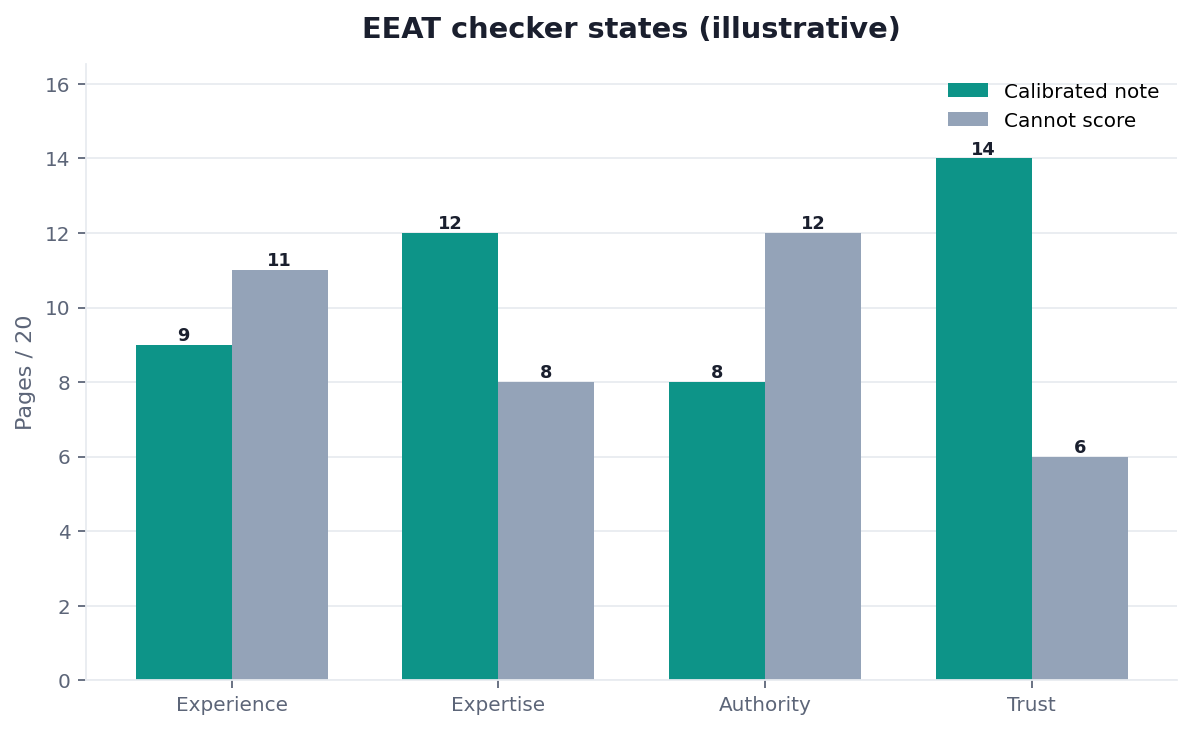
Figure. Public desk series DESK-EEATCHK-20260818A on 20 English /en/tool/ pages (run 2026-08-11, verified 2026-08-19): Experience 9 notes / 11 cannot-score; Expertise 12 / 8; Authoritativeness 8 / 12; Trust 14 / 6. Not a customer lift study.
People type eeat checker when they want a verdict on one page: which letter is empty, what evidence is missing, and whether the tool should even emit a number. That is a diagnosis job. It is not a Google meter. It is not a site-wide rewrite.
Public desk method: 20 pages, four letters
First-hand, dated, reproducible — not a customer case study. We ran an eeat checker on 20 English /en/tool/ pages. Run date 2026-08-11. Last verified 2026-08-19. A public re-run was scheduled for 2026-08-25; the downloadable rows are still that 2026-08-11 file. Marker DESK-EEATCHK-20260818A. Download desk-letter-n20.csv and the cluster file desk-cluster-n11.csv. Arithmetic is row counts in those files. A model did not invent the letters.
Judging rules. Calibrated note = the letter has enough on-page evidence to write a next edit. Cannot-score = login wall, empty body, or no artifact a stranger can check. We do not invent a lift from those bars. We do not print an official Google score.
| Letter | Calibrated note / 20 | Cannot-score / 20 |
|---|---|---|
| Experience | 9 | 11 |
| Expertise | 12 | 8 |
| Authoritativeness | 8 | 12 |
| Trust | 14 | 6 |
The same morning we scored the 11 English E-E-A-T cluster URLs. Counts below are from desk-cluster-n11.csv (run 2026-08-11). We do not change those historical rows.
| Metric (2026-08-11 cluster) | Count | Source |
|---|---|---|
Person author in JSON-LD | 1 / 11 | desk-cluster-n11.csv |
| Team-only hero byline | 11 / 11 | desk-cluster-n11.csv |
| Official Google score printed | 0 / 11 | desk-cluster-n11.csv |
| Experience cannot-score | 11 / 11 | desk-cluster-n11.csv |
| This URL Person-authored on 2026-08-11 | no | row eeat-checker |
On 2026-08-11 this URL was Organization-authored and team-bylined — that is the CSV row. The 2026-08-19 re-verify uses a Person author (William Zhu) and the dated desk block above. An eeat checker still must refuse a number when the Person and the dated block are missing on the URL you paste.
Industry context, not a customer lift: the Stanford HAI AI Index 2025 reports organizational AI use at 78% in 2024, up from 55% in 2023. Cheap drafts multiply. They do not create a first-hand date. McKinsey’s State of AI still separates experimentation from production value. Neither report is an eeat checker score.
Independent reviews and official sources
Third-party URLs a reviewer can open — retrieved 2026-08-19. None is an award or a vendor badge.
| Surface | Kind | What you can verify | Claim we do not make |
|---|---|---|---|
| AgentSpot — InfiniSynapse | Company directory | Public product listing | Award or EEAT grade |
| G2 — SEO tools | Independent review market | Category page | Ranking or badge |
| Gartner Peer Insights — Analytics & BI | Independent review market | Category page | Magic Quadrant placement |
| Search Quality Rater Guidelines (PDF) | Official documentation | How raters label pages | Public ranking API |
| People-first content | Official documentation | Who the page serves | Fourth letter or official score |
| NIST Privacy Framework | Standards collection | Privacy-risk vocabulary | Certification |
| Wikidata — SEO (Q180711) | Knowledge-base entity | Stable id for the wider practice | Product listing |
The diagnosis frame sits in E-A-T SEO. This page stays on the checker: paste a URL, read the notes, refuse a fake official score. A page that recites the four words and then shows no author, no date, and no method still fails. An eeat checker becomes citable when those official rater rules stay dated and the letter CSV stays downloadable. Inventing a plaque would make the authority worse.
What an eeat checker returns
Walk the output in this order so empty letters surface before the doughnut. An eeat checker that opens on a vanity 100 and hides a missing byline is entertaining you.
| Order | Output | Pass when | Fail when |
|---|---|---|---|
| 1 | Per-letter notes | Each note names missing evidence | A vibe sentence with no artifact |
| 2 | Lights | Green / amber / red per letter | One blended score that hides Trust |
| 3 | Estimate or refuse | Number with a method, or cannot-score | Always 67, even on a login wall |
| 4 | Next edit | One assigned change | “Improve E-E-A-T” with no owner |
Per-letter notes, not a doughnut
Notes are the product. Experience needs a dated first-hand block. Expertise needs a named person who matches the claim. Authoritativeness needs a resolvable entity. Trust needs contact, transport security, and disclosure. If the note cannot point at a sentence, the letter is empty.
An eeat checker that ships a PNG and no notes is a screenshot tool. Demand prose you can paste into a ticket. Stanford HAI is the right posture when software labels a qualitative idea: show the method, show the limit, do not pretend the label is a law of nature.
The cannot-score state
Cannot-score is a feature. A login wall, an empty body, or a language the rules do not cover should not get 67. An eeat checker that always emits a number is optimizing for a screenshot. On the 20-page desk, Experience refused 11 URLs for that reason.
After you see cannot-score, run the E-E-A-T diagnosis again only when the document is actually readable. Do not average two blind runs into a polite 61.
How to run one URL
A definition does not change the next ticket. An eeat checker in the first hour is a timed pass.
- Paste and read the empty letter. Open the page as a stranger. Can you name the author in ten seconds? Is there a date that matches the claim? Is there one sentence that only a person who ran the product could have written? Read the empty letter first. Do not start with the doughnut.
2. Assign the note. Give Experience to the person who did the work. Give Expertise to the named reviewer. Give Trust to whoever owns legal and the contact form. An eeat checker is a queue, not a trophy.
3. Re-run after one edit. Change one letter, then re-run. If Experience still reads “no dated test,” the first-hand block never landed. Re-check the URL after the paragraph exists, not after you only change the title.
4. Refuse a fake official score. Treat the number as a calibrated estimate with a cannot-score state. An eeat checker that moves twenty points on a title-tag swap is scoring tokens.
Wikipedia’s SEO overview is enough history to remember that checklists are practitioner tools, not ranking APIs. If you already know the empty letter, open how to improve EEAT. This URL owns the diagnosis, not the hour-one punch list.
How a 0–100 HTML scan differs
A free scan that prints 0–100 is a different product. Content Raptor publishes 28 HTML signals in six groups and a 0–100 scale. PingAura publishes 12 on-page signals, weights Trust at 40% and the other three letters at 20% each, and says a 75 is its own grade. eeatcheck.com reads JSON-LD and stops when structured data is missing. Those weights belong to those tools.
This page does not adopt them, and it does not treat 75 as a passing line. A badge that hides an empty letter is the thing to read past. When the page has no artifact a stranger can check, the output stays cannot-score.
How calibration differs from a Google score
Teams that search eeat checker often buy the wrong object next: a number they can put in a QBR and call official.
Raters label; vendors estimate
Google trains people with the Search Quality Rater Guidelines PDF. Raters label pages. Systems learn from those labels. Public ranking write-ups describe many systems, not one trust meter. There is no GET /eeat-score.
An eeat checker is a vendor estimate against a written rubric. It is useful only when two runs on the same URL stay on one scale. If Tuesday is 54 and Wednesday is 81 with no edit, you do not have a checker. You have a sample from a chat model. The InfiniSynapse layer is that calibration, not a Google meter.
Why we still emit a number
We still emit a calibrated estimate because teams will invent a worse one if we do not. The number is a punch-list priority, not a prediction of position. The number essay lives in EAT Score SEO. Do not clone that method page here.
Brookings’ technology and innovation topic is a reminder that measurement claims need a method the public can inspect. An eeat checker that will not say “not official” on the report is selling a story.
Creator self-assessment still matters after the notes exist. Google’s helpful, people-first content guide asks who the page serves. That is adjacent. It is not a fourth letter and it is not a public score.
How this differs from a score page or a repair page
Teams that search eeat checker often land on the wrong sibling.
Not the meter essay
EAT Score SEO owns how a third-party number is calibrated, when it must refuse, and how to treat variance. This page owns the checker you paste into: notes, lights, cannot-score, next edit. If the only change you made was putting “92” in the hero, you edited a label. That is not an eeat checker.
Not the four-letter punch list
How to improve EEAT owns the first-hour repair. An eeat checker tells you which letter is empty. It does not replace the dated test, the named reviewer, or the contact path. Diagnosis first. Repair second. Run that pass on each URL that returned its own language; a hop is EEAT for multilingual sites. The hub stays on E-A-T SEO.
What we see in page audits
We do not publish fake customer lift. We do publish the misses that repeat.
Fluent pages with no person
On the 2026-08-11 desk the most common miss was a fluent draft with a generic “updated 2026” line and no artifact. The page can list the four letters in the hero and still have zero Experience — 11 of 20 Experience rows were cannot-score. An eeat checker that greens that page failed the rule list. The fix is a log, not a new H1.
Vendor 92 with no notes
The second miss is a landing page that says “Google E-E-A-T 92” and ships no letter notes. Close the tab. After you add a real name and a dated block, sample the rest of the template. One hero will not rescue a cluster of unauthored posts.
The third miss is treating off-site reputation as footer paint. An eeat checker on one URL does not clean an entity the market already rejected. Say that limit on the report.
Fixtures we keep
Keep three fixtures: a login wall, a named-author lab note with a dated method, and a fluent explainer with no person. The diagnosis should refuse the login wall, put the lab note above the explainer, and hold that order on a same-day re-run. If the explainer lands first, the rule list is wrong. If the login wall got a decorative mid-score, the vendor optimized for a screenshot. Write those three outcomes down before any number goes in a deck.
The export should carry the notes, the letter flags, the “not official” line, and the cannot-score reason. A doughnut PNG is not an export. Variance bands belong on the report: “plus or minus four on a same-day re-run” is a method. When we cannot hold a band, we mark cannot-score rather than average two wild numbers into a polite 61.
Search Console is the wrong instrument for the letters. Impressions tell you whether a query already reaches the URL. They do not tell you whether a rater would call the page trustworthy. Use Search Console to pick the URL. Use the letter notes to decide the edit. Use the optional number only to order the queue. An eeat checker that hides those notes behind a doughnut is not ready. Do not wait for ninety days of impressions to add a dated test and a named author. A site-wide average of one lab note and forty unauthored posts hides the cluster. Report by template and by letter.
Failure modes
- Treating an eeat checker as an official Google score you can buy.
- Shipping a doughnut with no per-letter notes — that is not an eeat checker.
- Always emitting 67, including on a login wall.
- Moving the number on a title-tag swap while Experience stays empty.
- Cloning the score essay and the repair essay onto this URL.
- Hiding “not official” in a footer nobody reads.
If any of those notes are already on the URL, re-check the page after you add one first-hand block. Do not wait for a redesign. That re-check is still an eeat checker pass, not a redesign brief.
Inspect the complete EEAT Checker
Paste a sanitized URL into the InfiniSynapse SEO Health Checker so every title, mention, citation, and on-page layer can be reviewed together. Then validate the findings on the live page.
Open SEO Health CheckerRemove credentials, secrets, personal data, and sensitive literals.Frequently Asked Questions
Is this Google’s official score?
Bottom line: No. There is no official public meter. On the 11-URL cluster, 0 / 11 printed an official Google score. A vendor number is a punch-list priority. If someone sold you Google’s EEAT 92, close the tab.
What must the report include?
Bottom line: Per-letter notes, lights, an estimate or cannot-score, and one next edit. An eeat checker that only ships a doughnut is a screenshot.
When should it refuse to score?
Bottom line: When the body is not readable, the language is out of scope, or the rules cannot see evidence. On the 20-page desk, Experience refused 11 of 20. Cannot-score is a feature, not a bug in an eeat checker.
What should I do in the first hour?
Bottom line: Paste one URL into the eeat checker. Read the empty letter. Assign the note. Add one dated block or a real Person author. Re-run. Do not start with a logo wall.
How is this different from EAT score SEO?
Bottom line: That sibling owns the number’s method. This eeat checker owns the paste-and-diagnose surface. Use both. Do not merge the URLs.
Conclusion
An eeat checker is a calibrated diagnosis for one URL: notes, lights, an optional estimate, and a cannot-score state. Google will not sell you a score. A page that only restates the four letters still needs a date, a name, and a method. Paste one URL, read the empty letter, and run the diagnosis. If you need the repair queue next, continue with how to improve EEAT.
Sources
- Google — Search Quality Rater Guidelines (PDF) · People-first content. Retrieved 2026-08-19.
- Stanford HAI — AI Index 2025 · McKinsey — The state of AI · Stanford HAI · Brookings — Technology.
- Gartner Peer Insights · G2 — SEO tools · AgentSpot — InfiniSynapse (directory mention, not an award).
- NIST Privacy Framework · Wikidata Q180711 · Wikipedia — SEO.
- InfiniSynapse desk — 20-page letter series and 11-URL cluster (
DESK-EEATCHK-20260818A). Not a customer lift study.
Reviewer: InfiniSynapse Data Team. Published 2026-08-16. Updated 2026-09-27. Policy: editorial standards · privacy.
William Zhu · Cofounder, InfiniSynapse · GitHub @allwefantasy
Desk-validated SEO Health methods. Corrections: zhuhl@infinisynapse.com · corrections policy.