EEAT for Multilingual Sites: One Person per Locale
eeat for multilingual sites means one named person on the URL that returned that language. A 308 or a plugin page is not a local About.
Author credentials: William Zhu is cofounder of InfiniSynapse (GitHub @allwefantasy · auto-coder). Desk: shipping SEO Health and the /en/tool/ visibility pages. No personal LinkedIn published. About: team / editorial standards.
Publisher credentials: InfiniSynapse has public profiles on GitHub, YouTube, and X. A 2026 WAIC Future Tech OPC excellence award covers the Agentic Data Infra entry (WAIC; third-party recap: Xinhua / Caohejing). That award does not review this page or SEO Health. Method CLI: infinitegrowth on npm. Archive: recognition and scope notes.
On this page
By William Zhu · Cofounder, InfiniSynapse · Published: 2026-09-08 · Last updated: 2026-09-27 · Last verified: 2026-09-14 · Reviewed by the InfiniSynapse Data Team.
Reviewed by: InfiniSynapse Data Team · method review 2026-09-14.
/zh308 hops, English toollang=en, empty hreflang. No signed-ineeat. No invented Chinese HTML.
Trust / COI: About · Corrections. SEO Health is a commercial product from this team. This host is not a YMYL medical publisher. Locale hops are first-party, not a market study.
TL;DR
A /zh/tool request still 308s to the English tool; that hop is the multilingual finding.
Direct answer: EEAT for multilingual sites means experience, expertise, authoritativeness, and trustworthiness on the URL that returned that language: one named person and one method. On 2026-09-14,
/zhanswered 308 to/./zh/tool/{slug}answered 308 to/en/tool/{slug}. The English tool answered 200 withhtml lang="en"and empty hreflang. We did not invent Chinese HTML. A prior SH1 desk recorded IANA File-Date 2026-08-08; that date is the registry’s.
EEAT for multilingual sites that copies an English signer onto a path that never served that language is already late.
What you will learn
- Which first statuses we recorded
- Why empty hreflang is a field, not a hidden twin
- How IANA File-Date entered as a prior first-party hop
- When a 308 is the finding
- Where the cannot-score hub and siblings live
Four letters, one rendered URL
Experience, expertise, authoritativeness, and trustworthiness sit on the URL that returned that language. They are not a score this desk printed, and they are not a tag you switch on.
- Experience is a dated action on that HTML, not a slogan moved over from English.
- Expertise is a named person a stranger can open, with credentials written for that language.
- Authoritativeness is recognition that cites that URL, not only the English homepage.
- Trustworthiness is an About, a corrections path, and a method sentence someone can rerun.
EEAT for multilingual sites still starts from the hops below. A quality model does not turn a 308 into Chinese HTML.
A plugin page is not local experience
This host did not serve a translation-plugin body. /zh/tool/{slug} answered 308, so there was no machine-translated About to grade. On a host that does publish plugin HTML, the miss is the same class as pasting an English signer: words in a language, and no named human or method on that URL.
A machine-translated About is not the locale About. EEAT for multilingual sites refuses both the hop and the plugin page as a local person. Do not hire the reviewer until a URL returns that language.
What a local person actually requires
Key definition: EEAT for multilingual sites means one inspectable person × one method sentence × one URL that returned HTML in that language. A 308 to English is a hop, not a zh-Hans About. A generic “编辑部” stamp is not a translated profile.
People open EEAT for multilingual sites after a teammate pastes the English byline under a /zh label. That row is mislabeled. Write the URL that returned HTML, the lang attribute, and the first status.
Localized versions is Google’s annotation guide. We cite it as a third-party rule for how variants are labeled. It does not make /zh/tool/ a Chinese document.
SEO Health stays the deterministic evidence foundation for hop and HTML reads. A later signed-in InfiniSynapse Server API long-task workspace can attach SSE /api/ai/events to an eeat job on a locale URL; that workspace still cannot invent a /zh document that 308s to English.
lang and the path must agree
MDN lang is the attribute we read. The English tool pages in this packet rendered lang="en". EEAT for multilingual sites that assumes a hidden Chinese lang on a 308 is guessing.
Managing multi-regional sites is the companion Google page. It describes how to run locales. It does not certify a person on a hop.
A department stamp is not a local About
“Team,” “Editor,” and “本站” are generic. Translating the English About and leaving the byline as a department is the usual miss. We did not fetch a WordPress install or a Shopify merchant. We did not collect a SERP featured-snippet sample.
hreflang hygiene lives on the multilingual SEO checker. Stay here when EEAT for multilingual sites is the missing person on the URL that actually rendered.
Hops we recorded on this host
We tested /zh and /zh/tool/{slug} on 2026-09-14 with user-agent InfiniSynapse-SH67-desk/2026-09-14. The hops are first-party.
| Request | First status | Location / landing |
|---|---|---|
/zh | 308 | / |
/zh/tool/{slug} | 308 | /en/tool/{slug} |
| English tool | 200 | same URL, lang=en, hreflang none |
| IANA language-subtag registry (prior SH1 desk) | 200 | File-Date: 2026-08-08 |
Three hops on this host. One prior registry date. Zero Chinese HTML. EEAT for multilingual sites still has no zh-Hans reviewer to quote.
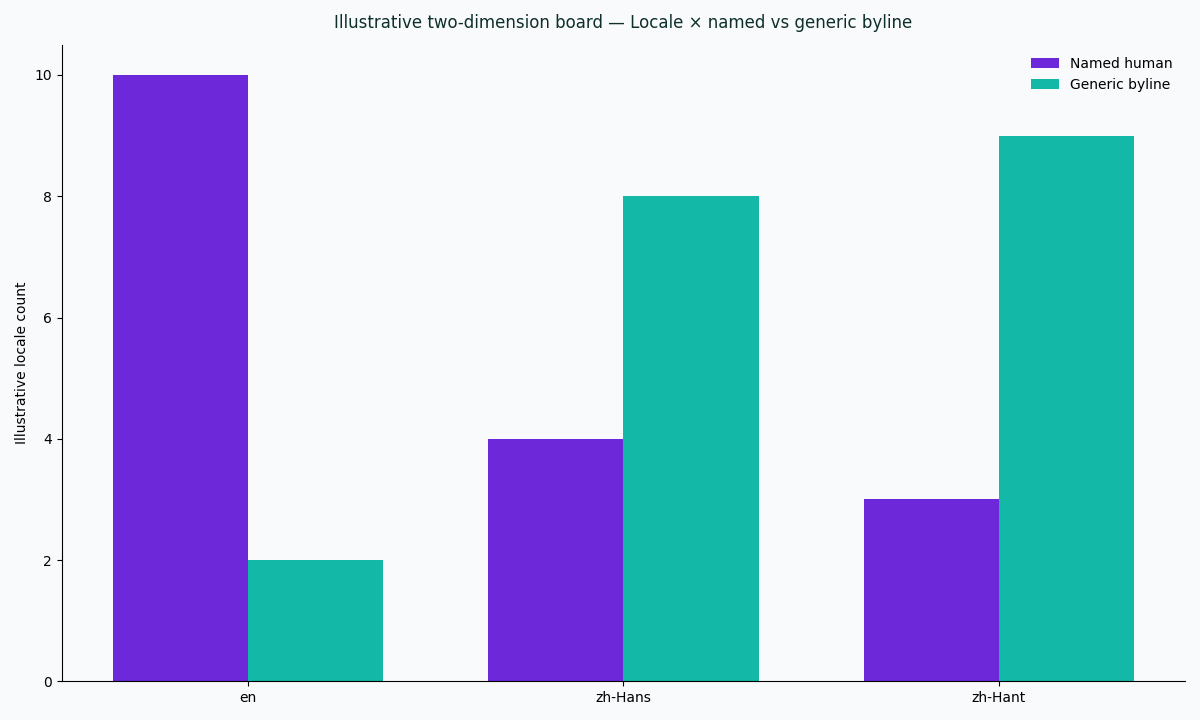
Figure: Two 308s, one English 200, empty hreflang. IANA File-Date is a prior first-party hop, not a translation date. This is the 2026-09-14 EEAT for multilingual sites hop grid.
IANA language-subtag registry is the public list. The SH1 desk already recorded File-Date 2026-08-08. We mention that hop; we do not invent a Chinese body to match it.
Schema.org inLanguage is the machine field for the language of the content. Empty hreflang plus lang="en" is the observed pair. Do not write zh-Hans into a ticket because the path started with /zh.
Unicode versus a person on the HTML
The Unicode Consortium’s internationalization FAQ splits internationalization from localization. Chrome that 308s is not localization. EEAT for multilingual sites records that split before anyone opens a native-review brief.
ISO’s ISO 639 language-code page is why a ticket that says “Chinese” and never picks Hans versus Hant is unfinished. Pick the tag after you have a URL that returned that tag.
How to reproduce the 308s
curl -sSI -A 'InfiniSynapse-SH67-desk/2026-09-14' \
  https://infinisynapse.com/zh/tool/eeat-for-multilingual-sites
Follow or do not follow; record both. EEAT for multilingual sites reproduction that only GETs /en will miss the hop.
On this hop desk the pin is infinitegrowth@0.1.1 and -V printed 0.1.0. seo-health eeat on the editorial URL printed 分析失败:unauthorized (28 bytes, exit 1). No signed-in eeat or aivisibility run. Unauthorized is login failure, not a Google verdict. CLI check exit 0 is not a page pass.
Limits that stay on the hop packet
No customer EEAT score. These tool URLs do not publish YMYL medical or finance advice. Empty alt="" on footer social icons is counted as missing by the CLI; that warning is an image-attribute row, not a locale person. EEAT for multilingual sites records those LIMIT rows as empty.
Google hreflang annotations describe return links. A hop that never served a second document has no return document to annotate.
What a later locale pack still needs
A URL that returns the language. A named human on that HTML. An About in that language. A method sentence a stranger can rerun. EEAT for multilingual sites fails when the brief hires a native reviewer for a 308.
Three rows on the URL that rendered
| Row | On the HTML that returned the language | Not enough |
|---|---|---|
| Author | A name a stranger can open, in that language | A department stamp, or an English signer on a hop |
| About | Organization controls in that language | A translated slogan with no profile |
| Method | One sentence a stranger can rerun | A number with no command |
zh-Hans and zh-Hant stay separate rows. This desk filled neither, because both paths 308.
Say what a credential means in that language
If a later pack cites a certification, write what it means to the reader of that URL. An English certificate image on a hop does not fill the row. This desk has no Chinese HTML, so it quotes no Chinese credential. EEAT for multilingual sites leaves that cell empty on purpose.
Script tags stay split
zh-Hans and zh-Hant are different rows even after a future /zh page exists. This desk never reached that future page. The honest sentence is still the 308.
Sample-size limit
Three requests cannot establish how readers treat Chinese copy, and they do not prove a translated About would have appeared on a path that 308s. As of 2026 this host’s /zh/tool/ path is a redirect, not a customer locale export. That limit is why EEAT for multilingual sites refuses a native panel here.
Product claims on SaaS URLs live on EEAT for SaaS pages. Stay here when EEAT for multilingual sites is the missing local person.
Hreflang labels the pair
Bidirectional tags, a self-reference, and x-default belong on the multilingual SEO checker and the hreflang audit. Those checks name which URLs are alternates. They do not copy a person onto a hop.
Empty hreflang on the English tool is a field we counted as none. It is not a claim that every language is covered. EEAT for multilingual sites stays on the missing person after the pair table is written.
Failure modes that invent a second language
308 as a translated page. Location points at English.
Empty hreflang as “all locales.” We counted none on the English tool.
English signer copied onto /zh. The document never rendered.
IANA File-Date as our publish date. 2026-08-08 is the registry’s, from a prior SH1 hop.
Unauthorized CLI as a locale block. Login failed. The finding is the hop.
Teaching city grid. Older drafts invented locale cities. They are gone.
A EEAT for multilingual sites memo that skips the Location header is already late.
How a reviewer should read the hop table
Start with /zh. It 308s to /. The homepage title in this packet is English. Do not label that request as a Chinese article. EEAT for multilingual sites that files /zh under zh-Hans HTML is misfiling a redirect.
Read /zh/tool/{slug} next. Location points at /en/tool/{slug}. The English tool is the document. html lang is en. hreflang is empty. There is no hidden Chinese alternate on that response. If a teammate pasted a machine translation into a ticket, that paste is not the page.
Read the English tool third. 200 is expected. Use it as the control, not as proof that Chinese exists. Empty hreflang means we did not advertise alternates. Do not invent them.
IANA File-Date 2026-08-08 belongs in the registry row, not in dateModified for this article. Mixing those dates makes it look like we translated a page in August. We did not. The SH1 desk fetched the registry; this SH67 desk reused that first-party hop and did not invent Chinese HTML to sit beside it.
When a later locale pack exists, each tag needs its own URL that actually returns that language, its own named human, and its own method sentence. A 308 URL cannot be a target. EEAT for multilingual sites that aims a native reviewer at a hop will measure the English landing page and call it Chinese.
If you only have the three hops, you have the desk. That is enough to reject a translated-byline slide. It is not enough to claim locale trust. Write both. A later native pack is an addendum with named people on real HTML. Do not put invented city rows back into the main table.
Two people repeating the HEAD requests should see the same Location class unless next.config changed. Store the user-agent InfiniSynapse-SH67-desk/2026-09-14. EEAT for multilingual sites that follows redirects and only prints the final 200 will hide the hop that is the finding.
zh-Hans and zh-Hant remain split even after a future /zh page exists. Script and market vocabulary differ. This desk never reached that future page.
What stays on disk after this desk
Keep the three response headers, the empty-hreflang note, and the IANA File-Date line from the prior SH1 hop. That is the 2026-09-14 EEAT for multilingual sites packet. Do not add a machine-translated About and label it /zh.
Print the package pin on the same page as the empty Chinese-HTML note: infinitegrowth@0.1.1 and -V = 0.1.0. Those strings do not prove locale trust. They prove which CLI we could have used and did not authorize.
A reviewer who needs a punch list can still run seo-health check on the English tool URL. Expect on-page lights, not a local person. EEAT for multilingual sites does not promote those lights into a Google score.
If legal asks whether we “tested Chinese EEAT,” the accurate answer is: we recorded two 308s and one English 200, and we did not invent Chinese HTML. Anything stronger is a different desk with captures.
Store the LIMIT list beside the hop table: no signed-in eeat; no WordPress or Shopify sample; no customer score; no medical advice on these tool URLs; CLI exit 0 is not a pass; empty footer alt="" is an image warning.
The decision this page supports is narrow: refuse a local reviewer until a URL returns that language. EEAT for multilingual sites does not decide translation budgets. Those decisions need a document that exists.
When the Chinese folder is still empty next quarter, republish the same hops with a new date if you re-fetched them. Do not backfill zh-Hans HTML to make the quarter look complete. Empty is a legal state for EEAT for multilingual sites.
Write the hop in the ticket subject
Subject lines that say “Chinese EEAT” hide the 308. Use “/zh/tool/ 308 → English tool” instead. Tickets with vague subjects get filled with translations of the English page.
If marketing wants a Chinese URL for a campaign, the work is a locale document, not a byline paste. Until that document exists, do not aim a native reviewer at a hop.
Nearby guides
Locale refuses live on cannot score EEAT. This page owns hops and local people.
| Job | Guide |
|---|---|
| Signer on advice URLs | named reviewer on YMYL |
| When and how you tested | EEAT date and method |
| Category definition | E-E-A-T SEO |
The EEAT checker still owns the signed-in product story. How to improve EEAT keeps the punch list that follows a signed-in number. EEAT for multilingual sites stays on the hop and the missing local person.
Replay the 308 before you hire a locale reviewer
HEAD /zh/tool/{slug}. If Location is English, stop the native-review ticket. Do not paste a translated byline over a hop.
Open the cannot-score hubFrequently Asked Questions
Is EEAT a ranking factor on a multilingual site?
No. The four words are a quality model, not a switch, and not a number this CLI printed. On 2026-09-14, seo-health eeat printed 分析失败:unauthorized. That is a login failure. EEAT for multilingual sites does not promote it into a Google verdict.
Does an English signer cover a /zh path?
No. The path 308s to English. EEAT for multilingual sites is per URL that returned HTML, not per brand.
Can hreflang transfer a person between locales?
No. We counted empty hreflang on the English tool. EEAT for multilingual sites treats annotations as alternate labels; they do not move a byline onto a hop.
Did we fetch Chinese HTML on 2026-09-14?
No. We recorded two 308s and one English 200. EEAT for multilingual sites does not invent a zh-Hans About to fill the folder.
May we hire a native reviewer against the /zh/tool URL?
No. Hire against a URL that returns that language. EEAT for multilingual sites stops at the Location line here.
Does IANA File-Date 2026-08-08 mean we translated in August?
No. That date is the registry’s, from a prior SH1 first-party hop. EEAT for multilingual sites does not reuse it as dateModified.
Conclusion
Use EEAT for multilingual sites when the job is to refuse a local person until the URL that returned that language is written down. This 2026-09-14 pass recorded two 308s, one English 200, empty hreflang, and a prior IANA File-Date. Stop when those Location lines remain visible. A bounded hop table beats an unsupported native-review slide.
Do not hire a native reviewer for a URL that never returned that language.
William Zhu · Cofounder, InfiniSynapse · GitHub @allwefantasy
Desk-validated SEO Health methods. Corrections: zhuhl@infinisynapse.com · corrections policy.