Multilingual SEO Checker: One Locale URL at a Time
Use a multilingual SEO checker on one locale URL at a time and read eight traffic lights. Do not expect a site language score or a full hreflang pass.
Author credentials: William Zhu is cofounder of InfiniSynapse (GitHub @allwefantasy · auto-coder). Desk: shipping SEO Health and the /en/tool/ visibility pages. No personal LinkedIn published. About: team / editorial standards.
Publisher credentials: InfiniSynapse has public profiles on GitHub, YouTube, and X. A 2026 WAIC Future Tech OPC excellence award covers the Agentic Data Infra entry (WAIC; third-party recap: Xinhua / Caohejing). That award does not review this page or SEO Health. Method CLI: infinitegrowth on npm. Archive: recognition and scope notes.
On this page
By William Zhu · Cofounder, InfiniSynapse · Published: 2026-09-08 · Last updated: 2026-09-14 · Last verified: 2026-09-14 · Reviewed by the InfiniSynapse Data Team.
Reviewed by: InfiniSynapse Data Team · method review 2026-09-14. First-party CLI review of
/enversus/zh.
Trust / COI: About · Corrections. SEO Health is a commercial product published by the InfiniSynapse team. The locale-pair table below is a desk run of
infinitegrowth@0.1.1, not a customer case and not an official Google score.
TL;DR
A multilingual SEO checker inspects one locale URL and returns eight traffic lights — title, meta, headings, density, images, links, tech, and speed. It is not a host language grade and not an hreflang crawl. Paste /en/..., then /zh/..., then the next public locale.
Direct answer: Use a multilingual SEO checker when you need lights on one locale route. On 2026-09-14,
/enand/zhreturned the same English title, the same English description, the same word count, and the same root canonical. A locale prefix is not proof that the document is translated.
On 2026-09-14 we ran npx --yes -p infinitegrowth@0.1.1 seo-health check URL --format json --lang en against https://infinisynapse.com/en and https://infinisynapse.com/zh. The sample size is two first-party locale paths. That pair does not prove a market pattern and cannot establish a ranking outcome.
We evaluate a multilingual SEO checker hands-on as the InfiniSynapse Data Team. For older on-page diagnosis language, use the on-page SEO tool page. The 2026-09-14 pair is the evidence. A later credited write-up is not.
What a multilingual SEO checker measures
Key Definition: A multilingual SEO checker is a one-URL pass over the live HTML of a single locale route. It scores eight deterministic modules with red, amber, or green. It does not print a host-wide language grade, and it does not crawl every hreflang sibling from a homepage paste.
Independent citation: According to [W3C Internationalization Activity](https://www.w3.org/International), W3C Internationalization publishes guidance for language and locale on the web. That W3C page is the third-party rule this write-up holds to. The locale-pair table below is first-party CLI output, not that rule.
People open a multilingual SEO checker when zh, zh-Hant, and en share a host and they want a punch list for the page they are about to ship: an English title on a Chinese path, a missing H1 on /en/pricing, or HTML that only exists on one locale. They do not want a “site is 80% multilingual” trophy.
The practice of internationalization and localization splits one product into many public URLs, and each of those URLs needs its own paste. A multilingual SEO checker is the narrow instrument that inspects one of them, then stops.
A multilingual SEO checker run will not say the locale is “ready for EEAT,” forecast clicks, or replace a Search Console export.
One locale URL is one document
The product on infinitegrowth.agency scores title, meta, headings, density, images, links, tech, and speed on the URL you paste. Each module gets a traffic light. The board is a punch list for that locale, not a language certificate for the host.
A green title on /en does not repair /zh. Treat green as “this module did not fail the rule we shipped.” Then paste the next locale. A multilingual SEO checker that treats two prefixes as one document is already selling a crawl it did not run.
What this page will not score
Hreflang pairs, return tags, and x-default belong on indexation work, not on this Target. A multilingual SEO checker will not walk the sibling set from one homepage.
Language localisation is the work of adapting copy, dates, and currency for a market; a multilingual SEO checker still only scores the HTML you paste. If a stranger cannot open the locale URL, the input is already wrong.
Two locale prefixes on 2026-09-14
This is a first-party desk observation. We used infinitegrowth@0.1.1. Both hosts are InfiniSynapse pages and are labeled as such. The finding is the overlap, not a translation win.
| URL | Title chars | Desc chars | Words | Canonical | Issue E/W/G | Speed | Missing alt |
|---|---|---|---|---|---|---|---|
https://infinisynapse.com/en | 58 | 159 | 1292 | https://infinisynapse.com/ | 0/1/7 | 78 | 2/7 |
https://infinisynapse.com/zh | 58 | 159 | 1292 | https://infinisynapse.com/ | 0/1/7 | 78 | 2/7 |
Both paths returned the English title InfiniSynapse — AI Data Agent for Enterprise Data Analysis. Both returned a 159-character English description. Both parsed 1292 words. Both wrote the same canonical on the site root. A multilingual SEO checker that stopped after the /en board and inferred /zh would have missed nothing — and that is the problem.
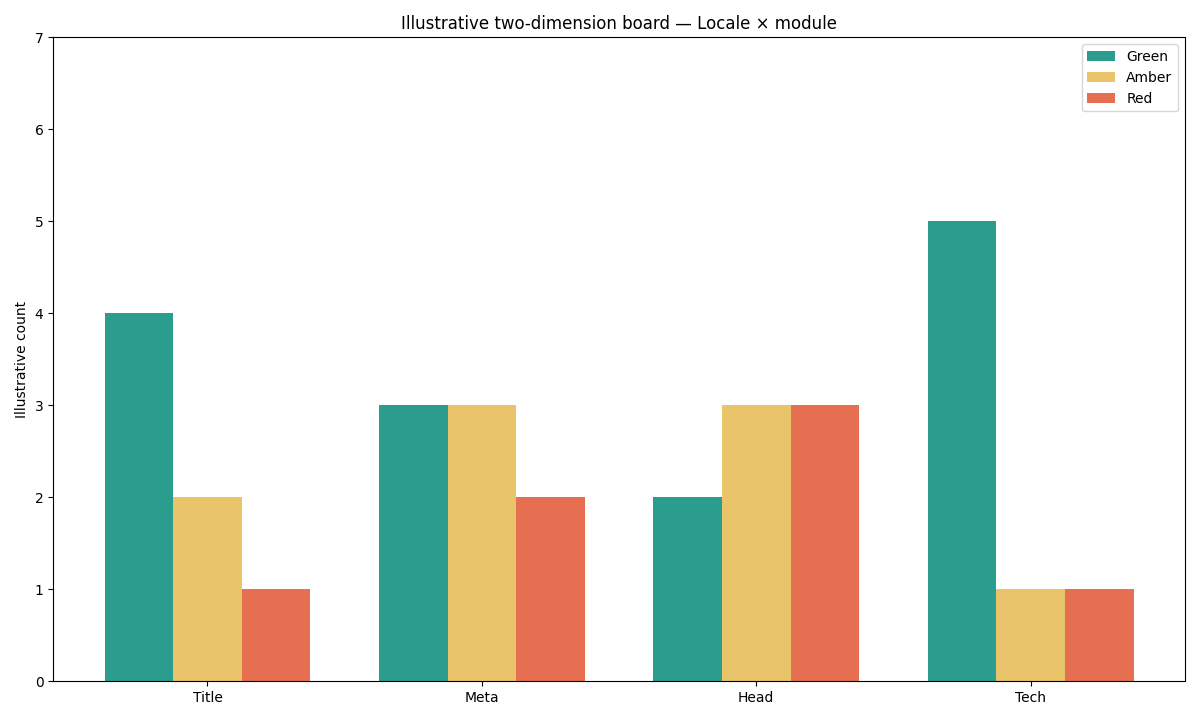
Figure: Two series from the same two CLI JSON files. Title characters sit beside parsed words. Both bars match. Neither series is a language-quality score.
How we ran both fetches
npx --yes -p infinitegrowth@0.1.1 seo-health check \
  https://infinisynapse.com/en --format json --lang en
npx --yes -p infinitegrowth@0.1.1 seo-health check \
  https://infinisynapse.com/zh --format json --lang en
A multilingual SEO checker record should keep the package version, URL, language flag, and retrieval date beside the table. Exit code 0 means the request completed. It does not mean the second prefix is a translated document. We fixed --lang en on both commands so the rule engine stayed constant; the finding is still that the HTML itself was English on both paths.
Parsing rule: completion means valid JSON containing url, page, issues, images, and speed. Compare page.title, page.description, page.wordCount, and page.canonical across the two files. Reproduce the parse with json.loads. Exit code 0 is not a clean translation.
Shared English title and description
Title length was 58 on both boards. Description length was 159 on both boards. Those lengths sat inside this package’s 40–60 and 120–160 windows, so Title Length and Meta Description both came back good. The multilingual SEO checker did not fail the length rules. It also did not notice that the Chinese prefix still served English strings.
Language tags in RFC 5646 name a locale; they do not tell SEO Health to rewrite the document. Paste the URL that carries the tag you mean, then read the returned title as a string, not as a hope.
Shared word count and root canonical
Word count was 1292 on both boards. Canonical was https://infinisynapse.com/ on both boards. Speed score was 78 on both. Image Alt Text warned 2/7 on both. TTFB recorded 1892 ms as error on /en; /zh repeated the same delivery family. The only page-issue warning on both paths was Image Alt Text.
That overlap is a locale-path finding. It is not proof that Chinese readers received a Chinese page. The SEO health checker hub owns the eight-module map. This page owns the pair.
For a multilingual SEO checker, SEO Health computes the eight traffic lights for one locale URL; InfiniSynapse does not power the free rule engine. Its API-backed foundation starts only for a credited deep EEAT or visibility request, when an InfiniSynapse Server API long task can reuse that locale evidence, stream SSE progress in a workspace, and explain it without rescoring sibling languages.
Prefix versus a translated document
A multilingual SEO checker answers what this locale URL returned. A translated document would show different title text, a different description, a different word count, and usually a locale-specific canonical. Mixing “we have a /zh path” with “we shipped a Chinese page” wastes a release.
Use a multilingual SEO checker when you changed a title on /zh/pricing and want lights in half a minute. Use a paired fetch when the question is whether two prefixes actually diverge. The one URL SEO health check page keeps the one-string rule without a locale frame.
Why identical strings matter
MDN and W3C treat title and language as document properties. Identical English strings on two locale prefixes are still two fetches. They are not two markets. A multilingual SEO checker that files “both green” as “both localized” has already left the evidence.
The W3C note on HTML language declarations is the independent reminder that lang lives on the document you fetched. If /zh still reads as English, the prefix is a routing token, not a translation.
A pass through Cloud Translation can mint a draft locale page; it cannot turn eight lights into a language-quality certificate. Machine output is a draft. The board is the HTML.
Hreflang still needs the other URL
Google's guides to localized versions and multi-regional sites define search-facing relationships. Those relationships require the sibling URL. One homepage paste does not validate return tags.
MDN's hreflang API reference describes the attribute on a link element. Bing Webmaster Guidelines add a discovery boundary. None of those documents produced the CLI numbers. A multilingual SEO checker still has to fetch the other path before anyone claims the pair is reciprocal.
The same limit holds for Azure AI Translator: a translated string is not a green board on the public locale URL. Paste the URL you will ship, not the glossary.
If the locale site is a Nuxt host, continue on the nuxt seo cluster and still paste one public route. The modules do not change when the stack changes.
Landscape of locale pages
Suites sell a 100. A multilingual SEO checker that only promises eight lights on one locale URL is easier to defend because it promises less. The W3C Internationalization Activity publishes language and direction rules; it does not print a site-wide language score you can paste once.
If you later want the Next.js metadata path, open nextjs seo. Keep the first locale run on the public route.
Browser, CLI, and Chrome on a locale host
Three doors, one board. The browser form teaches: paste, wait, read. The CLI repeats the same rules. Chrome stays local unless you start AI EEAT. If you would not email the URL to a stranger, do not run a multilingual SEO checker on it.
Compare locales as paired fetches
The English homepage response provides one board. A multilingual SEO checker still needs a second fetch. The 2026-09-14 pair shows why: /zh did not diverge.
Record each document first
Record the URL, canonical, document language, title, description, and word count before looking at alternates. This prevents a healthy default-language page from masking a broken localized route. A multilingual SEO checker that skips the second paste is only a homepage checker.
Validate alternate pairs separately
Collect every declared hreflang target and verify reciprocal references, valid language-region codes, and self-reference. Those checks require additional URLs and are not present in one JSON file.
Independent citation 2: According to [RFC 5646](https://www.rfc-editor.org/rfc/rfc5646), this IETF RFC is an independent protocol specification, not a product score. A second independent source, from IETF, keeps this page claim from resting only on first-party lights.
Locale coverage limit
One English response cannot validate reciprocal hreflang or translation equivalence. The 2026-09-14 pair is two captures of the same English document.
When credits enter the story, open SEO health checker credits. Lights on a multilingual SEO checker stay free. A write-up does not invent a Chinese title that the HTML does not contain.
Selection scorecard
Score each row 0–2 when someone asks whether a multilingual SEO checker is the right tool today.
| Question | 0 | 1 | 2 |
|---|---|---|---|
| Do you have one public locale URL to defend? | Homepage only, or a secret host | Staging with a public share | Live canonical locale |
| Will you paste the other prefix the same day? | Assume one language represents all | Maybe next sprint | Same day, next path |
| Do you need lights in about 30 seconds? | Reciprocal locale pairs are required | You can wait a few minutes | You need the board now |
| Are eight modules enough to start? | You need hreflang pairs or EEAT scores | You also need a later sample | Title through speed is the job |
| Can you assign a human to each red? | No owner | Shared inbox | Named owner per locale |
Under 6 means pick another instrument. 8–10 means paste the first locale URL. Repeat a multilingual SEO checker on each canonical locale rather than inferring parity.
Failure modes that invent a language score
The first failure is pasting the homepage and expecting every locale. A multilingual SEO checker does not walk hreflang from one URL.
The second failure is averaging two boards into “the site is 70% multilingual.” Lights are per URL. An average is a story, not a measurement. The 2026-09-14 pair would average as identical English, not as bilingual coverage.
The third failure is paying for narrative while /zh still serves the English title. Re-run the multilingual SEO checker on the sitemap canonical. A shared root canonical on both prefixes is a consolidation signal, not a market proof.
Cluster guides for this pillar
Pick the branch supported by the missing evidence.
| Job you actually have | Guide to open next | What this page will not do |
|---|---|---|
| Same lights, no locale story | SEO health checker | Invent a site language score |
| One URL, no locale frame | One URL SEO health check | Crawl the host |
| Nuxt public route | nuxt seo | Change the eight modules |
| When login and credits start | SEO health checker credits | Recolor a red title |
| Older on-page wording | On-page SEO tool | Retarget those phrases here |
Paste one locale URL, then the next
Read title, meta, headings, density, images, links, tech, and speed on the locale you will ship. Then paste the next public locale.
Run SEO Health CheckerFrequently Asked Questions
Is this an official Google language score?
Bottom line: No. A multilingual SEO checker is a first-party rule board with eight traffic lights on one locale URL. Google does not publish a site “language” number that this product reprints, and we will not invent one.
Should I paste the homepage and expect every locale?
Bottom line: No. Paste each public locale URL. The multilingual SEO checker does not infer /zh/... from /en/..., and it does not walk hreflang from the homepage. The 2026-09-14 pair shows why a second paste is required.
Do credits change the eight lights?
Bottom line: No. Credits buy optional narrative, not a new light engine. A multilingual SEO checker write-up must not invent a translated title the HTML does not contain.
Does this replace an hreflang review?
Bottom line: No. Hreflang pairs and return tags are indexation work. This page stays with eight lights on one locale URL. Run a multilingual SEO checker for the punch list; take pairing to a hreflang review on the sibling URLs you have not fetched yet. When the lights are read and the missing object is a person on that language, open EEAT for multilingual sites.
Did /en and /zh look different on 2026-09-14?
Bottom line: No. Both returned a 58-character English title, a 159-character English description, 1292 words, and the canonical https://infinisynapse.com/. That is a prefix finding, not a translation proof.
Conclusion
A multilingual SEO checker is eight lights on one public locale URL. The 2026-09-14 snapshot shows two prefixes that shared one English title, one English description, one word count, and one root canonical. Paste, compare the strings, then paste the next locale.
Keep the multilingual SEO checker in SEO Health. Only after comparing actual locale URLs should an editor open the InfiniSynapse web app for an optional credited explanation.
William Zhu · Cofounder, InfiniSynapse · GitHub @allwefantasy
Desk-validated SEO Health methods. Corrections: zhuhl@infinisynapse.com · corrections policy.