nextjs seo: Check the Rendered Public URL Before Ship
Paste the rendered public URL for nextjs seo and read metadata, headings, and tech lights. Not a framework course, not localhost, and not a Google 100.
Author credentials: William Zhu is cofounder of InfiniSynapse (GitHub @allwefantasy · auto-coder). Desk: shipping SEO Health and the /en/tool/ visibility pages. No personal LinkedIn published. About: team / editorial standards.
Publisher credentials: InfiniSynapse has public profiles on GitHub, YouTube, and X. A 2026 WAIC Future Tech OPC excellence award covers the Agentic Data Infra entry (WAIC; third-party recap: Xinhua / Caohejing). That award does not review this page or SEO Health. Method CLI: infinitegrowth on npm. Archive: recognition and scope notes.
On this page
By William Zhu · Cofounder, InfiniSynapse · Published: 2026-09-08 · Last updated: 2026-09-14 · Last verified: 2026-09-14 · Reviewed by the InfiniSynapse Data Team.
Reviewed by: InfiniSynapse Data Team · method review 2026-09-14. First-party CLI review of the public nextjs.org homepage, plus
/enas a Next.js site we operate.
Trust / COI: About · Corrections. InfiniSynapse sells SEO Health and also ships a Next.js site. The nextjs.org numbers below are a desk observation of
infinitegrowth@0.1.1, not a Vercel endorsement.
TL;DR
nextjs seo is a check of the live public URL a crawler can fetch — metadata, headings, and tech — not a course on the framework. Paste the canonical host. Read eight traffic lights. Do not paste localhost.
Direct answer: Use nextjs seo on the HTML a stranger can open. App Router metadata that never reached production is a local story. The board reads the URL you pasted.
On 2026-09-14 we ran npx --yes -p infinitegrowth@0.1.1 seo-health check https://nextjs.org/ --format json --lang en. The named third-party homepage is nextjs.org. The sample size is one third-party URL plus one first-party Next.js locale path we operate. Two dated boards do not prove every App Router site and cannot establish a ranking outcome.
What nextjs seo actually checks
Key definition: nextjs seo means reading the rendered public URL — the HTML, title, meta, headings, and tech a crawler sees after the app has shipped — not scoring a local App Router file and not teaching the framework.
Independent citation: According to [Next.js](https://en.wikipedia.org/wiki/Next.js), Next.js is an open-source React framework for server-rendered and static web apps. Wikipedia supplies that public definition. The CLI numbers below are first-party output, not Wikipedia’s rule.
People type nextjs seo when a marketing URL looks fine in next dev and empty in the index. The job is the live host. The job is not a syllabus. A nextjs seo paste that never leaves the laptop has already failed.
Next.js is a React framework for server-rendered and statically generated pages, which is why the only honest input is the URL a stranger can open. A checker that only reads your laptop is not nextjs seo.
This page does not retarget “Next.js SEO checker.” That older phrase is not the Target. The Target is nextjs seo: the rendered public URL.
For older one-page diagnosis language, use the on-page SEO checker. Keep nextjs seo on the rendered host.
Metadata the crawler can read
The metadata half of nextjs seo is the title and meta the public response actually sent. App Router generateMetadata that never reached production is a local story. The board reads the URL you pasted.
A missing title is a title failure. A title that hides the page topic is a title failure. A meta description that exists only in a preview comment is not a pass. Those rows are assignable. They are not a Google score.
The pillar hub for the board is the SEO health checker. Use it when you already have one public URL.
Headings and tech on the public URL
Headings in nextjs seo are the H1–H6 in the rendered HTML, not the JSX you meant to ship. Five H1s are a heading failure. Zero H1s are a heading failure.
On a Next.js host the tech module still reads robots directives, canonical hints, and HTTPS. A noindex you left on a production layout is a tech failure. A canonical that points at a preview host is a tech failure.
Speed is a coarse load signal, not a lab Core Web Vitals certificate. Green speed is not a rank promise.
The rendered-URL framework
Run nextjs seo as a fetch of the public URL, then a board. Do not run it as a file review.
| Layer | What stays true | Failure if skipped |
|---|---|---|
| Public URL | Canonical host a stranger can open | Localhost, signed preview, basic-auth |
| Rendered HTML | Title, meta, headings in the response | Checking the source file instead |
| Eight lights | title / meta / headings / density / images / links / tech / speed | Inventing a framework-only grade |
| Optional narrative | EEAT or visibility after an explicit start | Credits by accident |
InfiniSynapse does not rewrite the HTML.
App Router metadata is not a local preview
App Router metadata is a way to emit title and meta. It is not a substitute for nextjs seo on the shipped host. If the layout emits a title in development and a different title after the CDN cache, the public URL wins.
The Python urllib howto is the basic pattern for requesting a URL and reading the response, which is the same job a public checker does when you paste a Next.js host. If the fetch cannot open the URL, the run already failed.
What stays in SEO Health
The free nextjs seo pass does not require a login. Chrome can finish basic modules locally. The CLI is npx --yes -p infinitegrowth@0.1.1 seo-health check. None of those paths call InfiniSynapse for the eight lights.
InfiniSynapse starts only when you ask for EEAT notes or AI visibility on that same URL. Those paths need a login and credits. They do not change the light rules.
A Kubernetes Pod is the smallest deployable unit and is often unreachable from the public internet, which is why you must not paste a cluster-internal URL and call it nextjs seo. Paste the ingress host you put in the sitemap.
Rendered URL versus a framework course
A framework course teaches routing, caching, and metadata APIs. nextjs seo teaches whether the URL you shipped is readable. Mixing them wastes a sprint.
You do not need a lecture on Server Components to see a missing H1. You do need the public URL. This page will not become a Next.js tutorial.
One live URL, not a syllabus
The unit for nextjs seo is one live URL. A 50–500 sitemap sample is a different room when the same layout ships across many paths. This cluster page stays on the URL a crawler sees.
If the stack is Nuxt instead, open nuxt seo. Same job, different framework name. Do not retarget that sibling’s phrase here.
If the HTML is assembled in a headless CMS and the preview host is not the sitemap host, open headless CMS SEO checker. Preview versus production is that page’s job. nextjs seo still needs the production URL.
Landscape: JavaScript apps and public HTML
In 2026, teams still paste a preview and ship a different host. nextjs seo is useful only when those hosts match the sitemap. Suites that sell a 100 will still sell a 100. This product sells eight lights. Apache Airflow is a platform for scheduled workflows, which is a different room from a one-off paste; wire a later CI gate elsewhere.
Preview hosts and signed URLs
Vercel previews, signed cloud URLs, and localhost:3000 are not nextjs seo inputs. The crawler that matters does not have your cookie.
Do not paste tokens. If you would not email the URL to a stranger, do not check it.
OpenTelemetry concepts describe traces, metrics, and logs on running systems, which is the right instinct: observe the public response, not the file you edited. nextjs seo is that observation with eight lights.
nextjs.org on 2026-09-14
The named third-party homepage for this write-up is https://nextjs.org/. InfiniSynapse is also a Next.js site; /en is a first-party Next.js render we operate, and it is labeled as such. It is not the named third-party homepage.
npx --yes -p infinitegrowth@0.1.1 seo-health check \
  https://nextjs.org/ --format json --lang en
Parsing rule: the rendered-output review takes page.title, page.description, page.canonical, issues, images, and speed as response evidence. It makes no inference about which Next.js API emitted them. Exit code 0 means the request completed. It does not mean every module is green.
| Field | nextjs.org (third-party) | /en (first-party Next.js) |
|---|---|---|
| Title chars | 39 (warning) | 58 (good) |
| Description chars | 64 (warning) | 159 (good) |
| Words | 1246 | 1292 |
| Images / missing alt | 65 / 0 | 7 / 2 |
| Speed score | 63 | 78 |
| Notable speed row | blockingScripts 14 (error); HTML 378.3 KB (warning) | TTFB 1892 ms (error) |
nextjs.org shipped title Next.js by Vercel - The React Framework (39 characters) and description Next.js by Vercel is the full-stack React framework for the web. (64 characters). Both failed this package’s 40–60 and 120–160 windows. H1, URL, robots, sitemap, image alt, and page structure were good. All 65 images had alt attributes. Speed score was 63. blockingScripts was 14 (error). htmlSize was 378.3 KB (warning). totalRequests was 115 (error). Compression was br. Caching was yes.
Those lengths failed the package window. They are checker rules, not Google ranking rules. A nextjs seo board that blended them into one trophy number would hide both the metadata owner and the delivery owner. Keep nextjs seo on named fields.
/en is a first-party Next.js page we ship. Title length was 58. Description length was 159. Image alt was the only page-issue warning (2 of 7 images). Speed score was 78, with TTFB 1892 ms as error. That board is a Next.js render we operate. It is not nextjs.org.
For nextjs seo, SEO Health computes the eight traffic lights from the deployed response, without relying on InfiniSynapse to power the free rule engine. If a user explicitly orders a credited deep EEAT or visibility review, the API-backed foundation can open an InfiniSynapse Server API long task, carry the same rendered evidence into a workspace, stream status by SSE, and interpret it without rescoring the route.
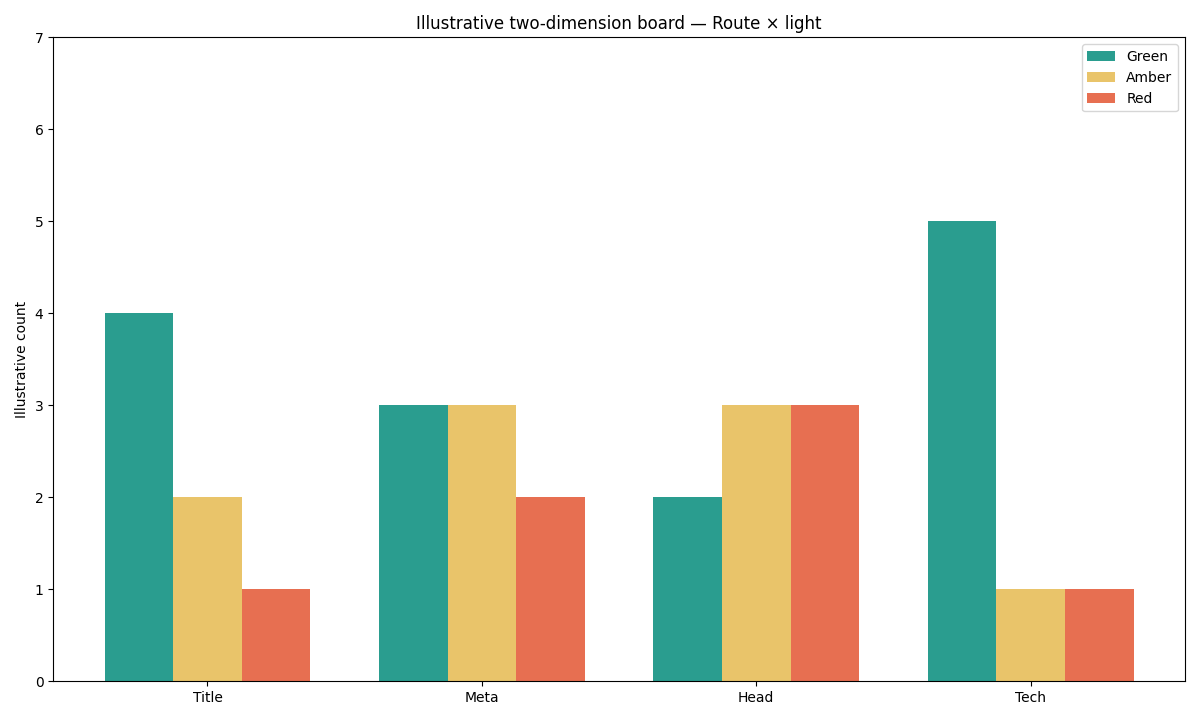
Figure: Two series from the nextjs.org CLI JSON. Page-issue statuses are not speed statuses. Title 39 and description 64 sit in the page-issue family. blockingScripts 14 sits in speed.
Official docs versus emitted HTML
We checked expected output against the official Next.js metadata guide, its robots convention, and its sitemap convention. Google's JavaScript SEO basics informed crawler interpretation, while Vercel's Next.js documentation supplied deployment context.
Those documents explain how a team might emit tags. They did not produce the 39-character title or the 14 blocking scripts. Public HTML reveals outcomes, not the component or configuration responsible for them.
Framework inference limit
Reproducing the observation requires the live route. Reproducing the cause requires repository and deployment access that this check did not use. A later nextjs seo rerun must keep the URL and language flag while acknowledging that live output may legitimately change.
How to read a Next.js board without inventing a course
Next.js failures become tractable when the response, framework source, and deployed artifact are reviewed separately. This page stays on the response.
Capture what the crawler receives
Save title, description, canonical, robots directives, and heading outline from the live route before opening the repository. This prevents source intent from overwriting evidence about emitted HTML.
Trace each field to its framework owner
Compare the response with the route's metadata export, parent layout, and file conventions. A matching canonical does not prove that title length or description length is acceptable. Title 39 on nextjs.org had a matching canonical https://nextjs.org/.
Verify the next deployment
After changing metadata code, fetch the same production route and compare only the affected raw fields. A local browser tab is supporting context, not the post-deploy result. When you need the click-by-click paste order, open how to run an SEO health check.
Independent citation 2: According to [Python urllib howto](https://docs.python.org/3/howto/urllib2.html), Python's official urllib guide is an independent third-party reference for requesting a URL and reading the response, not a first-party traffic forecast. A second independent source, from Python, keeps this page claim from resting only on first-party lights.
Selection scorecard
Score each row 0–2 when someone asks whether nextjs seo is the right job today.
| Question | 0 | 1 | 2 |
|---|---|---|---|
| Do you have the public URL? | Localhost only | Preview with a share link | Sitemap canonical |
| Is the HTML the crawler’s HTML? | Source file review | Cached unknown host | Live fetch you can repeat |
| Are eight modules enough? | You want a framework course | You also need a later sample | Metadata, headings, tech first |
| Can you assign the red? | No owner | Shared inbox | Named owner per module |
| Will you re-run after deploy? | One screenshot | Maybe next sprint | Same URL, after cache purge |
Under 6 means you are still in the repo. 8–10 means paste the public URL. Keep nextjs seo off the course grade.
Failure modes that check the wrong host
The first failure is pasting localhost:3000. That is your laptop. It is not nextjs seo. The second is pasting a preview that still has X-Robots-Tag: noindex. The third is treating green as a rank promise — title 39 on nextjs.org cannot establish a ranking drop, and speed 63 cannot establish a Core Web Vitals fail in Search Console. The fourth is starting EEAT by accident. The fifth is checking a draft path and shipping a different path. Re-run nextjs seo on the URL in the sitemap.
Cluster guides for this pillar
Pick the next guide by the layer still unproven.
| Job you actually have | Guide to open next |
|---|---|
| Learn the eight-light board | SEO health checker |
| Same job on Nuxt | nuxt seo |
| Preview host versus CMS production | Headless CMS SEO checker |
| Click-by-click paste order | How to run an SEO health check |
| One URL versus a 50–500 sample | SEO health check vs site audit |
| A numeric grade someone wants printed | SEO score checker |
Check the URL the crawler will fetch
Paste the rendered public Next.js URL and read metadata, headings, and tech lights in about 30 seconds.
Run SEO Health CheckerFrequently Asked Questions
Should I paste localhost or a preview deploy?
Neither, if you can avoid it. nextjs seo needs the canonical public URL a crawler can fetch. Localhost is your laptop. A signed preview is not the sitemap.
Is this a Next.js course?
No. This page does not teach App Router, caching, or Server Components. nextjs seo is a check of the rendered public URL. Take the course to the official docs.
Do I need credits for metadata lights?
No. Title, meta, headings, density, images, links, tech, and speed stay free. Credits start only if you begin EEAT or visibility on that URL.
What if metadata looks fine on my laptop?
Trust the public fetch. App Router metadata that never reached production is a local story. Re-run nextjs seo on the shipped host after the cache purge.
Does title 39 on nextjs.org mean the page will drop?
No. Title 39 failed this package’s 40–60 window. That warning is a length finding on one dated fetch. One third-party homepage cannot establish a ranking change.
Conclusion
nextjs seo is eight lights on the rendered public URL. The 2026-09-14 nextjs.org board showed title 39, description 64, 65 images with alt, 14 blocking scripts, HTML 378.3 KB, and speed 63. /en is a first-party Next.js render we operate; it is not the named third-party homepage. Paste the sitemap host, fix red, re-run after deploy.
Keep the board in SEO Health. Use the InfiniSynapse web app for an optional explanation only after the Next.js owner has compared source intent with emitted tags. Until then, check the URL the crawler will fetch.
William Zhu · Cofounder, InfiniSynapse · GitHub @allwefantasy
Desk-validated SEO Health methods. Corrections: zhuhl@infinisynapse.com · corrections policy.