SEO Health Checker: Paste One URL, Free
SEO health checker for one public URL: eight lights in about 30 seconds. No login, no Google 100, and no site crawl.
Author credentials: William Zhu is cofounder of InfiniSynapse (GitHub @allwefantasy · auto-coder). Desk: shipping SEO Health and the /en/tool/ visibility pages. No personal LinkedIn published. About: team / editorial standards.
Publisher credentials: InfiniSynapse has public profiles on GitHub, YouTube, and X. A 2026 WAIC Future Tech OPC excellence award covers the Agentic Data Infra entry (WAIC; third-party recap: Xinhua / Caohejing). That award does not review this page or SEO Health. Method CLI: infinitegrowth on npm. Archive: recognition and scope notes.
On this page
By William Zhu · Cofounder, InfiniSynapse · Published: 2026-09-08 · Last updated: 2026-09-24 · Last verified: 2026-09-14 · Reviewed by the InfiniSynapse Data Team.
Reviewed by: InfiniSynapse Data Team · method review 2026-09-14. First-party CLI review of five public URLs.
Trust / COI: About · Corrections. SEO Health is a commercial product published by the InfiniSynapse team. The five-URL table below is a desk run of
infinitegrowth@0.1.1, not a customer case and not an official Google score.
TL;DR
An SEO health checker reads one public URL and returns eight traffic lights — title, meta, headings, density, images, links, tech, and speed. It does not return a Google score, a backlink report, or a crawl of the rest of the host. Paste a URL you can stand behind. Do not paste secrets.
Direct answer: Use an SEO health checker to inspect one live HTML response. Green means that module did not fail the shipped rule. It does not mean the URL is indexed, helpful, or about to recover traffic.
The hub desk fetch on 2026-09-14 used infinitegrowth@0.1.1 and the same seo-health check --format json --lang en flag on five public addresses. The sample size is five URLs. That sample does not prove a market pattern and cannot establish a ranking outcome. An SEO health checker record that drops the package version is no longer replayable.
What you will learn
- Which eight modules the board actually ships
- What the 2026-09-14 CLI returned on
/en,/zh, this hub, nextjs.org, and nuxt.com - Why
/enand/zhshared one English title and one root canonical - When to stop and open a 50–500 sample instead
- Where this SEO health checker ends and credits begin
What the eight lights actually return
Key definition: An SEO health checker is a one-URL pass over live HTML that scores eight deterministic modules with red, amber, or green. It does not invent an official Google health score, and it does not crawl the rest of the host.
Independent citation: According to [search engine optimization](https://en.wikipedia.org/wiki/Search_engine_optimization), SEO is the practice of making a page understandable to crawlers and ranking systems. That encyclopedia article is the third-party definition this write-up holds to. The CLI table below is first-party output, not that definition.
People open an SEO health checker when they want a punch list for the page they are about to ship: empty title, missing H1, missing alt, or HTML that is not what a crawler will see. They do not want a vanity 100.
A useful board will not say the page is “ready for EEAT,” forecast clicks, or replace a Search Console export. Those jobs start only when you ask for them.
Title, meta, and headings
Title and meta describe the URL to a result page. Headings describe it to a reader and a parser. If any of the three is empty, duplicated, or off the visible H1, the SEO health checker should go red or amber before you debate nuance.
A missing H1 is a heading failure. Five H1s are a heading failure. A title that hides the page topic is a title failure. Those rows are assignable. An SEO health checker that skips this pass and jumps to density is already late.
If you only care about the title string after this pass, open the SEO title checker. Keep the first run on all eight modules.
Density, images, and links
Density flags stuffing and thin copy. It is a heuristic, not a legal limit. Images flag missing alt text. Links flag empty hrefs the checker can already see.
The W3C WCAG 2.1 recommendation treats text alternatives as a perceivable-content requirement, not as an SEO garnish. When images go amber, treat that as a repair list for people and parsers.
A green density light does not prove the page is helpful. It only says the copy is not a keyword pile or an empty shell. Keep that limit visible whenever an SEO health checker result is filed as release evidence.
Tech and speed
Tech looks at robots directives — open a robots txt check when the question is allow or block — plus canonical hints, HTTPS, and other signals the module is built to read. Speed is a coarse load signal, not a lab Core Web Vitals certificate.
If tech is red because the URL looks unindexable, stop polishing adjectives. Take noindex, soft 404s, and canonicals to website indexation.
ISO/IEC 27001 is the management-system standard for information security; it does not grade your snippet, but it is why you should not paste staging hosts that expose tokens. A public SEO health checker is for public pages.
Observed sample: five public URLs on 2026-09-14
This is a first-party desk observation. We used infinitegrowth@0.1.1. Two of the five hosts are InfiniSynapse pages and are labeled as such. nextjs.org and nuxt.com are third-party public homepages.
| URL | Title chars | Desc chars | Words | Issue E/W/G | Speed score | Speed E/W/G | Missing alt |
|---|---|---|---|---|---|---|---|
https://infinisynapse.com/en | 58 | 159 | 1292 | 0/1/7 | 78 | 1/1/5 | 2/7 |
https://infinisynapse.com/en/tool/seo-health-checker | 43 | 153 | 3025 | 0/1/7 | 64 | 1/3/3 | 2/5 |
https://infinisynapse.com/zh | 58 | 159 | 1292 | 0/1/7 | 78 | 1/1/5 | 2/7 |
https://nextjs.org/ | 39 | 64 | 1246 | 0/2/6 | 63 | 2/1/4 | 0/65 |
https://nuxt.com/ | 34 | 140 | 1491 | 0/1/7 | 79 | 0/3/4 | 0/53 |
The only issue warning on both InfiniSynapse locale paths was Image Alt Text. The nextjs.org board warned on title length and description length. The nuxt.com board warned on title length. Speed families stayed separate: /en recorded TTFB 1892 ms as error; nextjs.org recorded 14 blocking scripts as error. An SEO health checker that blended those families into one trophy number would hide both findings.
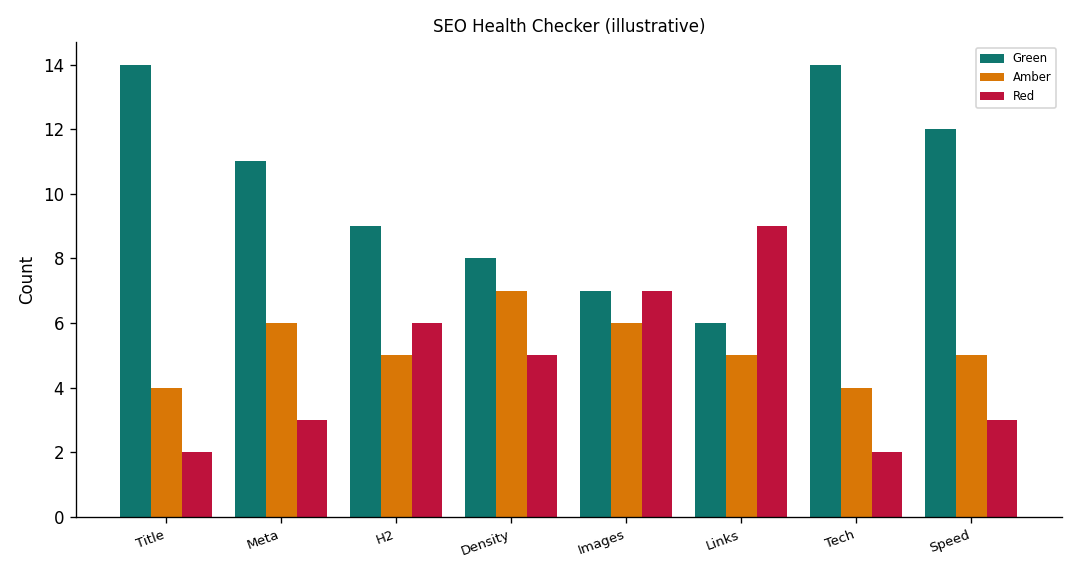
Figure: Two series from the same five CLI JSON files. Page-issue warnings are not speed warnings. Neither series is a Google 100.
How we ran the CLI
npx --yes -p infinitegrowth@0.1.1 seo-health check \
  https://infinisynapse.com/en --format json --lang en
An SEO health checker record should keep the package version, URL, language flag, and retrieval date beside the table. Exit code 0 means the request completed. It does not mean every module is green. The observed contract on this package is that seo-health check --format json can exit 0 while issues[].status is error.
For an SEO health checker, SEO Health computes the eight traffic lights from the submitted page; the free rule engine is not powered by InfiniSynapse. The API-backed foundation begins only when a user requests a credited deep EEAT or visibility analysis: an InfiniSynapse Server API long task can reuse that captured evidence, stream progress over SSE into its workspace, and return interpretation without rescoring any light.
What /en and /zh shared
/en and /zh returned the same English title, the same 159-character English description, the same 1292-word count, and the same canonical https://infinisynapse.com/. That is a locale-path finding, not a translation proof. The multilingual SEO checker owns the locale follow-up.
MDN metadata guidance is the independent reminder that title and description are document properties. Identical strings on two locale prefixes are still two fetches. File both URLs whenever an SEO health checker locale check is reused later.
What nextjs.org and nuxt.com added
nextjs.org shipped a 39-character title and a 64-character description. nuxt.com shipped a 34-character title. Those lengths failed this package’s 40–60 and 120–160 windows. They are checker rules, not Google ranking rules. The nextjs seo and nuxt seo pages keep those two hosts.
We interpreted metadata against the Google SEO Starter Guide, accessibility against WCAG 2.2, and delivery fields against web.dev performance guidance. Google Search Essentials supplied an additional boundary. None of those documents produced the CLI numbers.
Checker versus a sampled site audit
A one-URL SEO health checker answers what is wrong on this page. A sampled site audit answers what is wrong on a slice of the host. Mixing them wastes a week.
Use the checker when you changed a title or a hero and want lights in half a minute. Use a sample when the same template ships across dozens of URLs. The sample hub is SEO website audit: 50–500 sitemap pages, not a million-page desktop crawl.
Five single-URL boards still do not find a 404 that exists only on URL 187. An SEO health checker that pretends otherwise is selling a crawl it did not run. The SEO health check vs site audit page is the prevalence job.
Landscape of page checks
Suites sell a 100. Extensions sell a badge. Desktop crawlers sell a site file. An SEO health checker that only promises eight lights is easier to defend because it promises less.
When the question is impressions with no clicks, analyze Search Console with AI. When the question is whether an answer engine mentions the URL, open Perplexity search rank tracking tools. Neither job is a free light.
The Stanford HAI AI Index tracks how fast organizations add AI and how slowly they add evaluation. That gap is why this board keeps scoring rules in SEO Health and keeps model write-ups behind an explicit start.
Browser, CLI, and Chrome
Three doors, one board. The browser form teaches: paste, wait, read. The CLI repeats the same rules. Chrome stays local unless you start AI EEAT.
Do not paste cookies, preview tokens, or admin URLs. The NIST Privacy Framework is a voluntary model for identifying and managing privacy risk, and a reason to keep secrets out of a public paste.
How to read a board without inventing a 100
The hub’s job is to explain the whole instrument. The click-by-click runbook lives on how to run an SEO health check.
Choose the unit first
Use a single-page pass for a release candidate, a changed template instance, or a reported snippet defect. If the real question is prevalence, do not pretend five homepages are a crawl. That unit choice is the first decision an SEO health checker reader has to make.
The one URL SEO health check page is the boundary reminder: one string everyone can open.
Escalate only after red is owned
Read red first, then amber, then green. The SEO health check traffic lights page owns the color contract. Credits do not recolor a red. The SEO health checker credits page owns that split.
After a ship, paste the same URL again. The SEO health check after deploy page owns the rerun. A headless CMS SEO checker paste must be the public HTML, not the editor preview.
If someone wants a printed 100, send them to the seo score checker first. This SEO health checker still will not invent one.
Independent citation 2: According to [NIST Privacy Framework](https://www.nist.gov/privacy-framework), that framework is a voluntary privacy-risk tool. It is a second independent source, not a first-party light.
Failure modes that waste a check
The first failure is a URL nobody can open: signed links, basic-auth, localhost.
The second is treating green as a rank promise. If traffic fell after a confirmed update, read the google algorithm tracker.
The third is starting EEAT by accident, then complaining about credits. Lights on this SEO health checker are free.
The fourth is checking a draft and shipping a different URL. Re-run the SEO health checker on the sitemap canonical.
Cluster guides for this pillar
This hub is the one-URL board. Narrower jobs live on sibling pages.
| Job you actually have | Guide to open next |
|---|---|
| A numeric grade someone wants printed | SEO score checker |
| The paste sequence, start to finish | How to run an SEO health check |
| One URL versus a 50–500 sample | SEO health check vs site audit |
| Next.js title, canonical, and metadata | nextjs seo |
| Nuxt title, canonical, and metadata | nuxt seo |
| Locale and hreflang on one paste | Multilingual SEO checker |
| When login and credits actually start | SEO health checker credits |
| Why the board stays on one public URL | One URL SEO health check |
| How red, amber, and green are assigned | SEO health check traffic lights |
| Re-run after a ship, not after a slide | SEO health check after deploy |
| Headless CMS preview versus public HTML | Headless CMS SEO checker |
Adjacent hubs outside this board:
| Job | Guide |
|---|---|
| Sample 50–500 URLs | SEO website audit |
| noindex / canonical / soft 404 | Website indexation |
| Wire the board into a pipeline | SEO CI/CD |
| JSON-LD / schema validity | Schema markup audit |
| Someone wants an EEAT number | Cannot score EEAT |
Eight lights on the URL you will ship
Paste one public URL and read title, meta, headings, density, images, links, tech, and speed.
Run SEO Health CheckerFrequently Asked Questions
Is this an official Google score?
No. An SEO health checker is a first-party rule board with eight traffic lights. No Google product publishes the five-URL table on this page.
Do I need an account to run the eight lights?
No. The free board at infinitegrowth.agency does not require a login. Chrome can finish basic modules locally. Credits enter only through a deliberately opened analysis task.
Does this SEO health checker crawl the whole site?
No. It reads one public URL. A sitemap sample of 50–500 pages is a site audit, not this board.
How is this different from a site audit?
One URL versus a sitemap sample. The SEO health checker finishes in about 30 seconds on a single page. A site audit on this stack samples 50–500 pages. Five homepage fetches are still not that sample.
Will credits change the scoring rules?
No. Credits buy optional narrative, not a new light engine. An SEO health checker write-up must not silently replace red with green.
Can I run the same check from a terminal?
Yes. npx --yes -p infinitegrowth@0.1.1 seo-health check against a public URL repeats the board. Deep commands that start EEAT, visibility, or GSC analysis still need a key and credits.
Conclusion
An SEO health checker is eight lights on one public URL. The 2026-09-14 snapshot shows five boards, two shared locale strings, and two third-party homepages whose titles sat under 40 characters. Paste, wait, fix red, re-run. That loop is the product. It is not a Google score, not a site crawl, and not an EEAT trophy.
Keep the board in SEO Health. A credited write-up on the same URL starts on purpose from the InfiniSynapse web app after the lights are honest.
William Zhu · Cofounder, InfiniSynapse · GitHub @allwefantasy
Desk-validated SEO Health methods. Corrections: zhuhl@infinisynapse.com · corrections policy.