SEO Website Audit Caroline Springs: Sample
Run an SEO website audit Caroline Springs firms can replay: sample the sitemap, keep HTTP evidence, and open repair tickets from the rows you fetched.
Author credentials: William Zhu is cofounder of InfiniSynapse (GitHub @allwefantasy · auto-coder). Desk: shipping SEO Health and the /en/tool/ visibility pages. No personal LinkedIn published. About: team / editorial standards.
Publisher credentials: InfiniSynapse has public profiles on GitHub, YouTube, and X. A 2026 WAIC Future Tech OPC excellence award covers the Agentic Data Infra entry (WAIC; third-party recap: Xinhua / Caohejing). That award does not review this page or SEO Health. Method CLI: infinitegrowth on npm. Archive: recognition and scope notes.
On this page
By William Zhu · Cofounder, InfiniSynapse · Published: 2026-09-11 · Last updated: 2026-09-27 · Last verified: 2026-09-14 · Reviewed by the InfiniSynapse Data Team.
Reviewed by: InfiniSynapse Data Team · method review 2026-09-14. First-party sitemap inventory plus a stratified fetch of InfiniSynapse public URLs.
Trust / COI: About · Corrections. SEO Health is a commercial product from this team. The loc table is our own host, not a customer crawl and not a Google membership report.
TL;DR
A Caroline Springs business runs an SEO website audit Caroline Springs pass on its own public URLs: read the sitemap the host declared, fetch a bounded sample, keep the HTTP row, and open a ticket only for a row you fetched. The eight fetches below are this host’s desk on 2026-09-14. They are not a crawl of the suburb, and this page is not a local agency retainer.
Direct answer: Treat an SEO website audit Caroline Springs pass as inventory, strata, transport, then page lights. On 2026-09-14 this host’s robots file named three Sitemap lines. Those files held 1,568, 76, and 94
<loc>values. Eight fetches are a desk. They are not the 1,568.
The sample size is three maps plus eight public requests and one CLI document. That sample cannot establish template prevalence across the blog stratum, and it does not prove Google stored any URL. Keep the package version beside any later SEO website audit Caroline Springs enlarge so the replay stays honest. An SEO website audit Caroline Springs that quotes another company’s 40-loc sitemap as if it were this host is already off the job.
What you will learn
- Which three maps robots.txt actually named
- How
/en/tool/and/en/blog/split the main map - Why an invented
/en/path 301s into a blog 404 - When a CLI warning still sits on a 200
- Where this SEO website audit Caroline Springs hub stops and a sibling owns the surface
SEO website audit Caroline Springs this week
Four steps are enough to start an SEO website audit Caroline Springs pass on a site you control. Read the Sitemap lines in robots.txt. Count <loc> in each file. Split those URLs by template. Fetch only the URLs you wrote down, and store the first status beside each one.
Use your own hostname. The 1,568 / 76 / 94 counts in the next section are InfiniSynapse on 2026-09-14, published so the method can be checked. They are not a directory of Caroline Springs businesses.
What the job actually is
Key definition: An SEO website audit Caroline Springs pass is a bounded move from a declared URL list to verified status evidence and a repair queue. It is not a full-graph crawl, not a rank tracker, and not an official Google grade.
Maps and the business profile stay separate
Google Business Profile, map-pack photos, and review replies are a local-listing pass. The lights on this page sit on fetched HTML: status, hop, title, and the sample you can rerun. An SEO website audit Caroline Springs file can name that listing work as out of scope. It does not need a street address for this host to publish the loc table.
Google sitemap guidance is the official reminder that a sitemap is a hint list, not proof every important URL is listed. Google robots.txt introduction is the second public contract for what a crawler is allowed to request. Neither document grades this host.
People open an SEO website audit Caroline Springs when they need a population, a sample rule, and a place to put tickets. They do not need a 100.
SEO Health remains the deterministic evidence foundation for one-URL lights and for a documented audit --pages range of 50–500. After those rows exist, a team may send the export into an InfiniSynapse Server API long-task workspace, consume SSE /api/ai/events, then call /api/ai/message. The API does not refetch the sitemap.
Inventory before lights
Save every Sitemap line in robots.txt, the byte size of each map, the loc count, and the retrieval time. Reconcile that list with navigation. A missing commercial template is a scope defect, not a clean SEO website audit Caroline Springs.
Transport before copy
Resolve 5xx, 4xx, and leftover hops before titles. RFC 9110 is the HTTP semantics reference we used when deciding that a 308 is an intermediate. MDN HTTP status is the independent status vocabulary. Neither is a testimonial.
Declared maps on 2026-09-14
robots.txt answered 200 (938 bytes) and allowed /. It disallowed /auth/, /api/, /v1/, /webhooks/, /dashboard, /analyze, and /Volumes/. The robots response itself carried x-robots-tag: noindex, nofollow. That header describes the robots file, not the HTML URLs inside the maps.
Three Sitemap lines were present. All three maps answered 200.
| Declared map | Bytes | <loc> count |
|---|---|---|
/sitemap.xml | 192,851 | 1,568 |
/sitemap-seo-health.xml | 14,309 | 76 |
/contest/vibe-coding/gallery/sitemap.xml | 22,256 | 94 |
| Across the three files | 1,738 |
The main map split as 392 /en/tool/, 1,131 /en/blog/, and 45 other. No loc used page= or /page/. Last-Modified on /sitemap.xml was Fri, 11 Sep 2026 11:37:28 GMT. The map file also carried x-robots-tag: noindex, nofollow.
A blog-heavy list is still a list. An SEO website audit Caroline Springs that only samples the 1,131 blog locs will miss the tool templates.
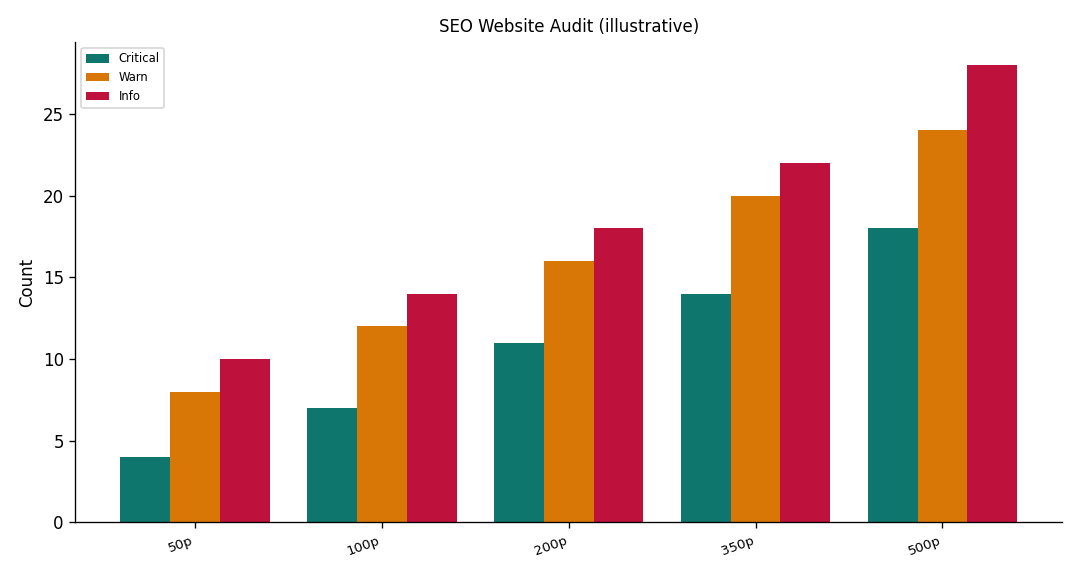
Figure: Two series from the same robots desk. Loc count is not a crawl. HTTP 200 is not index membership.
A stratified fetch, not a 1,568-page crawl
User-agent InfiniSynapse-P2-desk/2026-09-14 requested eight public addresses without treating them as a site audit.
| Requested URL | First status | Note |
|---|---|---|
/ | 200 | Homepage title; 91,875 bytes |
/en | 308 | Location / |
/en/tool/seo-website-audit | 200 | Self title; 95,445 bytes |
/en/blog/seo-website-audit | 308 | Location /en/tool/seo-website-audit |
/en/tool/seo-audit-tool | 200 | 87,057 bytes |
/en/blog/what-is-a-data-agent | 200 | Blog template; 93,934 bytes |
invented /en/this-path-…-p2-20260914 | 301 | Then /en/blog/… 404; title = homepage title |
/robots.txt | 200 | 938 bytes |
The invented path did not 404 in place. It walked into a blog 404 that still wore the homepage title. That row belongs in an SEO website audit Caroline Springs register even though it is not in the sitemap.
The same afternoon, npx --yes -p infinitegrowth@0.1.1 seo-health check against the hub URL exited 0. The JSON still carried one Image Alt Text warning (2/5). Title length 51. Word count 2,530. Speed 79. Cached false. Process 0 is not a clean page.
We did not run audit --pages 50. Help text documents that range. A range is not a completed crawl.
How to reproduce the inventory
curl -sS -A 'InfiniSynapse-P2-desk/2026-09-14' \
  https://infinisynapse.com/robots.txt
curl -sS -A 'InfiniSynapse-P2-desk/2026-09-14' \
  https://infinisynapse.com/sitemap.xml | grep -c '<loc>'
# 1568
Google HTTP status guidance is why first status and terminal status both get written. Google canonical guidance is why a 308 twin is not a second keep URL. Record the user-agent. A later bot can see different HTML.
As of 2026-09-14 those counts matched this desk. A later deploy can change Last-Modified. An SEO website audit Caroline Springs file that quotes only last week’s 40-loc Google docs map is answering a different host.
Four steps that stay honest
Inventory the URL estate
Write the three maps, the loc split, and the timestamp. Google title-link documentation can wait until a URL is a final 200. Inventory is still the first stage of an SEO website audit Caroline Springs.
Build a risk-weighted sample
Reserve tool, homepage, locale-root, and miss templates before filling the rest from the 1,131 blog locs. Write n beside N. Eight fetches do not become fifty because the sentence sounds confident.
Triage in dependency order
Hops and 404 titles before alt text. Google HTTP network errors own the transport language. The CLI board owns the eight lights after the URL has stopped moving.
Verify the same frame
Rerun the same eight (or the later 50) after a deploy. Do not swap in a homepage-only pass and call the SEO website audit Caroline Springs closed.
How to read the output
Read coverage by template, not by a global issue total. A clean blog row does not excuse an untested tool URL. Google snippet documentation and structured data intro are later checks on final 200 pages. They do not replace the hop table.
Keep the original row, the ticket, and the post-fix fetch together. That ledger is how a later SEO website audit Caroline Springs tells a regression from an old finding.
Google Search Console start remains the property-level surface if you need membership. This desk is not that tool.
The hub CLI document is useful only after the URL has stopped redirecting. The live tool page was already a 200 with a self title. The blog twin was a 308. If you check the twin, you are auditing a hop, not the keep URL. Write both rows. An SEO website audit Caroline Springs that files only the 200 and drops the 308 will look cleaner than the host is.
Speed 79 on the hub is a coarse board, not a lab Web Vitals certificate. The warning that mattered on 2026-09-14 was missing alt on two of five images. That is a repair list. It is not a reason to ignore the three maps.
When two people repeat the same robots fetch and the same eight URLs, they should see the same first codes unless a deploy landed between them. That repeatability is the point of an SEO website audit Caroline Springs desk. A narrative priority list is a different job.
Failure modes that fake coverage
Vendor docs as the sample. Fetching eight Google documentation URLs proves those eight URLs, not this host.
Homepage only. / was 200. /en was 308. Those are different tickets.
Sitemap count as a crawl. 1,568 locs are an inventory. SEO website audit Caroline Springs work still needs fetches.
Green CLI transport. Exit 0 plus a warning is a punch list, not a pass.
Soft 404 politeness. A 404 that reprints the homepage title still needs a row.
Credits before maps. Deep EEAT or visibility commands need a key. They do not replace curl on robots.txt. An SEO website audit Caroline Springs owner who starts InfiniSynapse before the loc table exists is buying a story about missing evidence.
One map only. robots.txt named three files. Reading only /sitemap.xml hides the 76-loc health map and the 94-loc gallery map. Write all three even if you only sample the main 1,568. Checking each declared file before that sample is a sitemap audit.
Record the user-agent on every later enlarge. A 50-page pass that uses a different UA than this desk is a new study. Keep that limit next to the loc table so a briefing cannot promote eight fetches into a completed SEO website audit Caroline Springs.
The developers.google.com sitemap remains a third-party example of a public map. It is not this host’s 1,568-loc file. Cite it when you need an independent sitemap shape. Do not paste its loc count into an InfiniSynapse repair ticket.
Tickets before a retainer
Stop when the rows can be replayed. An SEO website audit Caroline Springs deliverable here is the loc table, the eight status rows, and a ticket for each red or warning you actually fetched. Backlinks, rank tracking, and a monthly retainer stay outside this file. The FAQ below keeps that boundary.
A method page, not a suburb list
This URL does not list trades, swap in a wall of Melbourne suburbs, or publish a Caroline Springs street address. Those patterns belong on agency homepages that have an office. An SEO website audit Caroline Springs pass on this host stays a sampling method: declared maps, a written n, HTTP evidence, then tickets.
Cluster guides
This hub keeps the inventory and the sample rule. Narrower jobs live on siblings.
| Job you actually have | Guide to open next |
|---|---|
| Choose a tool by export fields, not a 100 | SEO audit tool |
| Map templates before you crawl | seo site audit |
| Scope and robots for a crawler | seo crawler |
| Design the sample frame | sampled site audit |
| Separate uptime from SEO | website health check |
| Keep a reproducible deliverable | sample SEO audit report |
| When a sample beats a desktop spider | Screaming Frog alternative |
| Compare vendor crawl scope | semrush site audit |
| Triage order | SEO audit checklist |
| Cadence after a deploy | how often to audit a website |
| 50 versus 500 on this population | 50 to 500 page SEO audit |
Inspect one live URL after you save the maps
Read status and canonical on a public URL. Then enlarge the sample only if templates disagree.
Run SEO Health CheckerFrequently Asked Questions
What can an SEO website audit Caroline Springs firm rerun?
The firm reruns an SEO website audit Caroline Springs pass on its own public host: Sitemap lines, a loc count, a written sample, and the first HTTP status for each fetched URL. The numbers in this article are InfiniSynapse on 2026-09-14. Copy the steps. Do not copy the loc totals onto another domain.
What should an SEO website audit cover?
An SEO website audit Caroline Springs pass covers the declared maps, a written sample, first status, leftover hops, and page lights on final 200s. It does not cover backlinks, rank tracking, or private apps that robots.txt already disallows.
Can a title rewrite replace the inventory?
No. A title change helps after the URL returns the status you meant. The maps and the hop table come first.
Do loc counts need InfiniSynapse?
No. curl and a loc count are enough to start. InfiniSynapse is optional only after the measured table exists and a team wants a credited memo.
Does 1,568 locs mean we crawled the site?
No. That number is a <loc> inventory from one file. An SEO website audit Caroline Springs still has to fetch a sample. This desk fetched eight.
Did we run the 50-page CLI audit?
No. Help text documents --pages 50–500. This rewrite used one check on the hub URL. Do not file a 50-page result we did not produce.
Conclusion
Use an SEO website audit Caroline Springs when the job is to move from declared maps to a replayable sample. The 2026-09-14 desk shows three maps, a blog-heavy split, and an invented path that 404s with the homepage title. Close the SEO website audit Caroline Springs file when the loc counts, the first statuses, and the unresolved templates are still visible. A bounded inventory is more useful than an unsupported site-wide score.
Leave the InfiniSynapse web app closed until a signed-in memo is the next job. The routine pass remains the maps, the fetches, and the retained JSON.
William Zhu · Cofounder, InfiniSynapse · GitHub @allwefantasy
Desk-validated SEO Health methods. Corrections: zhuhl@infinisynapse.com · corrections policy.