How Often to Audit a Website: A Change-Based Cadence
Learn how often to audit a website using deployment risk, template reach, sitemap freshness, and stable samples instead of an arbitrary weekly ritual.
Author credentials: William Zhu is cofounder of InfiniSynapse (GitHub @allwefantasy · auto-coder). Desk: shipping SEO Health and the /en/tool/ visibility pages. No personal LinkedIn published. About: team / editorial standards.
Publisher credentials: InfiniSynapse has public profiles on GitHub, YouTube, and X. A 2026 WAIC Future Tech OPC excellence award covers the Agentic Data Infra entry (WAIC; third-party recap: Xinhua / Caohejing). That award does not review this page or SEO Health. Method CLI: infinitegrowth on npm. Archive: recognition and scope notes.

On this page
By William Zhu · Cofounder, InfiniSynapse · Published: 2026-09-11 · Last updated: 2026-09-14 · Last verified: 2026-09-14 · Reviewed by the InfiniSynapse Data Team.
Reviewed by: InfiniSynapse Data Team · method review 2026-09-14. Sitemap Last-Modified refetch plus a Skills workflow search for schedule keys.
Trust / COI: About · Corrections. SEO Health is a commercial product from this team. The freshness table is our own host, not a customer cron and not proof that a weekly crawl ran.
TL;DR
We did not run a weekly crawl on this host. The main sitemap still said Friday 11 September 2026 when we refetched on 2026-09-14. That gap is the evidence for how often to audit a website.
Direct answer: Decide how often to audit a website from deploy risk and template reach, not from a calendar we did not run. Trigger after a routing, template, metadata, or sitemap change. Keep a baseline only when someone owns the comparison. A header date is a representation signal. It is not a release ticket.
On 2026-09-14 we used curl against InfiniSynapse public URLs with user-agent InfiniSynapse-P2-desk/2026-09-14. The sample size is three declared maps plus eight public requests. That sample cannot establish how often every template actually changes, and it does not prove Google recrawled any URL.
What you will learn
- Why Last-Modified on 11 Sep 2026 still matters on a 14 Sep refetch
- Why Skills workflows here have zero
schedule:keys - Which change classes deserve an immediate sample
- How to keep two runs comparable
- Where this page stops and a sibling owns gate order or 50–500 math
A calendar copied from another vendor is not a method. How often to audit a website on this host follows the last deploy and the last map header we actually saw.
Cadence is a change decision
Key definition: How often to audit a website is a trigger rule. Score a release by template reach, routing impact, locale reach, rendering change, metadata automation, and rollback difficulty. It is not a weekly badge. It is not an official Google recrawl SLA.
Google recrawl documentation is the official reminder that you may ask Google to look again. MDN conditional requests explain ETag and Last-Modified as cache validators. Neither document tells you how often to audit a website on this host.
People open this page when a deploy just landed or when a silent template might have drifted. They do not need a daily option because the UI offers one. An honest answer to how often to audit a website names the change class first.
SEO Health remains the deterministic evidence foundation for a replayable sample and for one-URL lights. After those rows exist, a team may send the export into an InfiniSynapse Server API long-task workspace; the API does not invent a cron.
Release risk is the clock
High-reach routing and shared templates deserve an immediate sample. A low-risk editorial edit may need only its URL. Write the blast radius before you pick an interval. A later how often to audit a website briefing that starts at “every Monday” has already skipped the clock.
A header is not a deploy
Last-Modified describes a representation. RFC 9111 is the caching standard we used when deciding not to treat a cached 200 as a new fetch. Absence of a validator does not prove a page is stale. Use the release record as the primary trigger. Use the header as a supporting signal. That split is how how often to audit a website stays attached to a ticket instead of a ritual.
Last-Modified versus the 2026-09-14 refetch
robots.txt answered 200 (938 bytes) and named three Sitemap lines. All three maps answered 200.
| Declared map | Bytes | <loc> count |
|---|---|---|
sitemap.xml | 192,851 | 1,568 |
sitemap-seo-health.xml | 14,309 | 76 |
| contest gallery map | 22,256 | 94 |
| Across the three files | 1,738 |
The main map Last-Modified was Fri, 11 Sep 2026 11:37:28 GMT. We refetched on 2026-09-14. Three days later the header had not moved. That is a freshness observation. It is not a customer outage. It is not a reason to invent a Monday job we did not run. If you need a worked example for how often to audit a website, this three-day quiet header is it.
The main map split as 392 /en/tool/, 1,131 /en/blog/, and 45 other. No loc used page= or /page/. A blog-heavy list can stay quiet while a tool template changes. Cadence that only watches the 1,131 blog locs will miss a routing hop.
The robots file still allowed / and still disallowed /auth/, /api/, /v1/, /webhooks/, /dashboard, /analyze, and /Volumes/. Those Disallow lines did not change between the Friday header and the Monday refetch. A quiet inventory plus an unchanged robots body is a reason to wait for the next deploy, not a reason to invent a weekday job.
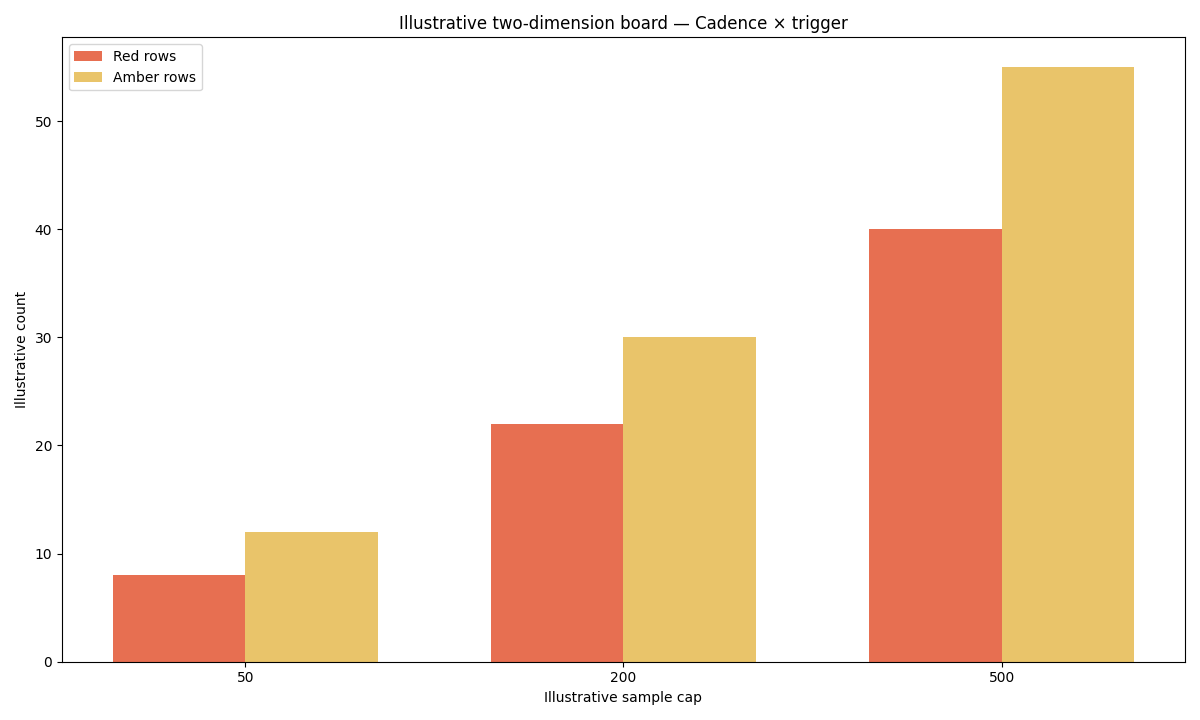
Figure: Two dates from the same desk. Last-Modified is not a crawl calendar. Refetch day is not a recrawl proof.
What the map said
As of 2026-09-14 the header still pointed at Friday 11 September. Reproduce it with curl -sSI on the main map. Record the user-agent. A later deploy can change the date. A file that quotes only a third-party documentation sitemap is answering a different host. Keep that refetch next to the trigger rule so how often to audit a website cannot be rewritten as folklore.
What we refetched
The same desk requested /, /en, the hub tool URL, the blog twin, a second tool URL, a blog article, an invented /en/ path, and robots.txt. First statuses were 200, 308, 200, 308, 200, 200, 301, and 200. The invented path then 404’d with the homepage title. Those codes tell you what changed in transport. They do not by themselves decide how often to audit a website. They tell you the frame you must rerun after the next deploy.
We did not run audit --pages 50–500. Help text documents that range. A range is not a completed cadence. If a later release changes a shared template, pick n from the sibling cap page and rerun the same frame. Do not grow the interval just because the help text mentions 500.
Why this repo has no weekly ritual
Zero schedule keys
This website repo has no scheduled Actions. Skills workflows have zero schedule: keys. That is a P8 finding you may mention once: we did not encode a weekly audit. Do not write as if a cron already exists. Zero keys is a limit on how often to audit a website claims from this rewrite. We can describe a trigger. We cannot point at a job that fired.
GitHub Actions schedule syntax is the public contract for on.schedule. Kubernetes CronJob docs are the cluster-side analogue. Google SRE monitoring is the reminder that a signal without an owner is noise. None of those pages ran on this host for us.
GitHub and Kubernetes are not our cron
Those manuals explain how a schedule could look. They do not prove we attached one. A later how often to audit a website file that cites the GitHub docs as if a weekly job fired is inventing coverage. If you add a schedule later, write the owner, the frame, and the comparison rule in the same ticket.
A four-trigger model
Template change
Shared layout, metadata automation, or a renderer change reaches many locs. Run a bounded sample immediately. Do not wait for a calendar that does not exist. Template reach is the first score in how often to audit a website.
Routing change
Locale roots, blog-to-tool twins, and catch-all /en/ paths change the hop table. On this host /en 308s to / and the blog twin 308s to the tool URL. Rerun those two requests after the next next.config change. That is the smallest honest rerun. Routing is a reason to answer how often to audit a website with “now,” not “next Monday.”
Sitemap freshness
When Last-Modified moves, inventory moved. Re-count the three maps. 1,568 / 76 / 94 is the 2026-09-14 snapshot. A later how often to audit a website pass that keeps last week’s counts without a refetch is already stale.
Unexplained drift
Increase frequency only after a baseline finds a hop, a 404 title mismatch, or a CLI warning that the last release did not explain. Reduce it after the same frame stays quiet. Google recrawl is optional after you have a keep URL. It is not the trigger.
How to read two runs
Keep the frame
Same URL list, same strata, same user-agent, same fields. If inventory grew, write the delta beside the new run. Changing the sample every interval destroys the comparison that how often to audit a website is supposed to produce.
Escalate after a signal
The invented path 301 → blog 404 with the homepage title is a classification finding. If a later deploy changes that hop, rerun immediately. If it does not, do not schedule a daily crawl to watch a known miss. The SEO audit checklist page owns the cell order for that rerun. The 50 to 500 page SEO audit page owns how large the next sample should be. Size and order are not substitutes for how often to audit a website.
Failure modes that invent a calendar
Daily because the option exists. A daily crawl on 1,568 locs is not a finding. It is a cost. That option does not answer how often to audit a website.
Waiting for Monday after a high-risk release. Template and routing changes deserve an immediate sample. A delayed how often to audit a website pass after a shared layout ship is already late.
Changing scope every interval. Two runs with different frames cannot answer drift.
Rank movement as a trigger. Rank belongs to performance diagnosis unless other evidence shows a technical change.
CLI range as a weekly job. audit --pages 50–500 is documented. We did not run it. Do not schedule a 50-page ritual we did not execute.
Scheduler without an owner. SRE monitoring is blunt here. If nobody answers a failed run, the schedule is decoration.
A how often to audit a website briefing that skips the Last-Modified refetch and jumps to “industry weekly” is already late.
Cluster guides for this pillar
This page keeps the trigger rule. The SEO website audit hub owns inventory. Adjacent jobs stay on siblings. Return to the hub when how often to audit a website is already decided and you still need the loc split.
| Job you actually have | Guide to open next |
|---|---|
| Maps and the eight-fetch desk | SEO website audit |
| Gate order after a deploy | SEO audit checklist |
| Whether the next sample is 50 or 500 | 50 to 500 page SEO audit |
Refetch the map after the next deploy
Read Last-Modified and first status on the public host. Then enlarge the sample only if a template actually moved.
Run SEO Health CheckerFrequently Asked Questions
Should a high-risk template release wait for a weekly job?
No. Run targeted checks during the deploy and a bounded sample immediately after. This host has no weekly Actions job. Waiting for a calendar we did not install is how how often to audit a website gets answered with fiction.
Is weekly appropriate for every website?
No. Use release frequency, blast radius, silent-change risk, and response capacity. Stable sites may use monthly or event-only checks. Weekly is a choice you must own, not a default. How often to audit a website on a quiet map can be event-only.
Should ranking changes trigger a technical pass?
Only when other evidence suggests a technical change. Rank movement alone belongs to performance diagnosis. It is not an automatic site crawl.
How can two scheduled runs stay comparable?
Keep URL frame, strata, cap, tool version, and fields stable. Record inventory changes explicitly. Monitor missed executions if you later add a schedule: key this repo does not currently have. Comparability is the only reason to schedule how often to audit a website at all.
Does Last-Modified tell you how often to audit a website?
No. The Friday 11 September header told us the representation had not moved by 2026-09-14. That supports a change-based rule. It does not set a weekly interval. Validators are supporting signals.
Conclusion
Use how often to audit a website when the job is to attach a rerun to a deploy, a template change, or a map that actually moved. The 2026-09-14 desk shows a Last-Modified still sitting on 11 Sep 2026, three maps, and Skills workflows with zero schedule: keys. Close the file when the trigger, the frame, and the owner are still visible. A dated refetch is more useful than an unsupported weekly claim.
Hold the InfiniSynapse web app until a named owner wants a credited rerun memo. The routine pass remains the header, the hop table, and the change that justified the refetch.
William Zhu · Cofounder, InfiniSynapse · GitHub @allwefantasy
Desk-validated SEO Health methods. Corrections: zhuhl@infinisynapse.com · corrections policy.