Sampled Site Audit: Design a Defensible URL Sample
Design a sampled site audit with a declared population, strata, seed, replacement rule, and confidence limits before interpreting patterns across templates.
Author credentials: William Zhu is cofounder of InfiniSynapse (GitHub @allwefantasy · auto-coder). Desk: shipping SEO Health and the /en/tool/ visibility pages. No personal LinkedIn published. About: team / editorial standards.
Publisher credentials: InfiniSynapse has public profiles on GitHub, YouTube, and X. A 2026 WAIC Future Tech OPC excellence award covers the Agentic Data Infra entry (WAIC; third-party recap: Xinhua / Caohejing). That award does not review this page or SEO Health. Method CLI: infinitegrowth on npm. Archive: recognition and scope notes.
On this page
By William Zhu · Cofounder, InfiniSynapse · Published: 2026-09-11 · Last updated: 2026-09-14 · Last verified: 2026-09-14 · Reviewed by the InfiniSynapse Data Team.
Reviewed by: InfiniSynapse Data Team · method review 2026-09-14. Declared loc counts (1,568 / 1,738) against eight stratified fetches.
Trust / COI: About · Corrections. SEO Health is a commercial product from this team. Eight stratified URLs cannot establish prevalence on 1,568 locs.
TL;DR
Eight fetches on a 1,568-loc map are a design, not a rate. Write a sampled site audit so every selected URL still points at a saved frame, a stratum, and a selection rule.
Direct answer: Treat a sampled site audit as n beside N. On 2026-09-14 the main map held 1,568
<loc>values (392 tool, 1,131 blog, 45 other). Across three declared maps the total was 1,738. The desk fetched eight stratified URLs. That sample size cannot establish template prevalence.
The sample size is eight public requests against 1,568 (or 1,738) declared locs. That desk cannot establish how common a defect is in the blog stratum, and it does not prove Google stored any URL. A sampled site audit that promotes eight hops into a site-wide percentage is already past its evidence.
What you will learn
- Which loc counts this host actually declared
- How the 392 / 1,131 / 45 split changes allocation
- Why eight fetches are a desk, not a census
- When a replacement URL must keep the original nonresponse
- Where this sampled site audit page stops and a 50-to-500 sibling owns batch math
What the population is
Key definition: A sampled site audit is a bounded draw from an explicitly saved eligible URL frame. The frame is often the declared maps plus documented additions and exclusions. It is not automatically every URL on the host.
NIST sampling handbook is the public reminder that a missing frame segment is often larger than sampling error inside the frame. OECD survey methodology guidance is the second public contract for writing selection rules before outcomes. Neither page grades this host.
People open a sampled site audit when someone wants a percentage from a convenience crawl. They need N, strata, a seed, and a sentence about what n cannot support.
SEO Health remains the evidence layer for one-URL lights on the URLs you already selected. After the sample manifest exists, a team may send stratum rows into an InfiniSynapse Server API long-task workspace; the API does not enlarge eight fetches into a prevalence rate.
Name N before you draw
Save map bytes, retrieval time, child-index list, and normalized eligible URLs. Deduplicate only by a documented key. Keep excluded counts by reason.
Keep discovery separate from estimation
A risk-weighted draw is good at finding defects. Raw percentages from that draw are not site-wide rates. A sampled site audit that mixes those goals will later be quoted as a health number.
Observed frame on 2026-09-14
robots.txt answered 200 (938 bytes) and named three Sitemap lines. All three maps answered 200.
| Declared map | Bytes | <loc> count |
|---|---|---|
main sitemap.xml | 192,851 | 1,568 |
sitemap-seo-health.xml | 14,309 | 76 |
| contest gallery map | 22,256 | 94 |
| Across the three files | 1,738 |
The main map split as 392 /en/tool/, 1,131 /en/blog/, and 45 other. No loc used page= or /page/. Last-Modified on the main map was Fri, 11 Sep 2026 11:37:28 GMT. The map file also carried x-robots-tag: noindex, nofollow.
Eight stratified requests were not a random sample of 1,568. They were a desk: homepage, locale root, two tool URLs, one blog twin, one blog article, one invented miss, and robots.
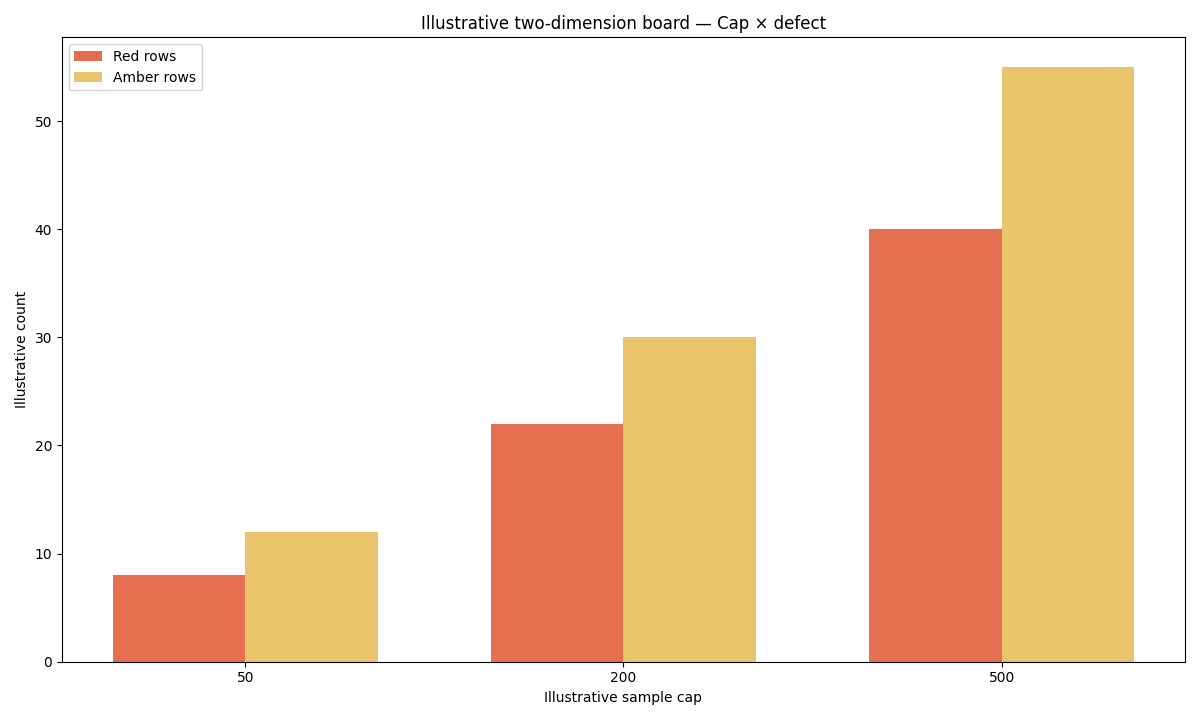
Figure: Two series from the same frame desk. Loc count is N. Eight fetches are n. Neither series is a prevalence.
How we drew eight URLs
curl -sS -A 'InfiniSynapse-P2-desk/2026-09-14' \
  https://infinisynapse.com/sitemap.xml | grep -c '<loc>'
UK Office for National Statistics methodology is why we write the frame date beside the draw. Google sitemap limits is the official reminder that a map has size rules and is still a hint list. Sitemaps XML protocol is the loc vocabulary. RFC 9110 status semantics is why a 308 is an intermediate, not a sampled document.
As of 2026-09-14 those loc counts matched this desk. A later deploy can change Last-Modified. A sampled site audit file that quotes another company’s documentation map as if it were this host is answering a different population.
We did not run audit --pages 50. Help text documents 50–500. That range is a later batch size, not this desk. A sampled site audit that pastes 50 from help text is already a fiction.
A four-rule sample manifest
Freeze the frame
Save the three maps, the 1,568 / 76 / 94 split, and the retrieval time. Deduplicate only by a documented key. This first stage is unique to a sampled site audit and sets what later evidence can support.
Choose allocation and seed
Set a minimum per template, then allocate the remainder by volume or risk. Publish both frame size and selected size. Write the seed before outcomes so the draw cannot be retuned after an inconvenient 404.
Measure nonresponse
Keep blocked, timed-out, oversized, and invalid-content selections in their own classes. The invented path 301’d then 404’d. That is a selected outcome, not a reason to swap in the homepage.
Estimate only supported quantities
Use stratum weights when the design supports estimation. Otherwise report sample counts and patterns. Eight fetches cannot establish how many of 1,131 blog locs share a title defect.
How eight fetches compare to 1,568
Eight against 1,568 is about 0.5%. Eight against 1,738 is smaller. A sampled site audit that calls that a representative rate is already past the math.
The 50 to 500 page SEO audit page owns the batch arithmetic: 50 ≈ 3.2% of 1,568, 200 ≈ 12.8%, 500 ≈ 31.9%. We did not run those batches. Homepage-only is not 50, and it is not this sampled site audit.
The seo site audit page owns the template names that make strata real. A frame with 1,131 blog locs still needs tool and miss rows.
Return to the SEO website audit Caroline Springs when you need the hop table beside this frame. Keep the sampled site audit manifest in its own file so a later batch cannot overwrite n.
A later briefing that says “we sampled the site” because eight URLs returned a mix of 200 and 308 has described a desk. Keep n and N in the same sentence.
What the strata actually were
392 / 1,131 / 45 is the main-map split. A sampled site audit that draws eight URLs without reserving tool, blog, locale-root, and miss slots will look random and still be a convenience set. This desk reserved those slots on purpose. It was stratified, not simple random.
The 76-loc health map and the 94-loc contest map are additional frames if you include them. Adding them changes N from 1,568 to 1,738. Write which N you used. A sampled site audit that switches N after seeing outcomes is already retuning the design.
Zero locs used page= or /page/. That is a frame observation. It does not invent a pagination stratum. Do not add a page-2 template you did not see.
robots.txt disallowed /auth/ and /api/. Those prefixes are documented exclusions, not missing sample units. Keep the exclusion count beside the eligible count.
What eight can and cannot support
Eight fetches can show that /en 308s, that a blog twin 308s, and that an invented path 404s with the homepage title. They cannot support “X% of blog titles are wrong.” A sampled site audit that prints that percentage from this desk is inventing a rate.
If you need a later batch, the sibling math is 50 / 200 / 500 against 1,568. We did not run those batches. Do not backfill them into this sampled site audit. Date a new draw if you take it.
Weights require selection probabilities. This desk did not assign each of the 1,568 locs a probability. Therefore it cannot produce a weighted site rate. Report the eight outcomes as a table.
The hub CLI warning on the tool URL is one document’s light. It is not a stratum estimate. Do not multiply one warning by 392.
Two people who repeat the same eight requests should see the same first codes unless a deploy landed. That repeatability is the point of a dated sampled site audit. A weekly ritual we did not run is a different claim.
Skills workflows in this website repo have zero schedule: keys. Cadence, if you need it, follows deploy and template change. It does not follow a timer this desk executed.
Failure modes that fake a rate
Guessing only slash sitemap.xml. This host declared three maps. The main file is not the only N.
Deduplicating without excluded counts. A silent drop changes the frame.
Changing the seed after seeing results. Freeze the rule first.
Replacing timeouts with responding URLs. Keep the original nonresponse.
Publishing unweighted percentages from unequal strata. 1,131 blog locs will dominate eight draws unless you reserved tool and miss slots.
Calling a discovery-oriented desk representative. This sampled site audit found hops. It did not estimate prevalence.
A later sampled site audit that guesses only /sitemap.xml and skips robots will miss two declared maps on this host. Read the three Sitemap lines first. Then freeze N.
If a selected URL times out, keep it. Substituting the homepage makes the subset look healthier than the frame. That substitution is how a sampled site audit becomes a convenience crawl.
Publish frame size and selected size in the same sentence. “We sampled the site” is not a sentence that contains n and N.
When a stratum has fewer eligible URLs than its minimum, include all of them and record the shortfall. Do not borrow blog locs silently to fill a tool quota.
A risk-weighted draw can be the right sampled site audit for finding defects. Label it discovery. Do not later present the raw defect percentage as a representative health rate.
The retrieval time belongs in the manifest. Last-Modified on the main map was 2026-09-11. We drew on 2026-09-14. Those dates are part of the design, not footnotes.
Cluster guides for this pillar
This cluster page returns to the complete SEO website audit guide for the hop table. Template mapping and 50-to-500 batch math stay on siblings. A sampled site audit that absorbs those jobs will hide the seed.
| Job you actually have | Guide to open next |
|---|---|
| Name systems before you draw | seo site audit |
| 50 versus 500 on this population | 50 to 500 page SEO audit |
Write n beside N before you quote a percentage
Save the frame on a public host you are authorized to test. Then draw only the URLs the seed named.
Run SEO Health CheckerFrequently Asked Questions
What is the population in a sampled site audit?
It is the explicitly saved eligible URL frame. On 2026-09-14 that frame was 1,568 locs in the main map, or 1,738 across three declared maps. It is not automatically every URL on the host.
Is a simple random draw always enough?
No. Stratify when templates differ and small high-risk groups could be missed. This host’s 45 other locs can vanish inside 1,131 blog locs. Save the allocation and seed.
How should failed fetches be counted?
Retain them as selected nonresponses with reason and timestamp. The invented path’s 301 then 404 is a kept outcome. Replacement may be added for coverage, but it must not erase the original row.
Can eight URLs estimate a site-wide error rate?
No. Eight fetches cannot establish prevalence on 1,568 locs. Report observed counts and bounded patterns unless the frame and weights support estimation. After the manifest exists, a credited memo may be opened once in the InfiniSynapse web app.
Did we sample 50 pages for this rewrite?
No. Help text documents --pages 50–500. This sampled site audit used eight stratified URLs. Do not file a 50-page result we did not produce.
Conclusion
Use a sampled site audit when the job is to keep N, strata, n, and a sentence about what the draw cannot support. The 2026-09-14 desk shows 1,568 main-map locs against eight fetches, with 1,131 of those locs in the blog prefix. Close the file when the untested remainder is still visible. A written frame is more useful than an unsupported site-wide rate.
William Zhu · Cofounder, InfiniSynapse · GitHub @allwefantasy
Desk-validated SEO Health methods. Corrections: zhuhl@infinisynapse.com · corrections policy.