SEO Site Audit: Map Templates Before You Crawl Live
Run an SEO site audit by mapping templates, languages, and URL states before sampling, so the result represents the site rather than its largest directory.
Author credentials: William Zhu is cofounder of InfiniSynapse (GitHub @allwefantasy · auto-coder). Desk: shipping SEO Health and the /en/tool/ visibility pages. No personal LinkedIn published. About: team / editorial standards.
Publisher credentials: InfiniSynapse has public profiles on GitHub, YouTube, and X. A 2026 WAIC Future Tech OPC excellence award covers the Agentic Data Infra entry (WAIC; third-party recap: Xinhua / Caohejing). That award does not review this page or SEO Health. Method CLI: infinitegrowth on npm. Archive: recognition and scope notes.
On this page
By William Zhu · Cofounder, InfiniSynapse · Published: 2026-09-11 · Last updated: 2026-09-14 · Last verified: 2026-09-14 · Reviewed by the InfiniSynapse Data Team.
Reviewed by: InfiniSynapse Data Team · method review 2026-09-14. First-party hop table across homepage, locale root, tool, blog twin, blog article, and invented 404.
Trust / COI: About · Corrections. SEO Health is a commercial product from this team. Eight first-party hops are a template desk, not a site census.
TL;DR
A site is a set of URL-producing systems, not a blog directory that happens to be large. Run an seo site audit only after those systems have names, hops, and a minimum draw.
Direct answer: Treat an seo site audit as a template map first. On 2026-09-14 this host answered 200 on
/, 308 on/en, 200 on the tool URL, 308 on the blog twin, 200 on a blog article, and 301 then 404 on an invented path. 1,131 of 1,568 main-map locs were/en/blog/. That split is not coverage.
The sample size is eight public requests plus the loc split. That desk cannot establish how every tool template behaves, and it does not prove Google stored any URL. An seo site audit that only samples the blog stratum is already answering a directory, not a site.
What you will learn
- Which first-party paths 308 into
/or/en/tool/ - Why an invented
/en/path 301s into a blog 404 - How the 392 / 1,131 / 45 loc split changes allocation
- When a locale root is a different template from the homepage
- Where this seo site audit page stops and a sample-design sibling owns n and N
What a site means here
Key definition: An seo site audit is a bounded pass that names every live URL-producing template, then fetches at least one URL from each before anyone talks about prevalence. It is not a crawl of the largest folder. It is not an official Google grade.
Sitemaps protocol is the public reminder that a map is a declared list, not a template registry. Google localized-page guidance is the second public contract for treating language variants as their own systems. Neither document grades this host.
People open an seo site audit when a homepage 200 has started to stand in for checkout, locale, and tool routes. They need a registry, not a comfort score.
SEO Health remains the evidence layer for one-URL lights after the template map exists. After those rows exist, a team may copy them into an InfiniSynapse Server API task workspace and consume SSE events; the API does not invent a missing locale stratum.
Locale roots are templates
/en answered 308 to /. That hop is a system. A file that lists both / and /en as live documents is already stale. Write the Location.
Blog twins are templates
/en/blog/seo-website-audit answered 308 to /en/tool/seo-website-audit. Google redirect guidance is why that twin is a hop, not a second keep URL. An seo site audit that samples only the 200 side will miss the consolidation.
Observed templates on 2026-09-14
User-agent InfiniSynapse-P2-desk/2026-09-14 requested eight public addresses without follow unless noted for the invented path.
| Requested URL | First status | Note |
|---|---|---|
/ | 200 | Homepage title; 91,875 bytes |
/en | 308 | Location / |
/en/tool/seo-website-audit | 200 | Tool title; 95,445 bytes |
/en/blog/seo-website-audit | 308 | Location /en/tool/seo-website-audit |
/en/tool/seo-audit-tool | 200 | 87,057 bytes |
/en/blog/what-is-a-data-agent | 200 | Blog article template; 93,934 bytes |
invented /en/this-path-…-p2-20260914 | 301 | Then /en/blog/… 404; title = homepage title |
/robots.txt | 200 | 938 bytes |
The invented path did not 404 in place. It walked into a blog 404 that still wore the homepage title. That row belongs in an seo site audit register even though it is not in the main map.
The main map held 1,568 <loc> values: 392 /en/tool/, 1,131 /en/blog/, 45 other. Across three declared maps the loc total was 1,738. No loc used page= or /page/. A blog-heavy list is still a list. It is not a finished site map of systems.
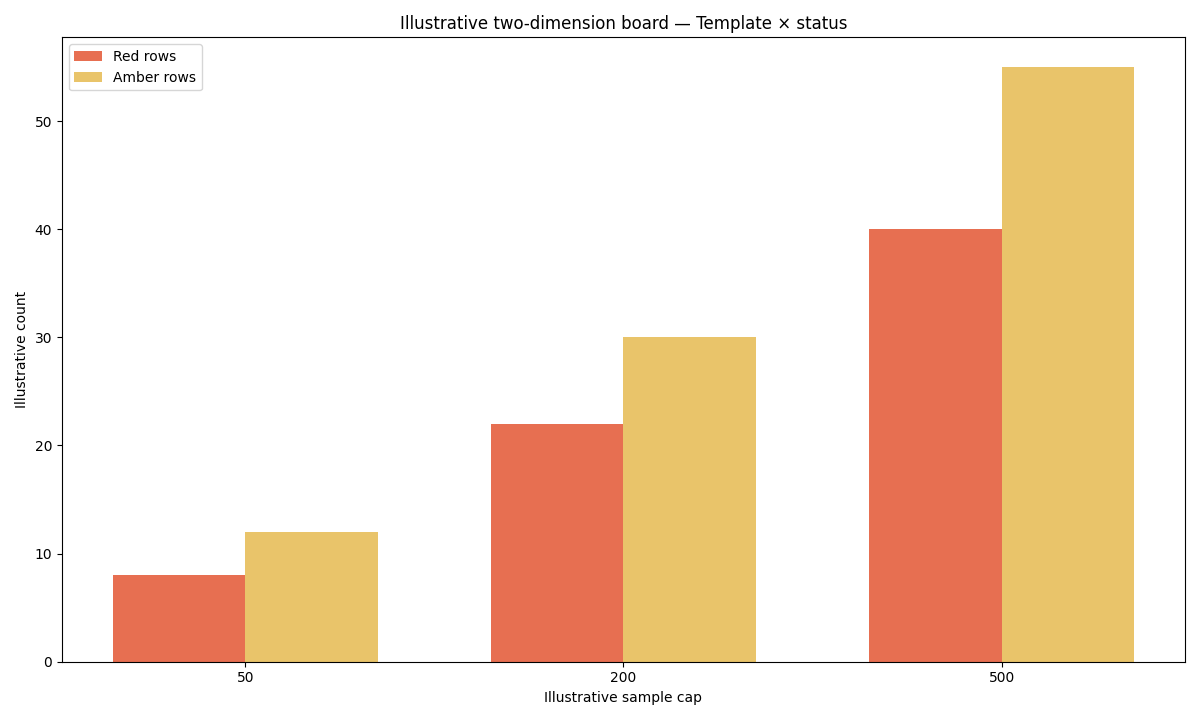
Figure: Two series from the same hop desk. First status is not hop count. Neither series is a site-wide defect rate.
How we fetched the hops
curl -sSI -A 'InfiniSynapse-P2-desk/2026-09-14' \
  https://infinisynapse.com/en
Record the user-agent, the first status, and the Location. Google duplicate URL guidance is why a 308 twin is not a second document. A later bot with a different UA can see different HTML.
As of 2026-09-14 those hops matched this desk. A later deploy can change Location. An seo site audit file that quotes only last week’s vendor documentation paths is answering a different host.
We did not run audit --pages 50. Eight fetches are a template desk. They are not fifty. An seo site audit that inflates eight hops into fifty is already past its evidence.
A four-stratum map
Homepage and locale root
/ was a 200 with a homepage title. /en was a 308. Those are two rows. Do not collapse them into “the home template” until Location is written.
Tool documents
Two tool URLs answered 200. The hub title was “SEO Website Audit: The Complete 2026 Sampling Guide.” The sibling tool URL answered 87,057 bytes. An seo site audit that samples one tool and calls the 392-loc tool stratum done is already thin.
Blog articles
One blog article answered 200 (93,934 bytes). The 1,131-loc blog stratum still needs a written allocation. One 200 does not speak for the folder.
Miss templates
The invented /en/ path 301’d into /en/blog/… and that blog URL 404’d. Final title was the homepage title. File that mismatch as a miss template, not as a copy win.
NIST Engineering Statistics Handbook is the independent reminder that a stratum with zero draws cannot support a rate. US Census sampling overview is why we write n beside N before anyone computes a percentage. Neither is a testimonial.
How a blog-heavy list misleads
1,131 of 1,568 locs were /en/blog/. Proportional sampling without a minimum for tool, locale-root, and miss templates will spend the budget on articles. That is how an seo site audit becomes a blog audit.
The sampled site audit page owns the frame, the seed, and the nonresponse rule. This seo site audit page stops at the template registry. Do not publish a prevalence from eight hops.
The website health check page owns the 200-versus-healthy split. The invented 404 still wore the homepage title. That is a health finding on a miss template, not proof the site is down, and not a finished seo site audit.
Return to the complete SEO website audit guide when you need the three-map inventory beside this hop table.
A later briefing that says “the site is fine” because the blog article was 200 has skipped /en, the blog twin, and the miss. Those skipped systems are the job.
Why the loc split is not a registry
392 tool locs and 1,131 blog locs are inventory. They do not name renderer, owner, canonical rule, or release frequency. An seo site audit registry still has to write those fields per system. A loc prefix is a hint, not a finished row.
The 45 other locs are the easiest to skip. They may include utility, contest, or locale leftovers. Give them a minimum draw before you spend the rest of the budget on articles. An seo site audit that labels them “other” and never fetches one has already hidden a system.
robots.txt answered 200 and allowed /. It disallowed /auth/, /api/, and related internals. Those disallowed prefixes are not templates for this public pass. Write them as out of scope so a later crawl does not treat the omission as a miss.
Last-Modified on the main map was Fri, 11 Sep 2026 11:37:28 GMT. We refetched on 2026-09-14. The map can move. An seo site audit that quotes only the loc split and skips the retrieval time will later look more stable than the file.
What eight hops can assign
Eight hops can assign a first status and a Location to named systems. They cannot assign a defect rate to 392 tool locs. Keep that limit in the same paragraph as the table.
The hub CLI on the tool URL exited 0 with one Image Alt Text warning. That light belongs to one document. It does not travel to the blog article or to /en. An seo site audit that copies one warning across untested templates is inventing blast radius.
Google localized-page guidance already asked you to treat language variants as their own systems. This host’s /en 308 is the live example. Do not wait for a second locale HTML body before you write the hop.
If a later team adds /zh or another locale root, give it a row before the next seo site audit claims the map is complete. This desk did not fetch /zh. Do not invent that hop.
Two people who repeat the same eight requests should see the same first codes unless a deploy landed. That repeatability is the point of the template desk. Narrative priority lists are a different job.
Failure modes that fake a site
Sampling the first URLs in file order. The main map is blog-heavy. File order will look like coverage.
Using directory size as the only allocation rule. 1,131 blog locs can starve 45 other locs.
Combining locales into an other bucket. /en was a 308. Write it as its own row.
Creating one ticket per URL in a shared template. Group by system. Keep representative examples.
Estimating blast radius from the sample alone. Eight hops cannot establish how many of 392 tool locs share a defect.
Verifying only the homepage after a template fix. / was already 200. Recheck the twin and the miss.
A later seo site audit that opens tickets from a vendor documentation crawl is answering a different host. Keep this host’s hop table as the worked example. The eight paths above are the fixtures. They are not Google’s documentation set.
Write the owner next to each system. A tool URL without an owner will sit in the register and never become a ticket. An seo site audit that stores hops and drops owners is already a museum.
When two templates disagree—homepage 200 versus invented 404 with the same title—file both rows. Do not average them into a site score. The disagreement is the finding.
If a later deploy changes only the blog twin, rerun that twin and one control tool URL. Do not declare the seo site audit closed from / alone.
The 1,738 loc total across three maps is still inventory. Adding the health map and the contest map does not finish the template list. Name those maps in the registry as extra frames, then decide whether they produce new systems.
Record the user-agent. A later bot can see different HTML. This desk used one string. It cannot stand in for Googlebot. If you need property-level membership, that job is Search Console, not this hop table.
Cluster guides for this pillar
This cluster page returns to the complete SEO website audit guide for the loc inventory. Sample design and health checks stay on their own pages. An seo site audit that absorbs those jobs will hide n and N.
| Job you actually have | Guide to open next |
|---|---|
| Frame, seed, and nonresponse | sampled site audit |
| 200 versus healthy SEO | website health check |
Name the templates before you enlarge the crawl
Read first status and Location on a public host. Then sample only if two templates disagree.
Run SEO Health CheckerFrequently Asked Questions
How many templates should an seo site audit include?
Every live URL-producing system should appear, even a small one. On this host that list includes homepage, locale root, tool, blog article, blog-to-tool twin, and miss. Document exclusions instead of letting 1,131 blog locs consume the draw.
Should URLs be sampled in proportion to the map?
Use proportional allocation only after a minimum for high-risk strata. Pure proportion on a 1,131-loc blog folder can omit locale roots and miss templates.
How are template defects reported?
Report the root cause once with the URL pattern, representative hops, estimated inventory reach, owner, and a verification pair. Do not open 1,131 tickets for one generator.
What makes a site-level rerun comparable?
Reuse the template registry, the hop policy, and the observation fields. Report inventory changes separately from repair changes. After the hop table exists, a credited memo may be opened once in the InfiniSynapse web app.
Does a blog-heavy sitemap finish the job?
No. 1,131 of 1,568 locs were blog paths. An seo site audit still has to fetch tool, locale, and miss templates. This desk fetched eight.
Conclusion
Use an seo site audit when the job is to name systems before anyone opens a crawl budget. The 2026-09-14 desk shows /en collapsing to /, a blog twin collapsing to the tool URL, and an invented path walking into a blog 404 with the homepage title. Close the file when those templates, their first statuses, and the untested strata are still visible. A hop table is more useful than an unsupported site-wide score.
William Zhu · Cofounder, InfiniSynapse · GitHub @allwefantasy
Desk-validated SEO Health methods. Corrections: zhuhl@infinisynapse.com · corrections policy.